
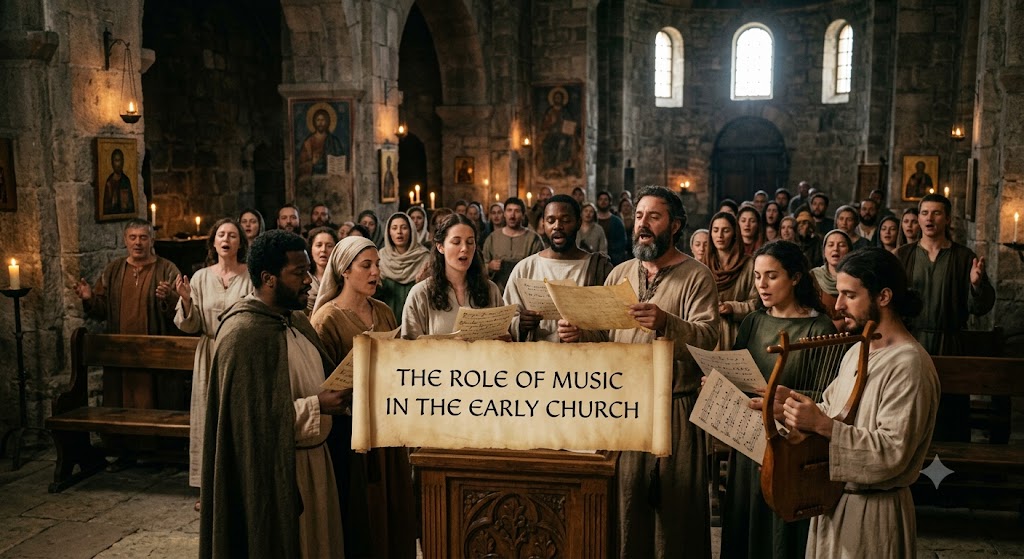
The Role of Music in the Early Church
The role of music in the early Church is one of the most fascinating and inspiring aspects of Christian history. Long before impressive cathedrals echoed with choirs and orchestras, before musical notation became common, and before modern worship bands filled churches with contemporary praise, the earliest followers of Jesus gathered in homes, courtyards, and hidden places where music became a powerful expression of faith. The role of music in the early Church extended far beyond entertainment or artistic performance. It was deeply connected to worship, teaching, fellowship, encouragement, remembrance, and the proclamation of the Gospel. Understanding the role of music in the early Church gives believers today a richer appreciation of why singing remains one of the defining characteristics of Christian worship across every nation and culture.
When Jesus established His Church through His apostles, the believers inherited a rich musical tradition from Judaism. Throughout the Old Testament, music occupied an honoured place in the worship of God. King David organised musicians, appointed singers, and wrote many of the Psalms that would become the soundtrack of Israel’s worship. These sacred songs expressed joy, repentance, thanksgiving, confidence, lament, hope, and unwavering trust in God. The early Christians did not abandon these songs after the resurrection of Christ. Instead, they embraced them with fresh understanding because they saw many of the Psalms fulfilled in Jesus Christ.
The role of music in the early Church therefore began with continuity rather than replacement. The first Christians continued to sing the Psalms while also composing new hymns that celebrated the life, death, resurrection, and lordship of Jesus. Their music reflected both their Jewish heritage and their new identity as followers of Christ. Singing became one of the most visible signs that the Gospel had transformed ordinary people into a new spiritual family united by faith rather than ethnicity or social status.
One remarkable moment demonstrating the importance of music appears during the final meal Jesus shared with His disciples. After celebrating the Passover, the Gospels record that they sang a hymn before going to the Mount of Olives. This seemingly simple detail reveals that singing formed a natural part of worship even for Jesus Himself. If Christ sang with His disciples during one of the most significant moments before His crucifixion, it should not surprise anyone that the apostles carried this practice into the life of the early Church.
The Book of Acts offers several glimpses into the musical life of the first believers. Although Acts primarily focuses on the spread of the Gospel, it consistently portrays Christians gathering for prayer, fellowship, teaching, and worship. Music naturally accompanied these gatherings. Worship was not limited to public ceremonies. It flourished inside homes where believers broke bread together with glad and sincere hearts. Their songs strengthened relationships and reinforced their shared faith during times of joy and persecution alike.
Perhaps one of the most memorable examples of the role of music in the early Church occurred when Paul and Silas found themselves imprisoned in Philippi. After being beaten and placed in chains, they chose not to complain or surrender to despair. Instead, they prayed and sang hymns to God while the other prisoners listened. Their worship transformed the atmosphere inside the prison. Scripture records that an earthquake followed, opening the prison doors and ultimately leading to the conversion of the jailer and his household. This extraordinary event demonstrates that music in the early Church was never viewed as a performance designed to impress an audience. It was an expression of faith that glorified God even in suffering.
The Apostle Paul frequently instructed believers about singing. In his letters, he encouraged Christians to speak to one another with psalms, hymns, and spiritual songs while singing and making melody in their hearts to the Lord. These instructions reveal that music served multiple purposes within Christian communities. It glorified God, encouraged fellow believers, strengthened faith, reinforced biblical truth, and promoted unity among people from diverse backgrounds.
The role of music in the early Church also included teaching sound doctrine. At a time when few people possessed written copies of Scripture, songs became powerful educational tools. Lyrics helped believers memorise essential truths about Christ, salvation, resurrection, grace, forgiveness, holiness, and eternal life. Many scholars believe that portions of Paul’s letters preserve fragments of early Christian hymns that were already familiar among believers. These hymns communicated theological truths in memorable forms, allowing Christians to carry Scripture within their hearts even when they could not read or own biblical manuscripts.
Music also played an important role in preserving Christian identity during persecution. The early Church often faced intense opposition from religious authorities and political leaders. Believers risked imprisonment, rejection, confiscation of property, and even death because of their faith in Jesus Christ. Under such difficult circumstances, songs reminded Christians of God’s faithfulness, Christ’s victory over death, and the hope of eternal life. Singing together strengthened courage when fear threatened to overwhelm them.
The role of music in the early Church cannot be separated from community life. Christianity was never designed as an isolated faith. Believers gathered regularly because worship, prayer, fellowship, teaching, and mutual encouragement were central to spiritual growth. Music naturally strengthened these gatherings by allowing everyone to participate regardless of education, wealth, occupation, or social standing. Unlike many forms of entertainment where only professionals perform, congregational singing invited every believer to become an active participant in worship.
Another beautiful aspect of the role of music in the early Church was its simplicity. Early Christians did not possess expensive instruments, elaborate stages, sophisticated sound systems, or impressive performance venues. Many congregations met secretly inside private homes because public worship could attract persecution. Their songs relied primarily upon voices lifted together in praise. This simplicity reminds modern believers that genuine worship depends more upon sincere hearts than elaborate productions.
The influence of Jewish worship remained strong throughout the earliest Christian communities. Psalms occupied a central place because they connected believers to centuries of God’s faithfulness. However, new hymns gradually emerged as Christians reflected upon the person and work of Christ. These hymns celebrated His incarnation, sacrificial death, victorious resurrection, ascension, and promised return. Music therefore became one of the earliest ways Christians expressed their understanding of Jesus as Lord.
Historical writings outside the New Testament also provide valuable insights into the role of music in the early Church. Early Christian leaders described believers gathering before sunrise to sing hymns to Christ as to God. This testimony demonstrates that worship through music remained central even during periods when Christians lived under suspicion from Roman authorities. Singing became a public declaration of loyalty to Christ above every earthly ruler.
Music also contributed significantly to the unity of the expanding Church. Christianity spread rapidly across regions speaking different languages and possessing distinct cultures. Despite these differences, believers found common ground in worship. Songs crossed geographical boundaries and connected Christians who had never met. Music expressed truths that united people from Jerusalem to Antioch, from Asia Minor to Rome, and eventually throughout the known world.
The role of music in the early Church included expressing gratitude for God’s grace. Salvation through Jesus Christ transformed lives completely. Former idol worshippers, tax collectors, fishermen, merchants, soldiers, widows, slaves, and government officials all discovered forgiveness and new life in Christ. Their songs naturally overflowed with thanksgiving because they recognised the magnitude of God’s mercy. Gratitude remained one of the defining characteristics of Christian worship.
Music also served as an instrument of encouragement during suffering. Early Christians understood hardship as an expected part of following Christ. Many experienced rejection from families, economic loss, imprisonment, and violence. Songs reminded believers that Christ Himself suffered before entering glory. Worship therefore shifted attention away from temporary circumstances toward God’s eternal promises. Singing became an act of hope rooted in faith rather than emotion.
The role of music in the early Church was closely connected with prayer. Many biblical songs functioned as prayers set to melody. Singing enabled believers to express praise, confession, dependence, gratitude, and longing before God. Even today, many Christians discover that music helps them pray with greater sincerity because melodies carry words deep into the heart. This pattern originated among the earliest followers of Jesus.
Early Christian music also reflected humility. Worship leaders did not seek personal fame or celebrity status. The focus remained entirely upon glorifying God and strengthening His people. Songs directed attention toward Christ rather than performers. This emphasis challenges every generation of believers to examine whether worship still points people toward God instead of personalities.
The Role of Music in the Early Church
The role of music in the early Church demonstrates that worship was deeply theological. Early Christians carefully preserved biblical truth within their songs because they understood that what believers sing influences what they believe. Songs became vehicles for proclaiming the Gospel, celebrating Christ’s victory, affirming God’s character, and reminding believers of their identity in Him. Music therefore shaped both worship and discipleship.
Children also benefited from this musical tradition. As families gathered with fellow believers, young people learned biblical truths through repeated songs. Even before they could fully understand complex theological concepts, they memorised Scripture and Christian doctrine through worship. Music became an effective means of passing faith from one generation to the next.
The missionary expansion of Christianity further highlights the role of music in the early Church. As the Gospel entered new cities and regions, worship songs often accompanied preaching. New believers quickly learned hymns that reinforced biblical teaching while strengthening their connection to the wider Christian community. Music therefore supported evangelism by helping converts understand and remember foundational truths about Christ.
The remarkable endurance of Christian music throughout history testifies to the solid foundation established by the early Church. Across two thousand years, cultures, languages, musical styles, and instruments have changed dramatically. Yet the essential purpose of Christian music remains remarkably consistent. Believers continue gathering to glorify God, proclaim biblical truth, encourage one another, and celebrate the saving work of Jesus Christ. These enduring priorities trace directly back to the earliest Christian communities.
Modern churches can learn valuable lessons from the role of music in the early Church. First, worship should always remain centred upon God rather than human performance. Second, songs should faithfully communicate biblical truth because theology expressed through music shapes Christian belief. Third, every believer should feel invited to participate actively in worship instead of becoming a passive observer. Fourth, music should strengthen unity within the Church by drawing attention to Christ rather than personal preferences. Finally, worship should remain sincere regardless of available resources because God values hearts devoted to Him above impressive productions.
The role of music in the early Church also reminds believers that worship belongs in every circumstance. Paul and Silas sang inside a prison. Early Christians worshipped under persecution. Families praised God inside ordinary homes. Their example demonstrates that genuine worship does not depend upon ideal conditions. Whether surrounded by celebration or suffering, believers can continue lifting songs of praise because God’s character never changes.
In today’s world, Christian music exists in countless styles ranging from traditional hymns to contemporary worship, gospel choirs, classical compositions, acoustic praise, indigenous expressions, and modern Christian pop. While musical styles differ greatly, the underlying purpose remains the same when worship honours Christ. The early Church teaches that authenticity matters more than style. Hearts transformed by the Gospel naturally overflow with praise.
The role of music in the early Church ultimately points beyond music itself. Songs were never the destination. They directed believers toward a deeper relationship with God through Jesus Christ. Worship united communities, strengthened faith, proclaimed truth, comforted the suffering, inspired courage, preserved doctrine, encouraged holiness, and glorified the risen Lord. Every hymn and spiritual song reminded believers that Christ had conquered sin and death, offering eternal hope to everyone who trusted in Him.
As Christians continue gathering around the world today, they participate in a tradition stretching back to the apostles and the earliest followers of Jesus. Every sincere song of praise echoes the faith of believers who worshipped in homes, prisons, and secret meetings long before Christianity became widely accepted. Their voices may have faded into history, but their legacy continues whenever the Church sings of God’s goodness, Christ’s sacrifice, and the hope of eternal life. The role of music in the early Church remains a timeless reminder that worship is far more than melody. It is the joyful response of redeemed hearts to the saving grace of God, a witness to the world, and a powerful expression of faith that continues to shape the Church until Christ returns.

Leave a Reply