
How Worship Inspires Spiritual Courage
How Worship Inspires Spiritual Courage is a powerful question for anyone who has ever faced a season when fear seemed louder than faith. Life can place people in situations where confidence disappears, answers become difficult to find, and the future feels uncertain. In such moments, worship can become much more than singing a song in church. Worship can become a declaration of trust, a reminder of God’s character, and a source of spiritual courage when circumstances seem overwhelming.
How Worship Inspires Spiritual Courage becomes especially meaningful when we understand that biblical worship is not simply about music. Worship involves recognising who God is, honouring Him, trusting His promises, surrendering our fears, and choosing to remain faithful even when we cannot see what lies ahead. A worshipper may still experience fear, disappointment, confusion, or pain, but worship can change the position from which those emotions are faced. Instead of allowing fear to become the final voice, worship reminds the believer that God remains greater than the situation.
Spiritual courage does not mean that a person never feels afraid. Courage means moving forward despite fear because there is confidence in something greater than the fear itself. For Christians, that confidence is rooted in God. Worship helps redirect attention from the size of a problem to the greatness of God. When a believer begins to praise God in the middle of uncertainty, the circumstances may not immediately change, but the heart can begin to change. Fear can lose some of its control, hope can return, and faith can become stronger.
Throughout Scripture, worship is repeatedly connected with moments of difficulty, victory, surrender, and spiritual warfare. One of the most remarkable examples can be found in the story of Jehoshaphat in 2 Chronicles 20. Judah faced an overwhelming enemy, and the people were afraid. Instead of depending entirely on military strength, they sought God. Worship became part of their response to the crisis. Singers were appointed to praise the Lord, and as they went before the army, they declared God’s goodness and enduring mercy. The story demonstrates an extraordinary principle: worship can be an expression of courage before the victory becomes visible.
This is one reason How Worship Inspires Spiritual Courage matters so deeply. Worship teaches believers to respond to fear with faith. When everything appears uncertain, worship creates an opportunity to say, “God, I may not understand this situation, but I still trust You.” That declaration can be incredibly powerful because it shifts the focus away from helplessness and towards God’s faithfulness.
Worship can also strengthen spiritual courage by reminding believers of what God has already done. Human beings are naturally capable of remembering painful experiences more vividly than previous victories. A difficult season can make someone forget the prayers God answered, the doors He opened, the protection He provided, and the moments when He made a way where there appeared to be no way.
Singing about God’s faithfulness can bring those memories back to the forefront. A worship song about God’s goodness can become a reminder that today’s problem is not the first problem God has helped His people face. A song about God’s promises can encourage someone to remember that God’s character does not change simply because circumstances have changed.
Worship therefore helps build courage through remembrance. When believers remember God’s faithfulness, they gain confidence to face what is ahead. David demonstrated this principle before confronting Goliath. He remembered how God had helped him against the lion and the bear, and that previous experience contributed to his confidence when he faced a much larger enemy. Spiritual courage often grows when we remember previous evidence of God’s faithfulness.
Another way worship inspires spiritual courage is by changing the language we speak over our circumstances. Fear often produces statements such as, “I cannot handle this,” “Nothing will change,” “I am finished,” or “There is no way forward.” Worship introduces a different vocabulary. Instead of focusing exclusively on what is impossible, the believer begins to speak about God’s power, goodness, wisdom, mercy, presence, and faithfulness.
This does not mean pretending that problems do not exist. Christian worship is not denial. Biblical worship allows people to acknowledge pain while still declaring faith. The Psalms provide countless examples of this. David sometimes expressed fear, loneliness, anger, confusion, and distress, yet he repeatedly returned to trust and praise. His worship did not require him to hide his emotions. Instead, worship gave those emotions a place beneath his confidence in God.
This is important because spiritual courage is not built through pretending to be strong. It is built through learning where to take weakness. A person can admit, “I am afraid,” while also saying, “But I know God is with me.” That combination is not weakness. It is faith in action.
Worship also helps believers confront spiritual intimidation. Fear can make an individual feel smaller than the challenge in front of them. Worship reverses that perspective by magnifying God. The problem may still be large, but God becomes larger in the believer’s awareness.
This is why worship can be particularly powerful before difficult decisions. When someone is uncertain about a career, relationship, financial situation, ministry responsibility, family challenge, or personal future, worship can create space to surrender the need to control every outcome. Instead of demanding immediate answers, the believer can acknowledge that God sees what they cannot see.
Surrender is one of the deepest forms of spiritual courage. It takes courage to say, “God, I trust You even if Your answer is different from what I expected.” Many people find it easier to worship when life is going well. The greater test is whether they can continue to trust God when prayers seem unanswered and circumstances become painful.
Job’s story demonstrates this difficult dimension of faith. After experiencing devastating losses, Job’s circumstances did not give him obvious reasons for celebration. Yet his response included worship. His example reminds believers that worship is not merely a reaction to blessings. It can also be an expression of trust when blessings are temporarily difficult to see.
How Worship Inspires Spiritual Courage can therefore be understood through the connection between surrender and trust. Every genuine act of worship communicates something about who has authority. When believers worship God, they acknowledge that their lives are not ultimately controlled by fear, circumstances, public opinion, or uncertainty. Their confidence rests in God.
Worship can also inspire courage because it creates spiritual focus. Modern life constantly competes for attention. News, social media, financial pressure, entertainment, criticism, comparison, and personal responsibilities can fill the mind with noise. In the middle of that noise, worship provides an opportunity to deliberately focus on God.
A few minutes of sincere worship can help redirect the mind. Instead of endlessly replaying a problem, a believer can spend time reflecting on God’s character. Instead of constantly imagining the worst possible outcome, the believer can meditate on God’s promises. Instead of allowing other people’s opinions to determine their identity, the believer can remember what God says about them.
This renewed focus can produce courage because attention influences emotion. What occupies the mind repeatedly can shape how a person responds to life. Worship does not magically eliminate every negative thought, but it can create a healthier spiritual pattern in which fear is confronted with truth.
Christian music can play a particularly important role in this process. A powerful worship song can stay in someone’s mind long after the music has stopped. Lyrics centred on Scripture, God’s promises, His faithfulness, and His presence can become spiritual reminders throughout the day.
Someone may hear a worship song in the morning and remember its message while facing a difficult conversation in the afternoon. A person travelling to work may quietly repeat words of faith while dealing with financial pressure. Someone waiting for medical results may find comfort in a song about God’s presence. A young Christian facing peer pressure may draw courage from worship that reminds them of their identity in Christ.
This is one reason Christian music has such a significant place in the lives of many believers. Music combines words, melody, memory, and emotion. When those elements communicate biblical truth, they can create powerful reminders of faith.
How Worship Inspires Spiritual Courage
However, spiritual courage does not come from music itself. The deeper source is the truth being expressed and the God being worshipped. A beautiful melody can move emotions, but biblical worship goes beyond emotional experience. It points the heart towards God and encourages a life of obedience, trust, humility, and faith.
Worship can also strengthen courage within a Christian community. There is something powerful about believers worshipping together. A person who feels spiritually exhausted may gain encouragement simply by hearing others declare God’s goodness. Congregational worship reminds individuals that they are not walking through life alone.
The early church understood the importance of collective faith. Acts 16 provides a striking example when Paul and Silas worshipped while imprisoned. Their circumstances were painful and humiliating, yet they prayed and sang praises to God. Their worship demonstrated remarkable spiritual courage because their praise was not dependent on comfortable surroundings.
Their example challenges modern Christians to reconsider what worship really means. If worship is only offered when everything is going well, it becomes easy to mistake comfort for faith. But when worship continues during hardship, it demonstrates that God’s worth is not dependent on circumstances.
This does not mean Christians should ignore grief or pretend suffering is enjoyable. Paul and Silas were genuinely imprisoned. They experienced pain and injustice. Yet their circumstances did not determine whether God was worthy of worship.
That distinction is essential. Spiritual courage does not require Christians to enjoy suffering. It means refusing to allow suffering to become the final authority over their faith.
Worship can also help believers overcome the fear of people’s opinions. Many people struggle to live boldly because they are constantly worried about criticism, rejection, comparison, or embarrassment. Worship redirects the heart towards God’s approval rather than human applause.
When a believer becomes deeply conscious of God’s presence, the opinions of other people can begin to lose their controlling power. This does not mean becoming arrogant or insensitive to correction. It means recognising that identity does not have to depend on popularity.
This is especially important for young Christians living in a world dominated by social media. Online platforms can create enormous pressure to perform, compare, impress, and seek validation. Worship can become an intentional reminder that human worth is not determined by likes, followers, comments, appearance, wealth, or status.
Spiritual courage grows when identity is anchored in God rather than public approval.
Worship can also inspire courage to obey God when obedience is uncomfortable. Sometimes the hardest spiritual decision is not knowing what God wants but choosing to do it when doing so requires sacrifice. Worship reminds believers that obedience is part of honouring God.
A person may need courage to forgive someone, walk away from a destructive habit, tell the truth, resist temptation, serve others, pursue a calling, apologise, give generously, or remain faithful when nobody is watching. These actions require more than emotional inspiration. They require conviction.
Authentic worship should therefore produce movement. If worship changes the song but never changes the life, something important is missing. Worship should influence attitudes, decisions, relationships, priorities, and character.
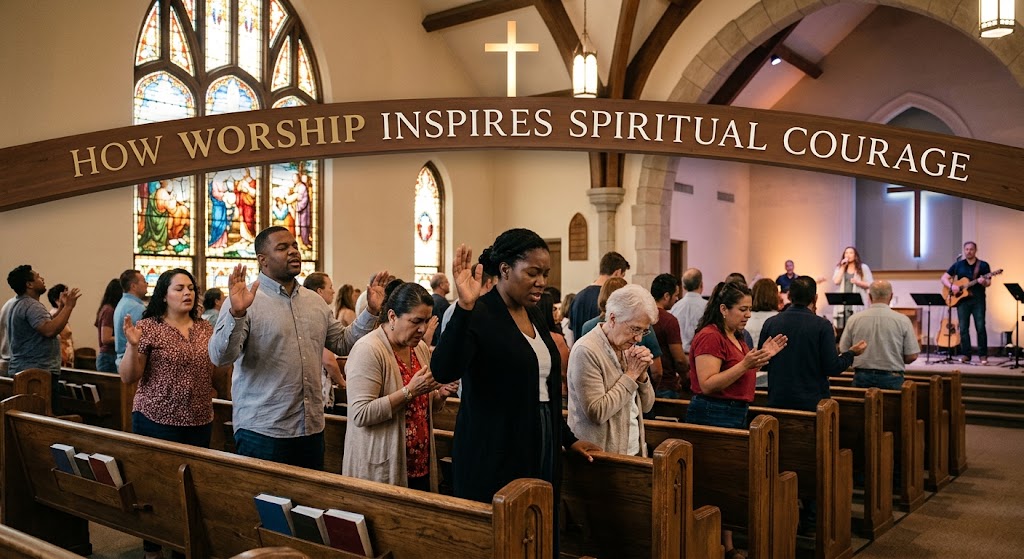
The courage developed through worship is ultimately meant to be lived outside the church building. A believer should be able to carry the confidence gained in God’s presence into the workplace, school, home, business, community, and everyday challenges.
How Worship Inspires Spiritual Courage is therefore not simply a topic about music. It is a conversation about how faith influences behaviour. Worship can remind believers that they belong to God, that their circumstances do not define Him, that fear does not have the final word, and that obedience is worth pursuing.
There will be seasons when courage feels natural and seasons when it feels impossible. During strong seasons, worship can deepen faith. During weak seasons, worship can help rebuild it. During seasons of victory, worship can cultivate gratitude. During seasons of waiting, worship can cultivate patience. During seasons of uncertainty, worship can cultivate trust.
This is why believers should not wait until they feel spiritually strong before worshipping. Sometimes worship is part of how strength is recovered.
A person who feels discouraged may begin worship with very little emotional energy. They may not feel inspired. They may not have answers. They may simply choose to whisper a prayer or play a worship song. Yet that small decision can become the beginning of renewed hope.
Worship can remind the weary heart that God has not disappeared simply because life has become difficult.
The most powerful worship is often not the loudest worship. Sometimes it is the quiet decision to trust God when nobody else knows what is happening. Sometimes it is continuing to pray when answers have not arrived. Sometimes it is choosing gratitude after disappointment. Sometimes it is standing firm when everyone else is walking away.
Spiritual courage is built through these seemingly small decisions.
For anyone struggling with fear today, worship can be a practical spiritual response. Find a quiet place. Put away distractions. Choose songs that focus on God’s character and biblical truth. Read Scripture. Pray honestly. Tell God what you are afraid of. Then deliberately remind yourself of who He is.
Do not worship because you are pretending everything is fine. Worship because God remains worthy even when everything is not fine.
Do not worship because you are certain about tomorrow. Worship because you trust the One who holds tomorrow.
Do not worship because you have already won every battle. Worship because you believe God is with you while you face them.
That is where How Worship Inspires Spiritual Courage becomes personal. It is not merely an idea to understand. It is a truth to practise.
When worship becomes part of everyday life, fear does not necessarily disappear overnight. Instead, the believer becomes increasingly equipped to face fear without surrendering to it. Problems may remain, but perspective changes. Uncertainty may remain, but trust becomes stronger. Opposition may remain, but courage grows.
Worship reminds believers that they do not have to manufacture courage from their own strength. They can draw confidence from knowing God. They can remember His faithfulness. They can surrender their fears. They can stand on His promises. They can continue walking even when the road ahead is unclear.
Ultimately, How Worship Inspires Spiritual Courage is about the transformation that happens when the heart stops magnifying fear and starts magnifying God. Worship gives believers an opportunity to declare that God is greater than their circumstances, stronger than their fears, and faithful through every season.
The next time fear tells you to stop, worship can remind you to trust. When uncertainty tells you that there is no way forward, worship can remind you that God sees the way. When disappointment tells you that your story is over, worship can remind you that God is still writing. When weakness tells you that you cannot continue, worship can remind you that your strength does not have to come from yourself.
Spiritual courage is not the absence of fear. It is faith that refuses to let fear become the master.
And sometimes, that courage begins with a song.

Leave a Reply