
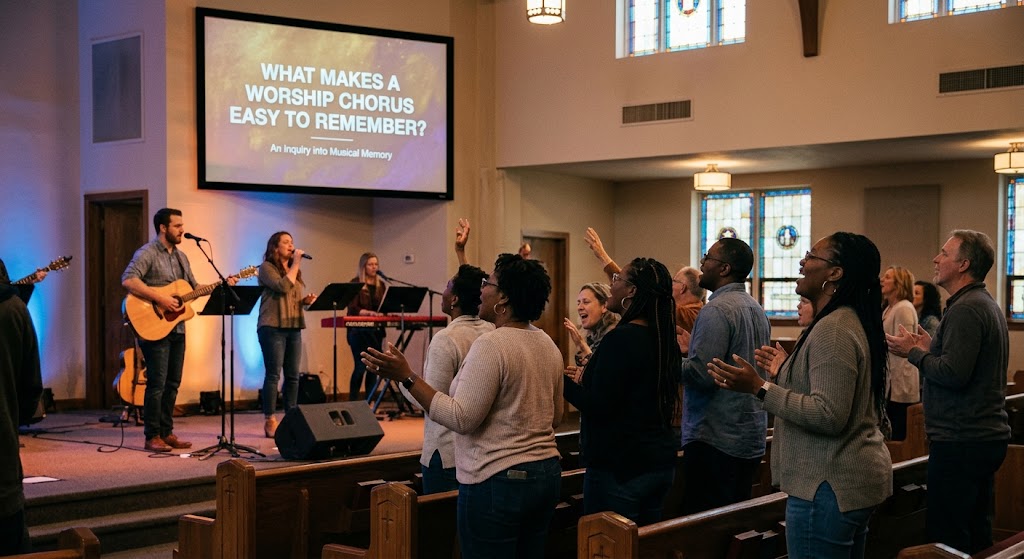
What Makes a Worship Chorus Easy to Remember?
What makes a worship chorus easy to remember? It is a question worth asking because some worship songs stay in our minds after hearing them only once, while others require several listens before we can sing even a single line. A powerful worship chorus does not always depend on complicated musical arrangements, impressive vocal runs, or sophisticated lyrics. In many cases, the simplest choruses become the most memorable because they communicate one clear idea in a way that people can easily understand, sing, and feel.
A worship chorus has a unique responsibility. It is not simply another section of a song. It is often the part that the congregation sings together, the part that remains in someone’s heart after the church service ends, and sometimes the part that becomes connected to a person’s personal testimony. This is why understanding what makes a worship chorus easy to remember matters to worship leaders, Christian songwriters, gospel artists, church choirs, and anyone interested in creating meaningful Christian music.
One of the biggest reasons a worship chorus becomes memorable is simplicity. People can remember simple ideas much more easily than complicated ones. When a chorus contains too many words, several different messages, or complicated phrases, the listener has to work harder to retain it. A simple chorus usually focuses on one central thought. It might express God’s faithfulness, His love, His greatness, His mercy, or the believer’s complete surrender.
Think about the difference between trying to remember a paragraph and remembering one powerful sentence. The sentence has a much better chance of staying with you. The same principle applies to worship music. A chorus does not need to explain everything about Christianity. It needs to capture one meaningful truth and express it beautifully.
This does not mean that every memorable worship chorus has to be extremely short. Length alone does not determine memorability. What matters is whether the words are organised around a clear and repeatable idea. A longer chorus can still be easy to remember when its structure is predictable and its central message is obvious.
Repetition is another major factor in what makes a worship chorus easy to remember. Repetition gives the brain multiple opportunities to store the same information. When a phrase appears several times throughout a chorus, people become familiar with it naturally.
What Makes a Worship Chorus Easy to Remember?
This is particularly important in congregational worship. Imagine hundreds or thousands of people hearing a new song for the first time. They may not know the melody, the lyrics, or the structure. Repetition gives them an opportunity to catch up. After hearing a line several times, people begin to anticipate what comes next.
However, repetition works best when it feels meaningful rather than forced. Repeating a phrase simply to make a song longer can become irritating. Effective worship songwriting uses repetition to reinforce the message. When a worshipper repeats a statement about God’s goodness or faithfulness, the repetition can become an act of affirmation.
A memorable worship chorus also tends to use everyday language. This is one of the most overlooked principles in Christian songwriting. Sometimes writers try so hard to sound poetic that they create lyrics people struggle to understand.
Beautiful language has its place, but clarity matters. If someone has to analyse a line for thirty seconds before understanding it, that line may be difficult for a congregation to sing spontaneously.
The strongest worship choruses often sound like something a believer would naturally say in prayer. They communicate deep truths without requiring complicated vocabulary. The words may be simple, but the meaning behind them can be profound.
Another important factor is melody. What makes a worship chorus easy to remember is not only the words but also the musical shape carrying those words. A memorable melody usually has a recognisable pattern that listeners can follow.
If the melody moves unpredictably from one note to another, contains too many complicated changes, or covers an extremely wide vocal range, ordinary worshippers may struggle to sing it. A chorus designed for congregational worship should consider the people who will actually sing it.
This is especially important because not everyone in a congregation is a professional singer. Most people are ordinary worshippers. They may not know musical terminology. They simply need to hear a melody and feel that they can join in.
A good worship chorus therefore creates a musical pathway that people can follow. The melody should have enough character to be interesting but enough predictability to remain accessible.
Rhythm also plays a major role. A rhythm that naturally matches the words can make a chorus much easier to remember. When the rhythm is awkward, listeners may struggle to reproduce the lyrics even if the words themselves are simple.
This is why some choruses immediately feel natural when sung. The words seem to fit perfectly into the rhythm. You do not have to think excessively about where each syllable belongs.
A memorable worship chorus often contains a strong rhythmic identity. Once people hear it, their minds can recognise it almost instantly. Sometimes the rhythm becomes memorable even before every lyric is remembered.
Emotional connection is another powerful element. People do not remember music only because they heard it. They remember it because they felt something while hearing it.
A worship chorus can become unforgettable when it connects with an experience in someone’s life. A person going through a difficult season may hear a simple declaration about God’s faithfulness and suddenly attach that song to their personal journey. Years later, hearing the chorus can bring back the emotions associated with that period.
This is one reason worship music can become deeply personal. A song can become part of someone’s testimony.
The emotional power of a worship chorus does not necessarily come from dramatic lyrics. Sometimes a very simple statement becomes powerful because of the truth it represents. When a congregation sings together with genuine emotion, the words can carry a weight that goes beyond the melody.
Biblical truth also contributes to memorability. Worshippers are more likely to hold onto lyrics that communicate truths they already encounter in Scripture.
A chorus centred on God’s faithfulness, mercy, holiness, grace, love, power, or promises can become memorable because the message connects with the believer’s existing understanding of God.
This is one reason Christian songwriters should take Scripture seriously. The Bible provides an enormous foundation for worship songwriting. Psalms, biblical narratives, prayers, promises, and descriptions of God’s character can all inspire meaningful songs.
When a worship chorus expresses biblical truth clearly, it can become more than entertainment. It can become a musical reminder of what the worshipper believes.
Another characteristic of memorable worship choruses is a strong central phrase. Sometimes one particular sentence carries the entire song.
When listeners hear that phrase, they immediately recognise the song. It becomes the musical identity of the chorus.
For a songwriter, identifying this central phrase can be extremely valuable. Ask yourself what you want people to remember if they forget everything else in the song. What single statement should remain in their minds?
That question can transform the songwriting process.
A worship chorus also becomes easier to remember when its lyrics have natural progression. Instead of presenting unrelated statements, the lines can build upon one another.
For example, the first line may introduce God’s character, the second may describe what He has done, and the third may express the worshipper’s response. The chorus then feels like one complete thought rather than several disconnected sentences.
Predictability can also help. When listeners begin to recognise the structure of a chorus, they can anticipate what comes next. This anticipation makes participation easier.
Interestingly, predictability does not necessarily make a song boring. A song can have predictable structural elements while still containing enough musical creativity to remain engaging.
Think about how people enjoy singing songs they already know. They do not need to concentrate on every word because their brains already know what is coming. That familiarity creates freedom.
A worship chorus can create the same experience. Once people know the words and melody, they can stop thinking about remembering the song and start focusing on worshipping.
Another factor is repetition of key words. If the most important word or phrase appears consistently, it becomes an anchor for the listener.
This is particularly useful in congregational worship because people often hear a new song while simultaneously trying to participate. Strong lyrical anchors make it easier for them to stay connected.
The vocal range also matters. A chorus may sound incredible when performed by a highly skilled worship leader but become uncomfortable when an entire congregation tries to sing it.
If the highest notes are too high or the lowest notes are too low, many people will simply stop singing.
A memorable worship chorus should therefore consider the average singer. The goal of congregational music is not to demonstrate how high or low the human voice can go. The goal is to create an opportunity for people to worship together.
This does not mean worship music should lack musical excellence. It means excellence should serve participation rather than replace it.
The arrangement can also influence how memorable a chorus becomes. Sometimes a simple arrangement gives the lyrics room to breathe. When too many instruments, vocal layers, effects, and production elements compete for attention, the central message can become difficult to identify.
A powerful chorus can survive with a piano, guitar, or even an unaccompanied voice. If the melody and message remain recognisable without elaborate production, the songwriting foundation is probably strong.
This is particularly important in modern Christian music, where production technology makes it possible to create increasingly sophisticated recordings. Technology can enhance a song, but it cannot compensate for a chorus that lacks a memorable message or melody.
Another factor is authenticity. People can often sense when a worship song feels genuine. A chorus that sounds like a sincere expression of faith can connect more deeply than lyrics written simply because they sound commercially appealing.
Authenticity does not mean every worship song must describe the songwriter’s personal experience word for word. It means the emotion and message should feel believable.
A worship chorus should sound like something the writer actually believes.
This is particularly important because worship music occupies a unique space in Christian culture. People are not simply listening to lyrics. They are often singing those lyrics as personal declarations.
When a congregation sings, “God, You are faithful,” they are not merely repeating words from an artist. They are making a statement of faith.
That gives worship songwriting a significant responsibility.
Another answer to what makes a worship chorus easy to remember is singability. A chorus can be lyrically beautiful and musically impressive but still be difficult to sing.
Singability means the average person can pronounce the words comfortably, follow the melody, understand the rhythm, and participate without feeling overwhelmed.
This is especially important when writing for churches. A song that works perfectly as a solo performance may not work equally well as a congregational song.
The best congregational choruses create a feeling that everyone can participate.
There is also something powerful about repetition combined with physical participation. When people clap, raise their hands, sway, or move naturally with a song, the experience can reinforce memory.
Music is not stored in the brain as isolated words. It is connected to rhythm, emotion, movement, environment, and experience.
This explains why a worship chorus heard repeatedly in church can become deeply familiar. Eventually, the opening notes may be enough to trigger the entire song in someone’s memory.
Another reason some worship choruses become memorable is timing. A chorus may become associated with a particular season, event, revival, conference, celebration, or personal experience.
A song released at the right moment can become connected to the emotions of that moment.
This is difficult to manufacture. No songwriter can guarantee that a song will become an anthem. However, writers can create songs that are clear, authentic, biblical, singable, and emotionally meaningful.
Ultimately, what makes a worship chorus easy to remember is the combination of simplicity, repetition, strong melody, natural rhythm, clear language, emotional connection, biblical truth, accessibility, and authenticity.
None of these elements should be viewed as a formula that guarantees success. Music remains creative, and people respond differently to different sounds and messages.
The most important lesson is that memorability should not become more important than meaning.
A worship chorus should not be written merely to become stuck in people’s heads. It should give people something worth remembering.
If the melody is unforgettable but the message is empty, the songwriter has created a catchy song but missed the deeper purpose of worship.
But when a memorable melody carries a meaningful biblical truth, something special happens. People remember the words. They sing them in church. They repeat them in their homes. They play them during difficult moments. They teach them to their children. Eventually, the song becomes part of their spiritual vocabulary.
That is the real power of a memorable worship chorus.
The best worship chorus is not necessarily the one with the most complicated lyrics, the biggest production, or the most impressive vocalist. Sometimes it is the simplest declaration sung sincerely by ordinary people who believe what they are singing.
So, what makes a worship chorus easy to remember? It gives the listener one clear truth, wraps that truth in a memorable melody, repeats it naturally, makes it easy to sing, and connects it to something deeper than music.
When those elements come together, a chorus can travel far beyond the recording that introduced it.
It can move from the church stage into the hearts of worshippers.
And sometimes, long after the music has stopped, the chorus is still being sung.

Leave a Reply