
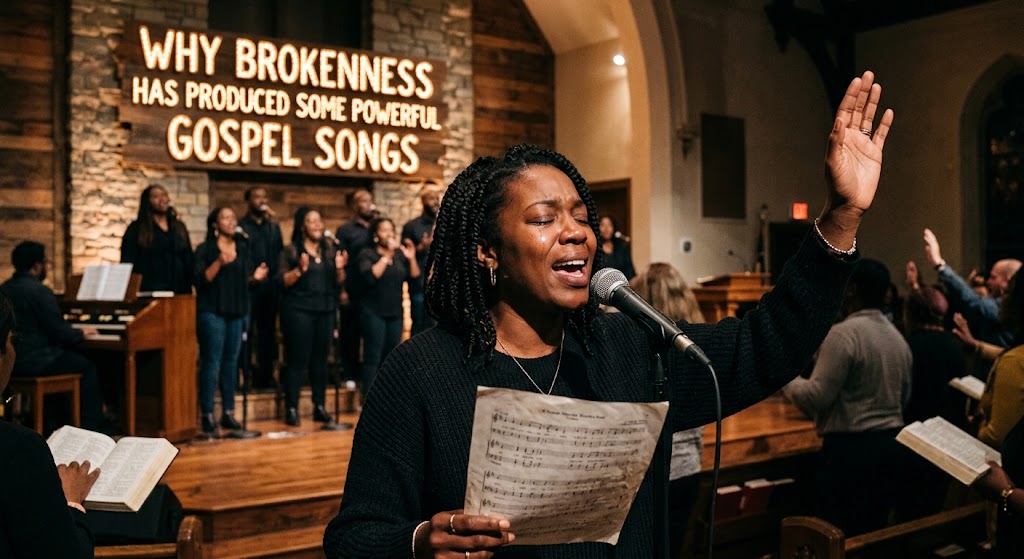
Why Brokenness Has Produced Some Powerful Gospel Songs
Why Brokenness Has Produced Some Powerful Gospel Songs is a question that takes us beyond music, melodies, microphones and recording studios. It takes us into the private places of human experience where pain, disappointment, rejection, failure, grief and uncertainty often live. Some of the most powerful gospel songs ever created were not born from moments when everything was going perfectly. They came from seasons when the songwriter had more questions than answers and more tears than words.
There is something different about a song written from a place of genuine brokenness. You can hear it in the voice. You can feel it in the lyrics. You can recognise it in the emotion behind the melody. The song does not simply tell you that God is good. It sounds like someone who has experienced God’s goodness while standing in the middle of something that could have destroyed their faith.
This is one of the reasons why brokenness has produced some powerful gospel songs. Pain has a way of making people honest. When life is comfortable, it can be easy to sing about faith. When everything is falling apart, however, faith becomes personal. The words are no longer just lyrics. They become declarations.
A person who has never experienced serious disappointment can sing about trusting God, but someone who has watched a carefully planned future collapse and still chooses to trust God sings those words differently. Someone who has never experienced rejection can sing about God’s acceptance, but someone who has been abandoned by people they trusted can sing about God’s unfailing presence with an entirely different depth.
Brokenness has a strange relationship with creativity. It can expose emotions that people normally hide. It can force people to confront questions they have avoided for years. It can create a hunger for meaning. And when that experience is expressed through gospel music, personal pain can become a message of hope for thousands or even millions of people.
This does not mean that Christians should desire suffering or deliberately seek painful experiences so they can write better songs. Pain is painful. Loss is loss. Betrayal is betrayal. There is nothing romantic about suffering. The remarkable thing is what can happen when someone takes the pieces of a painful experience and places them before God.
Why Brokenness Has Produced Some Powerful Gospel Songs
That process can turn tears into lyrics.
It can turn disappointment into worship.
It can turn a testimony into a melody.
It can turn a personal struggle into encouragement for someone who is quietly fighting the same battle.
One of the reasons brokenness creates powerful gospel music is because pain strips away pretence. When someone is hurting deeply, they often stop trying to impress people. They stop searching for sophisticated religious language. They simply cry out.
Sometimes the most powerful worship is not complicated.
Sometimes it is simply, “God, help me.”
Sometimes it is, “I don’t understand what You are doing, but I still trust You.”
Sometimes it is, “I have nothing left, but I am still holding on.”
Those simple expressions can become incredibly powerful songs because they reflect something millions of people experience but struggle to articulate.
People do not always need a song that tells them everything will be easy. Sometimes they need a song that tells them they are not alone in the difficult season.
That distinction matters.
A gospel song written from genuine brokenness does not necessarily pretend that pain does not exist. Instead, it acknowledges the pain while pointing beyond it. That is part of what makes gospel music so powerful. It can look directly at suffering without allowing suffering to have the final word.
A songwriter may lose a loved one and write about God’s comfort. Another may experience betrayal and write about forgiveness. Someone may struggle financially and write about God’s provision. Another may face rejection and write about identity in Christ. Someone may experience failure and write about grace.
The circumstances are different, but the message can become universal.
This is why listeners sometimes say, “That song was written for me.”
The songwriter may have been telling their own story, but somehow the listener finds their own story inside it.
That is one of the greatest strengths of gospel music.
Brokenness also creates vulnerability, and vulnerability creates connection. People are naturally drawn to authenticity. They can often tell when an emotional message is being performed and when it is being experienced.
A technically perfect song can leave someone unmoved, while a simple song recorded with genuine emotion can bring tears to their eyes.
Why?
Because human beings connect with truth.
A singer does not have to have the biggest voice in the room to move people. Sometimes the trembling voice of someone who has survived something difficult carries more weight than perfect vocal technique.
There is a story behind the sound.
There is a wound behind the words.
There is a testimony behind the melody.
And listeners recognise that.
This is particularly important in gospel music because the genre is deeply connected to testimony. Gospel music has historically provided a way for people to express faith through real life experiences. Songs can carry stories of hardship, deliverance, hope, gratitude, perseverance and redemption.
A powerful gospel song can therefore become more than entertainment. It can become a musical testimony.
Someone may hear a song while sitting alone in a hospital waiting room. Another person may hear it after losing a job. Someone else may play it after a painful breakup. A young person may listen to it after failing an examination. A parent may hear it while worrying about a child.
The songwriter may never know these people.
Yet the song can accompany them through one of the darkest moments of their lives.
That is extraordinary.
Brokenness also forces people to ask deeper questions. When life is comfortable, many people do not spend much time thinking about mortality, purpose, faith, forgiveness or dependence on God. But adversity has a way of forcing these questions to the surface.
Why did this happen?
Where is God in this?
Can I still trust Him?
What do I do now?
Will I ever recover?
What does faith look like when my circumstances contradict what I hoped would happen?
These questions can become the foundation of profound Christian music.
Some of the most meaningful gospel songs are essentially musical conversations with God. They contain questions, confessions, declarations and prayers.
That is another reason why brokenness has produced some powerful gospel songs.
Pain makes people search.
Searching makes people reflect.
Reflection can become songwriting.
And songwriting can become worship.
There is also something powerful about the transformation of pain into purpose. A songwriter may go through an experience that initially appears meaningless. Years later, that same experience may become the source of a song that encourages other people.
The songwriter may eventually realise that although the pain was not good, something meaningful came from it.
This is an important distinction. Faith does not require us to call suffering good. Instead, faith allows us to believe that God can bring something meaningful out of circumstances that were never good to begin with.
That belief has inspired countless gospel messages.
A broken heart can become a song about God’s love.
A season of waiting can become a song about patience.
A painful failure can become a song about grace.
A season of loneliness can become a song about God’s presence.
A period of uncertainty can become a song about trust.
In that sense, the songwriter becomes a witness to transformation.
The message becomes bigger than the pain.
Another reason brokenness produces powerful gospel songs is that it removes the illusion of self sufficiency. When everything is going well, people can easily convince themselves that they have everything under control.
Then life happens.
The plan fails.
The relationship ends.
The money disappears.
The opportunity is lost.
The diagnosis arrives.
The person you trusted walks away.
Suddenly, control becomes an illusion.
That experience can produce a deeper dependence on God.
And dependence is fertile ground for worship.
Some of the most sincere songs are born when the songwriter reaches the point where they realise they cannot fix everything themselves.
There is humility in that place.
There is honesty in that place.
There is also freedom.
Instead of pretending to have all the answers, the songwriter can admit weakness and still declare faith.
That combination is incredibly powerful.
“I am hurting, but I believe.”
“I am afraid, but I will trust.”
“I do not understand, but I will worship.”
“I have fallen, but I will rise.”
These are not merely positive statements. They are declarations made in the face of circumstances that could easily produce despair.
That is why gospel music often sounds strongest when it carries both pain and hope.
Pure optimism can sometimes feel shallow because it ignores reality. But hope that has passed through suffering has weight.
There is a difference between saying, “Everything will be fine,” and saying, “Everything is not fine right now, but I still believe God is with me.”
The second statement understands suffering.
The second statement understands faith.
The second statement can reach someone who is crying behind a closed door.
This is why people often return to certain gospel songs during difficult seasons. They are not necessarily looking for entertainment. They are looking for language.
They need words for what they are feeling.
They need something to sing when they cannot form their own prayer.
They need a reminder that their current situation is not the entire story.
A powerful gospel song can become that reminder.
It can become a prayer when the listener has no words.
It can become encouragement when the listener feels discouraged.
It can become a declaration when fear becomes overwhelming.
It can become a soundtrack for recovery.
The beauty is that the songwriter’s private pain can become public encouragement.
That does not mean every song about suffering is automatically powerful. Pain alone does not create great music. A songwriter still needs creativity, honesty, musical understanding and the ability to communicate clearly.
What makes brokenness powerful is what the artist does with it.
One person can experience pain and become bitter.
Another can experience pain and become reflective.
Another can experience pain and turn it into worship.
The difference is not necessarily the pain itself. It is the interpretation of the pain.
A songwriter who can look at a difficult experience and ask, “What can God teach me through this?” may discover a message that reaches far beyond their own circumstances.
This is also why authenticity matters so much in Christian music.
Listeners are increasingly exposed to polished productions, carefully edited videos and professionally managed social media pages. Everything can look perfect online.
But real life is not perfect.
People struggle.
People cry.
People fail.
People lose.
People question.
People recover.
People start again.
When a gospel artist is willing to acknowledge the messy parts of the journey, listeners often feel seen.
The song says, in effect, “You are not strange because you are struggling.”
That message can be deeply healing.
There is also an important spiritual lesson here. Brokenness can remind people that worship is not only something we offer when we receive what we want.
Anyone can celebrate when the breakthrough arrives.
But there is a different kind of worship when the breakthrough has not arrived yet.
There is something powerful about praising God while still waiting.
There is something powerful about singing while still hurting.
There is something powerful about trusting while still asking questions.
That kind of worship carries a different depth because it is not dependent entirely on circumstances.
It says, “My faith is bigger than this moment.”
That is often the heartbeat of powerful gospel music.
The greatest songs do not always come from the happiest moments. Sometimes they come from the moments when people discover that joy and pain can exist in the same heart.
A person can cry and still have faith.
A person can grieve and still worship.
A person can be disappointed and still believe.
A person can be broken and still be hopeful.
That tension creates powerful art because it reflects real human life.
Perhaps this is why certain gospel songs remain relevant for years. They are not attached only to one person’s experience. They speak to universal human emotions.
Everyone eventually experiences some form of disappointment.
Everyone knows what it feels like to lose something.
Everyone has faced uncertainty.
Everyone has had moments when they needed encouragement.
And everyone, at some point, needs hope.
A truly powerful gospel song enters that human space and points the listener towards God.
The songwriter may begin with a wound, but the final message can become worship.
The story may begin with tears, but it can end with hope.
The journey may begin with questions, but it can eventually lead to trust.
That is why brokenness has produced some powerful gospel songs.
Not because pain is desirable.
Not because suffering is necessary for creativity.
Not because every broken person automatically becomes a great songwriter.
It is because brokenness can take a person beneath the surface.
It can make their words honest.
It can make their worship costly.
It can make their testimony believable.
And when that experience is combined with faith, music can emerge that speaks to people who have never met the songwriter but somehow understand exactly what the song is saying.
The next time you hear a gospel song that makes you stop what you are doing, listen carefully.
There may be more behind those lyrics than a clever melody.
There may be a prayer.
There may be a testimony.
There may be a season of tears.
There may be a story of rejection.
There may be a night when the songwriter almost gave up.
And perhaps that is why the song reached you.
Sometimes the most beautiful worship comes from places that once hurt terribly.
Sometimes the strongest message comes from someone who has been weak.
Sometimes the song that gives you strength was written by someone who once had none left.
And sometimes God takes what looked like a broken chapter and turns it into a song that helps thousands of other people keep going.
That is the mystery of gospel music.
The wound may be personal, but the worship can become universal.
The pain may belong to one person, but the hope can belong to millions.
And the brokenness that once seemed like the end of the story can become the very thing that gives the song its voice.

Leave a Reply