
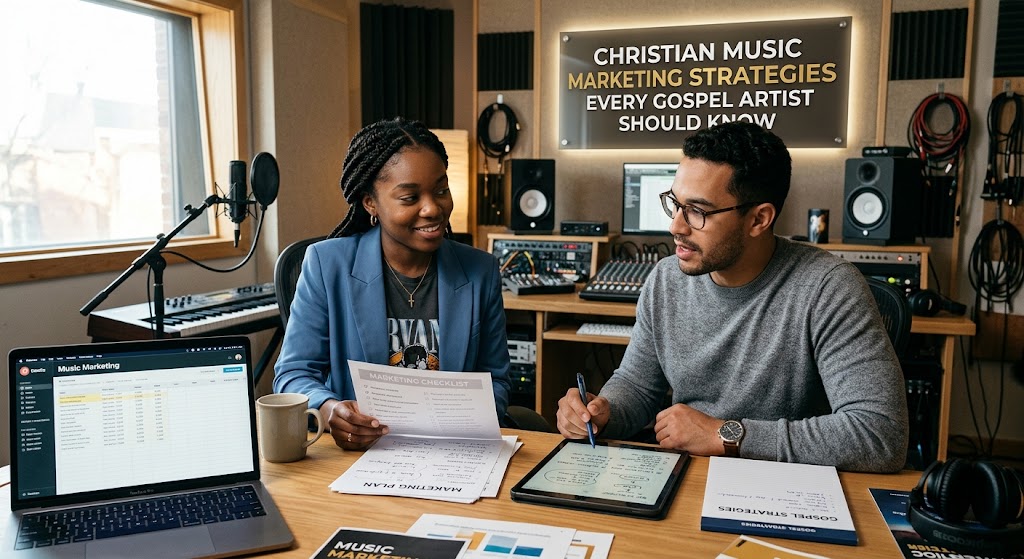
Christian Music Marketing Strategies Every Gospel Artist Should Know
Christian music has changed dramatically. A gospel artist no longer has to wait for a record label executive, radio presenter, church programme organiser, or music promoter to discover their talent before their music can reach an audience. Today, an independent artist with a smartphone, a good song, a clear message, an internet connection, and a smart marketing strategy can potentially reach listeners across Nigeria, Africa, Europe, America, and beyond. Christian Music Marketing Strategies Every Gospel Artist Should Know
But having a great voice is no longer enough.
Having a powerful worship song is no longer enough.
Even having an excellent music video is no longer enough.
There are thousands of talented Christian musicians releasing songs every year, yet many of them struggle to get their music heard. The problem is not always a lack of talent. In many cases, the problem is that the artist has never learned how to market the music effectively.
This is why understanding Christian Music Marketing Strategies Every Gospel Artist Should Know has become increasingly important. Music marketing is not about manipulating people into listening to a song. It is about helping the right people discover music that can encourage them, inspire them, strengthen their faith, or simply give them an enjoyable listening experience.
A gospel artist should therefore think beyond recording and releasing songs. Every song needs a journey. There should be a strategy for introducing it, creating anticipation around it, releasing it, keeping people interested in it, and giving listeners reasons to share it with others.
One of the first Christian Music Marketing Strategies Every Gospel Artist Should Know is understanding your audience.
You cannot effectively market your music if you do not know who you are trying to reach. A gospel artist might say, “My music is for everybody,” but that answer is usually too broad to create a focused marketing strategy.
Are you creating contemporary worship music for young Christians? Are you producing Afro gospel music for an African audience? Are your songs designed for church worship teams? Are you targeting gospel music lovers who enjoy inspirational music? Are you creating Christian music for teenagers and young adults? Are your songs focused on prayer, encouragement, evangelism, praise, or personal testimony?
Knowing your audience helps determine the language you use, the platforms you prioritise, the visual style of your content, the collaborations you pursue, and even the type of songs you release.
The next important strategy is building an artist brand.
Your brand is not simply your logo, photographs, clothing, or stage name. Your brand is the impression people develop when they repeatedly encounter your music and content. When people hear your name, what should immediately come to mind?
Christian Music Marketing Strategies Every Gospel Artist Should Know
Perhaps your music is known for deep worship. Perhaps you are recognised for energetic Afro gospel. Maybe your songs focus heavily on scripture and encouragement. Maybe your ministry is built around helping young people discover their identity in Christ.
A clear identity makes it easier for people to remember you.
Consistency is particularly important. Your photographs, social media content, music covers, videos, captions, interviews, and public communication should feel connected. This does not mean everything must look identical. It means people should be able to recognise your presence even before they see your name.
Another important strategy is creating anticipation before releasing a song.
One of the common mistakes gospel artists make is disappearing for months, recording a song privately, and suddenly posting, “My new song is out now. Please stream and share.”
By that point, the audience has not been prepared.
Instead, start telling the story before the release. You could share a short message about what inspired the song. You could publish a photograph from the recording session. You could release a short behind the scenes video. You could ask your followers a question related to the song’s theme. You could share a short lyric from the song without revealing everything.
The goal is to make people curious.
If the song is about God’s faithfulness, you could ask your audience to share a moment when they experienced God’s faithfulness. If the song is about overcoming difficult seasons, you could discuss the emotions behind writing it.
This transforms the release from an announcement into a story.
Social media should also become part of your daily music marketing strategy. However, simply posting links to your songs repeatedly is not an effective social media strategy.
People do not usually open social media because they want to see advertisements all day. They want entertainment, information, inspiration, connection, and conversation.
Therefore, a gospel artist should create content around the music rather than only posting the music itself.
You can share short performance clips, acoustic versions, lyric videos, worship moments, songwriting stories, rehearsal footage, interviews, testimonies, funny moments, devotional thoughts, musical challenges, questions, and audience reactions.
For example, instead of posting a streaming link with the caption “Listen to my new song,” you could post a 20 second section of the song where the strongest lyric appears and ask, “Have you ever reached a point where all you could do was trust God?”
That creates an opportunity for conversation.
Short form video is another powerful part of Christian Music Marketing Strategies Every Gospel Artist Should Know. Platforms that favour short videos can give an unknown artist an opportunity to introduce their music to people who have never heard of them.
A gospel artist does not need to produce an expensive music video for every social media post. A simple, well recorded performance can sometimes be more effective because it feels authentic.
You can create several pieces of content from one song. One recording session could produce a full music video, short performance clips, lyric videos, behind the scenes footage, acoustic versions, rehearsal videos, interviews, and short inspirational messages connected to the song.
This is called content repurposing, and it allows artists to get more value from the work they have already done.
Another important strategy is making your music easy to find.
A beautiful song can remain invisible if nobody knows where to find it. Your artist name, song title, cover artwork, descriptions, social media profiles, website, and streaming profiles should be consistent.
When people search for your music, they should not encounter confusion caused by different spellings, inconsistent artist names, or incomplete profiles.
Search engine optimisation can also help gospel artists discover new audiences. Your website and music related pages can target phrases people are actually searching for. These might include gospel songs, new gospel music, Nigerian gospel music, Afro gospel songs, Christian worship songs, gospel music downloads, Christian music releases, or specific song and artist names.
Your own website is particularly valuable because social media platforms can change their algorithms at any time. An artist who depends entirely on one platform does not have complete control over their audience.
A website can serve as your digital home. It can contain your biography, music, videos, upcoming events, press information, contact details, lyrics, articles, testimonials, and links to your streaming platforms.
Email marketing is another strategy that many independent gospel artists overlook.
An email list gives you a direct way to communicate with people who have deliberately chosen to hear from you. Instead of depending entirely on social media algorithms, you can notify your supporters when you release new music, announce events, share ministry updates, or publish exclusive content.
The relationship should not be purely promotional. If every email says “stream my song,” people may lose interest. Give your subscribers something valuable. Share a short devotional thought, explain the story behind a song, discuss your creative journey, or encourage them during difficult seasons.
Collaboration is another powerful strategy.
A gospel artist does not always need to collaborate only with musicians who are more famous. Sometimes working with artists who have a similar audience can create stronger results.
You can collaborate with singers, producers, worship leaders, Christian content creators, dancers, instrumentalists, church media teams, podcasters, bloggers, photographers, and Christian influencers.
The important thing is alignment.
A collaboration should make sense for both audiences. When two creators introduce their communities to one another, everyone gains an opportunity to discover something new.
Gospel artists should also develop relationships with Christian bloggers and music platforms. Independent music websites can help introduce new songs to audiences that already have an interest in Christian music.
A well written press release can make it easier for bloggers and media platforms to understand the story behind a release. Instead of simply sending a song file and asking for promotion, provide useful information about the artist, the song, its inspiration, release date, available platforms, and relevant promotional materials.
Radio promotion remains relevant as well, particularly in markets where gospel radio has a strong audience.
However, artists should not approach radio stations randomly. Research the programmes and presenters that actually play your style of music. Understand their submission requirements and communicate professionally.
The same principle applies to churches.
Churches can provide valuable opportunities for gospel artists, especially artists whose music is designed for worship and ministry. But artists should avoid treating every church invitation as a sales opportunity.
Build genuine relationships. Serve where appropriate. Respect church leadership. Understand the purpose of the event. When people see both your character and your musical ability, your opportunities can grow naturally.
Another major strategy is using storytelling.
People may forget a promotional caption, but they often remember a story.
Tell people why you wrote the song.
Tell them what happened when you first created it.
Tell them what the lyrics mean to you.
Tell them about the season of life that inspired it.
Tell them how the song relates to your faith.
A song becomes more memorable when listeners understand the human experience behind it.
For example, if a gospel artist wrote a song after surviving a difficult season, the marketing campaign can focus on the journey from uncertainty to hope. The audience is no longer simply hearing a song. They are connecting with a testimony.
Reviews and testimonials can also strengthen your marketing.
When listeners send messages explaining how your song encouraged them, ask for permission to share their experiences. Genuine audience reactions can provide powerful social proof.
People are often curious about what others think before they invest their attention in something unfamiliar.
Another important Christian Music Marketing Strategies Every Gospel Artist Should Know is learning how to use data.
Do not market blindly.
Pay attention to which songs receive the most streams, which videos attract the most watch time, which posts receive the most shares, where your listeners are located, what age groups are engaging with your content, and which platforms generate meaningful traffic.
The numbers do not replace creativity, but they can reveal what is working.
Perhaps you discover that your acoustic worship clips perform better than highly produced promotional videos. Perhaps your audience responds strongly to testimony based content. Perhaps listeners in another country are discovering your music unexpectedly.
Those insights can influence your next campaign.
Artists should also understand that releasing a song is not the same as marketing a song.
The release day is only the beginning.
A song can continue receiving attention weeks or months after release if the artist keeps creating relevant content around it. You might release a lyric video several days later, share a live performance the following week, publish the story behind the song, collaborate with another creator, launch a worship challenge, conduct an interview, or create a new acoustic version.
This gives the song multiple opportunities to reach people.
Another mistake artists should avoid is trying to appear bigger than they actually are.
Authenticity matters.
You do not need to pretend that thousands of people are listening to your music if they are not. You do not need to manufacture fake popularity. You do not need to buy questionable followers or engagement.
A smaller audience that genuinely cares about your music can be far more valuable than thousands of inactive followers.
Your first 100 genuine supporters matter.
Your first 500 listeners matter.
Your first group of people who consistently share your songs matters.
Treat those people well.
Respond to comments where possible. Thank people for sharing your music. Remember loyal supporters. Create a sense of community around your work.
Marketing is ultimately about relationships.
Budgeting is also important. Not every gospel artist has a large promotional budget, but that does not mean marketing has to be expensive.
A small budget can be used strategically for social media advertising, professional artwork, video production, website development, playlist promotion, public relations, or targeted campaigns.
The key is knowing what you are paying for.
Avoid anyone promising guaranteed fame, guaranteed millions of streams, or overnight success. The music industry contains many questionable promotional services, and artists should investigate before spending money.
Your reputation is more valuable than temporary numbers.
Finally, gospel artists should remember why they started.
Marketing can become overwhelming when everything is measured through views, likes, followers, streams, comments, and chart positions. These numbers can be useful, but they should not become the definition of your ministry or artistic value.
A song that receives a million streams is not automatically more spiritually valuable than a song that reaches 500 people deeply.
At the same time, having a sincere message does not mean an artist should ignore professional marketing. Excellence and faith can work together. You can have a genuine ministry and still learn branding, audience development, search engine optimisation, social media strategy, public relations, content creation, email marketing, networking, and digital promotion.
The strongest gospel artists of the future will understand both sides.
They will understand the message and the marketplace.
They will understand ministry and media.
They will understand music and marketing.
They will understand that releasing a song is only one part of building a sustainable music career.
Christian Music Marketing Strategies Every Gospel Artist Should Know are therefore not simply techniques for gaining streams. They are tools for helping meaningful music reach the people who need to hear it. The objective is not to manipulate an audience but to remove the barriers that prevent good music from being discovered.
If you are a gospel artist, start with what you already have. Identify your audience. Define your identity. Tell your story. Build anticipation. Create useful content. Use social media intentionally. Optimise your online presence. Collaborate strategically. Build relationships with churches and media platforms. Study your audience data. Continue promoting your releases after launch. Protect your reputation. Most importantly, remain authentic.
You may not become an overnight sensation, and you do not need to.
Build something people can trust.
Create music worth remembering.
Develop relationships that last.
Give your audience reasons to return.
And keep improving your craft.
The internet has made it possible for a gospel artist sitting in a small studio to reach someone thousands of kilometres away. But opportunity alone does not guarantee discovery. The artists who learn how to combine excellent music with intelligent, consistent, authentic promotion will have a greater chance of turning their songs into lasting connections.
In the end, the best marketing strategy is not simply getting people to click a play button. It is giving them a reason to listen, a reason to remember, a reason to share, and perhaps most importantly, a reason to come back for the next song.

Leave a Reply