
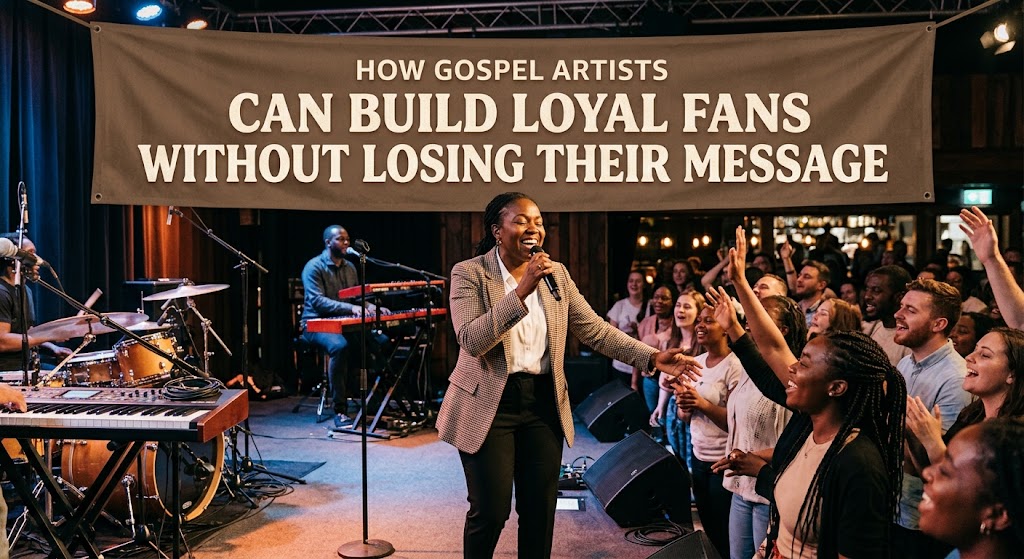
How Gospel Artists Can Build Loyal Fans Without Losing Their Message
How Gospel Artists Can Build Loyal Fans Without Losing Their Message is an important question for Christian musicians who want to grow their audience while remaining faithful to the reason they started making music in the first place. In today’s music industry, having a powerful voice or releasing excellent songs is no longer enough. Gospel artists are competing for attention on streaming platforms, social media, YouTube, radio, live events and countless other channels. The pressure to become popular can be intense, especially when artists see other musicians gaining millions of views, followers and streams.
But building a loyal fan base does not have to mean compromising your faith, changing your message or becoming someone you are not. In fact, the strongest Christian artists often build their audiences precisely because people recognise their authenticity. Fans may discover an artist because of a catchy song, but they usually remain connected because they believe in the person, the story, the values and the message behind the music.
The first thing every gospel artist needs to understand is the difference between attracting attention and building loyalty. Attention can come from controversy, a viral video, an unusual appearance or a catchy chorus. Loyalty is different. Loyal fans intentionally search for your music, share your songs, attend your events, recommend you to friends and remain interested in your journey even when you are not releasing a new song every week.
This distinction is important because chasing attention can easily push an artist towards decisions that do not represent their convictions. An artist might begin creating music simply because a particular sound is trending. They might copy another artist’s personality because that personality attracts engagement. They might deliberately create controversy because controversy generates comments. Eventually, the artist may have an audience, but that audience may no longer understand what the artist actually stands for.
If you want to know how gospel artists can build loyal fans without losing their message, start by becoming extremely clear about your identity. Before worrying about followers, streams and numbers, ask yourself why you make Christian music. What message do you want people to remember when they hear your name? What kind of emotional and spiritual experience should your music create? What values will you refuse to sacrifice even if compromising them would make you more popular?
Your answers become the foundation of your artistic identity.
A gospel artist does not have to sound exactly like every other gospel artist. Christian music has room for different voices, cultures, languages, personalities and musical styles. Some artists may thrive through worship music. Others may focus on contemporary gospel, Afro gospel, traditional gospel, Christian hip hop, Christian soul or other expressions of faith. The musical style can evolve, but the core message should remain recognisable.
This is where authenticity becomes one of the greatest marketing tools an artist can have.
People are becoming increasingly good at recognising when something feels forced. Social media may allow an artist to manufacture an image, but maintaining a manufactured personality for years is difficult. Fans eventually notice inconsistencies. When an artist speaks differently in private than in public, promotes values they do not practise or suddenly changes personality because a particular trend is popular, the audience can become confused.
Authenticity does not mean sharing every detail of your private life. It means allowing your public identity to be consistent with your genuine values.
How Gospel Artists Can Build Loyal Fans Without Losing Their Message
One of the most effective ways to build loyal fans is to tell your story. Behind every meaningful gospel song there is often a story. Perhaps the song came from a difficult season. Perhaps it was inspired by prayer. Perhaps it reflects a personal testimony, a family experience, a season of waiting or a lesson learned through faith.
Your audience may hear the finished song, but they may never understand the journey that produced it unless you tell them.
Storytelling gives people a reason to connect with your music beyond the melody. When fans understand why you wrote a song, they can relate to it more deeply. A person who has experienced something similar may suddenly feel that the artist understands them.
This is especially powerful in gospel music because Christian songs often deal with universal human experiences such as hope, fear, forgiveness, pain, gratitude, failure, restoration, faith and perseverance.
Instead of simply posting “My new song is out,” a gospel artist can explain the experience behind the song. What happened? What were you feeling? What did you learn? What Bible passage influenced the lyrics? What do you hope someone listening to the song will experience?
That kind of communication creates connection.
Another important principle is to stop treating fans like numbers. Followers, views and streams are useful measurements, but they are not the entire picture. One thousand people who genuinely care about your music can be more valuable than one hundred thousand people who clicked on one viral video and forgot your name the next morning.
Loyal fans want to feel that they are part of something.
Respond to comments when possible. Thank people who share your songs. Acknowledge people who attend your performances. Celebrate milestones with your audience. Ask them questions. Find out which songs have helped them. Invite them to share their testimonies.
The goal is not to pretend that you know every follower personally. The goal is to make the audience feel that there is a real human being behind the music.
Consistency is another major ingredient in building loyalty. An artist who disappears for six months and suddenly returns demanding attention may struggle to maintain momentum. You do not necessarily need to release a new song every week, but you should maintain a meaningful relationship with your audience.
You can share short reflections, behind the scenes content, rehearsal moments, songwriting stories, live performances, Bible inspired thoughts, interviews and updates about upcoming projects.
The key is to make your content meaningful rather than simply filling your social media pages with advertisements.
People do not want to be sold to every time they open their phones.
If every post says “Stream my song,” “Buy my album,” “Book me,” or “Watch my video,” followers may eventually tune out. Promotion is necessary, but promotion should be balanced with value.
Give people something before asking them for something.
A gospel artist can share a short encouragement in the morning, a songwriting story in the afternoon and a performance clip later. The audience begins to associate the artist with more than music promotion. They associate the artist with encouragement, creativity, faith and community.
Another important strategy is to understand social media without allowing social media to control the message. Platforms reward attention, but Christian music should not become a slave to algorithms.
Trends can be useful. Artists can participate in popular formats, create short videos and experiment with different content styles. However, the artist should ask one important question before participating in any trend: Does this fit who I am?
Not every viral trend deserves your participation.
The fact that millions of people are doing something does not automatically make it appropriate for your brand, ministry or convictions. A gospel artist can be relevant without copying everything happening online.
The strongest artists learn how to adapt the format without abandoning the message.
For example, instead of copying a popular trend exactly, an artist can use the format to communicate an encouraging Christian message. Instead of chasing controversy, the artist can create a thought provoking discussion about faith. Instead of using attention grabbing content that contradicts the artist’s values, the artist can create something entertaining while remaining authentic.
This is how relevance and conviction can coexist.
Gospel artists should also invest in the quality of their music. A powerful message deserves a strong presentation. Being a Christian artist does not mean poor production should be accepted as evidence of spirituality.
People can appreciate the message and still expect good songwriting, strong vocals, quality production, effective artwork and professional music videos.
Excellence can help the message travel further.
This does not mean every gospel artist needs an expensive studio or enormous production budget. Creativity can often compensate for limited resources. What matters is taking the available resources seriously and continually improving.
A growing artist should study songwriting, vocal performance, production, branding, social media, photography, video creation and audience development. Ministry and professionalism do not have to be enemies.
Another powerful way to build loyalty is to collaborate strategically. Collaboration introduces artists to new audiences while creating opportunities for creativity. But collaborations should not be chosen simply because another artist has more followers.
Choose collaborators whose music, character and audience align with your direction.
A successful collaboration should make sense musically and naturally fit both artists. When the partnership feels authentic, audiences are more likely to appreciate it.
Gospel artists should also remember the importance of live experiences. Streaming can introduce people to your music, but live performances can create much deeper emotional connections.
A powerful concert, church performance, worship night or community event can transform casual listeners into loyal supporters. People remember experiences.
When someone hears a song online, they may enjoy it. When they hear the same song performed live and experience the atmosphere, emotion and testimony surrounding it, the song can become attached to a personal memory.
That is why artists should not treat live performance as an afterthought.
Your stage presence, communication, musicianship and interaction with the audience all contribute to how people remember you.
Building loyal fans also requires patience. Many artists become frustrated because they expect overnight success. They see another musician suddenly go viral and assume their own career is moving too slowly.
But viral success is not the same thing as sustainable growth.
Some songs explode quickly and disappear just as quickly. Other artists build their audiences slowly over several years and eventually develop careers with remarkable staying power.
Do not allow someone else’s timeline to make you abandon your own direction.
Your responsibility is to keep improving, keep serving your audience and keep creating meaningful music.
Another mistake artists should avoid is trying to please everyone. If you attempt to make music that every Christian, every music lover and every demographic will enjoy, your artistic identity may become unclear.
You need to know who your music is primarily for.
Perhaps your music speaks particularly well to young Christians. Perhaps you connect strongly with people going through difficult seasons. Perhaps your sound appeals to worshippers, gospel music lovers, Christian hip hop listeners or audiences interested in Afro gospel.
Understanding your audience does not mean excluding everyone else. It simply helps you communicate more effectively.
When you know who you are speaking to, your lyrics, visuals, storytelling and promotional strategy become clearer.
Your audience should also understand what they can expect from you. If one song sounds completely different from the next, that is not necessarily bad, but there should still be something recognisable about your artistic identity.
Your voice, message, perspective, storytelling or emotional character can become your signature.
Loyalty grows when people know what your name represents.
Transparency is equally important. Nobody expects a gospel artist to be perfect. In fact, pretending to have a perfect life can create distance between an artist and the audience.
Christianity itself is built around grace, redemption, growth and dependence on God. An artist can acknowledge that they are still learning and growing without turning their personal struggles into entertainment.
There is strength in saying, “I have been through difficult seasons, but my faith carried me through.”
Such honesty can make music more relatable.
At the same time, artists should exercise wisdom about what they share publicly. Authenticity does not require oversharing. Your testimony belongs to you, and you should decide carefully which parts are appropriate for public consumption.
The ultimate goal is not simply to build fans. It is to build trust.
Fans can disappear when the next trend arrives. Trust is much harder to replace.
When people trust an artist, they are more likely to listen to new music, support projects, attend events and recommend the artist to others. They know that even when the sound evolves, the artist’s foundation remains intact.
This is perhaps the most important answer to the question of how gospel artists can build loyal fans without losing their message. Do not make your message an obstacle to your growth. Make it the reason people remember you.
Your faith should not be something you hide until the end of a song. Your Christian identity can influence your storytelling, creativity, relationships, work ethic and the way you treat your audience.
The objective is not to preach at people every second. It is to create music and content that naturally reflects what you believe.
A gospel artist can be entertaining without becoming empty. An artist can be commercially successful without becoming spiritually compromised. An artist can understand marketing without turning ministry into manipulation. An artist can pursue excellence without pursuing fame as an idol.
The balance comes from knowing what must never change.
Your sound may change. Your production may improve. Your audience may grow. Your visual identity may evolve. Your marketing strategy may become more sophisticated. Your technology may change completely.
But your core values should remain clear.
The music industry will always create new pressures. There will always be another trend, another viral sound, another artist gaining attention and another platform promising exposure. Gospel artists who build lasting careers will be those who learn to navigate these changes without allowing the changes to define them.
Build relationships rather than chasing numbers. Tell stories rather than simply advertising songs. Create value rather than constantly requesting attention. Use trends wisely rather than blindly following them. Invest in quality. Collaborate with people who share your direction. Perform with excellence. Communicate consistently. Understand your audience. And above all, remain authentic.
The most loyal fans are not necessarily looking for a perfect artist. They are looking for something real.
They want music that speaks to their lives. They want stories they can understand. They want artists whose words mean something. They want songs that give them hope when life becomes difficult and remind them of truths they may have forgotten.
That is the opportunity available to every gospel artist.
You do not have to choose between building an audience and protecting your message. You can do both.
In fact, your message may be the very thing that builds your strongest audience.
When people discover that your music consistently represents something meaningful, they have a reason to return. When they see that your public image matches your values, they have a reason to trust you. When your songs become connected to important moments in their lives, they have a reason to remember you.
That is how casual listeners become supporters, supporters become loyal fans and loyal fans become a community.
The future of gospel music will not belong only to the artists with the biggest voices or the largest marketing budgets. It will also belong to artists who understand that people are not merely looking for another song to stream. They are looking for something that speaks to them.
So build your audience. Promote your music. Learn the business. Understand the platforms. Improve your craft. Embrace technology. Tell your story. Take your career seriously.
But never become so desperate to be heard that you forget what you came to say.
Your message is not the price you pay for success.
Your message is part of the reason success is worth pursuing.

Leave a Reply