
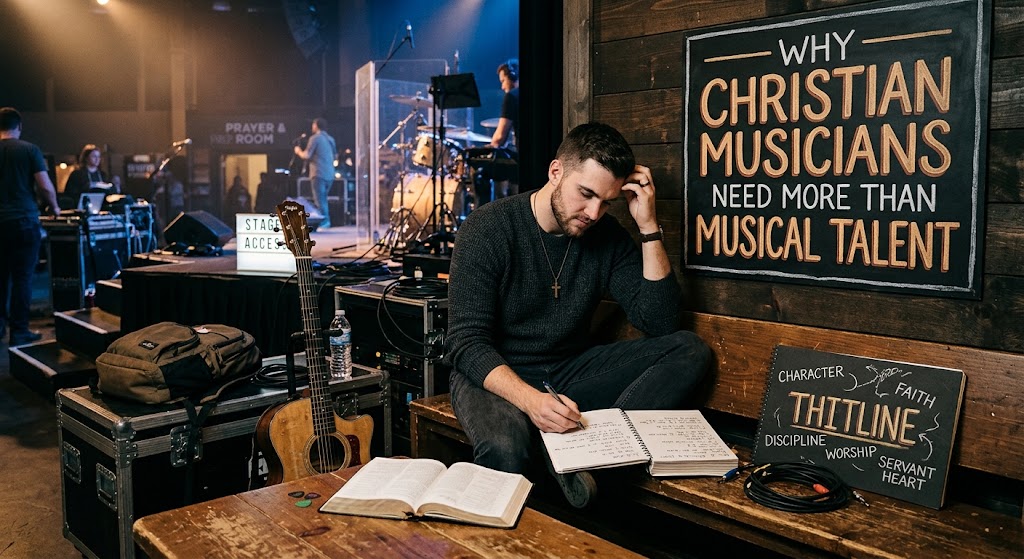
Why Christian Musicians Need More Than Musical Talent
Why Christian musicians need more than musical talent is a question worth asking in an age when Christian music is reaching millions of people through streaming platforms, social media, churches, concerts, and digital communities. The ability to sing beautifully, play an instrument exceptionally well, write memorable lyrics, or produce an impressive sound can open doors, but musical ability alone does not determine whether a Christian musician will have a lasting impact.
Talent can attract attention, but character determines what happens after the attention comes. A powerful voice may make people stop and listen, but integrity can determine whether they continue to respect the person behind that voice. A brilliant guitarist can impress an audience, but humility can determine whether that musician remains teachable. A gifted songwriter can produce songs that become popular, but spiritual depth can determine whether those songs actually speak meaningfully to people’s lives.
Christian music carries a unique responsibility because it is often connected to faith, worship, encouragement, testimony, and the message of Jesus Christ. People do not always listen to Christian music simply because they appreciate the melody. Sometimes they listen because they are hurting. Sometimes they are searching for hope. Sometimes they are praying. Sometimes they are grieving. Sometimes they are struggling with their faith and looking for something that reminds them that they are not alone.
That is why Christian musicians need more than musical talent.
A Christian musician can have an extraordinary voice and still lack the character required to handle influence responsibly. Talent can put someone on a stage, but character determines how that person behaves when the lights go off. It is easy to appear humble when thousands of people are applauding. The real test comes when nobody is watching.
Christian musicians live in a world where visibility can increase rapidly. One song can suddenly attract thousands or millions of streams. A short performance can become a viral video. A worship moment can spread across social media within hours. While this can create wonderful opportunities, it can also expose musicians to pressure, pride, comparison, temptation, criticism, and an unhealthy obsession with popularity.
Talent without character can become dangerous because success magnifies what is already inside a person.
Why Christian Musicians Need More Than Musical Talent
If someone is humble, greater success can provide more opportunities to serve. If someone is arrogant, greater success can make the arrogance louder. If someone is disciplined, greater opportunities can help them become more productive. If someone is careless, greater influence can make their mistakes more damaging.
This is one of the reasons Christian musicians need to develop themselves beyond their musical abilities. They need emotional maturity, spiritual discipline, integrity, humility, wisdom, patience, and a genuine understanding of what it means to represent Christ.
Musical talent is valuable. There is nothing wrong with pursuing excellence. In fact, Christian musicians should take their craft seriously. Singing well matters. Playing instruments well matters. Writing quality songs matters. Good production matters. Professional performances matter. There is a place for excellence in Christian music.
The problem begins when excellence in music becomes more important than excellence in character.
A musician can spend years learning vocal techniques but never learn how to control their temper. Someone can spend countless hours perfecting an instrument but spend almost no time developing their spiritual life. An artist can understand music theory while failing to understand the responsibility that comes with influence.
The strongest Christian musicians understand that their gift is only one part of their calling.
Another reason Christian musicians need more than musical talent is that talent does not automatically produce spiritual depth. A person can sing about faith without necessarily having a deep understanding of faith. Someone can write beautiful lyrics about trusting God while personally struggling to trust God. Someone can perform a worship song perfectly without understanding what worship actually means.
This does not mean every Christian musician must be perfect before making music. Nobody is perfect. Christian musicians are human beings who experience weakness, questions, failures, disappointments, and difficult seasons just like everyone else.
What matters is authenticity.
People can often sense when something feels genuine. A song can have excellent production, beautiful vocals, and sophisticated instrumentation, yet still leave listeners emotionally untouched. Another song may have relatively simple production but carry such sincerity that people listen to it repeatedly because it speaks directly to something they are experiencing.
Sometimes the difference is not talent. It is truth.
Christian musicians need to understand the message behind what they are singing. If an artist is singing about God’s faithfulness, they should take time to understand what faithfulness means. If they are writing about grace, they should understand grace. If they are singing about forgiveness, they should understand forgiveness. If they are singing about surrender, they should understand the cost of surrender.
The deeper the understanding, the more meaningful the expression can become.
Christian musicians also need discipline. Talent can get someone noticed, but discipline helps them remain consistent. There will be days when inspiration does not come. There will be seasons when opportunities disappear. There will be songs that receive little attention despite significant effort. There will be criticism. There will be rejection. There will be moments when another artist appears to be succeeding faster.
Without discipline, talent can easily become wasted potential.
A gifted musician who refuses to practise may eventually be overtaken by someone who is less naturally gifted but more committed. A talented songwriter who refuses to learn may stop growing. An artist who depends entirely on natural ability may discover that the industry changes faster than their skills.
Christian musicians therefore need to remain students.
They need to keep learning music, technology, songwriting, production, communication, business, marketing, performance, and audience engagement. They also need to continue developing spiritually. Growth should not stop simply because a person has released a successful song.
Another important quality Christian musicians need is humility.
The music industry can create an environment where numbers become extremely important. Followers, streams, views, likes, comments, awards, bookings, chart positions, collaborations, and audience size can all become measures of success.
These things have practical value. An artist needs an audience to reach people. Streaming numbers can indicate how widely music is being consumed. Awards can recognise excellence. Social media can create opportunities.
But none of these numbers can measure the value of a person’s soul.
A Christian musician who constantly compares their journey with another musician’s journey can quickly become frustrated. One artist may have millions of followers while another has a few thousand. One may receive international invitations while another is serving in a small local church. One song may become a global hit while another song seems to disappear immediately after release.
That does not necessarily mean one musician is more valuable to God than another.
Christian musicians need enough humility to understand that influence is not always measured by numbers. Sometimes one song can reach one person at exactly the right moment and become more significant than a song that receives millions of streams.
A musician should therefore pursue impact rather than simply popularity.
Christian musicians also need integrity because influence creates responsibility. People watch what successful musicians do. Young believers may imitate their language, behaviour, fashion, attitudes, and lifestyle. Fans may look up to them as examples even when the musician never asked to become a role model.
This means musicians need to think carefully about what they promote.
It does not mean Christian artists must pretend to be perfect or live under unrealistic expectations. It means they should recognise that public influence comes with consequences. When a person repeatedly speaks about faith while behaving in ways that contradict the values they publicly promote, people notice.
The issue is not perfection. The issue is hypocrisy.
A Christian musician who makes mistakes, admits them, learns, seeks forgiveness, and grows can actually demonstrate something valuable. People do not need perfect musicians. They need authentic human beings who are willing to grow.
Another quality Christian musicians need is emotional intelligence.
Music is deeply emotional. Artists experience criticism, rejection, excitement, pressure, disappointment, praise, jealousy, insecurity, and comparison. Without emotional maturity, these experiences can become overwhelming.
A musician may receive hundreds of positive comments but become obsessed with the one negative comment. They may perform successfully and still feel insecure. They may collaborate with someone and later feel threatened by that person’s success.
Learning how to manage emotions is therefore essential.
Christian musicians need to understand that criticism is not always persecution and praise is not always confirmation. Some criticism can help an artist improve. Some praise can feed pride. Wisdom is knowing the difference.
They also need healthy relationships.
No musician succeeds entirely alone. Behind many successful Christian artists are family members, pastors, mentors, musicians, producers, managers, friends, engineers, designers, promoters, and other professionals.
The danger of success is that people may become surrounded by individuals who are afraid to tell them the truth.
A Christian musician needs people who can say, “You are wrong,” without being immediately removed from their lives. They need mentors who can challenge them. They need friends who care about their character more than their career. They need spiritual communities where they are known as people rather than simply as performers.
The ability to receive correction can protect a musician from many avoidable mistakes.
Christian musicians also need a strong sense of purpose.
If the only reason someone creates Christian music is to become famous, success may never be enough. There will always be another artist with more followers, another song with more streams, another performer with a bigger stage.
But when purpose is stronger than popularity, an artist can continue creating meaningful music even when the numbers are not impressive.
Purpose asks a deeper question.
Why am I doing this?
Is it simply to become famous? Is it to make money? Is it to build a personal brand? Is it to receive recognition? Or do I genuinely want my music to encourage people, communicate truth, strengthen faith, tell my story, and point people towards God?
The answer to that question can shape an entire career.
Christian musicians also need patience.
The modern digital world creates the illusion that success should happen quickly. Artists see viral songs and may assume that everyone else is succeeding overnight. They may become discouraged when their own music does not immediately gain traction.
But many successful musicians spent years developing their craft before the wider world noticed them.
Patience allows an artist to keep improving during seasons when there is little applause.
There is another important reason Christian musicians need more than musical talent. They need to understand people.
A musician who understands human pain can write differently. A musician who understands hope can communicate differently. A musician who listens to people’s stories can create music that connects with real experiences.
The most meaningful Christian songs often speak to universal human experiences such as fear, love, loss, hope, failure, forgiveness, loneliness, gratitude, uncertainty, restoration, and faith.
Technical skill can make a song sound good. Understanding people can help make the song matter.
Christian musicians should therefore listen as much as they perform.
Listen to the person who is grieving. Listen to the young believer struggling with identity. Listen to the parent praying for a child. Listen to the person who has lost a job. Listen to the person rebuilding their life after failure. Listen to the believer waiting for an answer from God.
These experiences provide a deeper understanding of the people who consume Christian music.
Ultimately, Christian musicians need more than musical talent because music is only the vehicle. The message, the messenger, and the life behind the message also matter.
A beautiful voice can attract attention, but a beautiful character can sustain respect. A talented songwriter can create lyrics, but a spiritually grounded songwriter can communicate truth with depth. A gifted performer can entertain a crowd, but a mature Christian musician can use influence responsibly.
The goal should not simply be to become a better musician.
It should be to become a better person who happens to be a musician.
That distinction matters.
Christian musicians should practise their instruments, improve their voices, study songwriting, understand production, learn the business side of music, and develop professional skills. But alongside all of that, they should cultivate humility, integrity, discipline, wisdom, compassion, patience, spiritual maturity, and genuine love for people.
Because when the applause eventually stops, talent alone cannot carry a person.
The lights will go off. The audience will go home. The streams will eventually slow down. Trends will change. New artists will emerge. Musical styles will evolve. Social media algorithms will shift.
What remains is character.
What remains is the life behind the music.
What remains is the message.
And perhaps that is the greatest lesson for anyone pursuing Christian music today. Do not become so focused on perfecting the sound that you forget to develop the person producing it.
Musical talent is a gift, but gifts need character to be handled well. Influence is an opportunity, but opportunity needs wisdom. A platform can give someone a voice, but integrity determines what they do with that voice.
Christian musicians do not need to choose between musical excellence and spiritual maturity. They should pursue both.
They should strive to sing better, write better, perform better, produce better, and communicate better while also becoming more humble, more disciplined, more honest, more compassionate, more teachable, and more grounded in their faith.
Because the greatest Christian musicians may not necessarily be the ones with the most impressive voices or the biggest stages.
They may be the ones whose music sounds good, whose message carries truth, whose lives support what they sing, and whose influence continues to point people towards something greater than themselves.
That is why Christian musicians need more than musical talent. They need character behind the gift, purpose behind the platform, truth behind the lyrics, discipline behind the excellence, and faith behind the music.
When talent and character grow together, music becomes more than entertainment.
It becomes a testimony.
It becomes encouragement.
It becomes a bridge between people’s pain and their hope.
And for a Christian musician, that may be one of the most meaningful purposes a song can ever serve.

Leave a Reply