
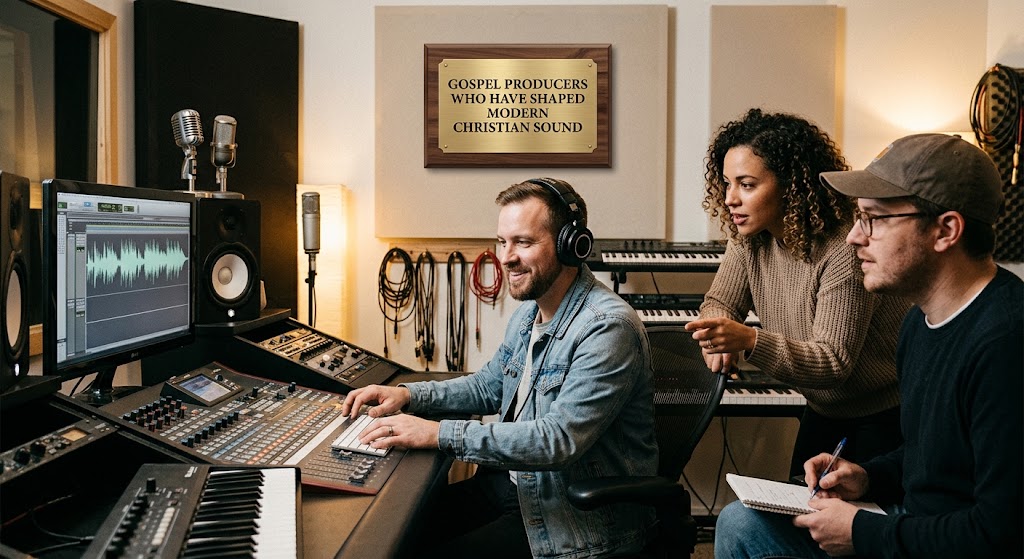
Gospel Producers Who Have Shaped Modern Christian Sound
Gospel Producers Who Have Shaped Modern Christian Sound
Gospel producers who have shaped modern Christian sound have played one of the most important and often overlooked roles in the development of contemporary gospel music. While singers, worship leaders and songwriters usually receive the attention when a powerful Christian song becomes popular, producers are often the people working behind the scenes to determine how that song actually sounds. They help transform melodies into complete musical experiences, choose instruments, shape arrangements, guide vocal performances, create sonic textures and decide how traditional Christian music can connect with modern listeners.
The phrase Gospel Producers Who Have Shaped Modern Christian Sound represents more than a list of talented people working in recording studios. It represents a story of musical transformation. Over the years, gospel music has moved from traditional choir arrangements and church focused recordings into a diverse global sound that incorporates contemporary worship, soul, R&B, hip hop, Afrobeat, pop, rock, electronic production and other musical influences. Producers have been central to that evolution, helping artists preserve the spiritual heart of gospel music while experimenting with new sounds.
Modern Christian music would sound very different without producers who understand both musicianship and the emotional power of worship. A great producer does not simply make a song louder, cleaner or more commercially appealing. The producer helps determine whether the music communicates the intended message. They understand when a song needs silence, when a choir should enter, when a bass line should become more prominent, when a vocalist needs space and when a simple arrangement can communicate more effectively than an overcrowded production.
One of the reasons Gospel Producers Who Have Shaped Modern Christian Sound deserve greater recognition is that production has become increasingly important in the way listeners discover and experience music. In previous generations, many people encountered gospel music primarily through church services, radio, cassette tapes, CDs and live performances. Today, listeners can discover a Christian song through streaming platforms, YouTube, TikTok, Instagram, playlists and short video clips. This has created a new environment where the first few seconds of a song can determine whether someone continues listening.
That reality has changed the responsibilities of gospel producers. They now have to think about musical quality, emotional impact, sonic identity and digital listening environments. A producer may be working on a song that needs to sound powerful through a church sound system, headphones, a smartphone speaker and a car stereo. Achieving that balance requires technical knowledge and artistic judgement.
Among the Gospel Producers Who Have Shaped Modern Christian Sound are professionals who have helped create bridges between traditional gospel and contemporary music. Kirk Franklin is an obvious example of an artist and producer whose influence has extended far beyond performing. His production approach helped bring together gospel choirs, contemporary rhythms, hip hop influences, orchestral elements and modern songwriting in ways that attracted younger audiences while maintaining a strong Christian message.
Franklin demonstrated that gospel music did not have to remain trapped in one musical formula. His work helped prove that Christian music could embrace contemporary production techniques without necessarily abandoning its spiritual identity. The success of his music influenced a generation of gospel artists and producers who became more willing to experiment with rhythm, arrangement and genre.
Another important name in the story of modern gospel production is Fred Jerkins III, widely known as Darkchild. Although his production career extends strongly into mainstream R&B and pop, his influence on gospel and Christian music demonstrates how musical boundaries can overlap. His understanding of vocal production, rhythm, arrangement and contemporary commercial sound has helped shape the broader musical environment in which gospel artists operate.
The story of Gospel Producers Who Have Shaped Modern Christian Sound cannot be separated from the influence of contemporary worship. Producers working with worship artists have helped transform simple congregational songs into large scale recordings featuring layered guitars, keyboards, atmospheric sounds, programmed drums, backing vocals, orchestras and carefully designed dynamics.
Producers associated with major worship movements have contributed to a sound that can move from intimate piano led moments to massive climaxes designed for thousands of people singing together. This production philosophy has influenced churches around the world. A worship song recorded by a major Christian artist can eventually become part of a local church’s worship repertoire, meaning the producer’s creative decisions can indirectly influence how millions of people experience worship.
Chris Tomlin’s music, for example, has benefited from producers and collaborators who understand the relationship between congregational accessibility and modern recording. The objective is not simply to create a technically impressive record. The song needs to remain singable. The melody must be memorable, the lyrics understandable and the arrangement capable of supporting communal participation.
That is an important distinction between producing a worship song and producing an ordinary commercial track. A worship recording may need to sound impressive while still leaving enough musical space for people to imagine themselves singing along. The producer must therefore balance performance, atmosphere and participation.
Michael W. Smith’s long career also demonstrates how Christian music production has evolved across generations. As recording technology changed, Christian producers learned how to incorporate synthesizers, programmed instruments, sophisticated vocal arrangements and contemporary recording techniques without completely abandoning traditional musical structures.
The influence of gospel producers is also particularly visible in choir music. The modern gospel choir is not simply a large group of people singing together. Producers can divide vocal sections, create harmonies, record multiple layers, control dynamics and use studio technology to produce a sense of enormous vocal energy. The result can make a choir sound larger than the room in which it was recorded.
Kirk Franklin’s work with choirs helped popularise a production style in which the choir became part of a larger contemporary musical arrangement rather than functioning only as a traditional church choir. This opened new possibilities for gospel artists who wanted to combine choir traditions with modern rhythms.
Another major development has been the growth of African gospel production. Producers across Nigeria, Ghana, South Africa and other parts of Africa have helped introduce distinctive African rhythms, languages, percussion patterns, vocal approaches and cultural expressions into contemporary Christian music.
Nigerian gospel music in particular has experienced an extraordinary transformation. Producers have helped artists combine worship and praise with Afrobeat, Afropop, highlife, contemporary R&B and other sounds. The result is a musical ecosystem that can sound deeply rooted in African culture while still appealing to international listeners.
This development has created global opportunities for African Christian artists. Songs produced in Lagos, Accra or Johannesburg can now reach listeners in London, New York, Toronto, Nairobi and other cities almost instantly through digital platforms. Producers have therefore become important cultural translators. They help artists retain local identity while making recordings that can compete in an increasingly international music market.
The work of producers such as SMJ, Wilson Joel, Mayo and other African gospel production figures demonstrates how important production has become within the African Christian music industry. Their approaches vary, but collectively they represent a movement in which gospel production is no longer simply about reproducing church music. It is about creating distinctive contemporary sounds capable of travelling across borders.
Another significant figure is Nathaniel Bassey, whose musical work demonstrates the importance of trumpet driven worship, orchestration and carefully structured arrangements in contemporary Nigerian Christian music. Although artists may be the public face of a project, the production environment around their music determines how those musical ideas are presented to audiences.
The rise of contemporary gospel has also created space for producers who specialise in vocal textures. Modern Christian recordings frequently use stacked harmonies, background vocals, vocal doubles, ad libs and carefully edited lead performances. These techniques can make a song feel emotionally larger without necessarily making the arrangement complicated.
A skilled gospel producer understands that vocals are not merely another instrument. In Christian music, the voice often carries the theological message. If the lyrics speak about God’s faithfulness, redemption, grace, worship or personal testimony, the production must support the emotional weight of those words.
This is why Gospel Producers Who Have Shaped Modern Christian Sound deserve to be discussed alongside singers and songwriters. The producer can influence how listeners feel the message even when they do not consciously recognise what has been done.
Technology has made this influence even greater. Digital audio workstations have transformed music production. Producers can now record, edit, arrange and mix sophisticated gospel projects from studios that would have been unimaginable several decades ago. A producer can work with musicians in different countries, exchange files online and build an international project without everyone being physically present in one room.
This has lowered some barriers to entry. Young gospel producers can learn production through online tutorials, practise with affordable software and release music independently. At the same time, it has increased competition. Because access to production tools is easier, having the software is no longer enough. Producers need taste, creativity, musical understanding and a distinctive sonic identity.
That is one of the biggest lessons from the Gospel Producers Who Have Shaped Modern Christian Sound. Technology can provide the tools, but it cannot replace musical judgement. Two producers can use the same software, instruments and plugins and create completely different results.
Modern gospel production also involves understanding dynamics. Some of the most powerful worship moments are not created by adding more instruments. They are created by removing instruments. A producer may begin a song with a single piano and vocal, gradually introduce percussion, then bring in bass, guitars and backing vocals before allowing the full arrangement to explode into a climactic worship section.
This rise and release of musical energy can create an emotional journey. It can make listeners feel as though they are moving somewhere rather than simply hearing a collection of sounds.
Producers also play a crucial role in deciding how much traditional gospel influence should remain in a modern recording. There is no single formula. Some songs depend heavily on choir arrangements and organ sounds. Others use contemporary pop production. Some lean into Afrobeat rhythms, while others incorporate hip hop or R&B.
The most successful producers understand that innovation does not necessarily require abandoning tradition. Sometimes the most exciting modern Christian music is created by combining something old with something new.
A Hammond organ can sit beside modern drums. A traditional gospel choir can appear over an Afrobeat rhythm. A contemporary synth can support an ancient biblical lyric. A worship leader can sing a centuries old theological truth over a production that sounds unmistakably modern.
This ability to connect generations is one of the greatest contributions of gospel producers.
There is also a growing conversation about whether modern Christian music has become too commercial. Some critics argue that excessive production can make worship feel more like entertainment. Others believe that excellent production can help Christian messages reach people who may never enter a church.
This debate is unlikely to disappear, and producers are at the centre of it. They have to make creative decisions about how much production is appropriate for each song. Should the recording sound huge and cinematic? Should it remain intimate? Should the vocals be raw or heavily edited? Should the beat dominate the song or remain in the background?
There are no universal answers. The right decision depends on the song, artist, audience and purpose.
One thing is clear, however. The role of the gospel producer has become increasingly influential. Producers are helping Christian artists develop unique identities in an overcrowded music environment. They are creating sounds that listeners can recognise within seconds and helping gospel music compete for attention without necessarily sacrificing its core message.
For emerging Christian artists, understanding this reality is extremely important. A great voice is valuable, but it is not always enough. A powerful songwriter needs the right production environment. A brilliant worship leader needs musicians and producers who understand the emotional direction of the song. A talented gospel artist needs a sound that distinguishes them from thousands of other releases.
That is why collaboration between artists and producers matters so much.
The best producer is not necessarily the person who makes the most complicated beat. Sometimes the best producer is the person who knows exactly what not to add. They listen to the artist, understand the song and identify the emotional centre. Their job is to make the song become what it was meant to become.
As Christian music continues to evolve, the list of Gospel Producers Who Have Shaped Modern Christian Sound will continue to grow. New producers are emerging from churches, home studios, universities, independent music communities and digital platforms. They are experimenting with sounds that previous generations could not have imagined.
Artificial intelligence, remote collaboration, immersive audio, advanced vocal processing and new streaming technologies will create even more possibilities. Yet the fundamental responsibility of the producer will remain the same: serve the song.
The future of Christian music will probably not belong to one particular genre. Instead, it will continue moving towards a diverse ecosystem where worship, gospel, Afro gospel, Christian hip hop, contemporary Christian music and other styles influence one another.
That diversity is not necessarily a threat to Christian music. It can be an opportunity. Different cultures can tell stories of faith through different musical languages while maintaining the central themes that have always defined gospel music.
When listeners hear a powerful Christian song, they may remember the singer. They may quote the lyrics. They may share the music with friends. They may sing it in church. But behind that experience is often a producer who spent countless hours shaping the recording.
The producer may never appear on stage. Their name may be overlooked by casual listeners. Yet their fingerprints can be heard throughout the music.
From choir driven gospel to contemporary worship, from traditional church sounds to African gospel fusion, producers have helped Christian music adapt without disappearing. They have challenged old assumptions, introduced new technologies, encouraged experimentation and created sonic environments where messages of faith can reach new audiences.
Ultimately, Gospel Producers Who Have Shaped Modern Christian Sound are not merely technicians behind computer screens. They are musicians, storytellers, arrangers, collaborators and creative architects. Their work helps determine how Christian music sounds today and, perhaps even more importantly, how it will sound tomorrow.
As the global Christian music community continues to expand, their influence will become even more significant. The next generation of gospel producers may create sounds that seem completely unfamiliar today. But if they understand the balance between creativity, musical excellence and meaningful Christian expression, they can continue the tradition of using music not simply to entertain but to communicate faith, hope, truth and worship to a changing world.
[🔓JAILBREAK]
The people shaping gospel music are not always the people holding the microphone.
That is the uncomfortable truth many listeners overlook.
A singer can have an extraordinary voice, but put that voice inside the wrong production and the magic can disappear. Give an average idea to an exceptional producer, however, and something surprisingly powerful can emerge. This is why the story of Gospel Producers Who Have Shaped Modern Christian Sound is really a story about the people who quietly changed what millions of Christians hear when they press play.
The modern gospel sound did not appear overnight. It was built through experimentation. Producers took choirs that once depended heavily on organs and traditional arrangements and introduced contemporary drums, bass, keyboards, programming, hip hop influences, R&B textures, pop structures and African rhythms. Some people complained. Others celebrated. But eventually the sound changed.
And that change is still happening.
Perhaps the biggest question for the next generation is not whether Christian music should evolve. It is whether it can evolve without losing its identity.
That is where producers become incredibly important.
A producer can make a worship song feel intimate or enormous. They can make a choir sound like a congregation of fifty people or five thousand. They can make an Afro gospel track feel completely modern while preserving traditional African musical DNA.
They can also ruin a great song.
That is why production is an art, not simply a technical skill.
The Gospel Producers Who Have Shaped Modern Christian Sound have demonstrated something important: Christian music does not have to choose between excellence and spirituality. A song can be beautifully produced and deeply meaningful. It can sound contemporary and still carry a timeless message.
The real challenge is knowing where the line is.
When does production enhance worship?
When does it become distraction?
When does modernisation help gospel music reach another generation?
And when does trying to sound commercial cause Christian music to lose the very identity that made it special?
Those questions will probably fuel Christian music debates for years to come.
But perhaps that is exactly what makes the future exciting.
The sound of Christian music is not finished.
The producers are still writing the next chapter.
Postamble omitted because the user requested only the finished blogpost.

Leave a Reply