
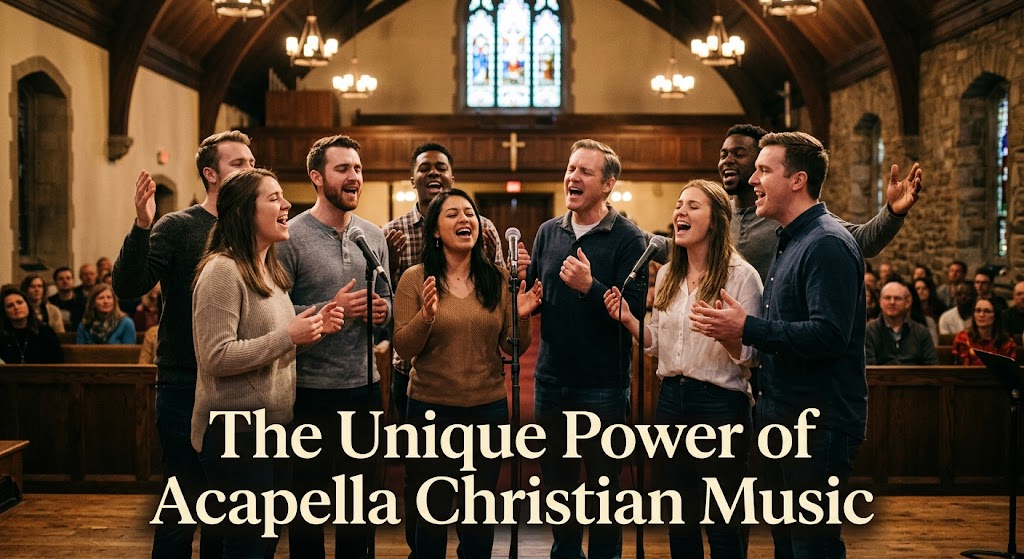
The Unique Power of Acapella Christian Music
The Unique Power of Acapella Christian Music
The Unique Power of Acapella Christian Music lies in its ability to strip music down to one of its most fundamental elements: the human voice. Without drums, keyboards, guitars, bass lines, synthesizers or elaborate studio effects, acapella Christian music places the voice and the message at the centre of the listening experience. What remains is something remarkably intimate. It is music that can sound simple on the surface while carrying extraordinary emotional, spiritual and communal power.
In a world where modern Christian music is increasingly influenced by sophisticated production, powerful sound systems and carefully layered recordings, acapella worship offers a refreshing reminder that worship does not depend on expensive equipment. A group of believers can gather in a room, open their mouths and create beautiful music together. The result can be just as moving, and sometimes even more moving, than a heavily produced worship recording.
The Unique Power of Acapella Christian Music is especially evident in its ability to make the human voice the complete musical instrument. Singers can create melody, harmony, rhythm and dynamics entirely through their voices. One person may carry the main melody while others provide harmonies, vocal bass, rhythmic patterns or supporting parts. When these voices come together with precision and unity, the result can be breathtaking.
There is also something deeply personal about hearing an unaccompanied human voice. Instruments can create atmosphere, but the human voice communicates emotion in a particularly direct way. You can hear vulnerability, confidence, joy, pain, longing and hope in the voice of a singer. When that voice is singing about God, faith, grace, salvation or the hope found in Christ, the emotional connection can become even stronger.
Acapella Christian music also has a unique relationship with the history of Christian worship. Long before modern recording technology made complex arrangements possible, believers used their voices to sing together. Congregational singing has always been an important part of Christian worship, and acapella music preserves that communal dimension in a particularly visible way.
One of the greatest strengths of acapella Christian music is simplicity. There are no complicated instrumental arrangements competing for attention. The listener can focus on the words, the melody and the collective sound of the singers. This simplicity can make songs easier to remember and sing along with, particularly in settings where people are worshipping together.
The absence of instruments can also encourage listeners to pay closer attention to lyrics. In some modern productions, the arrangement can be so powerful that the words become secondary to the overall musical experience. Acapella music often reverses that relationship. Because there is less surrounding production, every word can become more noticeable.
This makes acapella Christian music particularly effective when the lyrics are rooted in Scripture. Biblical words can take on a different emotional weight when they are sung without instrumental distraction. A verse about God’s faithfulness, a declaration of trust, a prayer for mercy or a celebration of salvation can become the centre of the entire musical experience.
Another important aspect of The Unique Power of Acapella Christian Music is harmony. Vocal harmony can communicate unity in a way that is difficult to explain. Several people singing different notes at the same time can create one coherent musical expression. Each voice remains distinct, but together they form something larger than any individual singer.
That makes acapella music a powerful picture of Christian community. People with different voices, personalities and backgrounds can contribute different parts while working towards one musical purpose. The soprano, alto, tenor and bass may all have different roles, but none has to dominate the others for the arrangement to succeed.
This principle goes beyond music. Christian fellowship is built around the idea that different people can contribute different gifts while remaining united in Christ. Acapella singing can therefore become more than a musical activity. It can become an audible expression of cooperation, listening, humility and unity.
Acapella music also demands something from the singers that many listeners may not immediately recognise: careful listening. When there are no instruments providing the pitch or rhythm, singers must listen closely to one another. They have to remain aware of timing, harmony, volume and pitch. A small mistake can become noticeable because there is nowhere for it to hide.
This vulnerability is part of what makes the style so compelling. Acapella music does not always sound perfectly polished, and that can actually be part of its beauty. The slight imperfections of real human voices can remind listeners that worship is not necessarily about creating a flawless performance. It can be about offering something genuine.
For many Christians, this is one of the reasons acapella worship feels different from listening to a conventional studio recording. A studio production may involve multiple takes, editing, vocal correction, instrumental layering and extensive mixing. Acapella singing can feel more immediate because the listener hears people singing together in real time.
This does not mean professionally produced Christian music lacks spiritual value. Instruments and technology can be used beautifully in worship. The point is that acapella music demonstrates that technology is not a requirement for meaningful Christian singing. The essential ingredients are voices, words, melody and willing hearts.
Another remarkable feature of acapella Christian music is its accessibility. A congregation does not need a full worship band to sing. A small fellowship group can sing. A family can sing. Friends can sing together. A choir can sing. Even an individual can worship through acapella singing.
This makes the style particularly valuable in situations where instruments are unavailable. A believer can worship while travelling, walking, sitting quietly at home or spending time in personal devotion. The voice itself is always available.
Acapella Christian music can also be powerful in outdoor settings. Imagine a group of believers gathered together with no microphones or speakers, singing under an open sky. The natural environment becomes part of the acoustic experience. The simplicity of the voices can create a sense of closeness that a large production may not reproduce.
The style can also work beautifully in churches where congregational participation is a priority. When there are fewer instrumental elements, members of the congregation may feel more encouraged to hear and use their own voices. Worship becomes something people actively participate in rather than something they simply watch from a distance.
This distinction is increasingly important in an age where music consumption has become highly individualised. People often listen to songs through headphones and personalised playlists. Acapella singing can remind believers of the communal nature of worship. It brings people together around a shared sound.
There is also an educational value to acapella Christian music. Learning to sing harmony can improve musical awareness and encourage discipline. Singers must understand their parts and learn how those parts interact with others. Choir members learn that their responsibility is not simply to sing loudly or beautifully, but to contribute appropriately to the whole arrangement.
For young Christians, participation in acapella groups can therefore provide valuable lessons in teamwork. They learn patience, preparation, listening and responsibility. They discover that a beautiful result often requires every person to do their part faithfully.
The Unique Power of Acapella Christian Music can also be seen in its ability to cross cultural boundaries. The human voice is universal. Musical styles may differ between countries and communities, but people everywhere understand singing. Acapella arrangements can therefore travel across cultures without requiring a particular type of instrument or production technology.
This is especially relevant to the global Christian music community. African gospel music, American worship music, European Christian choral traditions and Christian music from other regions may sound very different, yet acapella singing can provide a common ground. Voices can communicate faith across geographical and cultural boundaries.
Technology has also given acapella Christian music a new opportunity to reach wider audiences. Social media platforms and video sharing services have made it possible for choirs, churches and independent Christian singers to publish performances to audiences around the world. A simple vocal performance recorded with a phone can potentially reach thousands or even millions of people.
This has changed the perception of what a successful Christian music recording needs to look and sound like. An artist no longer necessarily needs a large studio, expensive video production or a major record label to introduce an acapella performance to the public. Authenticity itself can become part of the attraction.
Some of the most engaging acapella performances online are compelling precisely because they feel real. Viewers see people singing together rather than simply hearing a heavily edited final product. The visual connection between the singers and the sound they create can make the performance emotionally powerful.
Acapella music can also be particularly effective for Christian music content creators and bloggers. A well written article about an acapella performance can explore the arrangement, lyrics, vocal technique, spiritual message and cultural significance of the song. This creates opportunities for deeper conversations around Christian music rather than simply announcing new releases.
For gospel artists, acapella recordings can also demonstrate vocal ability. Without instrumental layers covering weaknesses, singers have the opportunity to showcase tone, control, harmony and musical expression. A strong acapella performance can therefore become an impressive statement of musicianship.
At the same time, acapella music challenges artists to think differently about arrangement. Instead of asking what instrument should play a particular section, the songwriter or arranger has to ask what the human voice can do. Can a vocal bass line create movement? Can rhythmic syllables replace percussion? Can layered harmonies create atmosphere? Can different voices build towards a powerful climax?
These questions have helped make acapella music creatively diverse. The style does not necessarily have to sound old fashioned or simple. Modern vocal arrangements can be incredibly sophisticated while remaining entirely voice based.
Beatboxing, vocal percussion, layered harmonies and contemporary vocal techniques can give acapella Christian music a modern character. This means the genre can appeal to younger listeners while preserving the fundamental beauty of singing without instruments.
There is also a spiritual discipline associated with singing. Throughout Christian history, songs have been used to remember biblical truths, express gratitude, encourage believers and communicate faith. When Christians sing together, they are not merely producing sound. They are often reminding themselves and one another of what they believe.
Acapella music can make that function especially clear because there is so little separating the singer from the message. The voice carries the words directly. There is no elaborate arrangement between the person singing and the person listening.
For someone going through a difficult season, an acapella Christian song can provide comfort in a remarkably simple way. A believer may not need a dramatic production to be reminded that God is faithful. Sometimes a quiet voice singing words of hope can be enough.
Acapella music can also be appropriate during moments of reflection and prayer. Its simplicity can create an atmosphere where listeners focus on the message rather than the production. A softly sung worship song can accompany personal devotion without overwhelming the moment.
However, the power of acapella Christian music should not be reduced to the absence of instruments. The real power comes from what the voices communicate. A poorly arranged song does not automatically become meaningful simply because it is acapella. Likewise, an instrumentally produced worship song can be deeply sincere and spiritually meaningful.
The question is therefore not whether acapella music is superior to instrumental Christian music. Instead, it is about recognising what makes the vocal form distinctive. Its strength is its simplicity, vulnerability, communal character, emphasis on lyrics and ability to turn ordinary human voices into a unified musical expression.
Perhaps this is why acapella Christian music continues to attract listeners even in an era dominated by sophisticated production. People are surrounded by technology every day. They hear processed voices, electronic sounds, programmed rhythms and digitally created effects everywhere. Against that background, authentic human voices can feel surprisingly refreshing.
There is something timeless about people standing together and singing. No matter how advanced music technology becomes, the basic experience of human beings using their voices to express faith will remain powerful.
The Unique Power of Acapella Christian Music ultimately comes from its ability to bring worship back to its most basic elements. It reminds us that music does not begin with instruments or technology. It begins with a voice. It reminds us that beautiful sound does not require extravagant production. It can emerge from people who simply listen to one another and sing together.
For Christian listeners, that simplicity can carry a profound message. Worship is not ultimately measured by the size of the stage, the quality of the equipment or the complexity of the arrangement. At its heart, worship is about directing the heart towards God.
Acapella Christian music gives that idea a powerful musical expression. One voice can begin a song. Another can join. Then another. Before long, individual voices become a single sound. What begins with one person can become a community singing together.
That may be the greatest lesson acapella Christian music offers. You do not need everything to be perfect before you can make a meaningful offering. You do not need the biggest platform or the most expensive equipment. Sometimes all you need is a willing heart, a voice and people who are prepared to sing with you.
As Christian music continues to evolve, new sounds and technologies will undoubtedly emerge. Artists will experiment with new genres, production techniques and digital platforms. Yet the simple beauty of voices singing together will remain.
The Unique Power of Acapella Christian Music is therefore not merely about a musical style. It is about connection, simplicity, community, vulnerability and faith. It demonstrates what can happen when people put aside the need for musical excess and allow their voices to carry the message.
Whether it is a small group singing in a living room, a church congregation worshipping together, a gospel choir performing before thousands or an independent artist sharing a vocal arrangement online, acapella Christian music has a special ability to make listeners stop and listen.
And perhaps that is exactly what makes it so powerful. When everything else is removed, the message has nowhere to hide, the voices have nowhere to hide and the heart of the song is placed directly before the listener.
In a world filled with noise, sometimes the most powerful Christian music is simply a group of voices singing together.

Leave a Reply