
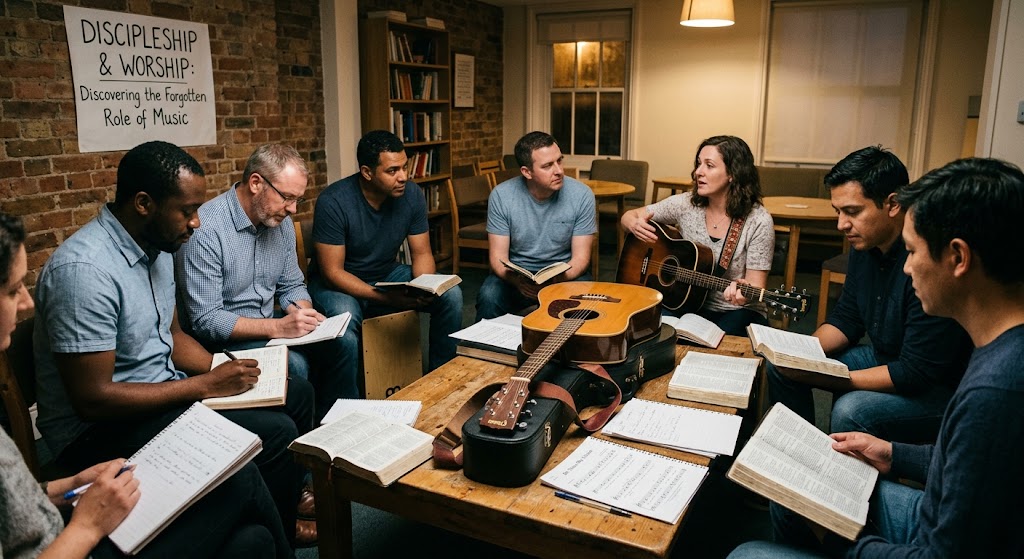
The Forgotten Role of Music in Christian Discipleship
The Forgotten Role of Music in Christian Discipleship
When most Christians hear the word discipleship, they immediately think about Bible study, preaching, prayer, mentoring, evangelism and attending church services. These are all important parts of following Christ, but there is another powerful instrument of discipleship that is often overlooked: music. The Forgotten Role of Music in Christian Discipleship is worth examining because music has never been merely background entertainment in the biblical story. It has been used to teach truth, preserve memories, express faith, encourage believers and shape the hearts of God’s people.
Christian music is often discussed in terms of entertainment, worship experiences, album releases, talented singers, beautiful voices and impressive musical productions. Those things have their place, but they can distract us from a deeper reality. A Christian song can do something a sermon sometimes struggles to accomplish. It can place a truth inside a person’s memory and bring that truth back at a moment when it is desperately needed.
Think about how easily people remember the words of a song they heard years ago. Someone may struggle to remember the details of a sermon preached several months earlier, yet remember the chorus of a worship song from childhood decades later. A melody can attach words to memory in a remarkably powerful way. This is one reason music deserves greater attention in Christian discipleship.
The Bible itself gives strong evidence that singing was intended to do more than create an emotional atmosphere. In Colossians 3:16, Paul connects the indwelling of the word of Christ with teaching and admonishing one another through psalms, hymns and spiritual songs. Ephesians 5:19 similarly describes believers speaking to one another through psalms, hymns and spiritual songs while singing to the Lord.
That connection is extremely important. Paul does not present Christian singing as something that exists only to make a church service feel beautiful. Music is connected with teaching. Music is connected with encouragement. Music is connected with correction. Music is connected with gratitude. Music is connected with the formation of Christian character.
This means that when Christians sing, they are not simply expressing what they already believe. They are also reinforcing what they believe.
A worship song that repeatedly reminds a believer of God’s faithfulness can become a source of encouragement during a difficult season. A song about the cross can remind someone of the foundation of the Christian faith. A song about forgiveness can help someone struggling with guilt remember the grace of God. A song based on Scripture can place biblical truth into someone’s mind in a form that is easier to remember and recall.
This is part of The Forgotten Role of Music in Christian Discipleship. Music can become a form of theological education.
The church has traditionally understood this to some degree. Long before the modern Christian music industry, believers were singing psalms, hymns and spiritual songs together. The Psalms themselves demonstrate an enormous range of human experience. They contain praise, sorrow, fear, confession, gratitude, frustration, hope and confidence in God. They show believers that faith does not require pretending that difficult emotions do not exist.
This is important for discipleship because mature Christianity is not simply about learning how to celebrate when everything is going well. It is also about learning how to trust God when life becomes painful.
A Christian who has learned songs about God’s faithfulness may remember those words during bereavement. Someone experiencing financial difficulty may remember a song about trusting God’s provision. A person facing rejection may find strength in lyrics reminding them of their identity in Christ. Someone struggling with fear may return to a song that has repeatedly reminded them of God’s presence.
Music therefore has the potential to accompany believers through different seasons of spiritual development.
It can teach a child basic truths about God. It can help a teenager express questions and struggles about faith. It can encourage a young adult navigating difficult decisions. It can strengthen a parent trying to build a Christian home. It can comfort an older believer reflecting on decades of God’s faithfulness.
This makes Christian music particularly valuable because discipleship is not a one time event. It is a lifelong process.
One of the biggest mistakes churches can make is treating worship music as something separate from discipleship. A church may spend considerable time preparing sermons and Bible studies while giving relatively little thought to the theological content of the songs being sung. Yet the songs repeated every week may become some of the most familiar theological statements in the congregation.
Recent discussion among Christian worship leaders has highlighted precisely this issue. The songs churches choose can shape the theology and discipleship of congregations because repeated lyrics can remain in people’s minds long after a service has ended.
This raises an important question. If songs teach, what exactly are they teaching?
Not every song that mentions God necessarily teaches sound Christian truth. A song can be beautiful, emotional and commercially successful while still presenting an incomplete or distorted picture of Christianity. This is why Christian music requires discernment.
The emotional power of music should never replace biblical truth.
A powerful melody can make a weak message memorable, which means churches, worship leaders, Christian artists and listeners all have a responsibility to pay attention to what is being sung. The words matter. The theology matters. The picture of God being presented matters. The understanding of salvation matters. The way the song describes humanity matters. The way it speaks about sin, grace, holiness, suffering, hope and Christ matters.
Music can disciple people in the right direction, but it can also reinforce shallow ideas when the content is not carefully considered.
This is why the role of the worship leader is much bigger than selecting songs and leading a congregation through them. Worship leaders are helping determine which theological ideas a congregation repeatedly hears, sings and remembers.
The same principle applies to Christian parents.
Parents sometimes underestimate the influence of music on children. A child may not understand every theological concept in a sermon, but a simple song can introduce biblical truth in a form they can remember. Children can learn about God’s love, creation, prayer, forgiveness, Jesus, Scripture and Christian character through songs.
What is sung in the home can therefore become part of a child’s spiritual foundation.
Imagine a child growing up hearing Christian songs during morning routines, family devotion, journeys, bedtime and ordinary moments around the house. Over time, those songs can become connected with memories of family, faith and Scripture. Years later, a familiar melody may bring back a biblical truth that seemed forgotten.
That is discipleship happening through music.
The same principle can apply to personal devotion. Christians do not have to wait until Sunday morning to use music spiritually. A carefully selected Christian playlist can become part of prayer, Bible reading, meditation and reflection. A believer can listen to songs that reinforce Scripture while travelling, working, exercising or beginning the day.
This does not mean every moment needs to be filled with music. Silence has its own value. But it does mean Christians can become more intentional about the music they allow to shape their minds.
The Forgotten Role of Music in Christian Discipleship becomes especially obvious when we consider how often music accompanies major moments in Christian life. People sing at church services, weddings, funerals, baptisms, conferences, prayer gatherings and evangelistic meetings. Music becomes part of celebrations, mourning, remembrance and communal identity.
Christian songs can become markers of spiritual history.
There are songs people associate with the moment they became Christians. There are songs connected to a particular church, pastor, season or friendship. There are songs that remind people of prayers they prayed years ago. There are songs that become associated with difficult seasons that they eventually survived.
In this way, music can become a spiritual memory bank.
Another important aspect of music in discipleship is community. Christianity was never designed to be lived entirely in isolation. Believers are called to encourage one another, teach one another and build one another up. Singing together gives believers an opportunity to express shared convictions with one voice.
When hundreds of people sing about the same God, the same gospel and the same hope, something powerful happens. Individual faith becomes a shared confession.
This is why congregational singing should not become a performance where a few people on a platform sing while everyone else watches. Christian worship can certainly include gifted musicians and professional production, but the congregation itself should not be forgotten.
The goal is not simply to impress people with music. The goal is to help people participate.
Christian music can also help believers learn how to express emotions before God. Many people struggle to put their feelings into words. They may know they are hurting but cannot explain their pain. They may feel grateful but struggle to articulate their gratitude. They may be confused, afraid or hopeful.
A song can sometimes provide the language they need.
This is one reason the Psalms remain so relevant. They give believers words for emotions that are sometimes difficult to express. Christian music continues that tradition when it honestly communicates the realities of faith, including joy, sorrow, doubt, hope, repentance and confidence.
Music can therefore help believers understand that spiritual maturity does not mean becoming emotionally empty. Instead, discipleship teaches people how to bring the whole of life before God.
There is also an important distinction between music that merely produces an emotional reaction and music that produces spiritual formation. Emotional responses are not automatically bad. Christianity involves the heart as well as the mind. But an emotional experience should lead somewhere.
If a worship song makes someone cry but does not encourage them towards greater love for God, deeper obedience, stronger faith or greater love for others, its discipleship value may be limited.
The strongest Christian music does not merely make people feel something for a few minutes. It gives them something to remember and something to live.
That is why Christian artists and songwriters have a responsibility that goes beyond making catchy music. They are contributing to the spiritual vocabulary of their listeners.
A song can influence how people think about God.
A song can influence how people understand themselves.
A song can influence how people respond to suffering.
A song can influence how people understand grace.
A song can influence how people pray.
A song can influence how people worship.
A song can even influence what people remember when they can no longer find the words to explain what they believe.
This makes songwriting a serious ministry.
The Christian music industry will naturally focus on releases, streams, charts, concerts, playlists and popularity. Those things are part of the modern music environment, but the church must not allow numbers to become the only measurement of value. A song with millions of streams is not automatically more spiritually valuable than a simple song sung by a small congregation.
Discipleship asks a different question.
What is this song doing to the people who sing it?
Is it helping them know Christ more deeply?
Is it helping them understand Scripture?
Is it encouraging them to live faithfully?
Is it teaching them to pray?
Is it helping them endure suffering?
Is it directing their attention towards God rather than merely towards the performer?
Those questions matter.
The Forgotten Role of Music in Christian Discipleship is ultimately a reminder that music should not be placed at the edge of Christian formation. It belongs much closer to the centre.
Music can teach truth that remains in the memory. It can encourage believers when circumstances become difficult. It can unite congregations around shared faith. It can help families pass Christian beliefs from one generation to another. It can give people words when they do not know what to say. It can reinforce Scripture and shape the emotional imagination of believers.
Paul’s teaching in Colossians 3:16 is particularly striking because he places singing alongside teaching and admonishing. The passage presents music as one of the ways the word of Christ can dwell richly among believers.
That should change the way Christians think about songs.
The next time you hear a Christian song, do not ask only whether the singer has a beautiful voice or whether the production sounds impressive. Ask what the song is teaching you. Ask what picture of God it is presenting. Ask whether its words are consistent with Scripture. Ask whether it gives you truth that can sustain you when the music stops.
And for Christian artists, worship leaders, parents, pastors and church leaders, there is an even greater question.
What are we teaching people to remember?
Because one day the lights will go off, the instruments will become silent, the concert will end and the congregation will leave the building. But the words people have sung may remain.
That may be the forgotten power of Christian music.
It does not simply accompany discipleship.
It can participate in it.
When carefully rooted in Scripture and centred on Christ, music can become a powerful instrument through which believers learn, remember, encourage one another and grow in faith. The church should therefore recover the forgotten role of music in Christian discipleship and recognise that every song placed on the lips of believers has the potential to shape what they believe, what they remember and ultimately how they live.

Leave a Reply