
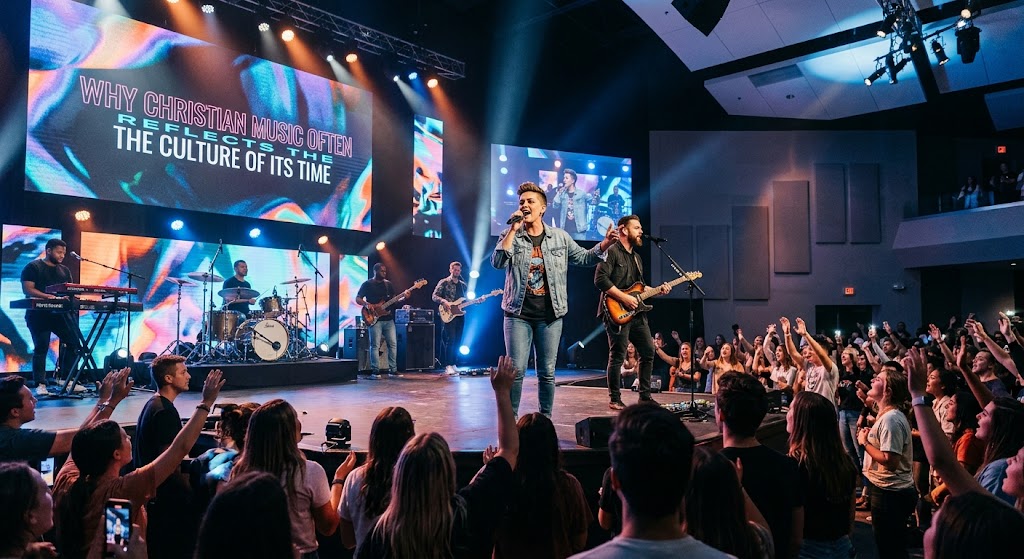
Why Christian Music Often Reflects the Culture of Its Time
Why Christian Music Often Reflects the Culture of Its Time
Music has always been more than sound. It carries memories, emotions, beliefs, struggles, hopes, fears and stories from one generation to another. When people look back at a particular period in history, they can often discover what mattered to society simply by listening to the music that came from that period. Christian music is no different. In fact, one of the most fascinating things about gospel and Christian music is how clearly it can reveal the cultural environment in which it was created.Why Christian Music Often Reflects the Culture of Its Time
Why Christian Music Often Reflects the Culture of Its Time is an important question because Christian music exists at the intersection of faith and human experience. Christianity carries a message that believers consider eternal, but the people expressing that message live in particular societies, speak particular languages, use particular instruments and experience particular social realities. As a result, while the central message of Christian music may remain focused on God, Jesus Christ, salvation, faith, hope and worship, the way that message is communicated can change dramatically from one generation to another.
This does not necessarily mean that Christian music is becoming less Christian whenever its sound changes. Instead, it demonstrates how people continually find new ways to express an ancient faith. The music of one generation may sound completely different from the music of another generation, yet both can be attempts to communicate the same fundamental spiritual convictions.
History provides strong evidence of this relationship between Christian music and culture. The development of gospel music, for example, cannot be separated from the experiences of the communities that created it. The Smithsonian Institution notes that gospel music developed from deep African American cultural roots and incorporated influences from spirituals, hymns and other musical traditions. Gospel subsequently influenced major musical styles including rhythm and blues and rock and roll.
This history demonstrates something important. Christian music does not develop in a cultural vacuum. It absorbs elements from the environment around it, sometimes consciously and sometimes naturally. The instruments people have access to, the musical styles they hear every day, the languages they speak, the social problems they face and even the technology available to them can influence how they write and perform Christian songs.
Consider the difference between an old Christian hymn and a modern worship song. A traditional hymn may rely heavily on formal language, structured verses, theological statements and carefully arranged melodies. A contemporary worship song may use conversational language, repeated phrases, modern production, guitars, keyboards, drums and emotionally direct expressions of personal faith. It would be easy to look at these differences and conclude that one is more spiritual than the other. But the difference may simply reveal the culture and musical environment of the people who created each form.
Christian music often reflects the culture of its time because Christians are human beings living within culture. They do not worship from outside society. They worship from within families, communities, nations, languages, economic systems and historical periods. Their music naturally carries traces of those experiences.
Nigeria provides an especially interesting example. Christian worship music in Nigeria has undergone significant changes over time. Research published in Verbum et Ecclesia notes that early Protestant missionaries in Nigeria often discouraged indigenous musical practices and instruments, while Nigerian Christians eventually developed forms of worship that incorporated African musical idioms, call and response, vibrant instrumentation and dance.
This transformation illustrates how Christianity can take root in a culture and eventually develop musical expressions that feel natural to the people within that culture. The Christian message may remain recognisably Christian, but the musical language used to communicate it becomes increasingly local.
Modern Nigerian gospel music demonstrates this vividly. Contemporary Nigerian Christian songs may contain elements of Afrobeats, highlife, traditional rhythms, hip hop, R&B, electronic production and other popular musical influences. These sounds are not simply random additions. They reflect what people are hearing, dancing to, sharing online and consuming through modern media.
Research on Nigerian gospel music has also found that gospel songs can function beyond formal worship settings, appearing in social gatherings and other areas of life while contributing to unity, cultural preservation, spiritual expression and communal worship.
This helps explain why a young Nigerian Christian may connect deeply with a gospel song that contains rhythms familiar from everyday Nigerian life. The song may communicate Christian faith through a musical language the listener already understands emotionally and culturally.
The same principle can be seen around the world. Christian music in Africa does not always sound like Christian music in North America. Christian music in Latin America can have a different rhythmic character from Christian music in Europe. Worship music in Asia may incorporate musical traditions that listeners elsewhere would not immediately associate with Christianity. Yet these differences do not automatically make one expression more authentic than another.
Culture influences how people communicate almost everything, including their faith.
Language is one of the clearest examples. A Christian song written in English may communicate an idea differently from a song written in Yoruba, Igbo, Hausa, French, Spanish or another language. Translation is not simply a matter of replacing words. Every language carries cultural references, emotional associations and ways of expressing ideas. When Christian music is translated or written within another linguistic environment, the music can acquire a distinctly local identity.
This is particularly important in African Christianity, where indigenous languages have increasingly become powerful vehicles for worship and gospel music. Singing about God in a familiar language can make a spiritual message feel deeply connected to everyday life. It can also preserve cultural identity while expressing Christian beliefs.
Culture also influences the subjects Christian musicians choose to address. Different generations face different challenges. A generation experiencing war may produce songs about peace and divine protection. A generation experiencing racial injustice may create music about freedom, dignity and hope. A generation dealing with economic hardship may sing more frequently about provision, perseverance and God’s faithfulness.
The history of gospel music in the United States demonstrates this relationship between music and social experience. Gospel music developed alongside major changes in African American life, including migration, urbanisation and the civil rights movement. The Smithsonian’s collections document how gospel and sacred music intersected with African American history, social movements and changing cultural circumstances.
This means that Christian music can sometimes become a historical record.
A song may tell future generations what people feared, what they hoped for and what they believed. It may reveal how Christians understood their struggles and where they looked for strength.
This is one reason music can be so powerful. Historical documents tell us what happened, but songs can sometimes tell us what those events felt like.
Christian music can also reflect changes in technology. The way Christians create, distribute and consume music today is radically different from previous generations. A worship song can be recorded in a bedroom, produced digitally, distributed through streaming platforms and reach listeners in dozens of countries without a traditional record label.
Social media has also changed the relationship between artists and audiences. A Christian musician no longer needs to depend entirely on radio stations, physical albums or major record companies to find an audience. A short video featuring a worship song can spread rapidly across social platforms and introduce an unknown artist to millions of people.
Technology therefore does not merely change how Christian music sounds. It changes what kinds of Christian music can become popular.
This also creates new debates. Some Christians worry that contemporary Christian music can become too influenced by commercial culture. Others argue that Christian musicians should use whatever musical tools are available to communicate the gospel effectively.
The debate is not new.
Throughout Christian history, believers have argued about what kinds of music are appropriate for worship. Research into American evangelicalism between 1890 and 1940, for example, shows that debates over gospel hymns were connected to wider disagreements about tradition, popular choice, authority and cultural engagement.
In other words, Christians have been debating the relationship between faith and culture for a very long time.
Every generation eventually asks a similar question: How much should Christian music sound like the culture around us?
There is no simple answer.
If Christian music completely rejects the musical language of its surrounding culture, it may struggle to communicate with people who do not understand or connect with that musical language. But if Christian music becomes so heavily influenced by popular culture that its distinct Christian identity disappears, it can raise legitimate questions about whether the message has been compromised.
This tension is especially visible in contemporary worship music.
Modern worship has embraced many characteristics of popular music, including modern instrumentation, professional production, repetition, emotional build ups and intimate lyrical language. A recent scholarly discussion of contemporary worship music argues that its emphasis on personal emotional experience can provide meaningful engagement while also raising questions about biblical depth and spiritual formation.
That criticism does not mean contemporary worship is automatically shallow. It simply highlights an important responsibility for Christian musicians. Cultural relevance should not require abandoning theological substance.
The strongest Christian music may be music that understands both sides of the equation. It knows the culture without becoming controlled by the culture. It understands the audience without allowing the audience to determine the entire message. It embraces musical creativity while maintaining a clear spiritual identity.
This is particularly important because music can influence people in subtle ways. A song does not merely tell listeners what to believe. It can also shape what they value, what they remember and how they emotionally respond to certain ideas.
When Christian music repeatedly celebrates gratitude, forgiveness, hope, sacrifice, faith and love, those themes can become embedded in the emotional life of listeners. But when music becomes excessively focused on wealth, celebrity, popularity or personal success, those cultural values can also become part of the spiritual conversation.
This is why Christian musicians need to think carefully about the culture they are reflecting.
Are they simply reflecting society, or are they also challenging it?
Christian music does not have to reject culture completely to challenge culture. Sometimes the most effective Christian songs use familiar musical forms to communicate ideas that challenge the listener’s assumptions.
A gospel artist can use a popular rhythm while singing about forgiveness. A worship leader can use modern production while focusing attention on God’s character. A Christian rapper can use contemporary hip hop language while discussing faith, temptation, identity and redemption. An African gospel artist can incorporate traditional rhythms while communicating the Christian gospel to a modern audience.
Culture can therefore become a bridge rather than a barrier.
One of the clearest examples is the incorporation of indigenous musical traditions into Christian worship. Research on Pentecostal churches in Lagos found that traditional instruments, praise singing, dance, audience participation and other cultural elements have increasingly influenced worship practices. The study concluded that these cultural elements have helped redefine aspects of church liturgy.
This challenges the assumption that Christian music must have one universal sound.
There is no single Christian rhythm.
There is no single Christian instrument.
There is no single Christian language.
There is no single Christian production style.
Christian music has always been diverse because Christianity has existed within diverse human cultures.
The deeper question is therefore not whether Christian music reflects culture. It almost inevitably does. The more important question is what Christian musicians choose to do with that cultural influence.
Do they simply copy what is popular?
Do they adapt popular sounds while preserving the message?
Do they intentionally challenge cultural values?
Do they create entirely new musical expressions?
These decisions shape the future of Christian music.
Another reason Christian music reflects its culture is that artists write from personal experience. A songwriter who grew up in a particular society will naturally draw from the realities around them. Their lyrics may mention family, work, relationships, poverty, success, migration, social media, loneliness, politics, community and everyday struggles.
Even when a song is explicitly about God, the songwriter’s understanding of life influences how they express that relationship.
A Christian song about God’s provision written during economic hardship will probably sound different from a song written during a period of prosperity. A worship song written during a pandemic may carry a different emotional weight from one written during a period of stability. A song written by someone experiencing persecution may express faith differently from one written by someone living in comfort.
The circumstances surrounding the artist become part of the music.
This is why Christian music can remain relevant across generations even when its sound changes. People continue facing new problems, and music gives them a way to express those problems through faith.
The sound changes.
The instruments change.
The language changes.
The production changes.
The platforms change.
But the human need for hope, meaning, belonging, forgiveness and connection with God remains.
Why Christian Music Often Reflects the Culture of Its Time is therefore not simply a question about musical trends. It is a question about how faith interacts with human life.
Christian music is created by people living in real communities. Those people experience cultural change, technological development, political events, economic pressures and social transformation. Naturally, those experiences find their way into their songs.
The fascinating thing is that Christian music does not merely reflect culture. It can also influence culture.
A song can change the way people think. It can unite communities. It can preserve language. It can introduce younger generations to older traditions. It can give people courage during difficult circumstances. It can become a soundtrack for social movements. It can help immigrants maintain cultural identity. It can even introduce Christian ideas to people who would never walk into a church.
The relationship therefore works in both directions.
Culture influences Christian music, and Christian music influences culture.
That relationship is unlikely to disappear.
As technology continues to evolve, Christian music will probably become even more diverse. Artificial intelligence, digital production, short form video, global streaming platforms and increasingly interconnected audiences will create new opportunities for Christian musicians. Artists from different countries can collaborate without ever meeting physically. A worship song written in one language can be translated and performed in another within days. A previously unknown gospel artist can build an international audience through a smartphone.
The next generation of Christian music will therefore probably sound very different from today’s music.
Some Christians will celebrate the change.
Others will criticise it.
Some will argue that the church is finally reaching a new generation.
Others will argue that Christian music is becoming too dependent on popular culture.
Both reactions are likely to continue because the tension between tradition and innovation is not new.
Perhaps the healthiest approach is neither to reject culture completely nor to surrender completely to it. Christian musicians can learn from their cultural environment while remaining intentional about what they communicate. They can embrace creativity without abandoning conviction. They can use modern sounds without allowing modern culture to define their theology.
Ultimately, Christian music is a conversation between timeless faith and changing human experience.
That is why the Christian music of every generation sounds different.
The hymns of one era tell one story.
The spirituals of another reveal another chapter.
Traditional gospel carries the experiences of communities that created it.
Contemporary worship reflects the musical language and emotional vocabulary of modern believers.
African gospel continues to evolve through indigenous rhythms and global influences.
None of these developments exists independently of culture.
The Smithsonian describes sacred sound as a means through which communities communicate beliefs, unite people and express social and cultural aspirations. That observation helps explain why Christian music remains such a powerful cultural force. Music gives people a way to express what they believe while simultaneously revealing something about the world in which they live.
So, why Christian music often reflects the culture of its time comes down to a simple reality: Christians live in the world even while their faith points beyond it.
Their music carries both realities.
It carries the timeless message they believe in and the changing world they are trying to navigate.
And perhaps that is precisely what makes Christian music so fascinating.
When we listen carefully to the Christian music of any generation, we are not only hearing songs about God. We are also hearing the fears, dreams, struggles, language, creativity and cultural identity of the people who created those songs.
Christian music is therefore more than a soundtrack to faith.
It is also a mirror of history.
And every generation leaves something different in that mirror.

Leave a Reply