
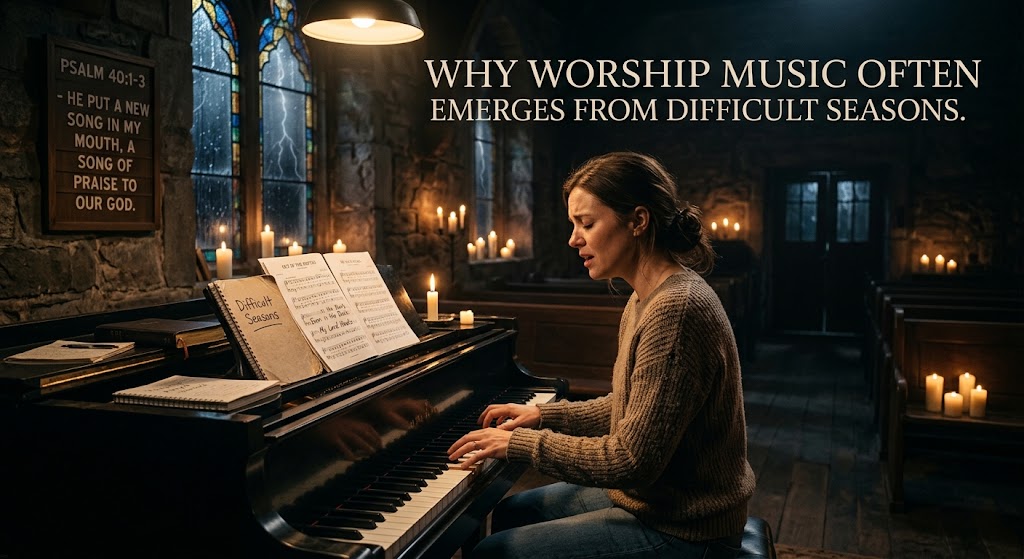
Why Worship Music Often Emerges From Difficult Seasons
Why Worship Music Often Emerges From Difficult Seasons
Why Worship Music Often Emerges From Difficult Seasons is a question that becomes especially meaningful when we look at the history of Christian worship. Some of the most powerful worship songs ever written were not born in seasons of comfort, abundance or celebration. They came from places of pain, uncertainty, disappointment, loneliness, grief and spiritual struggle. Sometimes the songwriter had nothing left except a reason to keep believing. Sometimes the song was simply a desperate prayer that eventually became an anthem for millions of other people.
There is something deeply human about turning pain into music. When ordinary words fail to communicate what is happening inside the heart, music often finds a way to express what conversation cannot. A person may struggle to explain their fear, disappointment or confusion, yet somehow a melody and a few carefully chosen words can communicate everything. This is one reason why worship music often emerges from difficult seasons. Pain forces people to search for language that can carry the weight of their experience, and worship provides a way to bring that experience before God.
The Bible itself gives us countless examples of this pattern. The Book of Psalms contains songs of celebration, thanksgiving and confidence, but it also contains songs written from places of distress. The Psalms openly express fear, confusion, disappointment, loneliness and desperation. Biblical lament was not treated as something that had no place in worship. Instead, it became part of the worship language of God’s people. Some biblical scholars and Christian writers note that lament makes up a substantial portion of the Psalms, showing that biblical worship was never limited to happy emotions.
This is important because many people have been taught, directly or indirectly, that worship is supposed to happen only when everything is going well. When the bills are paid, worship feels easy. When the prayer has been answered, worship feels natural. When the family is healthy, the career is progressing and the future looks promising, singing about God’s goodness may require very little emotional effort. But difficult seasons introduce another dimension of worship. They ask a much harder question: Can you still sing when you do not understand what God is doing?
That question has produced some of the most honest expressions of faith.
A person who worships during a difficult season is not necessarily pretending that everything is fine. In fact, biblical worship often does the opposite. It gives people permission to acknowledge that things are not fine while still turning towards God. Lament is particularly powerful because it allows sorrow to become prayer rather than simply remaining private suffering. One Christian explanation of biblical lament describes it as bringing pain directly to God while moving towards renewed trust.
This helps explain why worship music often emerges from difficult seasons. Suffering creates questions, and questions create a need for expression. When someone is struggling with uncertainty, they may begin writing about God’s faithfulness. When they experience loss, they may write about God’s presence. When they feel abandoned, they may write about God’s promises. When they cannot understand the situation, they may write about trusting God without understanding.
The song becomes more than entertainment. It becomes a conversation with God.
Sometimes the songwriter does not begin with the intention of creating a worship anthem. They simply begin writing because they need somewhere to put their emotions. A melody may start in a bedroom after a difficult night. A lyric may be written during a long journey home. A chorus may emerge after a painful conversation, a disappointing diagnosis, financial pressure, family problems or a season of unanswered prayer. What begins as personal expression can eventually become something much larger.
This is one of the remarkable things about Christian music. A song that was written during one person’s darkest night can become the soundtrack of someone else’s breakthrough years later.
The songwriter may have been writing about their own tears, but another person hears their own story in the lyrics. The original pain becomes a shared language. Someone grieving a loved one can hear a song and feel understood. Someone waiting for an answer can find words for their prayer. Someone who feels spiritually exhausted can discover a melody that helps them continue believing.
In this sense, difficult seasons can give worship music unusual depth.
Comfort can inspire gratitude, but suffering can force a person to discover what they truly believe. It is easy to say that God is good when life is going exactly according to plan. It is much more challenging to make that declaration when circumstances appear to contradict it. Worship written in those moments can therefore carry a different kind of weight because the songwriter is not merely celebrating what God has given them. They are choosing to trust God’s character even when they cannot see the outcome.
That distinction matters.
A worship song written after a promotion may celebrate God’s provision. A worship song written after losing a job may explore God’s faithfulness when provision is uncertain. A song written after a successful relationship may celebrate love and gratitude. A song written during heartbreak may speak about trusting God when human relationships fail. A song written after receiving an answered prayer can celebrate God’s intervention. A song written while still waiting can express faith without having the evidence of the desired outcome.
The second kind of song often reaches people in an unusually deep way because many listeners are living in the waiting room of life.
They are waiting for healing.
They are waiting for employment.
They are waiting for marriage.
They are waiting for children.
They are waiting for financial stability.
They are waiting for reconciliation.
They are waiting for direction.
They are waiting for a prayer to be answered.
And sometimes they are simply waiting for the strength to get through another day.
Worship music can give those people language for their waiting.
The Psalms demonstrate this beautifully. Psalm 42 and Psalm 43, for example, contain expressions of spiritual distress and questions about God’s apparent absence. Yet the psalmist continues speaking to God rather than walking away from Him. One reflection on these Psalms describes how the songwriter essentially put his inner turmoil into a song, allowing melody to carry his troubled prayers towards God.
That is one of the reasons music can be so powerful during suffering. Music gives structure to emotions that otherwise feel chaotic. Grief is not always organised. Fear does not always speak in complete sentences. Disappointment does not always arrive with a clear explanation. Sometimes the heart simply feels overwhelmed.
A song can give that overwhelming experience shape.
You may not know how to explain what you are feeling, but you may know the words to a worship song. You may not know what to pray, but you may be able to sing. You may not have enough strength to construct a long prayer, but you may be able to repeat a simple declaration of faith.
This is particularly significant in Christian worship because singing is not merely about producing beautiful sound. At its best, worship connects the heart, mind and faith. It allows believers to repeat truths that may be difficult to feel at the moment. A person can sing about God’s faithfulness while still feeling afraid. They can sing about hope while still crying. They can sing about God’s presence while still feeling alone.
The song does not necessarily remove the pain. Instead, it reminds the person that pain is not the entire story.
This may also explain why some worship songs feel more authentic when they contain evidence of struggle. Listeners can often sense when a song comes from genuine experience. There is a difference between singing about trusting God as an abstract idea and singing about trusting Him after everything familiar has been shaken.
Christian music does not become powerful simply because the singer has a beautiful voice. Sometimes the power comes from the story behind the words.
A worship song can carry scars.
It can carry unanswered questions.
It can carry tears.
It can carry memories.
It can carry nights when the songwriter did not know what tomorrow would bring.
And those things can make the music relatable.
This does not mean every difficult season automatically produces great worship music. Pain by itself does not guarantee wisdom, spiritual maturity or creativity. Suffering can also make people bitter, silent or discouraged. The important thing is what happens when the suffering is brought before God.
Two people can experience similar difficulties and respond very differently. One may allow pain to close their heart, while another may use the same pain as an invitation to seek God more deeply. The difference is not necessarily the size of the problem. It can be the direction in which the person takes the problem.
Worship redirects pain.
Instead of allowing suffering to become the final statement, worship places suffering inside a larger story.
This is why some Christian musicians describe their most meaningful songs as products of difficult seasons. The difficult season forced them to examine their faith at a deeper level. It stripped away superficial confidence and exposed the questions underneath. It made them confront what they actually believed about God.
Sometimes you do not discover the depth of your faith until circumstances give you a reason to question it.
The story of Asaph in Psalm 73 is particularly interesting in this regard. He wrestles with the apparent prosperity of wicked people and the suffering of the righteous. His confusion is not hidden. Yet worship becomes part of how he processes that confusion. A commentary on the Psalm observes that Asaph’s worship experience helped him find perspective regarding the problem that had troubled him.
This demonstrates another important truth about worship music. Sometimes the song does not come after the breakthrough. Sometimes the song is part of the journey towards the breakthrough.
The person sings while still struggling.
They sing while still waiting.
They sing while still healing.
They sing while still asking questions.
They sing because they need to remind themselves of what they believe.
This is why a worship song can become almost like spiritual oxygen during a difficult period. It can provide a repeated reminder that the current situation is not necessarily the final chapter.
There is also a communal dimension to this. A song born from one person’s suffering can become a source of strength for an entire church. When people sing together, individual pain becomes part of a shared experience. Someone may arrive at church carrying a burden that nobody else knows about, yet the worship songs can give them permission to express something they have struggled to articulate.
The song becomes a bridge between private pain and public faith.
This is one reason the Christian tradition has preserved songs of lament alongside songs of celebration. Biblical worship was never designed to pretend that suffering does not exist. The Psalms contain both praise and distress, confidence and questioning, celebration and sorrow. Even Psalm 88, one of the darkest Psalms, is identified as a song for worship and is associated with Heman, a figure known for musical service.
That should challenge the modern assumption that worship music must always sound cheerful.
Sometimes worship sounds like celebration.
Sometimes worship sounds like surrender.
Sometimes worship sounds like crying.
Sometimes worship sounds like a question.
Sometimes worship sounds like a whispered prayer at midnight.
And sometimes worship is simply the decision to keep singing when you do not yet know how the story will end.
There is something incredibly powerful about that kind of worship because it demonstrates that faith is not dependent entirely on circumstances. A person who praises God only when everything works out may be expressing gratitude. A person who continues to worship when nothing makes sense is expressing something deeper: trust.
This does not mean Christians should deny pain or force themselves to feel happy. Authentic Christian worship leaves room for grief. The Psalms show that believers can bring difficult emotions into God’s presence rather than hiding them. The biblical model is not emotional dishonesty. It is honest pain directed towards God.
That distinction is essential.
There is a difference between saying, “I am not hurting,” when you are hurting and saying, “I am hurting, but I still choose to seek God.”
The first hides the wound.
The second brings the wound into God’s presence.
This may be why songs created during difficult seasons often remain relevant long after the circumstances that inspired them have passed. A songwriter may eventually recover from a particular experience, but the song continues speaking to people who are currently walking through similar valleys.
The songwriter’s yesterday becomes someone else’s today.
A song written during unemployment may encourage someone who just lost their job. A song written during grief may comfort someone attending a funeral. A song written during loneliness may become the soundtrack for someone living alone. A song written during spiritual confusion may help another believer realise that asking difficult questions does not automatically mean abandoning faith.
That is the remarkable journey of worship music.
It can begin as one person’s private cry and become another person’s public declaration.
The difficult season may eventually end, but the song can continue travelling.
This also explains why Christian music should not be evaluated only by production quality, vocal ability or streaming numbers. Those things have their place, but the deepest value of worship music often lies in whether it helps people encounter truth, process suffering, remember God’s character and turn their hearts towards Him.
A technically perfect song can still feel empty.
A simple song written in a difficult season can become unforgettable.
The difference is often not complexity. It is authenticity.
The greatest worship songs are not necessarily those with the biggest production budgets. Sometimes they are the songs that say exactly what someone needed to hear when they were at their weakest.
Why Worship Music Often Emerges From Difficult Seasons ultimately comes down to something deeply human and deeply spiritual. Difficult seasons force people to search for meaning. They expose weakness. They challenge assumptions. They create questions. They make people confront mortality, uncertainty and dependence. For Christians, these experiences can also become opportunities to discover God’s presence in ways that comfort alone might never reveal.
Pain can make a person search.
Searching can lead to prayer.
Prayer can become words.
Words can become melody.
Melody can become worship.
And worship can become a testimony.
That is why some of the most powerful Christian songs do not sound like they were written from a place where everything was perfect. They sound like they were written by people who had been through something.
They had cried.
They had waited.
They had questioned.
They had lost.
They had hoped.
And somehow, in the middle of all of it, they found enough faith to sing.
Perhaps that is the real beauty of worship music. It does not always come from people who have escaped the storm. Sometimes it comes from people who are still standing in the rain.
They may not have all the answers.
They may not understand the timing.
They may not know what tomorrow holds.
But they have discovered one thing they can still hold onto.
God is worthy of worship even when life is difficult.
The next time you hear a worship song that moves you deeply, do not only listen to the melody. Think about the possibility that somewhere behind those words there may be a story of pain, waiting, loss, prayer or perseverance. The song may have been born in a season the songwriter never wanted, but that difficult season may have produced something capable of encouraging millions.
And perhaps your own difficult season can do the same.
Your pain does not automatically become a song, and suffering should never be romanticised. But your experience can become a testimony. Your tears can become prayers. Your questions can become deeper faith. Your waiting can become wisdom. And your darkest season may eventually give you words that someone else desperately needs to hear.
Sometimes the song comes after the victory.
Sometimes the song leads you through the battle.
And sometimes the song is the very thing that helps you keep believing until morning.

Leave a Reply