
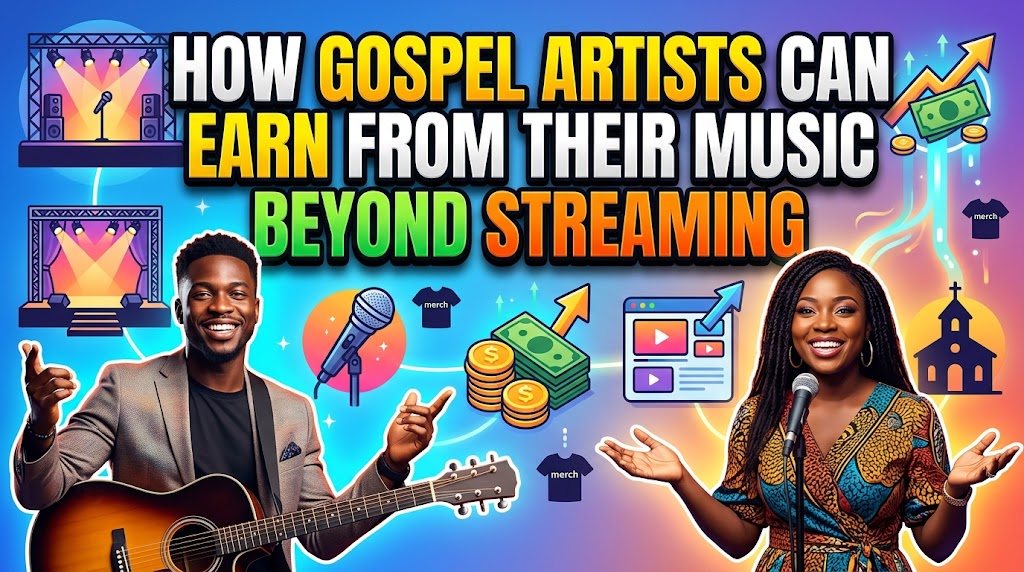
How Gospel Artists Can Earn From Their Music Beyond Streaming
How Gospel Artists Can Earn From Their Music Beyond Streaming
When many gospel artists release a song today, one of the first things they think about is streaming. They want people to listen on Spotify, Apple Music, YouTube Music, Audiomack and other platforms. They watch the numbers, celebrate when the streams increase and hope that enough plays will eventually translate into meaningful income. Streaming is certainly an important part of the modern music business, but one thing I have come to realise is that a gospel artist who depends entirely on streaming may be leaving several other opportunities on the table. How Gospel Artists Can Earn From Their Music Beyond Streaming
The question is not simply how many people listened to your song. The bigger question is what your music can create around those listeners.
This is why understanding how gospel artists can earn from their music beyond streaming is becoming increasingly important. A song can be much more than an audio file uploaded to a distribution platform. It can become a performance opportunity, a teaching resource, a licensing asset, a merchandise opportunity, a digital product, a booking tool, a brand asset and even the foundation of an entire music ministry.
I have noticed that one of the biggest mistakes emerging artists make is treating a song as the final product. They record the song, upload it, share the link everywhere, ask people to stream it and then wait for the next song. But there is a lot that can happen between creating a song and releasing another one.
Imagine spending weeks writing a song, paying for production, recording vocals, mixing it, mastering it, creating artwork and promoting it, only for the entire business strategy to end with “please stream my song”. That is a lot of effort resting on one income source.
A better approach is to think of the song as an asset.
If a gospel song communicates a powerful message, connects with an audience and becomes recognisable, the artist can potentially build multiple legitimate revenue opportunities around it. This does not mean every song will generate significant money from every possible source. It simply means artists should understand the different ways their creative work can potentially produce value.
One of the most obvious opportunities beyond streaming is live performance.
Gospel artists can earn money by performing at concerts, church programmes, worship events, conferences, weddings, festivals, private events and other gatherings where appropriate. In many cases, people may know an artist because of a song they discovered online, but the actual income may come from the opportunity to perform that song live.
This changes the way an artist should think about promotion.
Instead of promoting a song only with “stream my new song”, an artist can also use the song to demonstrate their live performance ability. Short performance clips, rehearsal videos, acoustic versions and live worship sessions can help potential event organisers understand what the artist brings to a stage.
A song therefore becomes part of a larger professional portfolio.
Another opportunity is songwriting.
Not every talented songwriter has to earn primarily as a performing artist. Some gospel musicians have the ability to write songs that other singers, choirs, churches and worship teams can use. If an artist develops strong songwriting skills, songwriting can become a separate professional opportunity.
This is particularly interesting because a songwriter can potentially work on music without always being the person standing at the microphone.
A gospel artist may write a worship song for another artist, collaborate with another songwriter or contribute to a larger music project. Depending on the arrangement and applicable rights, the songwriter may receive royalties or other agreed compensation.
This is where understanding music publishing becomes important.
Many upcoming artists focus heavily on recording but pay little attention to the underlying rights connected to their songs. A recording has its own rights, while the underlying composition has separate rights. Understanding ownership, publishing, songwriting splits and royalty collection can make a significant difference over the long term.
Another way gospel artists can potentially earn from their music beyond streaming is licensing.
Imagine a Christian organisation, documentary producer, church media team, filmmaker or content creator wants to use an artist’s song in a project. Instead of simply sending the song for free, the artist may be able to license the appropriate rights under agreed terms.
Licensing can apply to different types of projects, although the specific permissions required depend on how the music will be used and who owns the relevant rights.
For example, an artist might have an instrumental worship piece that works beautifully underneath a Christian documentary. Another song might fit a church promotional video. Another might be suitable for a Christian film or online programme.
This is one reason I believe artists should stop thinking only about whether people are streaming their music. Sometimes the right person listening to your song is not another fan. It could be someone looking for music for a project.
Another potential revenue stream is merchandise.
A successful gospel artist can build a brand around their music and message. Merchandise might include T shirts, caps, notebooks, journals, worship themed accessories or other products that make sense for the artist’s audience.
The important point is that merchandise should feel connected to the artist rather than looking like random products with a name printed on them.
A powerful lyric, phrase or message from a song can sometimes become part of a merchandise concept. However, artists should make sure they have the necessary rights to use any lyrics, artwork or third party intellectual property involved.
Digital products are another area worth considering.
A gospel songwriter could create a songwriting guide. A worship leader could develop training materials for emerging worship teams. A Christian musician who teaches an instrument could create lessons or downloadable resources. A producer could create educational materials about music production.
The music becomes the doorway through which people discover the artist’s wider expertise.
This is particularly useful because an artist does not necessarily need millions of followers to sell a specialised digital product. A smaller audience with a strong connection to the artist can sometimes be more useful than a huge audience that barely pays attention.
Another opportunity is music related education.
If you can sing, write, produce, play an instrument or lead worship effectively, there may be people willing to learn from you.
A gospel artist could teach vocal technique, songwriting, keyboard, guitar, music production, choir arrangement or stage performance. The artist’s experience can become educational content.
This is where personal branding becomes powerful.
People may initially discover an artist because of a song, but eventually become interested in the person behind the song. Once that relationship develops, educational products, workshops and training can become additional business opportunities.
There is also the possibility of monetising YouTube content.
YouTube should not be treated simply as a place to upload official music videos. Gospel artists can create behind the scenes videos, songwriting sessions, acoustic performances, live worship sessions, interviews, devotionals, music tutorials and discussions about their creative journey.
Depending on eligibility and applicable platform policies, creators can earn through YouTube’s monetisation programmes. There may also be opportunities involving sponsorships, memberships or other platform features.
The important thing is to build content around the music rather than repeatedly posting the same streaming link.
One song can potentially produce dozens of pieces of content.
You can explain why you wrote it. You can perform an acoustic version. You can tell the testimony behind it. You can show part of the recording process. You can interview the producer. You can perform it with a choir. You can create a lyric video. You can discuss the Bible passage that inspired it.
Suddenly, one song is no longer one piece of content.
It becomes a content ecosystem.
Another opportunity is direct fan support.
Artists sometimes assume that earning money from fans means asking people for donations. It does not necessarily have to work that way. Artists can create legitimate value for supporters through exclusive content, special experiences, private online sessions, early access, physical products or other offerings.
The key is transparency and value.
People who genuinely connect with an artist’s ministry or music may be willing to support the work directly, especially when they understand what the support contributes towards.
Artists can also explore brand partnerships.
A gospel musician with a clearly defined audience may eventually become attractive to businesses whose products or services align with that audience. This could include Christian publishers, music equipment companies, fashion brands, technology companies, event organisers and other relevant businesses.
However, artists should be careful about accepting every sponsorship simply because money is involved.
Your audience trusts you.
If you promote something that conflicts with the values you have consistently communicated, you may create a bigger problem than the money solves. A partnership should make sense for the artist, the audience and the brand.
Another area worth considering is church and organisational partnerships.
Many gospel artists already have access to churches, ministries, Christian organisations and worship communities. Instead of viewing these relationships only as opportunities to perform, artists can develop professional partnerships around music education, worship events, conferences, songwriting projects, music production and other relevant services.
The artist’s network can therefore become part of the business model.
There is also an opportunity in selling physical music products.
Although digital music dominates the market, some fans still value physical products such as CDs, USB collections where appropriate, special edition releases, lyric books and other tangible items. These products may work particularly well at concerts, church programmes and special events.
The goal is not to return to an old business model simply because it worked in the past. The goal is to recognise that different members of an audience prefer different ways of supporting an artist.
Another important opportunity is booking.
A gospel artist with a professional online presence can use their music catalogue as evidence of their ability. A strong website can contain music, videos, biography, performance history, testimonials, press coverage and booking information.
This can turn a music catalogue into a professional business portfolio.
I think this is one area many independent gospel artists underestimate.
If someone wants to book you, they should not have to search through twenty social media posts just to find out how to contact you. Your online presence should make the process straightforward.
Your music should help answer the question, “Why should we consider this artist?”
This is also where owning your music catalogue becomes increasingly important.
When an artist controls the rights to their work, subject to any contracts and agreements they have entered into, they may have greater flexibility in determining how that work is licensed, distributed and monetised.
That does not mean every artist should reject record labels or every form of partnership. Different artists have different circumstances. But understanding what you own, what you have assigned and what you have licensed is extremely important before signing agreements.
An artist should know what happens to their masters, publishing rights, performance rights and other relevant interests.
Professional legal and music business advice can be valuable here, especially before signing significant agreements.
Another thing I have learned is that the value of music often increases when an artist builds an audience rather than simply chasing numbers.
Ten thousand random streams are not necessarily the same as ten thousand people who know your name, understand your message and are interested in your next project.
An engaged audience can potentially create opportunities across performances, products, partnerships, education, licensing and direct support.
That is why artists should think beyond “How many streams did I get?”
Better questions include “Who listened?”, “Why did they connect?”, “What else do they need?”, “How can I serve them?”, and “What legitimate opportunities can this song create?”
This approach does not turn gospel music into something purely commercial. In fact, it can help artists think more responsibly about sustainability.
Ministry and business can intersect, but they should not be confused.
A gospel artist can genuinely want to glorify God through music while also recognising that recording, musicians, producers, studios, marketing, transportation, equipment and content production all cost money.
Earning income from legitimate creative work does not automatically make the work less spiritual.
The important issue is the values guiding the work.
If an artist can create meaningful music, serve an audience, maintain integrity and build sustainable income around their creative work, that can provide the resources needed to continue creating.
This is why I believe every gospel artist should stop looking at a song as something that is simply released and forgotten.
Before releasing a song, ask what else can be built around it.
Can it become a live performance?
Can it introduce people to your songwriting?
Can it lead to a booking?
Can it become part of a worship project?
Can it generate licensing opportunities?
Can it inspire merchandise?
Can it become educational content?
Can it attract a relevant partnership?
Can it strengthen your catalogue?
Can it help you build an audience that will support future projects?
Those questions can completely change how an artist approaches music.
The goal is not to squeeze money out of every listener. The goal is to understand the legitimate economic value that can exist around creative work.
Streaming can be one piece of the puzzle, but it does not have to be the entire puzzle.
For gospel artists who are serious about building sustainable careers, the bigger opportunity may be learning how to turn music into an ecosystem of creativity, ministry, community and business.
Your song can be heard once and forgotten.
Or it can become the beginning of something much bigger.
That is why learning how gospel artists can earn from their music beyond streaming is not simply a financial conversation. It is a conversation about ownership, creativity, audience building, professionalism and sustainability.
The next time you release a gospel song, do not only ask people to stream it.
Ask yourself what the song can build.
Because sometimes, the biggest value of a song is not found in the number of times it is played. It is found in everything that happens because you created it.

Leave a Reply