
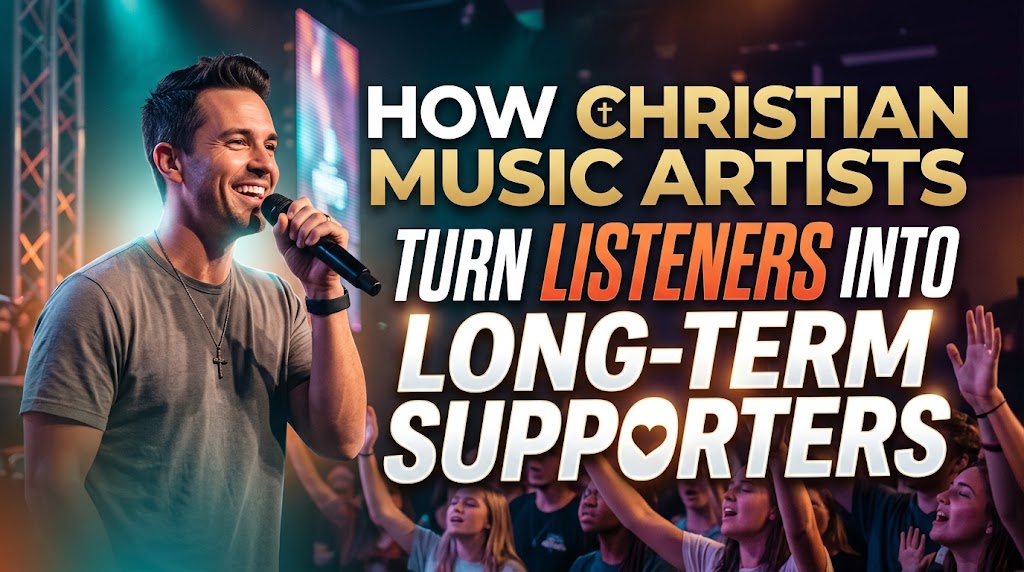
How Christian Music Artists Can Turn Listeners Into Long-Term Supporters
How Christian Music Artists Can Turn Listeners Into Long-Term Supporters
There was a time when I used to think that the biggest achievement for a Christian music artist was getting people to listen to a song. The logic seemed simple. If people were streaming the song, watching the video, sharing the lyrics and talking about the artist, then everything must be working.
But the more I observed how music careers actually develop, the more I realised that getting someone to listen to a song is only the beginning.
A listener can discover your song today, enjoy it for three minutes, add it to a playlist and completely forget about you tomorrow. Another artist can release a song next week and capture that same listener’s attention. This is particularly important for Christian music artists because the relationship between an artist and a listener can go much deeper than entertainment.
Christian music often becomes part of people’s personal experiences. A song can be playing when someone is praying, travelling, grieving, celebrating, struggling financially, preparing for an examination, getting married, recovering from disappointment or simply trying to find strength to continue another day. That creates a unique opportunity for Christian music artists.
The real question therefore is not simply how to get people to listen to your music. The bigger question is, how Christian music artists can turn listeners into long term supporters.
I began to understand this distinction when I noticed something about the artists people continue to support. The artists who build lasting careers are rarely supported only because they have one good song. People support them because they have developed a connection with the person behind the music.
A hit song may introduce you to someone, but connection is what can make that person stay.
This is one of the biggest lessons I believe Christian music artists need to understand. Your song may be the product, but your story, personality, consistency, message and relationship with your audience can become the foundation of your career.
Imagine someone discovers one of your songs on YouTube. They listen to it once and enjoy it. What happens next?
If there is nothing else for that person to discover about you, the relationship may end there.
But imagine the same person discovers your Instagram page and sees you sharing the story behind the song. Then they find another song that addresses a different situation in their life. They watch a short video where you explain why you started making Christian music. They see you interacting with people in your comments. They discover that you occasionally share encouragement, behind the scenes content, live performances and personal reflections.
Suddenly, you are no longer just another name attached to a song.
You have become someone they recognise.
That recognition matters.
One of the simplest ways to turn listeners into long term supporters is to give people a reason to know you beyond your music.
This does not mean that you need to reveal every private detail about your life. It does not mean turning your entire personal life into content. It simply means allowing people to understand the person, purpose and message behind the music.
People naturally become more invested when they understand why someone is doing what they are doing.
If your music is about faith, tell people what faith means to you. If you write songs about hope, explain some of the experiences that have shaped your understanding of hope. If your music focuses on worship, explain what worship means beyond singing.
Your story can give your music context.
I have also noticed that Christian music artists sometimes make the mistake of communicating with their audience only when they have something to promote.
New single coming soon.
Stream my new song.
Watch my video.
Download my album.
Please support me.
There is nothing wrong with promotion. In fact, promotion is necessary. The problem begins when every interaction becomes a sales announcement.
Imagine having a friend who only contacts you whenever they need money. After some time, you will probably begin to associate their phone calls with requests.
Audiences can develop a similar feeling towards artists.
If the only reason you appear online is to promote something, people may begin to see your page as an advertising board rather than a community.
This is why Christian music artists should learn to communicate even when they are not releasing music.
Talk to your listeners.
Encourage them.
Ask questions.
Share your creative process.
Show them how a song was developed.
Share moments from rehearsals.
Talk about the meaning behind your lyrics.
Celebrate milestones with them.
Respond to meaningful comments.
Thank people who consistently support your work.
Create moments where your audience feels that they are participating in your journey rather than simply watching advertisements about your journey.
This is one of the most important answers to the question of how Christian music artists can turn listeners into long term supporters.
Build a relationship before you ask for repeated support.
Another lesson I have come to appreciate is the importance of consistency.
A Christian music artist can release an amazing song today and disappear for six months. When they return, they may wonder why their audience has become quiet.
The reality is that attention has a short memory.
People have jobs, families, school, businesses, relationships, problems, entertainment options and thousands of other things competing for their attention. You cannot assume that because someone loved your song six months ago, they are still actively following everything you do.
Consistency helps keep the relationship alive.
This does not necessarily mean releasing a new song every week. That would be unrealistic for many artists.
Consistency can mean creating useful and meaningful content around your music. You could share a short worship session, explain a lyric, post a devotional thought, share a testimony connected to your music or simply check in with your audience.
The objective is not to force people to consume your content every day. The objective is to remain present enough that your audience continues to remember you.
There is another important factor that is often underestimated.
Make your supporters feel appreciated.
A person who streams your music may not have to do it. Someone who shares your song with ten friends does not have to do it. Someone who attends your event, buys your merchandise, recommends your music or contributes financially to your project is making a decision to support you.
Do not treat that support as an entitlement.
Thank people.
Celebrate them.
Respond to them.
If someone sends you a message explaining how your song encouraged them during a difficult period, do not treat that message like another notification to scroll past.
Sometimes one thoughtful response can create a supporter who remains connected to your career for years.
Christian music also gives artists an opportunity to build communities around shared values.
People may initially come because they like the sound, but they can remain because they identify with the message.
Think about the difference between saying, “Listen to my song,” and saying, “I wrote this song for anyone who has ever felt like giving up but decided to keep trusting God.”
The second statement creates a conversation.
Someone who has experienced that situation may immediately feel represented.
That is where your music begins to move from being merely something people hear to something people associate with their own lives.
This is why understanding your audience matters.
You need to know who you are communicating with.
What challenges do they face?
What questions are they asking?
What kind of encouragement do they need?
What experiences influence their faith?
What kind of Christian music do they naturally connect with?
You do not need to manufacture emotions just to gain attention. You simply need to understand the people you are trying to serve through your music.
A song can reach thousands of people, but understanding your audience can help you serve those people more intentionally.
Another thing I would encourage Christian music artists to take seriously is the ownership of their audience.
Social media platforms are useful, but an artist should not build their entire relationship with listeners around an algorithm.
Today your post may reach thousands of people. Tomorrow the same platform may change how content is distributed.
You do not control the platform.
That is why it can be valuable to create channels where supporters can stay connected to you directly.
An email list, website, community, official artist page or other direct communication channel can become extremely valuable over time.
Imagine releasing a new album and having thousands of people who have voluntarily chosen to receive updates from you.
That is very different from hoping an algorithm decides to show your announcement to your followers.
Your website can also become the central home of your music career.
Instead of sending people to ten different platforms, you can create one place where they can discover your biography, music, videos, events, booking information, merchandise, latest releases and other important information.
This makes your career easier to navigate.
It also gives your supporters a place to return to.
Another mistake artists can make is believing that supporters only want polished content.
Sometimes people want to see the journey.
Show them the rehearsal where something went wrong.
Show them the songwriting process.
Show them how you prepared for a performance.
Share the excitement of recording a new song.
Let them see that the finished music they hear required effort before it reached their ears.
Behind the scenes content can make supporters feel like insiders.
And people love feeling like insiders.
You can even create recurring content around your journey. Perhaps every Friday you share a short acoustic version of a song. Maybe you occasionally explain one lyric from your catalogue. Perhaps you document the process of preparing for a concert.
The format is less important than the consistency and authenticity.
I have also learned that not every supporter will support you in the same way.
One person may stream your music.
Another may attend your concerts.
Another may buy your album.
Another may recommend your music to their church.
Another may simply pray for your ministry.
Another may share your song when somebody needs encouragement.
Do not create a narrow definition of support.
Your audience is made up of people with different abilities, interests and circumstances.
This means you should create different opportunities for people to participate.
Someone who cannot purchase your merchandise may still share your song.
Someone who cannot attend your concert may watch the livestream.
Someone who cannot contribute financially may introduce your music to their church community.
The goal is to create a healthy ecosystem around your music where different forms of support are appreciated.
There is also something powerful about asking your audience to participate in the creative journey.
You could allow supporters to vote on which song receives a visualiser.
You could ask them which lyric resonates with them most.
You could invite them to submit questions for an interview.
You could organise a listening session.
You could create a private community for your most engaged supporters.
When people participate, they develop a sense of ownership in the journey.
They begin to feel that they are not simply spectators.
They are part of the story.
Christian music artists should also remember that trust takes time to build and seconds to damage.
Your audience is watching more than your music.
They are watching how you communicate.
They are watching how you treat people.
They are watching how you respond when criticised.
They are watching whether your public message is consistent with the way you conduct yourself.
Nobody expects an artist to be perfect. But authenticity matters.
If your music consistently talks about faith, love, humility, hope and service, your communication should ideally reinforce those values rather than constantly contradict them.
This does not mean pretending to be perfect.
In fact, being honest about your growth can sometimes make your story more relatable.
People do not necessarily need an artist who has never struggled.
Sometimes they need an artist who can honestly say, “I struggled too, but here is what helped me keep going.”
That kind of honesty can create a deeper connection than a perfectly packaged promotional message.
Another important lesson is that Christian music artists should not measure everything by immediate numbers.
Streams matter.
Views matter.
Followers matter.
But they do not tell the entire story.
One person who listens to your song repeatedly and shares it with others can be more meaningful to your long term career than a large number of passive views.
The real question should increasingly become, “Are people returning?”
Are they listening to your next release?
Are they attending your events?
Are they sharing your content?
Are they recommending your music?
Are they responding to your messages?
Are they joining your community?
Are they purchasing your products?
Are they telling other people about you?
Those behaviours can reveal whether an audience is becoming a community.
Ultimately, the answer to how Christian music artists can turn listeners into long term supporters comes down to one fundamental idea.
Do not treat people like numbers.
A listener is a person.
A follower is a person.
A stream is connected to a person.
A comment is connected to a person.
A ticket sale is connected to a person.
A share is connected to a person.
When you remember the person behind the number, your approach to building your music career can change.
You stop asking only, “How many people listened to my song?”
You start asking, “How many people did my music genuinely connect with?”
You stop thinking only about your next release.
You begin thinking about the relationship you are building between releases.
You stop seeing your audience as people who should constantly promote you.
You begin seeing them as people you are privileged to serve, encourage and connect with.
And that is where something much more valuable can happen.
A listener can become a follower.
A follower can become an engaged fan.
An engaged fan can become a supporter.
A supporter can become an advocate who introduces your music to other people.
And over time, a community can form around your message.
That is the bigger opportunity available to Christian music artists today.
The objective should not simply be to create a song that people hear once.
Create music that people remember.
Create stories that people connect with.
Create conversations that people want to join.
Create experiences that people want to return to.
Create a community where people feel appreciated.
And most importantly, create a relationship with your audience that is bigger than the promotion of your next song.
When people believe in the message, understand the person behind the message and feel genuinely connected to the journey, they have more reasons to remain involved.
Your next song may introduce you to them.
Your consistency may keep you in their attention.
Your authenticity may build trust.
Your communication may build connection.
Your music may create emotional and spiritual memories.
And your relationship with them may turn a temporary listener into a long term supporter.
That, in my view, is one of the most important things Christian music artists can build in an increasingly crowded music industry.
Because at the end of the day, the goal is not simply to be heard.
The goal is to become meaningful enough that people want to keep listening, keep sharing, keep showing up and keep walking with you as your musical journey continues.

Leave a Reply