
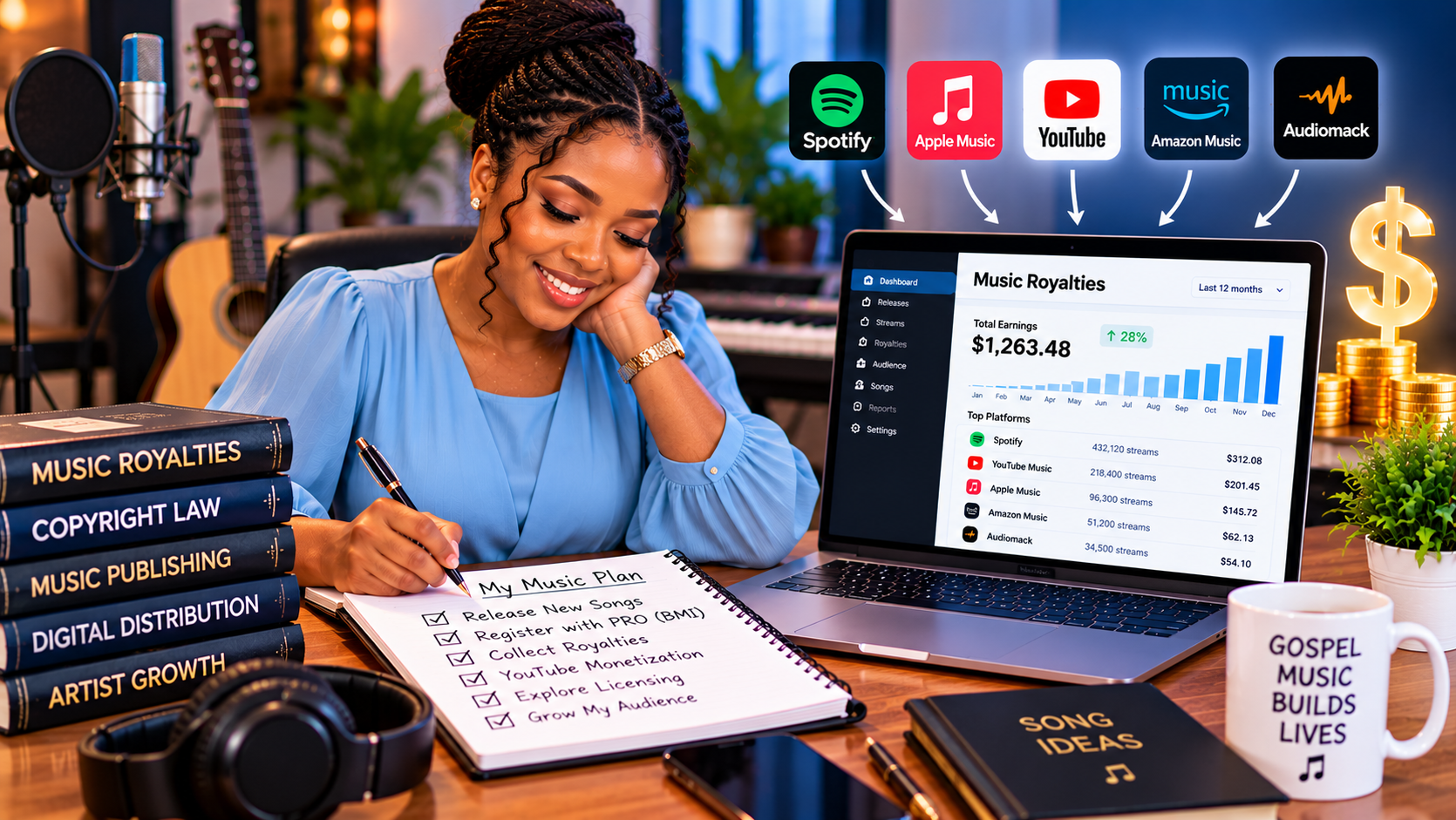
How Gospel Artists Can Earn Royalties From Their Music
How Gospel Artists Can Earn Royalties From Their Music
Many gospel artists create music to glorify God, encourage believers, and spread the message of Jesus Christ. However, making music also requires time, money, creativity, and dedication. Understanding music royalties can help gospel artists sustain their ministry while continuing to bless listeners through their songs.
Independent gospel artists sometimes assume that uploading a song to streaming platforms automatically guarantees regular income. In reality, royalties come from different sources, and each source has its own rules, registration requirements, and payment processes.
Whether you are a new gospel singer or an established independent artist, understanding these systems can help you manage your music career more effectively.
What Are Music Royalties?
Music royalties are payments made to the people or organizations entitled to earn income when music is used in ways covered by their rights.
Depending on the type of music right involved, royalties may be generated when a song is streamed, performed publicly, broadcast on radio or television, reproduced, or used in certain videos and other media.
For example, when a listener streams your gospel song on a digital music platform, that activity may generate recording royalties and, in some circumstances, royalties connected to the underlying musical composition.
However, not every stream produces the same amount of money. Payments depend on factors such as the platform’s payment arrangements, the listener’s market, the applicable rights, and the agreements between the parties involved.
Understanding where these earnings come from is the first step toward collecting the royalties you are entitled to receive.
1. Understand the Two Main Copyrights in a Song
One of the most important lessons for every gospel artist is that a song can involve two separate copyrighted works.
The musical composition
The composition consists of the underlying music and lyrics. Depending on the song, the relevant rights may belong to the songwriter, composer, or other rights holders.
If you write the lyrics and compose the melody yourself, you may own the composition, subject to any agreements or other rights involved.
Songwriters and composers may earn publishing-related royalties when their compositions are used in ways that generate such payments.
The sound recording
The sound recording is the particular recorded performance of the song. It is sometimes called the master recording.
For example, you may write a worship song and record it in a studio with a vocalist, instrumentalists, a producer, and a sound engineer. The finished audio recording is distinct from the lyrics and composition.
The owner of the master recording may receive recording income through a distributor or other applicable arrangements.
Do not assume that owning the lyrics automatically means you own every right in the finished recording. Studio agreements, artist agreements, producer agreements, and other contracts may affect ownership.
Understanding this distinction helps you identify the different income streams available to your music.
2. Distribute Your Music to Digital Streaming Platforms
Digital music distribution is one way independent gospel artists can make their recordings available to listeners around the world.
A digital distributor can deliver your music to participating services such as Spotify, Apple Music, YouTube Music, and other platforms, depending on the distributor’s coverage.
When listeners stream your music, the relevant platform may generate royalties or other payments under its agreements. Your distributor typically collects the recording-related revenue covered by its service and credits your account according to its terms.
To get started:
- Choose a reputable digital distributor.
- Upload a high-quality recording and correctly sized cover artwork.
- Provide accurate artist, songwriter, title, and release information.
- Confirm that you have the necessary rights and permissions.
- Review the distributor’s commission, fees, payment thresholds, and payout rules.
- Monitor your reports to see how your music performs.
Remember that a stream does not guarantee a fixed payment. Streaming income varies, and a new artist may initially earn very little.
The goal is to build a catalogue of quality music, reach the right audience, and maintain accurate records as your releases grow.
3. Register Your Songs With a Performing Rights Organization
A performing rights organization, or PRO, helps administer certain public-performance rights in musical compositions. Depending on its territory and agreements, it may collect royalties when eligible compositions are performed or communicated to the public in covered circumstances.
Examples include BMI and ASCAP in the United States, PRS for Music in the United Kingdom, and other organizations operating in different countries.
If you are a songwriter or composer, investigate the organization that serves your territory and the requirements for membership and song registration.
When registering a song, you may need to provide:
- The song title.
- The names of the writers and composers.
- Each writer’s agreed ownership share.
- Relevant publisher information, where applicable.
- Other identifying details requested by the organization.
Ensure that the ownership shares are accurate and agreed upon by the relevant parties.
Registering a song does not mean every possible royalty will automatically be collected. A performing rights organization generally handles specific rights and revenue types, so you should understand its coverage and whether additional registrations are necessary.
If you belong to an organization such as BMI, check your account to confirm that your works have been submitted correctly and whether any registrations require further attention.
4. Understand Music Publishing Royalties
Music publishing involves the administration and exploitation of the rights in musical compositions.
Songwriters may earn publishing-related income from certain performances, reproductions, licensed uses, and other uses covered by applicable agreements.
A music publisher may help manage registrations, licensing, royalty collection, and opportunities for placing songs in films, television programmes, advertisements, or other media.
Independent artists do not necessarily need to sign with a publisher immediately. Some manage their own publishing, while others choose to work with a publishing administrator or publishing company.
Before signing a publishing agreement, examine the contract carefully. Pay attention to the rights being granted, the length of the agreement, the territory covered, the commission or fees, reporting obligations, and the circumstances in which rights may be returned to you.
Do not give away rights simply because someone promises to make your music famous. A good agreement should clearly explain what the other party will do and how income will be handled.
5. Explore YouTube Music and Content ID
YouTube can provide opportunities for gospel artists to reach listeners through official music releases, music videos, live performances, and other authorised content.
There are different ways music may generate income on YouTube, and they should not be confused.
YouTube music distribution
If your distributor delivers your recording to YouTube Music, your release may become available through that service. Eligible uses may generate revenue under the applicable platform and distributor arrangements.
YouTube Content ID
Content ID is a rights-management system that can identify matching material in videos uploaded by other users. Depending on the rights holder’s arrangements and the applicable policies, a matched video may be monetised, tracked, or blocked.
Content ID is not a guarantee of earnings. Eligibility requirements apply, and you must have the necessary rights to the material you submit.
If your recording contains non-exclusive beats, leased instrumentals, uncleared samples, or other material shared with multiple creators, confirm whether the relevant licences permit Content ID registration.
Also, do not assume that every video containing your song will generate money. Results depend on rights, eligibility, claims, monetisation settings, and the use involved.
6. Earn From Licensed Uses of Your Music
Your gospel music may have value beyond ordinary streaming.
Churches, filmmakers, event organisers, video producers, broadcasters, and other creators may want permission to use your music in their projects.
Depending on the intended use, you may be able to negotiate a licence and receive a fee. For example, a filmmaker may wish to include your song in a documentary, or a video creator may want to use your recording in a production.
Before granting permission, establish which rights are needed. Using an existing recording can involve both the composition and the master recording. If you do not control all the necessary rights, you may need permission from other rights holders as well.
A written licence should explain the permitted use, duration, territory, payment, credit requirements, and any restrictions.
Some uses may be covered by existing licences or other legal rules, so not every use requires the same arrangement. When the situation is unclear or commercially significant, seek appropriate legal advice.
7. Keep Written Agreements With Collaborators
Gospel music is often created through teamwork. A single recording may involve songwriters, composers, vocalists, producers, instrumentalists, and recording professionals.
Good relationships are important, but clear agreements are equally valuable.
Before recording or releasing a song, discuss:
- Who wrote the lyrics and composed the music.
- Who owns the master recording.
- Whether a producer receives a fee, royalties, or both.
- Whether musicians or vocalists receive agreed fees or other compensation.
- How songwriting and publishing shares will be divided.
- Whether anyone has permission to distribute, license, or monetise the recording.
Put the agreed terms in writing and ensure everyone understands them.
Paying a studio fee does not automatically settle every question about copyright ownership or future royalties. The effect of a payment depends on the agreement and applicable law.
Written agreements reduce misunderstandings and help protect both the artist and the people contributing to the music.
8. Maintain Accurate Records of Your Music
Good recordkeeping makes royalty collection easier to manage.
Create a central record for every song you release. Include its title, release date, songwriter and composer details, ownership shares, master owner, distributor, relevant registration information, and agreements with collaborators.
Keep copies of final audio files, project files where appropriate, contracts, invoices, licences, and correspondence relating to permissions and rights.
Record the identifiers associated with each release, such as an International Standard Recording Code (ISRC) when one has been assigned. A composition may also have its own identifying information through the relevant registration systems.
Check that the titles, artist names, and credits are consistent across your distributor, streaming platforms, and rights registrations.
Mistakes in metadata can make it harder to match music uses to the correct rights holders. Accurate records help you identify errors and follow up with the relevant organisation when necessary.
9. Monitor Your Royalties and Payment Reports
Uploading music is only part of the process. You should also learn how to review your royalty reports.
Check your distributor dashboard for reported streams, territories, revenue, deductions, and payment status. Review your performing rights organization’s account and any other royalty services you use.
Keep in mind that different services report and pay on different schedules. A stream may appear in one dashboard before the associated income becomes payable in another. Some services also have minimum payout thresholds or account verification requirements.
If earnings appear lower than expected, do not immediately conclude that money has been stolen or lost. First check the reporting period, platform, payment terms, eligibility, deductions, and whether the revenue has reached the relevant account.
If a discrepancy remains, contact the responsible organisation with the song title, relevant identifiers, reporting period, and supporting information.
Never pay an unverified person who promises guaranteed royalties or claims they can release withheld earnings without proper evidence.
10. Promote Your Music to Build Sustainable Income
Royalties depend partly on how your music is used, so reaching genuine listeners is important.
Share your songs with your church community, gospel music groups, social media followers, and people who appreciate your style of worship. Publish meaningful content around each release, such as the story behind the song, a short performance, the inspiration for the lyrics, or a message connected to its theme.
Make it easy for listeners to find the official release. Use your website, artist profiles, and verified streaming links to direct people to the correct recording.
You can also build an email list, collaborate with other gospel artists, perform at appropriate events, and publish useful articles that introduce audiences to your music and ministry.
Avoid buying fake streams or using services that promise artificial listening activity. Such practices can violate platform rules, damage your artist profile, and put your releases or earnings at risk.
Sustainable growth comes from genuine listeners, consistent releases, responsible promotion, and music that serves its audience.
11. Be Patient and Manage Your Expectations
Music royalties are rarely a quick or guaranteed source of income, particularly for new independent artists.
A song may encourage thousands of people spiritually while generating only a modest amount of money. Another song may perform well in one territory but receive fewer streams elsewhere. Income depends on several factors, including audience size, rights ownership, usage, licensing arrangements, and the services involved.
Do not measure the value of your ministry solely by streaming income. At the same time, learning the business side of music can help you manage your resources, protect your work, and support your long-term creative efforts.
Set realistic goals, review your progress regularly, and reinvest wisely in quality recordings, promotion, and audience development.
Conclusion
Gospel artists can build more sustainable music careers by understanding how royalties work and learning how to collect the income they are entitled to receive.
Start by distinguishing the composition from the sound recording. Choose a suitable distributor, register your songs with relevant rights organisations, understand music publishing, investigate eligible YouTube monetisation options, and keep accurate records. Put collaboration agreements in writing and review your royalty reports regularly.
Most importantly, combine good rights management with consistent, honest promotion and music that genuinely serves people.
Your calling to share the gospel and your responsibility to manage your creative work can go hand in hand. With knowledge, patience, and careful planning, you can protect the music you create and give your ministry a stronger foundation for the future.
Disclaimer: This article provides general educational information and is not legal, tax, or financial advice. Music rights and royalty systems vary by country, platform, contract, and type of use. Consult the relevant rights organisation or a qualified professional for advice about your particular circumstances.

Leave a Reply