
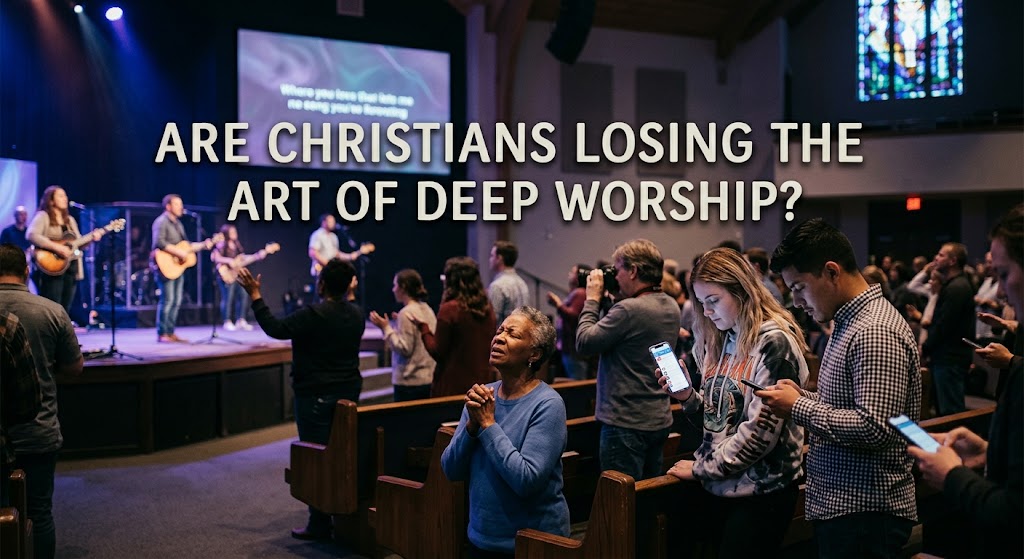
Are Christians Losing the Art of Deep Worship?
Are Christians Losing the Art of Deep Worship?
The question, “Are Christians Losing the Art of Deep Worship?” is one that has become increasingly relevant in churches across the world. It is a question that stirs emotions, invites reflection, and challenges believers to examine the condition of their hearts. While Christianity continues to grow in many regions and worship music remains one of the most influential forms of Christian expression, many believers, pastors, worship leaders, and theologians have expressed concerns that something important may be fading from modern Christian worship. The concern is not necessarily that Christians are worshipping less, but that they may be worshipping differently, sometimes in ways that prioritise experience over reverence, entertainment over reflection, and emotional stimulation over spiritual transformation. Recent discussions within Christian communities have increasingly focused on whether worship has become centred on the worshipper rather than on God Himself.
To understand whether Christians are losing the art of deep worship, it is first necessary to understand what deep worship actually means. Deep worship is not merely singing songs, raising hands, attending church services, or listening to Christian music. Deep worship is the intentional act of honouring God with the heart, mind, soul, and strength. It is an expression of love, reverence, obedience, gratitude, surrender, and devotion. Deep worship goes beyond external actions and reaches into the inner life of the believer. It is possible to sing every song in a worship service and still not worship deeply. Conversely, it is possible to sit quietly in prayer, reflect on Scripture, or serve others in love and experience profound worship.
One of the challenges facing modern Christianity is that worship is often measured by visible enthusiasm rather than genuine spiritual engagement. In many churches, worship services are designed to create memorable experiences. There is nothing inherently wrong with excellent music, professional sound systems, creative presentations, or engaging worship teams. Excellence can honour God. However, when the pursuit of an experience becomes the primary objective, worship risks becoming centred on human feelings instead of God’s glory. Some Christian thinkers have raised concerns that worship services increasingly resemble concerts, where the focus shifts from congregational participation to audience observation.
The reality is that deep worship has never been about how a person feels. Throughout Scripture, worship often occurred during moments of suffering, uncertainty, fear, and hardship. The Psalms are filled with songs of lament, confusion, repentance, and dependence upon God. David worshipped while facing enemies. Paul and Silas worshipped while imprisoned. Job worshipped after devastating loss. These examples remind believers that worship is not dependent upon favourable circumstances or emotional highs. Deep worship often emerges during life’s most difficult moments because it reflects trust in God regardless of what is happening externally.
In today’s culture, many Christians have become accustomed to seeking instant results and immediate gratification. This mindset can unintentionally affect spiritual life. Worship may be evaluated based on whether it feels exciting, emotionally moving, or personally beneficial. If a service does not produce a strong emotional response, some believers conclude that worship was ineffective. Yet genuine worship is not always accompanied by dramatic emotions. Sometimes worship is quiet. Sometimes it is reflective. Sometimes it is a deliberate act of faith when emotions are absent. The expectation that worship must always feel powerful may actually prevent believers from developing deeper spiritual maturity.
Another factor contributing to concerns about deep worship is the increasing pace of modern life. People live in a world filled with constant notifications, social media updates, entertainment options, and endless distractions. Silence has become rare. Reflection has become difficult. Many believers struggle to spend even a few uninterrupted minutes in prayer or meditation. Deep worship requires attentiveness, but modern culture trains people to seek stimulation. The result is that many Christians bring distracted minds into worship services and find it challenging to focus fully on God.
Technology has brought many blessings to the Church. Worship music can reach global audiences. Sermons can be streamed across continents. Christian artists can share their message with millions of people. Yet technology also creates challenges. Worship can become another form of content consumption. Instead of actively participating in worship, believers may passively consume worship experiences through screens. While digital ministry has tremendous value, it cannot fully replace the communal and participatory nature of gathered worship.
The rise of celebrity culture within Christian circles has also influenced perceptions of worship. Certain worship leaders, musicians, and ministries have gained enormous followings. While many of these individuals sincerely desire to glorify God, there is always a risk that personalities become more prominent than the One being worshipped. Deep worship flourishes when attention is directed toward God. It diminishes when admiration for performers overshadows devotion to Christ.
It is also worth considering the role of biblical literacy in worship. Deep worship is often rooted in a deep understanding of God’s character and truth. When believers know Scripture, they have a richer foundation for worship. They understand God’s faithfulness, holiness, mercy, justice, and love. However, some observers have noted that many churches place significant emphasis on music while dedicating less attention to biblical teaching, prayer, and theological depth. This imbalance can produce worship experiences that are emotionally engaging but spiritually shallow.
At the same time, it would be unfair to suggest that all modern worship is shallow or that previous generations worshipped perfectly. Every generation faces unique challenges. Older forms of worship could sometimes become ritualistic and disconnected from the heart. Newer forms of worship have introduced fresh creativity, accessibility, and passion. The issue is not whether worship uses hymns or contemporary songs, organs or guitars, liturgy or spontaneity. The issue is whether God remains at the centre.
Interestingly, there is evidence that many Christians themselves are sensing a hunger for something deeper. Conversations across churches, online communities, and Christian forums frequently reveal a desire for authenticity, reverence, theological depth, and meaningful spiritual encounters. Some believers express concern that worship can feel performative or overly focused on emotional experiences rather than genuine communion with God.
This growing hunger may actually be a sign of hope. Throughout church history, periods of spiritual renewal have often emerged when believers recognised what was missing and began seeking God more earnestly. The fact that Christians are asking whether deep worship is being lost suggests that many still value it deeply. They recognise that worship should be more than music, more than tradition, and more than personal preference.
Deep worship requires humility. It requires believers to approach God not as consumers seeking an experience but as worshippers offering themselves in surrender. It requires prayer that is honest, Scripture that is treasured, and obedience that extends beyond church services. Deep worship is expressed not only through songs but also through forgiveness, generosity, compassion, service, and faithfulness. Worship does not end when the music stops. It continues in everyday life.
There is also a need to recover the practice of silence. In a noisy world, silence creates space for reflection, conviction, gratitude, and awareness of God’s presence. Many Christians have become uncomfortable with silence because it feels unproductive. Yet some of the deepest moments of worship occur when words are absent and hearts are attentive. Deep worship is often cultivated in stillness rather than spectacle.
Another important aspect of deep worship is community. Worship was never intended to be a solitary pursuit alone. The early Church gathered regularly to pray, sing, learn, and encourage one another. Congregational worship reminds believers that faith is not merely individual but communal. When Christians worship together with sincerity and unity, they experience something greater than personal inspiration. They participate in a shared declaration of God’s worthiness.
The future of deep worship will depend largely on the choices believers make today. Churches must resist the temptation to evaluate success solely by attendance figures, production quality, or emotional responses. Worship leaders must remember that their primary role is to direct attention toward God rather than themselves. Believers must cultivate private devotion that strengthens public worship. Families must prioritise spiritual formation at home. Christian artists must pursue authenticity over popularity.
The question remains: Are Christians Losing the Art of Deep Worship? The answer is both yes and no. In some contexts, worship has become increasingly shaped by consumer culture, entertainment values, and emotional expectations. There are legitimate reasons for concern. However, deep worship has not disappeared. Across the world, countless believers continue to seek God with sincerity, reverence, and devotion. Many are rediscovering the importance of prayer, Scripture, silence, reflection, and wholehearted surrender. The art of deep worship may be challenged, but it is not lost.
Ultimately, deep worship is not preserved through traditions, music styles, technology, or church programmes. It is preserved through hearts that genuinely desire God above all else. When believers seek God’s presence more than personal comfort, His truth more than cultural approval, and His glory more than human recognition, deep worship flourishes. The greatest threat to deep worship is not modern music, changing technology, or cultural shifts. The greatest threat is a heart that becomes distracted from God. Likewise, the greatest hope for deep worship is a heart that continually returns to Him.
As Christians navigate the complexities of modern life, the call remains the same as it has always been. Worship God in spirit and in truth. Worship Him when life is good and when life is difficult. Worship Him when emotions are strong and when they are absent. Worship Him not because of what He gives, but because of who He is. If believers embrace that calling, then the art of deep worship will not disappear. Instead, it will continue to inspire, transform, and draw generations closer to the God who alone is worthy of all worship.

Leave a Reply