
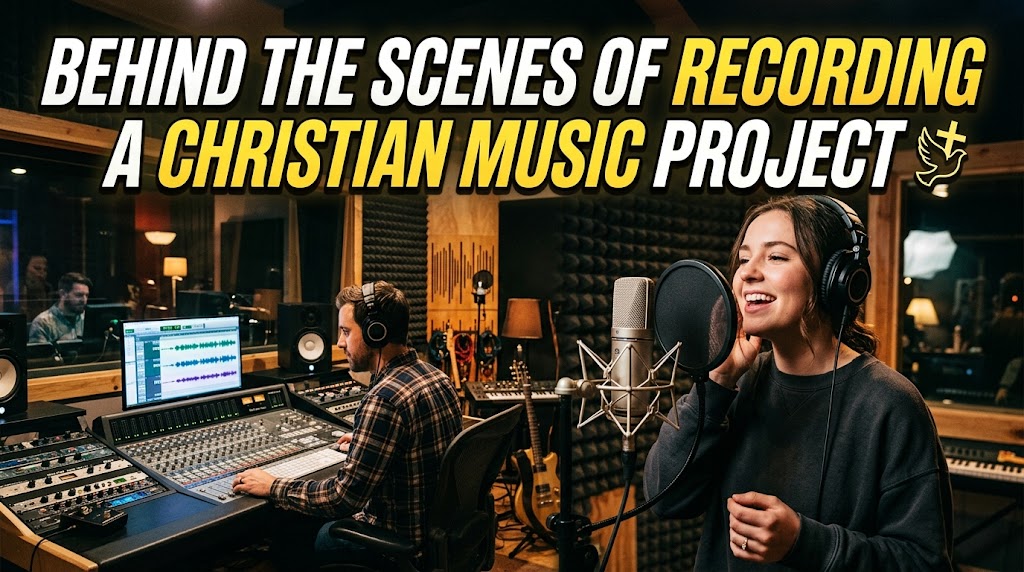
Behind the Scenes of Recording a Christian Music Project
Behind the Scenes of Recording a Christian Music Project
There is something fascinating about listening to a finished Christian song and knowing that what you are hearing is only the final result of a much longer journey. A song may last three or four minutes, but getting those few minutes right can take days, weeks, or even months of preparation, recording, editing, prayer, creativity, arguments, laughter, corrections, and plenty of moments when somebody in the studio says, “Let us do that part again.” Behind the Scenes of Recording a Christian Music Project
When people hear a Christian song playing on their phones, in church, on YouTube, on the radio, or through their favourite streaming platform, they usually hear the polished version. They hear the vocals, instruments, harmonies, effects and carefully arranged production. What they do not hear are the conversations that happened before the microphone was turned on, the countless decisions made in the studio, the rejected takes, the tired moments, the excitement when everything suddenly comes together, and the little imperfections that had to be corrected before the song was finally released.
That is why I find the Behind the Scenes of Recording a Christian Music Project so interesting. There is a completely different story behind the song that eventually reaches the listener.
One thing I have come to understand is that recording a Christian music project does not really begin inside the studio. It starts much earlier, often with an idea. Sometimes the idea comes from a personal experience. Sometimes it comes from a Bible passage, a prayer, a difficult season, a testimony, a conversation, or simply a melody that refuses to leave the mind.
A songwriter can wake up with a line in their head and quickly record it on a phone before forgetting it. Another person may spend weeks writing lyrics before finally finding the right words. There are also moments when the melody arrives before the lyrics, and the songwriter has to work backwards to discover what the song is actually trying to say.
This is one of the parts of the Behind the Scenes of Recording a Christian Music Project that listeners rarely see. Before there is a finished song, there is usually an unfinished idea that needs to be developed.
The first version of a Christian song may sound nothing like the final recording. It might be someone humming into a phone, singing into a cheap microphone, tapping a rhythm on a table, or playing a few chords on a keyboard or guitar. At that stage, nobody is necessarily thinking about streaming numbers, music videos or social media promotion. The main question is whether there is something worth developing.
Once the songwriter believes there is something there, the next stage is usually arranging the song. This is where things become much more interesting.
A simple song can suddenly become a serious production project. The producer may ask questions about the tempo, key, instrumentation, structure and overall direction. Should the song begin quietly? Should the drums enter later? Should there be background vocals? Should the chorus become bigger the second time? Should the bridge be repeated? Should there be a musical break?
These decisions may sound small, but they can completely change how a listener experiences the song.
I have also realised that recording a Christian music project requires people to have different ideas about the same song. The artist may hear one thing in their head. The producer may hear something else. The instrumentalist may suggest another approach. The engineer may notice a technical issue that nobody else heard.
That does not necessarily mean someone is wrong. Music is creative, and creative work often involves opinions.
This is why communication becomes extremely important inside a recording session. Everyone needs to understand what the song is trying to communicate. A technically perfect recording can still feel empty if the people involved have lost sight of the message.
The recording studio itself can be a fascinating environment. From the outside, it may look simple. There is a microphone, headphones, a computer, some speakers and musical equipment. But behind those objects is an enormous amount of technical work.
The recording engineer has to make sure the microphone is positioned correctly. The right recording levels have to be established. Background noise has to be controlled. Headphone mixes have to be comfortable for the singer. The room itself can influence the sound.
Then comes the moment when the artist finally stands behind the microphone.
This is where preparation meets reality.
Sometimes the first take is surprisingly good. Other times, it is nowhere close to what everyone expected. The singer may forget a line. The timing may be wrong. A note may not come out correctly. Somebody may laugh in the middle of the recording. A phone might ring. A car horn may suddenly become part of the background noise.
Then somebody says the familiar words: “Let us take it again.”
And again.
And again.
One of the biggest misconceptions about recording music is that professional artists simply walk into a studio, sing a song once and leave with a finished masterpiece. In reality, recording often involves multiple takes.
A singer might record the first verse several times. Then the chorus. Then the second verse. Then specific lines may be recorded again because one word was pronounced differently or because the emotion was not quite right.
Sometimes the technically perfect take is not the best take.
This is particularly important with Christian music because the emotional delivery can be just as important as vocal accuracy. A singer may hit every note correctly but still feel disconnected from the message. Another take might contain a tiny imperfection but communicate the emotion much better.
The producer then has to decide which performance works best.
This is where the magic of editing begins.
A finished vocal performance may actually be created from several different takes. The best parts of different recordings can be selected and combined. Timing can be adjusted. Unwanted sounds can be removed. Pitch can be corrected where necessary. Breaths can be managed. Background noise can be reduced.
None of this necessarily means the artist cannot sing. Modern music production simply gives professionals tools for refining a performance.
The same thing happens with instruments.
A guitarist may record several versions of a section. A drummer may play multiple takes. Keyboard parts may be adjusted. Bass lines may be changed. Additional sounds may be added after everyone thought the instrumental arrangement was already finished.
Sometimes the most important part of production is knowing what not to add.
It is tempting to keep adding instruments because technology makes almost anything possible. But more does not always mean better. A producer may remove an instrument because it is competing with the vocal. Another sound may be added because the chorus needs more energy.
This is one reason the Behind the Scenes of Recording a Christian Music Project can be so different from what listeners imagine. What sounds simple when finished may have involved dozens of decisions.
Background vocals are another important part of the process.
When I hear a powerful gospel chorus, I sometimes think about how different it would sound without the supporting voices. Background vocals can make a chorus feel wider, stronger and more emotional. They can respond to the lead singer, repeat certain phrases, create harmonies or help build the climax of the song.
But recording harmonies is not always as easy as it sounds.
The singers have to know their parts and stay together. One voice can easily become too loud. A harmony can clash with the lead vocal if it is not arranged properly. Sometimes several people may record the same section multiple times to create a fuller sound.
Then comes editing.
After recording, the project may still sound very different from what listeners eventually hear. The engineer begins the process of cleaning and organising the recordings. Tracks are arranged, unwanted sections are removed and the different sounds are balanced.
Then comes mixing.
Mixing is where the different elements of the song are brought together. The vocals need to sit properly with the instruments. The drums should not overpower the lyrics. The bass should support the song without becoming distracting. Background vocals need to be audible without fighting the lead vocal.
Effects such as reverb and delay may be used to create space and atmosphere.
This stage can take longer than people expect because small changes can make a significant difference.
Moving a vocal slightly forward in the mix can change how intimate it feels. Reducing an instrument can make the lyrics easier to understand. Increasing certain frequencies can make a voice clearer. Changing the amount of reverb can make a recording feel more spacious or more direct.
After mixing comes mastering, which prepares the final recording for distribution and playback across different systems.
At this point, the song may finally sound like the version people will hear.
But even then, the work is not necessarily finished.
The artist and team may listen to the recording repeatedly. They may test it through headphones, phones, cars, speakers and other systems. Something that sounds perfect in the studio may reveal a problem somewhere else.
This is also the stage when emotions can become complicated.
Imagine spending weeks working on a song and finally hearing the finished version. There can be excitement because the project is almost ready. There can also be uncertainty. Is the song good enough? Will people understand the message? Will listeners connect with it? Should something be changed?
Those questions are normal.
A Christian music project can carry an additional responsibility because the artist is not simply thinking about entertainment. There is often a message attached to the music. The artist may want listeners to feel encouraged, reminded of God’s faithfulness, challenged in their faith or simply given a reason to worship.
That makes the recording process deeply personal.
There is also a practical side that listeners rarely consider. Once the audio is ready, there may be artwork, distribution, credits, promotional materials, music videos, social media content and release planning.
A song does not automatically find an audience simply because it exists.
The artist may need to create short videos around the song. The team may prepare promotional graphics. Bloggers may be contacted. Playlists may be targeted. Interviews may be arranged. The artist may have to explain the story behind the song repeatedly.
And sometimes, despite all the effort, the song may not immediately receive the attention everyone hoped for.
That can be difficult.
But one lesson I find valuable from the Behind the Scenes of Recording a Christian Music Project is that the value of a song cannot always be measured by the number of streams it receives.
A song may have thousands of streams and still mean very little to one particular listener. Another song may receive modest numbers but become the song someone listens to during a difficult night, a personal prayer, a season of uncertainty or a major life decision.
You may never know every life your music touches.
That is one of the beautiful things about Christian music.
Behind every finished recording is a group of people who spent time trying to communicate something. There was probably a songwriter trying to find the right words, a producer shaping the sound, musicians contributing their skills, vocalists recording multiple takes and an engineer making countless technical decisions.
What eventually sounds like three or four effortless minutes may represent an enormous amount of work.
The next time I listen to a Christian song, I try to remember that I am not simply hearing a finished recording. I am hearing the result of a process.
I am hearing an idea that became lyrics, lyrics that became a melody, a melody that became an arrangement, an arrangement that became a recording, and a recording that went through editing, mixing and mastering before finally reaching my ears.
That perspective makes music more interesting.
It also makes me appreciate the people working behind the microphone just as much as the person standing in front of it.
The Behind the Scenes of Recording a Christian Music Project is ultimately a story about much more than microphones, computers and musical instruments. It is a story about creativity, patience, teamwork, technical skill and the desire to communicate a meaningful message through sound.
The next time you hear a Christian song that moves you, take a moment to think about everything that may have happened before that song reached you.
There may have been a late night when the songwriter found the first line. There may have been an unfinished melody recorded on a phone. There may have been a producer questioning an arrangement. There may have been a singer recording the same chorus several times. There may have been musicians experimenting with different sounds. There may have been an engineer sitting behind a computer making tiny adjustments that nobody would consciously notice.
Then, eventually, everything comes together.
The noise disappears.
The unnecessary parts are removed.
The right voices, instruments and words find their places.
And the song begins to breathe.
That is what makes recording a Christian music project so fascinating. The listener eventually receives a few polished minutes, but behind those minutes is a much bigger story of people turning an idea into something they can finally share with the world.
And perhaps that is one of the most beautiful things about music itself. Before a song becomes something we listen to, it is first something someone imagined.

Leave a Reply