
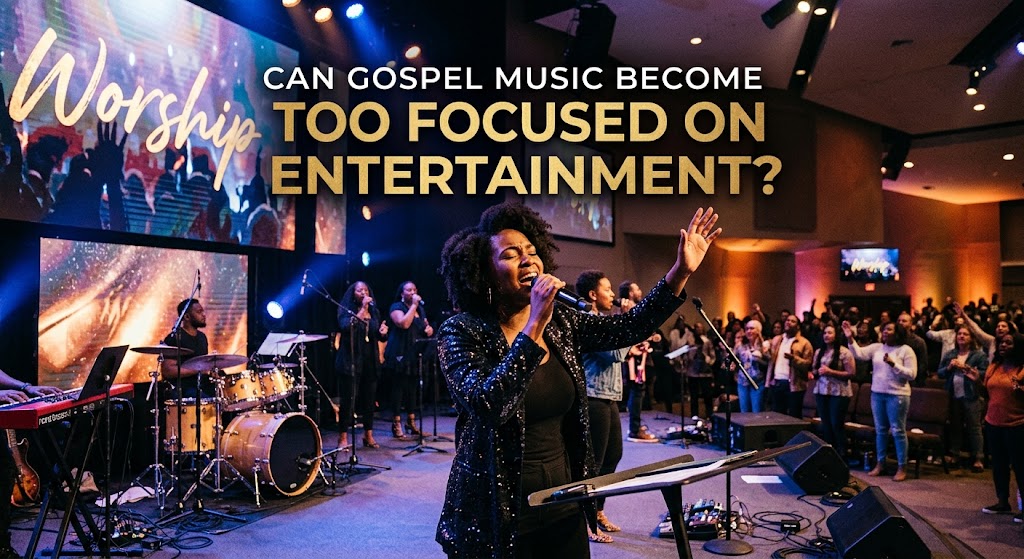
Can Gospel Music Become Too Focused on Entertainment?
Can Gospel Music Become Too Focused on Entertainment?
Can Gospel Music Become Too Focused on Entertainment? It is a question that deserves an honest conversation, especially at a time when gospel music has become more visible, more commercially successful and more accessible than ever before. Gospel music is now available on virtually every major streaming platform, social media has made it easier for Christian artists to reach millions of people, and modern gospel performances can attract audiences far beyond the walls of the traditional church. This growth is exciting, but it also raises an important concern. When gospel music becomes increasingly entertaining, where do we draw the line between using entertainment to communicate the message and allowing entertainment to become the message?
There is nothing inherently wrong with gospel music being enjoyable. Music has always been connected with emotion, celebration, creativity and human expression. A powerful melody can capture attention. A talented singer can communicate emotion in a way that spoken words sometimes cannot. A beautiful musical arrangement can make people want to listen repeatedly. There is therefore no biblical reason to assume that gospel music must be dull, poorly produced or emotionally lifeless in order to be spiritually meaningful. Excellence in music is not the enemy of spirituality. The real question is what happens when the desire to entertain becomes more important than the message the music is supposed to carry.
Gospel music has a unique responsibility because its identity is connected to the Christian faith. Unlike music created purely for entertainment, gospel music traditionally carries a spiritual message. It speaks about God, Jesus Christ, salvation, grace, faith, hope, repentance, worship, suffering, forgiveness and eternal life. For many listeners, gospel songs are not simply songs. They become prayers during difficult moments, reminders during seasons of doubt and sources of encouragement when life becomes overwhelming. That is why the question of entertainment deserves serious attention.
The problem does not begin when gospel music becomes attractive. The problem begins when attractiveness becomes the primary objective. An artist may become so concerned about getting streams, going viral, selling tickets, gaining followers and creating memorable performances that the spiritual substance of the music gradually becomes secondary. The song may still carry Christian language, but its main purpose may have shifted from communicating truth to producing a reaction.
This distinction can be difficult to recognise because entertainment and ministry can exist together. A gospel artist can create a song that is catchy, professionally produced and commercially successful while still presenting a sincere Christian message. There is no contradiction in reaching a large audience and remaining faithful to Christian principles. In fact, reaching more people can be a wonderful opportunity for ministry. The challenge is ensuring that success does not quietly change the reason the music exists.
Can Gospel Music Become Too Focused on Entertainment? Yes, it can. But the issue is not entertainment itself. The issue is when entertainment begins to control the content, purpose and direction of the music.
Consider what happens when an artist starts writing primarily for algorithms rather than people. Streaming platforms reward songs that attract attention and encourage repeated listening. Social media rewards short moments that can be turned into clips. Audiences often respond quickly to catchy choruses, impressive vocals, energetic dances and visually appealing music videos. These things can help gospel music spread, but they can also create pressure for artists to produce whatever is most likely to generate engagement.
When that pressure becomes dominant, an artist may begin asking, “What will go viral?” instead of asking, “What message needs to be communicated?” Those questions may sometimes lead to the same answer, but they are not always the same question.
A song created primarily to satisfy a trend can become outdated as quickly as the trend disappears. A song created from genuine conviction can continue speaking to people years after its release. This is one reason some gospel songs remain meaningful across generations. Their value is not dependent entirely on production techniques, fashion or social media popularity. Their message continues to speak because it addresses something deeper than the moment.
Another concern is the growing emphasis on performance. Gospel concerts can be powerful experiences. Lights, sound, choreography, stage design and energetic performances can create an atmosphere that audiences genuinely enjoy. There is nothing automatically wrong with this. Christian gatherings have always involved celebration, singing and collective expression. However, there is a danger when the audience becomes more impressed by the performer than moved by the message.
If people leave a gospel concert remembering the artist’s outfit, stage entrance and special effects but cannot remember anything meaningful about the message of the songs, it is worth asking what the event ultimately accomplished. Entertainment may have succeeded, but ministry may have been weakened.
The same concern applies to Christian music videos. Visual storytelling can make a gospel song more powerful. A well produced video can communicate emotion, illustrate biblical themes and introduce Christian music to audiences who might never attend a church service. But if the visual spectacle becomes so dominant that the message disappears into the background, the music can lose part of its identity.
There is also the issue of celebrity culture. Christian artists are not immune to the attraction of fame. Once an artist becomes successful, the surrounding industry can begin treating that person like any other celebrity. Interviews, endorsements, fashion, awards, social media influence and commercial opportunities can become increasingly important. Again, none of these things are automatically wrong. Christian musicians are allowed to build careers, earn money and enjoy success. The concern is what happens when celebrity identity becomes stronger than ministry identity.
A gospel artist can become so famous that audiences know everything about the artist except what the artist actually believes. The personality becomes the product. The music becomes a vehicle for personal branding. Eventually, listeners may follow the artist because of the artist’s image rather than because of the message being communicated.
This is particularly important for younger audiences who consume music through social media. A short clip may become popular because of a dance challenge, funny moment or impressive vocal performance. People may hear the song without understanding its context. That is not necessarily a failure. Music has always travelled beyond its original setting. But it means gospel artists must think carefully about what remains when the entertainment is removed.
What is left when the lights go off?
What is left when the concert ends?
What is left when the social media trend disappears?
What is left when the applause stops?
Those questions can reveal whether a gospel song has genuine substance.
One of the strongest arguments against excessive entertainment is that Christian music should point beyond the artist. The purpose of worship is not ultimately to make the worship leader look impressive. The purpose of gospel music is not ultimately to make the singer famous. The music should direct attention towards God and the truths of the Christian faith.
This does not mean every gospel song needs to sound like a traditional hymn. Christian music can take many forms. Gospel, contemporary worship, Christian hip hop, Afro gospel, Christian R&B, choir music and other styles can all communicate Christian themes. The style can change while the message remains meaningful.
This is especially relevant to African gospel music, which has developed a remarkable ability to combine Christian messages with local rhythms, languages and cultural expressions. Afro gospel, for example, demonstrates that Christian music can be energetic, modern and culturally relevant without automatically losing its spiritual identity. The problem is not whether a gospel song sounds modern. The question is whether the modern sound serves the message or replaces it.
There is also nothing wrong with gospel artists wanting people to dance. Scripture contains numerous examples of joyful celebration. Music can express happiness, thanksgiving and victory. A Christian song can make people smile, dance and celebrate while still pointing them towards God. Entertainment and spiritual depth are not mutually exclusive.
The real danger is imbalance.
A gospel song can have an incredible beat and almost no meaningful message. Another song can have beautiful lyrics but be so poorly produced that listeners struggle to engage with it. Neither extreme is necessarily ideal. There is room for excellence and substance to exist together.
Perhaps the better question is not whether gospel music should entertain but whether entertainment should serve the gospel.
That changes the conversation completely.
If a catchy chorus helps someone discover a message about God’s grace, entertainment has served the gospel. If a beautiful music video helps someone hear a song about hope during a difficult season, entertainment has served the gospel. If an energetic concert encourages people to celebrate their faith, entertainment can serve the gospel. But if the Christian message is reduced to decoration around a product designed primarily to generate fame, money and attention, then the priorities have become questionable.
Artists themselves have an important role to play in maintaining this balance. Before releasing a song, a gospel musician can ask several difficult questions. Why am I writing this song? What am I trying to communicate? Is this message consistent with Scripture? Would I still want people to hear this song if it never became popular? Am I creating this because I genuinely believe it or because I think it will perform well online?
Those questions do not eliminate ambition. They simply place ambition in the right position.
Listeners also have a responsibility. Audiences influence the direction of music through what they stream, share, purchase and celebrate. If listeners reward only spectacular performances and viral moments, artists will naturally notice. If audiences also celebrate meaningful lyrics, biblical depth, originality and genuine testimony, they create room for substance to succeed.
Churches have a similar responsibility. Churches can support professional musicians without turning worship into a concert where the congregation becomes an audience rather than participants. There is a difference between appreciating musical excellence and treating worship like a celebrity show.
Worship leaders also need humility. Musical ability can attract attention very quickly. A gifted singer can receive applause, admiration and public recognition. But Christian ministry requires remembering that talent is a gift and not a reason for pride. The microphone can amplify a person’s voice, but it can also amplify the person’s ego if character does not develop alongside talent.
The gospel music industry itself faces an even bigger challenge because commercial success is often measured using numbers. Streams, views, followers, ticket sales, chart positions and awards are easy to measure. Spiritual impact is much harder to quantify.
How many people prayed because of a song?
How many people returned to faith?
How many discouraged people found hope?
How many families were strengthened?
How many people opened the Bible because of a lyric?
How many people worshipped privately because a song reminded them of God’s presence?
Those results may never appear on a streaming dashboard.
This is why Christian music should not judge its entire success by popularity. A song with ten million streams is not automatically more spiritually valuable than a song with ten thousand streams. Numbers can demonstrate reach, but they cannot fully measure impact.
At the same time, Christians should be careful not to romanticise small audiences. A song does not become more spiritual simply because it is unpopular. Poor production does not automatically mean spiritual depth. Lack of commercial success is not proof of authenticity. Gospel artists should be encouraged to pursue excellence, professionalism and wide reach while remaining faithful to the message.
The healthiest future for gospel music may therefore be one where entertainment and ministry are not treated as enemies. Instead, entertainment can become a tool. Creativity can become a tool. Technology can become a tool. Social media can become a tool. Streaming platforms can become a tool. Fame can even become a tool when handled responsibly.
The important thing is who controls the tool.
If the message controls the entertainment, gospel music can remain powerful while reaching modern audiences. If entertainment controls the message, gospel music risks becoming indistinguishable from ordinary commercial music except for the religious vocabulary attached to it.
Can Gospel Music Become Too Focused on Entertainment? Absolutely. But that does not mean Christian music needs to become boring, old fashioned or disconnected from contemporary culture. Gospel music can be exciting. It can be innovative. It can be beautiful. It can be professionally produced. It can dominate streaming platforms. It can fill stadiums. It can win awards. It can create unforgettable performances.
The question is whether all that success still points people towards something greater than the performer.
The most powerful gospel music often achieves something remarkable. It gives listeners something enjoyable to hear while giving them something meaningful to carry. It entertains the ear while challenging the heart. It creates an emotional experience while communicating a spiritual truth. It may make people dance in one moment and pray in another.
That balance is possible.
Perhaps the real danger is not that gospel music has become too entertaining. Perhaps the deeper danger is forgetting why the music exists in the first place.
When entertainment becomes the servant, gospel music can reach more people.
When entertainment becomes the master, the message can slowly disappear.
And that is where every gospel artist, producer, worship leader, church and listener has a role to play. The future of gospel music should not be about choosing between excellence and spirituality. It should be about proving that the two can exist together.
Because at its best, gospel music does more than make noise. It tells a story. It carries testimony. It gives hope. It encourages faith. It creates moments of reflection. It celebrates God. It reminds people that their circumstances are not the end of their story.
That is a responsibility worth protecting.
So the next time you listen to a gospel song, do not only ask whether the beat is good or whether the singer can sing. Ask yourself a deeper question. After the music stops, what remains in your heart?
That answer may tell us more about the true purpose of gospel music than the number of streams, views or applause ever could.

Leave a Reply