
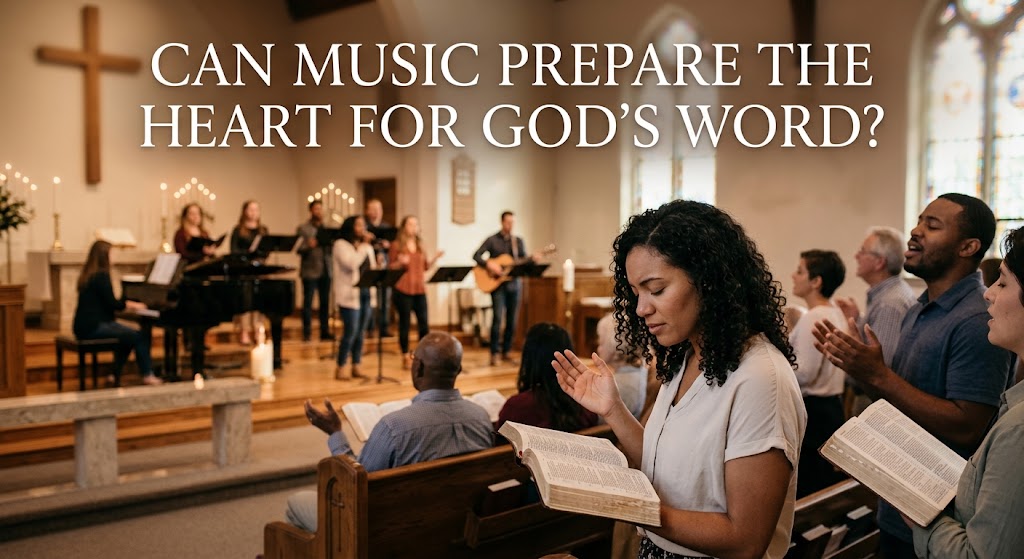
Can Music Prepare the Heart for God’s Word?
Can Music Prepare the Heart for God’s Word?
Can music prepare the heart for God’s Word? It is a question worth asking because music has always occupied a remarkable place in Christian worship. Before a sermon begins, people often sing. Before a Bible study, there may be worship. During personal devotion, many Christians listen to songs that help them slow down, reflect, pray and focus their minds on God. But is something deeper happening? Can music actually prepare the heart to receive God’s Word?
The short answer is yes, music can help prepare a person’s heart and mind for God’s Word, but it is important to understand what music can and cannot do. Music does not replace Scripture, and a beautiful melody cannot make a person spiritually receptive if the heart is deliberately closed to God. However, music can create an atmosphere of reflection, redirect attention, awaken gratitude, reinforce biblical truths and help a person become emotionally and mentally ready to listen.
The Bible itself gives music a significant role in the life of God’s people. One of the clearest examples appears in Colossians 3:16, where Paul connects the Word of Christ with psalms, hymns and spiritual songs. The passage presents singing not merely as entertainment or background noise but as one of the ways believers teach and encourage one another while allowing the message of Christ to dwell richly among them.
That connection is extremely important when considering the question, can music prepare the heart for God’s Word? The biblical picture does not place music and Scripture in competition. Instead, it shows that music can become a vehicle through which biblical truth is remembered, expressed, taught and celebrated.
Think about what happens when you hear a song you have not listened to for years. Sometimes you can remember the words almost immediately. A melody can bring back a place, a person, a season or an experience with surprising speed. Music has an unusual relationship with memory, and this is one reason it can be particularly powerful when connected with biblical truth.
A Christian song based on Scripture can place biblical ideas into a form that the listener can easily remember. Someone may forget the details of a sermon after several weeks, but a line from a worship song may remain in their mind for years. That line may return during a difficult moment, while travelling, during prayer or when facing temptation. In that sense, music can help carry biblical truth into places where a sermon may no longer be immediately present.
This does not mean that songs are automatically biblical simply because they are labelled Christian. That distinction matters. Christian music can be beautiful, emotionally powerful and professionally produced while still lacking theological depth. A song can make someone feel inspired without actually teaching anything accurate about God.
This is why the question should not simply be, can music prepare the heart for God’s Word? A better question is, what kind of music prepares the heart for God’s Word?
Music that directs attention towards God, reinforces biblical truth and encourages reflection can be particularly useful. Music that is centred entirely on human emotion, personal achievement or vague spirituality may create an emotional experience without necessarily preparing someone to understand Scripture.
The difference is significant.
Emotion can open our attention, but emotion is not the same thing as truth. A person can feel deeply moved and still misunderstand what God is saying. Christian maturity therefore requires both heart and mind. Worship should engage emotion, but it should also lead people towards truth.
Ephesians 5:19 similarly speaks about psalms, hymns and spiritual songs, describing believers as singing and making melody to the Lord from the heart. This demonstrates that music was not treated as an unnecessary decoration added to Christian gatherings. Singing was part of how believers expressed their relationship with God and encouraged one another.
There is also an important psychological dimension to this discussion. Research involving believers has found that music can help facilitate focus on God during worship, and that different musical conditions can influence the intensity of reported religious experiences. However, the researchers also cautioned against assuming that music automatically produces deeper spiritual experiences than worship without music. In other words, music can assist attention and experience, but it is not a magical shortcut to God.
That finding fits remarkably well with a balanced Christian understanding of worship.
Music can help you focus, but it cannot believe for you.
Music can stir emotion, but it cannot replace obedience.
Music can remind you of God’s promises, but it cannot replace reading those promises.
Music can prepare you to listen, but it cannot do the listening for you.
This distinction is essential because modern Christian music has enormous influence. Millions of Christians consume worship music through streaming platforms, social media, radio, church services and personal playlists. Songs can shape what people think about God, themselves, suffering, salvation, relationships, prayer and faith.
That means Christian music is not spiritually neutral.
The words matter.
The theology matters.
The message matters.
The intention matters.
The heart of the listener matters.
A song that accurately communicates biblical truth can become a powerful companion to Scripture. A song that repeatedly communicates a distorted view of God can also influence the listener’s understanding over time.
This is one reason Colossians 3:16 is so interesting. The passage does not simply say to sing because singing feels good. It connects singing with the message of Christ dwelling richly among believers and with teaching and admonishing one another.
In other words, Christian music can teach.
That should make every Christian musician, songwriter, worship leader and listener think carefully about what is being sung.
If music is capable of carrying theological ideas into people’s memories, then songwriting becomes more than a creative exercise. It becomes a form of communication.
A worship song may be repeated hundreds of times. A congregation may sing it every week. A child may grow up hearing it. A struggling believer may use it during prayer. Someone who has never opened a Bible may encounter a biblical idea for the first time through a song.
That is a tremendous responsibility.
Music can also help calm the mind before Scripture is read. Modern life is full of distractions. Phones constantly demand attention. Social media feeds move rapidly. Notifications interrupt conversations. Work creates pressure. Family responsibilities consume mental energy. By the time someone sits down to read the Bible, their body may be present while their mind is somewhere else.
A carefully chosen worship song can become a transition point.
It can signal that it is time to slow down.
It can move attention away from the noise of the day.
It can encourage gratitude.
It can remind the listener why they are about to open Scripture.
It can create a moment of stillness.
Then the Bible can be opened with a more focused mind.
This is one practical way to understand how music can prepare the heart for God’s Word.
Imagine someone returning home after a difficult day. They are frustrated, mentally exhausted and distracted. They sit down to read Scripture but find themselves thinking about everything that happened during the day. Instead of forcing themselves immediately into concentrated reading, they play a quiet worship song centred on God’s faithfulness.
As the song plays, their thoughts begin to settle.
They remember God’s goodness.
Their breathing slows.
Their attention changes.
They become more reflective.
Then they open the Bible.
The music did not replace God’s Word. It helped create a transition into a posture where the person was more ready to receive it.
That distinction may be one of the healthiest ways to think about Christian music.
Music can prepare the soil, but God’s Word is still the seed.
A song can soften the atmosphere, but Scripture still provides the truth.
A melody can awaken attention, but the Holy Spirit works through God’s truth.
A worship moment can move the heart, but spiritual transformation involves more than emotion.
This also explains why some worship experiences can feel powerful without producing lasting spiritual change. A person may experience intense emotion during a song and then return to exactly the same habits afterwards. Emotional intensity is not proof of spiritual maturity.
Christianity is not simply about feeling something during worship. It is about becoming someone who lives according to God’s truth.
This is where Scripture must remain central.
A recent scholarly discussion of contemporary worship music has raised concerns about what happens when songs place emotional experience above biblical content. The argument is not that worship music is inherently harmful, but that music can create genuine emotional engagement while potentially weakening biblical understanding if songs become substitutes for Scripture.
That is an important warning for modern Christianity.
We should never create a situation where people know hundreds of worship songs but struggle to explain the basic teachings of the Bible.
We should never allow emotional worship to become a replacement for biblical literacy.
We should never assume that because a song makes us cry, the message must be true.
We should never confuse musical atmosphere with the presence of God.
And we should never make music the destination when it was designed to point us towards God.
The healthiest relationship between Christian music and Scripture is complementary.
Music can help us approach Scripture.
Scripture can give our music its foundation.
Music can help us remember Scripture.
Scripture can help us evaluate the message of our music.
Music can express what Scripture teaches.
Scripture can correct what our emotions sometimes tell us.
This relationship is particularly powerful in personal devotion.
Imagine creating a morning routine that begins with a carefully selected Christian song, followed by prayer and Bible reading. The song is not there simply to create a pleasant mood. It becomes a spiritual transition from ordinary activity into intentional attention towards God.
The same principle can work at night.
A person may end the day by listening to a quiet worship song, reflecting on God’s faithfulness and then reading a short portion of Scripture. Over time, such habits can create a rhythm that encourages consistent spiritual reflection.
Parents can also use Christian music intentionally within the home. Children often remember songs extremely well. A biblical truth placed inside a memorable melody can become something they carry with them into adulthood.
Churches can benefit from the same principle.
A worship team should not think of its role merely as creating an emotional experience. Its ministry can help the congregation remember who God is, what He has done and what Scripture teaches. Music can prepare people to listen, but the goal should ultimately be deeper engagement with God and His truth.
This means worship leaders have an important responsibility when choosing songs.
Is the song biblically sound?
Does it communicate something true about God?
Does it point people towards Christ?
Does it encourage faithfulness?
Does it help believers think about Scripture?
Does it give the congregation words that are worth remembering?
Does it encourage genuine worship rather than simply emotional excitement?
These questions matter because the most popular song is not necessarily the most spiritually useful song.
Likewise, the loudest worship experience is not necessarily the deepest.
Sometimes the most powerful preparation for God’s Word may be a quiet song with simple lyrics and a message rooted deeply in Scripture.
Sometimes it may be an old hymn.
Sometimes it may be contemporary gospel music.
Sometimes it may be instrumental music.
And sometimes the best preparation may be silence.
That last point is worth emphasising.
If music becomes so dominant that a person cannot sit quietly with Scripture, then music may have moved from being a servant to becoming a distraction.
The goal is not to keep the listener emotionally stimulated.
The goal is to help the listener encounter truth and respond to God.
There is nothing wrong with powerful music. There is nothing wrong with energetic praise. There is nothing wrong with emotional worship. Christianity is not opposed to emotion.
The danger comes when emotion becomes the measure of spiritual truth.
A worship service does not become successful because everyone cried.
A song does not become anointed simply because people raised their hands.
A Christian song does not become biblically sound because it is popular.
And a sermon does not become powerful simply because people felt emotional.
The deeper question is always what happens afterwards.
Does the music make you more willing to hear God’s Word?
Does God’s Word change how you live?
Does worship lead to obedience?
Does singing produce gratitude?
Does Scripture produce transformation?
That is where the real test lies.
The relationship between music and God’s Word can also be seen in the story of Paul and Silas in Acts 16. While imprisoned, they prayed and sang hymns to God. Their circumstances were terrible, yet their worship did not depend upon comfort. Their singing became an expression of faith in the middle of suffering. The account reminds us that Christian music can carry faith into places where circumstances seem to contradict hope.
This is perhaps one of the greatest strengths of gospel music.
It gives people language for faith when ordinary conversation is not enough.
A person facing grief may struggle to pray but find themselves singing.
Someone experiencing fear may remember a worship chorus.
Someone waiting for an answer may repeatedly sing about God’s faithfulness.
Someone who feels spiritually weak may listen to a song reminding them that God has not abandoned them.
Music can give emotional expression to truths that Scripture has already established.
That is why the question, can music prepare the heart for God’s Word, has such a meaningful answer.
Yes, it can.
But the preparation is not the same as transformation.
Music can open attention.
God’s Word provides truth.
Music can awaken emotion.
God’s Word provides understanding.
Music can help us remember.
God’s Word provides the message we are remembering.
Music can help us slow down.
God’s Word speaks into the heart and mind.
Music can create an environment of worship.
God remains the object of worship.
The distinction protects Christian worship from two opposite mistakes.
The first mistake is treating music as unimportant. Throughout Scripture, singing and music are repeatedly associated with worship, thanksgiving, teaching and communal faith.
The second mistake is treating music as spiritually sufficient.
It is not.
A Christian can listen to worship music all day and still neglect Scripture.
A person can know every popular gospel song and still lack biblical understanding.
Someone can attend worship every week and still refuse to obey what God teaches.
Music is powerful, but power must be directed towards something.
For Christian music, that something should ultimately be God.
So the next time you press play on a worship song before reading your Bible, do not think of the music merely as background noise. Use the moment intentionally. Let the song quiet the noise around you. Let it remind you of God’s character. Let it move your attention away from distractions. Then open Scripture and listen.
Do not stop at the feeling.
Go deeper into the truth.
Do not simply ask whether the song made you feel close to God.
Ask what the song taught you about God.
Do not simply ask whether the melody was beautiful.
Ask whether the message was faithful.
Do not simply sing the words.
Think about them.
And after the music stops, allow God’s Word to continue speaking.
Perhaps that is the most balanced answer to the question, can music prepare the heart for God’s Word?
Music can prepare the heart, focus the mind, awaken gratitude and reinforce truth. Research also suggests that music can influence attention during religious experiences, although it does not guarantee a deeper spiritual experience. The Bible presents singing as closely connected with teaching, encouragement and allowing Christ’s message to dwell richly among believers.
But music is not God’s Word.
It can point towards it.
It can help us remember it.
It can help us emotionally respond to it.
It can create space for us to hear it.
Yet ultimately, the purpose of Christian music should not be to keep us endlessly listening to songs. It should help us become people who know God’s truth, love His presence and live according to His Word.
The greatest worship song is therefore not necessarily the one that produces the strongest emotional reaction. It may be the one that leaves you thinking more deeply about God after the final note has disappeared.
A song may last four minutes.
A biblical truth can shape an entire lifetime.
That is why music can be a powerful doorway into Scripture, but God’s Word must remain the foundation.
So, can music prepare the heart for God’s Word?
Yes. When it is rooted in truth, used intentionally and directed towards God, music can help quiet distractions, focus attention, awaken gratitude and make the listener more receptive to Scripture. But the ultimate purpose is not simply to feel prepared. It is to hear, understand, believe and live out what God has said.
The music may open the door.
The Word must still enter the heart.

Leave a Reply