
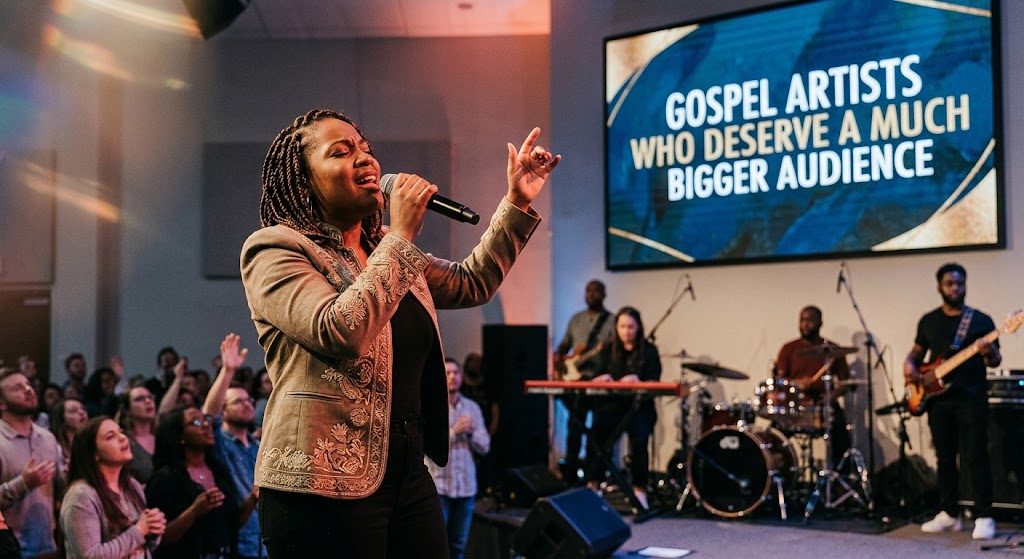
Gospel Artists Who Deserve a Much Bigger Audience
There are gospel artists who fill stadiums, dominate streaming platforms and have millions of followers across social media. Their songs are everywhere, their names are familiar, and their latest releases can become popular within hours. But beyond the biggest names in gospel music, there are countless gifted musicians creating beautiful, meaningful and spiritually uplifting music without receiving anything close to the attention they deserve. These are the Gospel Artists Who Deserve a Much Bigger Audience, and their stories deserve to be told.
The gospel music industry is filled with extraordinary talent. Some artists have powerful voices, some are exceptional songwriters, some are brilliant performers, while others have a unique ability to communicate faith through music in ways that reach deeply into the human heart. Yet talent alone does not guarantee visibility. Sometimes an artist can produce excellent music for years while remaining relatively unknown outside a small community of dedicated listeners.
This raises an important question. Why do some gospel artists become household names while equally talented musicians struggle to get noticed?
The answer is not always about musical quality. In today’s music industry, visibility, marketing, social media presence, playlist placement, collaborations, audience engagement and financial resources can have a major influence on how far a song travels. An artist may have an incredible voice and a powerful message, but if very few people discover the music, the talent can remain hidden.
That is why discussions about Gospel Artists Who Deserve a Much Bigger Audience are important. There are musicians producing songs that deserve to be heard beyond their immediate churches, cities or countries. There are artists whose music can encourage someone going through grief, strengthen someone struggling with faith, inspire someone who feels forgotten and remind another person that they are not alone.
One of the most interesting things about gospel music is that its value cannot always be measured by numbers. A song with 10 million streams is not automatically more meaningful than a song with 10,000 streams. A singer with millions of followers is not necessarily more gifted than an independent artist with a small audience. Numbers can measure reach, but they cannot completely measure impact.
Some of the Gospel Artists Who Deserve a Much Bigger Audience are already making music that competes with anything being released by bigger names. Their challenge is often discovery rather than ability.
Think about the independent gospel artist recording songs in a small studio after work. Think about the worship leader serving faithfully in a local church while writing songs that could encourage thousands of people. Think about the songwriter whose lyrics are filled with Scripture, personal testimony and genuine emotion but whose music has barely reached beyond their immediate circle.
These musicians may never have the marketing budgets of major artists, but that does not make their work less valuable.
Another reason some deserving gospel artists remain underappreciated is that the modern music industry rewards consistency and visibility. An artist may release an incredible song, but if they disappear for six months without communicating with their audience, the momentum can disappear. Meanwhile, another musician may consistently release music, post content, interact with listeners and collaborate with other artists.
The Gospel Artists Who Deserve a Much Bigger Audience
This does not mean the more visible artist is better. It simply means they have developed a stronger system for getting their music in front of people.
The rise of social media has changed the situation considerably. A relatively unknown gospel artist can now reach listeners across the world without waiting for a traditional record label to discover them. Platforms such as YouTube, TikTok, Instagram and streaming services have created opportunities that previous generations of musicians never had.
Yet opportunity does not automatically produce success.
Thousands of gospel songs are uploaded online every day. That means an artist can easily become invisible in an overcrowded digital environment. The quality of the music matters, but so does the ability to package, promote and consistently present that music to potential listeners.
This is why listeners also have a role to play.
If you discover a gospel artist whose music genuinely blesses you, do more than listen once. Follow the artist. Share the song. Add it to your playlist. Recommend it to a friend. Leave a meaningful comment. Watch the video. Attend the artist’s concert if possible. Purchase their music or merchandise when available.
A simple share can introduce an artist to someone who desperately needs the message contained in their song.
Many Gospel Artists Who Deserve a Much Bigger Audience are not necessarily asking to become celebrities. Some simply want their music to reach the people who need it. There is a major difference between seeking fame and seeking impact.
A gospel musician can desire a larger audience because a larger audience means a larger opportunity to communicate a message of hope, faith, repentance, encouragement, love and salvation.
Of course, not every gospel artist needs to become globally famous. There is nothing wrong with being a local artist who ministers effectively to a specific community. Bigger is not always better.
However, there are musicians whose artistic quality, lyrical depth and spiritual message are so strong that it is difficult not to wonder why more people have not discovered them.
One category that deserves more attention is the emerging African gospel artist.
Africa has become an increasingly influential force in contemporary gospel music. From Nigeria and Ghana to South Africa, Kenya, Uganda and beyond, African musicians are blending traditional sounds with contemporary production, creating music that can connect with listeners from different cultural backgrounds.
The energy of African gospel music is remarkable. It can combine powerful vocals, infectious rhythms, rich harmonies and deeply spiritual messages. Yet many talented African gospel artists remain largely unknown outside their home countries.
This is changing gradually as streaming platforms and social media make geographical boundaries less important.
An artist in Lagos can release a song today and have someone in London, New York, Johannesburg or Toronto listening to it tomorrow. A worship song recorded in Accra can find an audience in another continent. A choir in South Africa can inspire listeners thousands of kilometres away.
The internet has effectively turned the world into one enormous potential audience.
But discovering these artists requires curiosity. Listeners have to look beyond the biggest names appearing repeatedly on popular playlists.
There is also something beautiful about discovering an artist before everyone else does.
You find a song with only a few thousand views. You listen to it. The lyrics speak directly to something you have been experiencing. You share it with a friend. Months later, the artist begins to grow. Eventually, the song reaches a much larger audience.
There is a unique satisfaction in knowing you discovered the music before it became popular.
Some Gospel Artists Who Deserve a Much Bigger Audience are also excellent songwriters. Songwriting is one of the most important yet frequently overlooked parts of gospel music. A powerful melody may attract attention, but meaningful lyrics can stay with someone for years.
Consider the difference between simply singing about faith and telling a story of faith.
The strongest gospel songs often feel personal. They sound as though someone took a difficult experience, brought it before God and turned it into music. That kind of songwriting can connect with listeners because life itself is complicated.
People experience disappointment, rejection, financial pressure, broken relationships, grief, loneliness, uncertainty and fear. They need music that acknowledges those realities while pointing them toward hope.
This is where lesser known gospel artists can be particularly powerful.
Because many independent musicians are writing from personal experiences rather than trying to manufacture a commercial sound, their songs can sometimes feel remarkably honest.
Their voices may not be technically perfect. Their productions may not have the biggest budgets. Their music videos may not look like major label productions. But there can be something genuine in the music that expensive production cannot manufacture.
Authenticity still matters.
Another group that deserves recognition is the gospel artist who refuses to compromise the message simply to chase trends.
The pressure to become popular can be enormous. Musicians see what is trending and naturally want to participate. There is nothing inherently wrong with adapting to changing musical styles, but the danger comes when the message becomes secondary to popularity.
Some artists continue creating music that reflects their convictions even when it may not be the easiest route to mainstream attention.
Those musicians deserve respect.
A gospel song does not necessarily need to sound old fashioned to be spiritually meaningful. Contemporary gospel music can incorporate Afrobeats, hip hop, R&B, soul, pop, electronic production and other modern influences while maintaining a Christian message.
The important question is not simply whether the sound is modern.
The more important question is whether the message still has substance.
This is another reason the conversation around Gospel Artists Who Deserve a Much Bigger Audience matters. There are artists experimenting creatively while still producing music that encourages listeners to think about their relationship with God.
There are also gospel musicians who deserve attention because of their live performances.
Some singers sound good in the studio but struggle to create an atmosphere when performing live. Others can walk onto a stage with very little production and immediately command attention.
A great gospel performer does more than sing notes. They communicate.
They can take a room full of strangers and create a moment of collective reflection, celebration or worship. They can make people feel something beyond the music itself.
These artists should not be overlooked simply because they are not yet household names.
Churches and gospel music organisations also have a role to play in discovering and supporting emerging talent.
Many future gospel stars are currently singing in local churches, university fellowships, choirs and small worship groups. They may have never performed on a major stage. They may not have professional management. They may not even consider themselves professional musicians yet.
But talent often begins quietly.
Someone has to notice.
Someone has to give them an opportunity.
Someone has to invite them to perform.
Someone has to share their music.
Someone has to believe that their voice deserves to be heard.
The next major gospel artist may not currently have millions of followers. They may be recording songs in a bedroom, church studio or modest local facility. They may be posting music that receives little engagement today.
That does not mean the music will always remain unnoticed.
Every established artist was once an unknown artist.
Every famous song was once an unreleased idea.
Every large audience began with a first listener.
That first listener matters more than we sometimes realise.
For music bloggers, gospel websites and Christian media platforms, there is also an opportunity to change the discovery process. Instead of covering only artists who are already famous, media platforms can dedicate space to emerging musicians.
A thoughtful review can introduce an unknown artist to thousands of readers. An interview can give listeners a reason to learn about the person behind the music. A well written feature can explain the story behind a song and encourage people to listen.
This is how music ecosystems grow.
The responsibility should not fall entirely on artists.
Listeners can help. Bloggers can help. Churches can help. DJs can help. Radio presenters can help. Playlists can help. Influencers can help. Music promoters can help.
When these different groups work together, talented musicians have a better chance of reaching the audiences they deserve.
There is also a lesson here for aspiring gospel artists.
If your music is not receiving the attention you hoped for, do not immediately conclude that your talent is the problem.
Sometimes the problem is visibility.
Sometimes your audience has simply not discovered you yet.
Keep improving your craft. Keep writing. Keep recording. Keep learning. Study your audience. Learn how digital platforms work. Build relationships with other musicians. Collaborate. Perform. Tell your story. Promote your music consistently.
Most importantly, do not allow low numbers to convince you that your music has no value.
A song can have a small audience and still have enormous impact.
Perhaps one person listens to it on the worst night of their life and decides not to give up.
Perhaps another person hears it while travelling home and finds the encouragement they needed.
Perhaps someone who had stopped praying hears one lyric that makes them pray again.
Those moments will never necessarily appear in a streaming report.
But they matter.
That is why Gospel Artists Who Deserve a Much Bigger Audience should not be judged exclusively by follower counts, streaming numbers or chart positions.
Some of the most valuable Christian music is still waiting to be discovered.
The next time you open your favourite streaming platform, do not only search for the artists you already know. Search for emerging gospel musicians. Explore independent worship artists. Listen to new African gospel releases. Give unfamiliar voices a chance.
You may discover something extraordinary.
You may find an artist whose voice becomes part of your personal worship journey.
You may find a songwriter whose lyrics describe exactly what you have been unable to express.
You may discover a song that becomes the soundtrack to a season of your life.
And perhaps most importantly, you may help an artist reach someone else who needs their music.
The gospel music world does not need only bigger stars. It needs more meaningful voices.
It needs musicians who understand that music can entertain but can also encourage. It needs songwriters who understand that lyrics can become prayers. It needs worship leaders who understand that performance is not the same thing as ministry. It needs artists who are willing to develop their craft without losing the heart behind their message.
There are countless Gospel Artists Who Deserve a Much Bigger Audience waiting for someone to discover them.
Maybe that someone is you.
Maybe the next time an unfamiliar gospel song appears on your feed, you will listen instead of scrolling past.
Maybe you will share it.
Maybe you will tell someone about the artist.
Maybe you will help turn an unknown musician into a voice heard around the world.
Because sometimes an artist does not need another million followers to prove that their music matters.
They simply need the right person to press play.
And that is perhaps the most beautiful thing about discovering Gospel Artists Who Deserve a Much Bigger Audience. You are not simply finding new music. You may be discovering a voice that has the potential to encourage, inspire and strengthen someone else’s faith for years to come.

Leave a Reply