
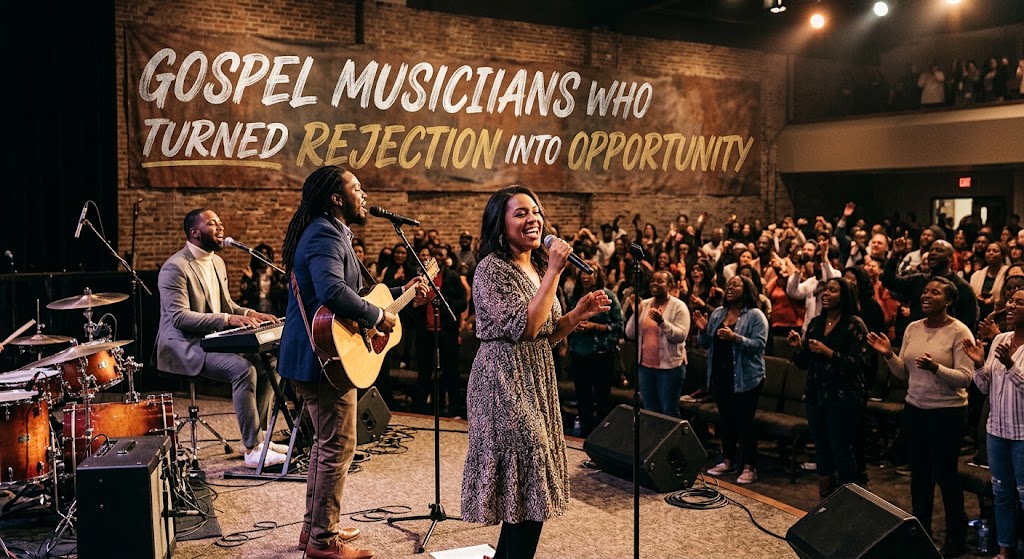
Gospel Musicians Who Turned Rejection Into Opportunity
Gospel Musicians Who Turned Rejection Into Opportunity
Gospel musicians who turned rejection into opportunity remind us that a closed door is not always the end of the story. Sometimes, rejection is simply a painful interruption before a much bigger opportunity appears. Behind some of the most recognised names in gospel music are stories of disappointment, criticism, limited opportunities, unanswered requests, and moments when people had to keep believing even when others did not believe in them.
The Christian music industry can look glamorous from the outside. We see the packed concerts, powerful worship sessions, sold out events, awards, streaming numbers, television appearances and thousands of people singing along to familiar songs. What we do not always see is what happened before the spotlight arrived. Many gospel musicians had to deal with seasons when their music was ignored, their abilities were questioned, their opportunities were limited or their dreams seemed impossible.
That is why stories about gospel musicians who turned rejection into opportunity are so powerful. They demonstrate that talent alone does not guarantee success. Faith, persistence, preparation, courage and the willingness to keep moving can make a tremendous difference when circumstances appear to be working against you.
Rejection can be painful, especially for an artist who genuinely believes that music is part of their calling. Imagine spending months writing songs, rehearsing, recording and praying over your work, only to hear that a record label is not interested. Imagine submitting your music to promoters and receiving no response. Imagine being told that your sound is not commercially viable or that there is no place for your style of music. For many musicians, those experiences could easily become reasons to quit.
Yet some artists have responded differently.
Kirk Franklin is one of the clearest examples of a gospel artist who demonstrated the importance of persistence and innovation. His career was not built simply by following the established gospel music formula. Franklin brought together gospel, choir music, hip hop, contemporary R&B influences and spoken word elements in ways that initially challenged expectations about what gospel music could sound like. His approach helped introduce gospel music to audiences who might not traditionally have listened to it.
The lesson is important. Sometimes rejection happens because an idea is too different for people who are accustomed to what already exists. An artist who constantly changes their vision simply to satisfy every critic may eventually lose the very uniqueness that makes their music valuable.
Franklin’s career demonstrates how an artist can take resistance and turn it into creativity. Instead of treating traditional expectations as an absolute boundary, he developed a sound that connected with a new generation. His success helped demonstrate that Christian music could communicate its message through contemporary musical languages without necessarily abandoning its spiritual foundation.
Another important example is CeCe Winans, whose career shows how persistence and preparation can create opportunities over time. Before becoming one of the most respected voices in contemporary Christian and gospel music, Winans developed her craft through years of singing and performing. Her partnership with her brother BeBe became an important part of her early musical journey, and her career eventually expanded into a successful solo path.
What makes stories like this significant is that opportunities in music are rarely created overnight. An artist may spend years developing their voice before the wider public discovers them. What looks like sudden success is often the result of a long period of preparation that nobody was watching.
Donnie McClurkin also represents the kind of artist whose difficult experiences became part of the message behind his ministry. His life story has included significant personal struggles, and those experiences influenced the themes of restoration, faith and perseverance that became central to his music.
This is one of the remarkable things about gospel music. Pain does not necessarily disqualify an artist from ministry. Sometimes the experiences that almost break a person become the very experiences that give their testimony depth.
A song about surviving a difficult season sounds different when the person singing it has actually lived through hardship. A message about God’s faithfulness can carry unusual weight when it comes from someone who has experienced seasons when faith was all they had.
The story of gospel musicians who turned rejection into opportunity is therefore not simply a story about getting a record deal after being rejected. It is also about transforming difficult experiences into meaningful art.
Tasha Cobbs Leonard is another powerful example of how an artist can grow from relatively local ministry settings into an international gospel career. Her rise was strongly connected to worship ministry and the impact of her music, particularly through songs that resonated with congregations and listeners beyond her immediate environment.
Her journey demonstrates something aspiring gospel musicians sometimes forget. Not every opportunity initially looks like an opportunity.
A church worship service may not feel like a major career platform. Singing in a small congregation may not generate millions of streams. Leading worship at an event may not attract record executives. But an artist who treats every opportunity as a chance to develop their gift, serve people and build genuine connections may eventually discover that small platforms are preparing them for larger ones.
Sinach provides another remarkable example, particularly from an African gospel music perspective. As a Nigerian gospel singer and songwriter, she spent years writing and releasing Christian music before achieving the kind of international recognition that would eventually make songs such as “Way Maker” known across churches and Christian communities around the world.
The global success of “Way Maker” demonstrated the power of a song that began within an African Christian music context to cross geographical and cultural boundaries. The song was subsequently recorded and performed by numerous international Christian artists, helping expose Sinach’s songwriting to audiences far beyond Nigeria.
Her journey carries an important message for gospel musicians who feel overlooked because they are not based in the traditional centres of the global music industry. Geography does not necessarily determine the ultimate reach of a song.
The internet has completely changed this equation.
A gospel musician no longer has to wait for a major label executive to discover them before they can reach an audience. YouTube, streaming platforms, social media and digital distribution have created opportunities for independent musicians to publish their work directly to listeners.
This means rejection from one gatekeeper does not necessarily prevent an artist from building an audience.
A musician who is rejected by a record label can release independently. An artist who is ignored by a radio station can build an audience through social media. A singer who cannot secure a major concert can start with smaller worship events. A songwriter whose compositions are rejected by established performers can continue writing and eventually find an artist who connects with the material.
This is one of the biggest changes in the modern gospel music industry.
In the past, a handful of institutions could determine who received significant exposure. Today, technology has distributed some of that power among artists and audiences.
That does not mean rejection has disappeared. It means rejection has become less final.
A “no” from one person does not automatically mean “no” from the entire world.
This is a lesson every emerging gospel musician should understand.
Rejection should be evaluated rather than simply accepted as a verdict on your worth. Sometimes rejection means the music genuinely needs improvement. Sometimes the timing is wrong. Sometimes the audience is wrong. Sometimes the person making the decision simply does not understand your vision. Sometimes there are business considerations that have nothing to do with your talent.
The mature response is to ask questions.
What can I learn from this rejection?
Was the song properly produced?
Is the songwriting strong enough?
Am I targeting the right audience?
Is my branding clear?
Have I promoted the music effectively?
Am I relying too heavily on one platform?
Do I need more experience?
Am I giving up because someone said no?
These questions can turn rejection into useful information.
One of the greatest mistakes an aspiring gospel musician can make is allowing rejection to become an identity.
There is a huge difference between “they rejected this song” and “I am a rejected musician.”
The first is an event.
The second is an identity.
An event can be analysed, corrected and overcome. An identity can become a prison.
Many gospel musicians who turned rejection into opportunity understood this distinction. They did not allow one failed audition, one unanswered email, one negative review or one missed opportunity to define their entire future.
They kept developing.
They kept writing.
They kept singing.
They kept serving.
They kept learning.
Most importantly, they kept showing up.
Another lesson from these musicians is the importance of patience. Modern social media can make success appear much faster than it really is. An emerging artist sees another musician go viral and may wonder why their own career has not taken off.
But viral success is not the same thing as sustainable success.
A gospel musician can have one song explode online and still struggle to build a long term career. Another musician may spend years developing a catalogue of meaningful songs, strengthening their audience and improving their craft before experiencing major recognition.
The second journey may appear slower, but it can create a stronger foundation.
This is why emerging gospel artists should not measure their entire journey against someone else’s highlight reel.
Rejection can also force musicians to become more creative.
When traditional opportunities are unavailable, artists often discover alternative routes. They may learn how to record music independently. They may become better at social media. They may start their own music platform. They may collaborate with other independent musicians. They may organise their own concerts. They may learn digital marketing and audience building.
What initially looks like a limitation can therefore become a training ground.
An artist who is forced to learn how to promote their own music may eventually become better at marketing than an artist who has always depended on a record label.
An artist who cannot afford expensive production may learn how to create compelling music with limited resources.
A singer who is not immediately accepted by mainstream gospel circles may discover an underserved audience online.
Sometimes the opportunity is hidden inside the rejection.
This does not mean every rejection should be romanticised. Some rejection is simply rejection. Some doors genuinely need to remain closed. Not every criticism is persecution, and not every setback means that success is just around the corner.
Gospel musicians must also be humble enough to accept legitimate criticism.
If several experienced people independently identify the same weakness in your music, ignoring them may not be faith. It may be stubbornness.
The goal is not to become immune to criticism. The goal is to become wise enough to separate useful criticism from discouragement.
That distinction can change an artist’s career.
The stories of gospel musicians who turned rejection into opportunity ultimately teach a lesson that extends far beyond music. Everyone experiences rejection. Someone may reject your business idea. Someone may reject your application. Someone may reject your writing. Someone may reject your relationship. Someone may reject your creative work.
The natural reaction is to feel embarrassed or discouraged.
But rejection does not automatically mean you are finished.
Sometimes it forces you to improve.
Sometimes it redirects you.
Sometimes it introduces you to a different audience.
Sometimes it pushes you to create something nobody expected.
Sometimes it teaches you that your identity cannot depend on human approval.
For Christian musicians, there is another dimension to this conversation. Calling, talent and opportunity are not always experienced in the same order.
A person may know they have a gift but still spend years waiting for the right platform. That waiting period can feel frustrating, but it can also become a period of preparation.
The hidden season matters.
The rehearsals matter.
The small audiences matter.
The songs nobody hears matter.
The failed opportunities matter.
The lessons learned from criticism matter.
The discipline developed when nobody is watching matters.
When the larger opportunity eventually comes, the artist who used the waiting season wisely may be better prepared to handle it.
That is why the stories of gospel musicians who turned rejection into opportunity should not simply be viewed as inspirational celebrity stories. They are lessons in resilience.
They remind musicians that the absence of an opportunity today does not necessarily mean the absence of an opportunity tomorrow.
They remind songwriters that one rejected song does not invalidate their gift.
They remind worship leaders that a small congregation can still be a meaningful ministry.
They remind independent artists that technology has created alternative paths to audiences.
And they remind Christians that success should not be measured solely by visibility.
A song does not have to dominate the charts to touch someone’s life.
A musician does not have to win an award to make a difference.
A worship leader does not need a massive platform to serve God faithfully.
Sometimes the most important listener is the person nobody else knows is listening.
The next time a gospel musician faces rejection, the question should not simply be, “Why did they say no?”
A better question may be, “What can I build from this?”
That question changes everything.
Maybe the rejected song can be rewritten.
Maybe the ignored demo can become the foundation for an independent release.
Maybe the failed audition can expose areas that need improvement.
Maybe the closed door can encourage the musician to create their own platform.
Maybe the criticism can make the next project stronger.
Maybe the disappointment can become the story behind the next great gospel song.
That is the real power behind the stories of gospel musicians who turned rejection into opportunity. They did not necessarily avoid rejection. They learned how to respond to it.
And perhaps that is the lesson every aspiring Christian musician needs to hear.
You may be rejected today without being defeated forever.
Someone else’s “no” does not have the authority to write the final chapter of your story.
Keep growing. Keep serving. Keep creating. Keep learning. Keep your heart right. Keep your message clear. Keep improving your craft.
The door that closes may hurt, but it may also force you to discover a door you would never have noticed otherwise.
In gospel music, some of the most powerful songs have come from people who understood disappointment, endured difficult seasons and refused to allow rejection to silence their voices.
The next great gospel testimony could therefore be forming in a season that currently feels like failure.
And that is why the stories of gospel musicians who turned rejection into opportunity matter so much. They prove that sometimes the setback is not the end of the music.
Sometimes, it is where the real song begins.

Leave a Reply