
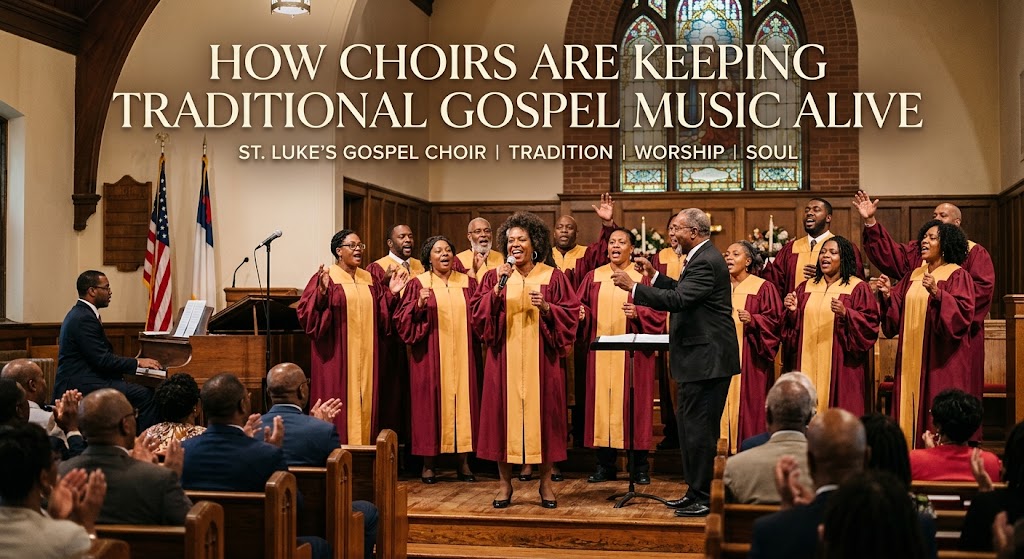
How Choirs Are Keeping Traditional Gospel Music Alive
How Choirs Are Keeping Traditional Gospel Music Alive
How Choirs Are Keeping Traditional Gospel Music Alive is a question worth asking at a time when Christian music is changing faster than ever. New sounds are emerging, worship styles are evolving, and digital platforms are changing the way listeners discover songs. Yet, despite all these changes, traditional gospel music continues to find a place in churches, communities, families, and the hearts of millions of listeners. Much of this survival can be credited to choirs.
Choirs have always been more than groups of people standing together to sing. They are musical communities that carry memories, stories, beliefs, traditions, and spiritual experiences from one generation to another. When a choir performs an old gospel song, it is not simply reproducing an arrangement from the past. It is keeping a piece of musical and spiritual history alive.
Traditional gospel music has a distinctive character. Its powerful harmonies, call and response patterns, memorable melodies, emotional vocals, meaningful lyrics, hand clapping, rhythmic arrangements, and strong emphasis on faith have helped it survive different generations of musical change. While contemporary Christian music has introduced new production techniques and modern influences, traditional gospel continues to offer something that many listeners find deeply authentic.
One of the most important ways choirs are keeping traditional gospel music alive is through generational transfer. Older members of church choirs often know songs that younger generations may never encounter through mainstream music platforms. These older singers can teach younger members songs they learned decades ago, including hymns, spirituals, traditional gospel compositions, and locally recognised Christian songs.
This creates a musical chain between generations. A grandmother may have learned a song from her parents, sung it in church for many years, and eventually taught it to younger choir members. Those younger singers may then perform the song for an entirely new audience. Without that process, many traditional gospel songs could gradually disappear from public memory.
Choirs also preserve traditional gospel music by maintaining musical styles that are sometimes overlooked by modern commercial music. Contemporary Christian music often relies heavily on studio production, electronic instruments, programmed rhythms, and carefully produced vocals. Traditional gospel choir music, by contrast, often places greater emphasis on human voices, harmonies, rhythm, emotion, and collective performance.
There is something unique about hearing several voices blend together naturally. The strength of a choir does not come from one person alone. It comes from the combination of different voices working together. That collective sound is one of the characteristics that makes traditional gospel music so recognisable.
Another important contribution choirs make is preserving songs that may not be commercially popular. The music industry naturally focuses attention on songs that generate streams, downloads, views, and revenue. As a result, some older gospel songs may receive little attention from modern commercial platforms. But a church choir does not necessarily need a song to be commercially successful before performing it.
A choir can continue singing a song simply because the message remains meaningful.
This is extremely important for the survival of traditional gospel music. A song does not have to become a viral sensation to remain valuable. Sometimes its greatest legacy is created quietly inside churches and communities where people continue to sing it year after year.
Choirs also keep traditional gospel music alive through church services. Sunday worship remains one of the most important spaces where older Christian songs are introduced to younger people. A child who hears a choir singing a traditional gospel song may become familiar with that song without ever intentionally searching for it online.
Over time, that song can become part of the child’s personal musical memory. Years later, the same person may sing it with another generation. This is how musical traditions survive.
Church choirs also give traditional gospel songs a living environment. A song performed in a church is not merely heard. It can become connected to prayer, celebration, mourning, thanksgiving, fellowship, and personal testimony. These emotional experiences give the music meaning beyond entertainment.
This is another reason traditional gospel music remains powerful. Many listeners associate certain songs with important moments in their lives. A particular hymn may remind someone of childhood. Another gospel song may remind someone of a parent or grandparent. Another may be associated with a difficult season that eventually ended in victory.
Choirs help create these memories.
How Choirs Are Keeping Traditional Gospel Music Alive can also be understood through the role of live performance. In an age where much of the music people consume is recorded and edited in studios, live choir performances provide a different experience. The audience can see singers interacting with one another, responding to the worship leader, following the conductor, clapping, moving, and responding emotionally to the music.
Traditional gospel music was built for this kind of communal experience. The audience is often not simply an audience. People may sing along, respond to the choir, clap their hands, or join the chorus. This participation gives the music energy that can be difficult to reproduce through a recording alone.
Choirs are also adapting traditional gospel music without completely abandoning its identity. This is an important part of its survival. Keeping traditional gospel music alive does not necessarily mean performing every song exactly as it was performed decades ago.
Some choirs introduce modern instruments, updated arrangements, new harmonies, improved recording techniques, or different vocal structures while preserving the original message and character of the song. This approach allows traditional music to remain accessible to younger listeners.
A traditional gospel song can therefore receive a fresh arrangement while still retaining its original spiritual message. This balance between preservation and innovation is one of the reasons the genre continues to survive.
Younger choir members also play an important role in this process. Many young Christians are comfortable with modern worship music, social media, streaming platforms, and contemporary sounds. When they become members of choirs that perform traditional gospel music, they become a bridge between two musical worlds.
They can take an old song and introduce it to their friends through social media. They can record choir performances and upload them online. They can create short clips from rehearsals or church services. They can recommend traditional gospel songs to people who might never have encountered them otherwise.
This means the internet, which is sometimes blamed for the decline of traditional music, can actually become one of its greatest preservation tools.
A choir performance that once would have been heard only by people inside a church can now potentially reach thousands or millions of people through digital platforms. A traditional gospel song performed by a local choir can suddenly find listeners in another city, country, or continent.
This is particularly significant for African gospel music. Across many African countries, choirs have played a major role in preserving local Christian musical traditions. Different regions have developed distinctive approaches to harmony, rhythm, language, instrumentation, and performance.
Church choirs can preserve these cultural elements while incorporating Christian messages. This creates a musical heritage that is both spiritual and cultural.
In Nigeria and other African countries, for example, gospel music has often been deeply connected to community life. Choirs perform during church services, weddings, funerals, conferences, celebrations, conventions, and other important occasions. Through these performances, traditional Christian songs continue to be heard by people of different ages.
Language is another important part of this preservation. Traditional gospel music is not always performed in English. Choirs may sing in indigenous languages, allowing Christian music to remain connected to local culture. This can give traditional gospel music a distinctive identity that cannot easily be reproduced by mainstream international music.
Choirs also preserve traditional gospel music through rehearsals. Rehearsal may not seem like a major part of music preservation, but it is actually one of the most important. During rehearsals, experienced singers teach younger members melodies, harmonies, lyrics, timing, pronunciation, and performance techniques.
A song that is rehearsed repeatedly becomes part of the choir’s musical vocabulary. Eventually, younger singers can perform it without needing the original singers to be present. That is how musical knowledge survives beyond individual people.
Choir directors also have an important responsibility. A knowledgeable choir director can deliberately introduce older songs into the repertoire instead of focusing exclusively on new releases. This creates a balance between contemporary Christian music and traditional gospel music.
The best choir programmes do not necessarily have to choose between old and new. They can celebrate both.
A choir can perform a contemporary worship song during one part of a service and then introduce a traditional gospel hymn or classic gospel arrangement during another part. This gives younger listeners an opportunity to discover older music while allowing older members to remain connected to familiar traditions.
Choirs also help preserve gospel music through recordings. Modern technology has made it easier than ever for choirs to record performances. A choir can record a traditional song using relatively affordable equipment and make it available online.
This creates a digital archive.
Future generations may be able to hear recordings made by today’s choirs long after the original singers are gone. In that sense, recording is not merely a promotional activity. It can become an important form of cultural preservation.
Christian music blogs, websites, podcasts, radio stations, and social media pages can contribute to this process as well. When traditional gospel songs and choir performances are discussed online, they become easier for new audiences to discover.
Music journalism can introduce younger listeners to the history behind old songs, the artists who originally performed them, the churches and communities that preserved them, and the messages contained within their lyrics.
This is why the future of traditional gospel music does not depend only on older generations. It depends on whether younger generations are given opportunities to discover, understand, perform, and reinterpret the music.
Choirs are uniquely positioned to make this happen.
There is also a spiritual dimension to the preservation of traditional gospel music. Traditional gospel songs often contain messages about faith, perseverance, salvation, God’s faithfulness, hope, forgiveness, suffering, victory, and trust. These themes do not become outdated simply because musical trends change.
People still experience pain. People still need encouragement. People still face uncertainty. People still search for hope. People still celebrate answered prayers. Because the human experiences behind many traditional gospel songs remain relevant, the songs themselves can continue speaking to new generations.
A powerful gospel song from decades ago can still move someone who hears it for the first time today.
That is perhaps one of the greatest strengths of traditional gospel music.
Choirs also demonstrate that gospel music is not simply about individual celebrity. Modern music culture often places considerable attention on individual performers. People follow artists, study their personal brands, watch their videos, and discuss their lifestyles.
Choir music offers a different model. The collective voice matters.
This collective approach reflects an important aspect of Christian worship. Different people bring different voices and abilities, but they come together for a shared purpose. Traditional gospel choir music naturally communicates this idea through its structure.
One person may lead. Another may sing harmony. Another may play an instrument. Another may conduct. The congregation may respond. Together, they create something that no individual could produce in exactly the same way.
This is one reason choirs remain important in Christian music.
However, keeping traditional gospel music alive requires intentional effort. Churches cannot assume that older songs will automatically survive. Choir leaders need to teach them. Parents need to expose children to them. Christian music platforms need to feature them. Artists need to record them. Bloggers need to write about them. And younger singers need to be encouraged to perform them.
Preservation requires participation.
The good news is that traditional gospel music does not need to compete with every modern musical trend. Its greatest strength may actually be its authenticity. As music becomes increasingly digital, carefully produced, and algorithm driven, listeners may continue searching for music that feels genuine and emotionally meaningful.
A choir standing together and singing from the heart can provide exactly that experience.
How Choirs Are Keeping Traditional Gospel Music Alive is therefore not simply a question about music. It is a question about heritage, faith, community, memory, culture, and identity. Every time a choir teaches an old gospel song to younger singers, performs it in church, records it, shares it online, or introduces it to a new audience, that choir contributes to the survival of a musical tradition.
The future of traditional gospel music may look different from its past, but that does not mean its identity has to disappear. Music can evolve without losing its roots. New instruments can be introduced. Arrangements can become more modern. Recordings can become more sophisticated. Younger singers can bring different vocal styles to the music.
Yet the heart of the message can remain.
Perhaps the greatest lesson is that traditional gospel music does not survive simply because old songs are preserved in books or recordings. It survives because people continue to sing them.
As long as choirs continue gathering together, learning the songs of previous generations, teaching them to younger singers, adapting them for new audiences, and performing them with genuine faith, traditional gospel music will continue to have a voice.
And that voice will not belong only to the past.
It will belong to every generation willing to sing.

Leave a Reply