
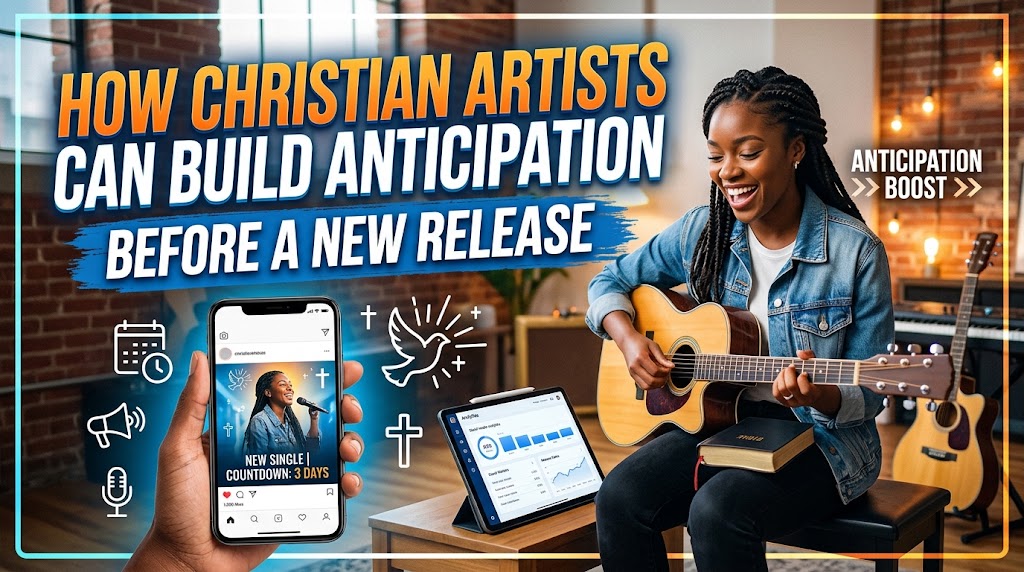
How Christian Artists Can Build Anticipation Before a New Release
How Christian Artists Can Build Anticipation Before a New Release
When I first started paying closer attention to how Christian artists release music, I noticed something that is easy to overlook. Many artists spend weeks, sometimes months, creating a song, recording vocals, designing the artwork, mixing, mastering and preparing distribution. Then the song is released and the artist makes one post saying, “My new song is out everywhere. Please stream, download and share.”
And that is supposed to be the beginning of the excitement.
The problem is that for the audience, nothing happened before that moment.
The artist may have spent three months thinking about the song, but the listener only discovered that the song existed three seconds ago. There is no curiosity. There is no emotional connection. There is no story. There is no reason to remember the title. There is certainly no reason to wake up at midnight waiting for the release.
This is why understanding how Christian artists can build anticipation before a new release is so important.
A great Christian song deserves more than a release link. It deserves a journey.
One of the biggest mistakes I have noticed is that artists often assume that because they are excited about their song, their audience will automatically be excited too. Unfortunately, excitement is not transferable simply because you have a microphone, a beautiful cover art and a distribution date.
Your audience needs a reason to care.
Think about it from the perspective of someone scrolling through social media. They are seeing hundreds of posts every day. Someone is celebrating a birthday. Someone is advertising a product. Someone is posting a relationship problem. Someone is sharing political news. Someone is posting a funny video. Then suddenly an artist appears and says, “My new song drops Friday.”
The audience may say, “Congratulations.”
Then they scroll.
The artist interprets that as lack of support.
But sometimes the problem is not that people do not want to support the artist. The problem is that the artist did not give them anything to become emotionally invested in before the release.
Learning how Christian artists can build anticipation before a new release starts with understanding that promotion is not simply telling people that a song exists. Promotion is gradually giving people reasons to become curious about the song.
Before releasing a song, I would want the audience to know something about the journey behind it. What inspired it? What problem was the artist dealing with when they wrote it? What scripture influenced the lyrics? What experience made the artist realise that this song needed to exist? Was it written during a difficult season? Was it inspired by prayer? Was it born from gratitude? Was it written for people going through something similar?
These things matter because Christian music is not merely about sound. For many listeners, it is connected to faith, emotions, testimony, encouragement and personal experiences.
Imagine an artist preparing to release a song about trusting God during difficult seasons.
Instead of announcing the song immediately, the artist could spend several days talking about the experience that inspired it.
One day, the artist could share a short story about a season when everything seemed uncertain.
Another day, they could share the Bible verse that encouraged them.
Another day, they could ask their audience a simple question such as, “Have you ever had to trust God when you had absolutely no idea what would happen next?”
People begin responding.
Some tell their stories.
Some share scriptures.
Some tag friends.
At this point, something important has happened.
The song has not even been released, but the audience has already started participating in the message behind it.
That is anticipation.
This is one of the most powerful ideas behind understanding how Christian artists can build anticipation before a new release. Do not introduce the song as a product first. Introduce the message, story and emotion behind the song.
People may forget an announcement.
They are more likely to remember a story that reminds them of themselves.
Another mistake artists make is revealing everything too early.
There is nothing wrong with showing your audience that you are working on new music, but you do not necessarily have to reveal the entire song immediately. Mystery can be useful.
You could post a five second vocal teaser.
You could play one interesting line from the chorus.
You could show a short studio clip.
You could record yourself listening to the finished song for the first time.
You could show the reaction of someone who heard the song before release.
You could post a blurred section of the artwork.
You could reveal the title without revealing the entire concept.
The objective is not to confuse people. The objective is to make them curious.
There is a difference between telling someone, “I have a new song coming,” and giving them a reason to wonder, “What is this song about?”
That small difference can completely change how people respond to your campaign.
Another thing I have learnt is that repetition is not necessarily the enemy.
Artists sometimes worry that they are posting about their song too much. But there is a difference between repeating the same advertisement and repeatedly introducing different pieces of the same story.
If your song is coming in ten days, you could use those ten days differently.
One post could introduce the inspiration behind the song.
Another could introduce a lyric.
Another could show the recording process.
Another could ask a question related to the song.
Another could introduce the artwork.
Another could reveal the release date.
Another could share a short testimony.
Another could post a snippet.
Another could show a rehearsal.
Another could allow fans to hear a particular line.
Another could explain why the song matters to you.
You are not simply saying the same thing ten times.
You are giving people ten different opportunities to discover the song.
This is especially important for Christian artists because the message behind a song can become part of the marketing itself.
For example, suppose an artist has written a song about God’s faithfulness.
Instead of making every post say, “My song is coming soon,” the artist could create conversations around faithfulness.
“Tell me one thing God has done for you that you will never forget.”
That question could produce comments.
Someone may talk about surviving a difficult year.
Someone may talk about receiving unexpected help.
Someone may talk about family.
Someone may talk about healing.
Someone may simply write, “God kept me alive.”
Now the artist has an opportunity to connect those stories to the message of the upcoming song.
The audience is no longer being treated as people who are supposed to consume the song. They are becoming part of the conversation surrounding the song.
That is much more powerful.
Another important part of how Christian artists can build anticipation before a new release is involving existing supporters.
Do not wait until release day before asking your closest supporters to help.
If you have a small community of loyal listeners, they can become part of the campaign before everyone else hears the song.
Send selected people a private preview.
Ask them what line stands out to them.
Ask them what emotion the song creates.
Ask them to record themselves reacting to the song.
Ask them to share the announcement.
You do not need thousands of people to start creating movement.
Sometimes ten genuinely excited people can create more meaningful momentum than thousands of people who have no emotional connection to what you are releasing.
This is where relationships become extremely important.
I have seen artists become obsessed with numbers and forget the people behind those numbers. They look at follower counts, views and likes while ignoring the handful of people who consistently comment, share and encourage their work.
Those people matter.
Treat them like people, not statistics.
If someone has been supporting your music for years, let them know about the new release before everyone else. Give them a reason to feel like they are part of the journey.
You could even create a small group of supporters who receive exclusive snippets and updates.
That group does not need a fancy name.
It could simply be a WhatsApp community, email list, broadcast list or private social media group.
The important thing is that the artist is building an audience they can communicate with directly.
Social media algorithms can change.
Platforms can change.
Reach can fall.
But an audience that genuinely cares about your music can continue following your journey.
Another powerful strategy is to make your release date meaningful.
Do not simply announce, “Song out Friday.”
Give the date context.
Perhaps the song is being released on a significant personal anniversary.
Perhaps the artist wants to dedicate the song to people going through a particular season.
Perhaps the release marks a new chapter.
Perhaps the song is connected to a testimony.
Perhaps the artist wants listeners to participate in a prayer challenge before the release.
The more meaning you attach to the journey, the more memorable the release becomes.
Christian artists also need to understand the power of countdowns.
A countdown should not become boring.
“Seven days to go.”
“Six days to go.”
“Five days to go.”
“Four days to go.”
If that is all you post, your audience may start counting down to unfollowing you.
The countdown needs content.
Seven days before release, tell the story behind the song.
Six days before release, reveal an important lyric.
Five days before release, share a studio moment.
Four days before release, explain the scripture that influenced the song.
Three days before release, post a short teaser.
Two days before release, reveal the artwork or another visual element.
One day before release, explain why you are personally excited about the song.
Then release day becomes the moment everything comes together.
This approach answers a major question surrounding how Christian artists can build anticipation before a new release: what exactly should you post before the song comes out?
The answer is simple.
Post the journey.
People enjoy seeing what happens behind the final product.
Show the microphone.
Show the headphones.
Show the notebook.
Show the studio.
Show the mistakes.
Show the laughter.
Show the prayer.
Show the rehearsal.
Show the excitement.
Show the vulnerability.
You do not have to turn every private moment into content, but selected behind the scenes moments can make your audience feel closer to the music.
Another strategy that should never be underestimated is short form video.
A Christian artist does not need a huge production budget to create useful promotional content.
A smartphone, decent lighting and a clear idea can be enough.
Imagine recording a simple video saying, “I wrote this song after one of the most confusing seasons of my life. I almost gave up on the idea, but one scripture kept coming back to me.”
Then play five seconds of the song.
That is content.
You have created curiosity without giving away the entire song.
You can also create multiple videos from one song.
One video can focus on the lyrics.
Another can focus on the testimony.
Another can focus on the production.
Another can focus on the scripture.
Another can focus on the artist’s personal experience.
Another can ask listeners a question.
One song can therefore generate weeks of content if the artist stops thinking of promotion as simply posting the audio link.
This is particularly important because many artists wait until the song is released before they start creating content.
By then, they have already missed a major opportunity.
The release should be the climax of the campaign, not the beginning.
Think about a movie trailer.
The cinema does not wait until the movie starts before telling you that the movie exists.
You see the trailer.
You see posters.
You hear interviews.
You see actors talking about the project.
You see clips.
You become curious.
By the time the movie arrives, you already know about it.
Music can work in a similar way.
Your song needs a trailer.
Your story is the trailer.
Your snippets are the trailer.
Your behind the scenes videos are the trailer.
Your conversations with listeners are the trailer.
Your artwork reveals are the trailer.
Your countdown is the trailer.
The full song is the movie.
Another mistake Christian artists should avoid is making every promotional post sound like begging.
“Please stream.”
“Please share.”
“Please download.”
“Please support me.”
“Please tell your friends.”
There is a place for calls to action, but if every post sounds like a request for a favour, the campaign can quickly become exhausting.
Instead, give people something worth sharing.
Give them a powerful line.
Give them a story.
Give them an emotional moment.
Give them a question that makes them think.
Give them a short testimony.
Give them a beautiful visual.
Give them a reason to tag someone.
For example, instead of saying, “Please share my new song,” an artist could post a lyric and say, “Send this to someone who needs to remember that their current season is not the end of their story.”
Now the audience has a reason to share the content beyond simply helping the artist.
That distinction is huge.
The artist is no longer asking people to advertise the song.
The artist is giving people something they can use to communicate with someone else.
Another powerful idea is allowing your audience to contribute to the release.
Ask them which snippet they prefer.
Ask them what they think the song title means.
Ask them to guess the theme from the artwork.
Ask them to complete a lyric.
Ask them to share the scripture that has carried them through difficult times.
Ask them what they would tell someone who feels like giving up.
When people participate, they become more invested.
There is also something deeply valuable about vulnerability.
Christian artists sometimes feel pressure to present themselves as people who have everything figured out.
But a song about faith can become more powerful when people understand that the artist also had to learn, struggle, pray, wait and trust.
You do not need to expose every personal detail of your life.
But if there is a genuine story behind the song, do not hide it behind a generic promotional graphic.
Tell the story.
If the song came from pain, explain the lesson.
If it came from gratitude, explain what you are grateful for.
If it came from uncertainty, explain what helped you keep believing.
If it came from prayer, explain what the prayer meant to you.
This gives the song context.
And context creates connection.
Another lesson I would give any Christian artist is this: do not measure anticipation only by likes.
Some of the people who eventually become your biggest supporters may never like your announcement posts.
Someone may watch your video silently.
Someone may save your snippet.
Someone may send it to a friend.
Someone may remember your release date but never comment.
Someone may listen to the song weeks later.
Not every form of attention is visible.
This does not mean artists should ignore analytics. Analytics can be useful. But numbers should be interpreted intelligently rather than emotionally.
A post that receives fewer likes may still have introduced the song to the right person.
A small conversation may eventually become a meaningful relationship.
A simple testimony may reach someone at exactly the right time.
That is one of the beautiful things about Christian music.
You cannot always measure impact immediately.
Ultimately, learning how Christian artists can build anticipation before a new release is about changing the mindset from “I have a song to promote” to “I have a message and a story to share.”
That shift changes everything.
You start thinking about the audience before the release date.
You start creating conversations.
You start telling stories.
You start revealing the song gradually.
You start giving people reasons to care.
You start building relationships instead of simply requesting streams.
And most importantly, you stop treating release day as the day people should first hear about your song.
If you have a song coming out in thirty days, do not disappear for twenty nine days and suddenly appear on release day with a streaming link.
Start now.
Tell people why you created the song.
Give them a glimpse into the process.
Share a line.
Ask questions.
Show the journey.
Let them hear a tiny piece.
Give your supporters something exclusive.
Create short videos.
Talk about the message.
Reveal the artwork.
Start the countdown.
Build curiosity.
Then, when release day arrives, your audience should not be asking, “Who is this artist and what is this song?”
They should be saying, “Finally, it is here.”
That is the difference between announcing a song and building anticipation for a song.
And if I had to reduce the entire idea of how Christian artists can build anticipation before a new release to one simple principle, it would be this: do not make people wait for your song before giving them something to care about.
Give them the story first.
Give them the emotion.
Give them the message.
Give them the journey.
Give them a reason to become curious.
Then give them the song.
Because the strongest release campaigns do not begin when the music becomes available.
They begin when somebody first hears the story and thinks, “I want to hear this.”
That is when anticipation starts.

Leave a Reply