
How Christian Music Has Changed Since the 20th Century
How Christian Music Has Changed Since the 20th Century
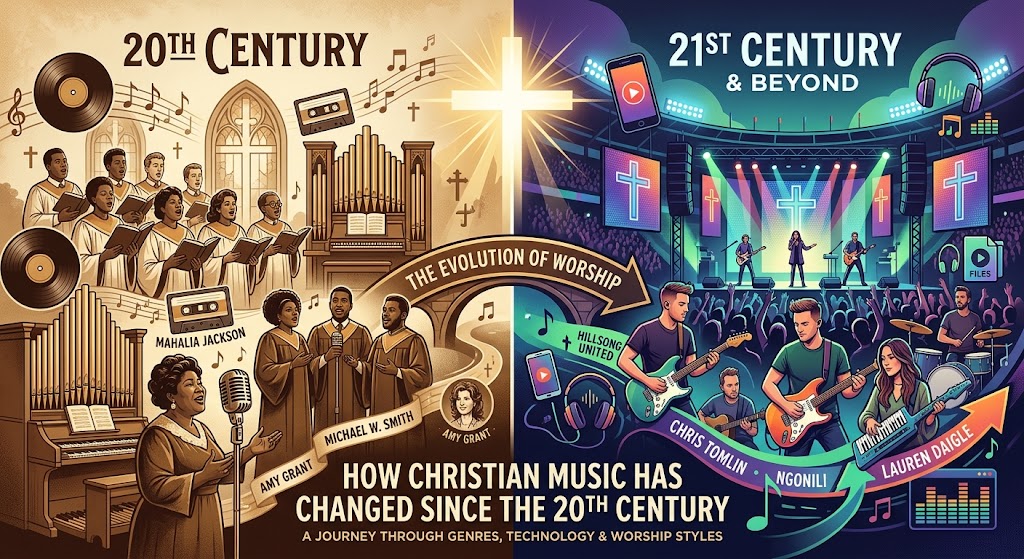
How Christian Music Has Changed Since the 20th Century is a fascinating story of faith, culture, technology, creativity and changing generations. Christian music did not simply move from old hymns to modern worship songs. It travelled through radio, records, choirs, gospel quartets, television, cassettes, CDs, music videos, digital downloads, streaming platforms and social media. Along the way, the sound changed, the artists changed, the audiences changed and even the way people discovered and experienced Christian music changed.
At the beginning of the 20th century, Christian music was largely connected to the church, revival meetings, hymnals, choirs and established traditions. Congregational singing was central to worship, while gospel music was developing rapidly in different communities. Publishing houses and songbook companies played an important role in spreading Christian songs, particularly in the United States. By the middle of the century, gospel music had become a significant cultural and commercial force, while radio and recorded music were making it possible for Christian songs to travel far beyond the church where they were first performed.
One of the biggest changes in the history of Christian music was the arrival of recording technology. Before recordings became widely available, a Christian song depended heavily on people being physically present to hear it. A worship leader could teach a congregation a song, a choir could perform it at church, or an evangelist could take it from one revival meeting to another. Recording changed that relationship completely. Songs could be preserved, reproduced and distributed to people who had never met the original singers.
The Library of Congress notes that “Amazing Grace” was recorded as early as 1922, illustrating how Christian songs were already becoming part of the emerging recording industry. During the 1920s, record companies increasingly recognised commercial opportunities in recording music associated with African American communities and rural Southern audiences, including gospel and related forms.
Radio created another major transformation. Christian music could now enter homes without the listener attending a church service. Families could listen to gospel quartets, hymns, preaching programmes and religious broadcasts from their homes. This helped create Christian music audiences that were no longer restricted by geography. A song produced in one city could become familiar to believers hundreds or even thousands of kilometres away.
This development also helped Christian music become more organised as an industry. Publishers, record companies, radio stations, promoters and performers increasingly became part of a wider ecosystem. Gospel music developed established channels for publication, recording, distribution and performance during the 20th century.
Another major change involved African American gospel music. Throughout the 20th century, Black gospel developed a powerful musical language built around expressive vocals, choirs, rhythm, testimony and emotional intensity. Gospel music became an important expression of faith, identity, community and lived experience. Its influence eventually reached far beyond churches and Christian audiences, contributing to the development of wider popular music.
The relationship between gospel and popular music was particularly important because Christian music was never completely isolated from the wider musical world. Jazz, blues, rhythm and blues, soul, rock and later hip hop all influenced the sounds available to Christian musicians. This created debates that still exist today. How much musical influence from outside the church is acceptable? Can a Christian message be carried through a musical style associated with secular culture? Does changing the sound change the spiritual character of the music? How Christian Music Has Changed Since the 20th Century
These questions became particularly important from the 1950s onward.
Rock and roll initially faced resistance from many Protestant churches because some leaders associated the new sound with undesirable aspects of popular culture. However, as Evangelical and Pentecostal churches sought ways to connect with younger audiences, popular musical styles increasingly entered Christian environments.
This was one of the foundations for what eventually became known as Contemporary Christian Music. The transformation was not merely musical. It represented a generational change. Young Christians wanted songs that sounded more like the music they heard in everyday life. They wanted guitars, drums, modern rhythms and contemporary songwriting while still expressing Christian beliefs.
The late 1960s and early 1970s became a crucial period. The Jesus movement produced a new generation of Christian musicians who combined Christian themes with folk, rock and other contemporary sounds. What became known as Jesus music developed alongside the movement and eventually contributed to the formation of the modern Christian music industry.
This was revolutionary because it challenged the idea that Christian music had to sound a particular way.
Christian music could now have electric guitars. It could have rock rhythms. It could sound youthful. It could be performed by bands rather than only choirs, quartets or soloists accompanied by a piano or organ. The musical vocabulary of Christianity was expanding.
At the same time, the change was controversial. Some Christians believed modern musical styles were inappropriate for worship or evangelism. Others believed that music was simply a tool and that the message mattered more than the musical style. This tension between tradition and innovation has remained one of the most interesting debates in Christian music.
By the 1970s, the emerging Christian music movement was becoming increasingly commercialised. The term Contemporary Christian Music gained popularity, and an identifiable Christian music industry began to take shape. By the middle of the decade, the industry was moving beyond the earlier Jesus music movement and developing its own structures, labels and publications.
The 1980s accelerated this transformation.
Christian music became increasingly professional. Better studios, improved recording equipment, music videos, professional touring and larger record labels helped Christian artists produce music that could compete technically with mainstream recordings. Artists such as Amy Grant, Michael W. Smith and Sandi Patty became significant names within Christian music, while artists such as Stryper demonstrated that even harder rock sounds could find an audience within Christian circles. How Christian Music Has Changed Since the 20th Century
The boundaries between Christian music and mainstream music also became less rigid.
Some Christian artists began appearing on mainstream radio. Some Christian songs reached listeners who did not necessarily identify as Christians. Some artists deliberately targeted Christian audiences, while others attempted to cross into the broader commercial market.
This created another important change. Christian musicians were no longer simply musicians performing songs for their local churches. They could become recording artists, touring performers, media personalities and commercial brands.
The 1990s brought another wave of experimentation.
Christian music increasingly incorporated pop, rock, alternative music, contemporary gospel, hip hop and other genres. The Christian music industry was no longer defined by one particular sound. Different audiences wanted different musical experiences, and artists began exploring more diverse approaches.
Gospel music also continued evolving. Contemporary gospel increasingly incorporated elements of rhythm and blues and other popular styles while maintaining explicitly Christian themes. The Carnegie Hall Timeline of African American Music identifies Edwin Hawkins’ 1968 recording of “Oh, Happy Day” as a major turning point that helped usher in a new era of contemporary gospel.
The 1990s also demonstrated that Christian music could become a major commercial enterprise. Contemporary Christian music had grown from a relatively small movement into a substantial industry, with Christian artists gaining wider recognition and some achieving mainstream success. Research on the history of contemporary Christian music notes that Christian pop music had developed into a billion dollar industry by the 1990s.
Then came the internet.
The internet changed Christian music perhaps more dramatically than any previous technology.
For most of the 20th century, an artist needed access to established channels to reach a large audience. Record labels, radio stations, music retailers, television networks and concert promoters controlled much of the pathway between artist and listener.
The internet began breaking down those barriers.
A Christian musician could create a song, upload it online and potentially reach listeners around the world without first securing a major record deal. Websites, blogs, online music communities and later social media gave independent artists opportunities that previous generations could hardly have imagined.
Music discovery also changed.
Instead of waiting for a Christian radio station to play a song, listeners could search for exactly what they wanted. Instead of buying an entire album because they liked one artist, they could create personalised playlists containing songs from dozens of musicians.
Then streaming transformed the industry again.
Platforms such as YouTube and music streaming services changed Christian music from something people primarily purchased into something people could access continuously. A worship song could be played during personal prayer in the morning, during a commute, at work, at home or inside a church service.
This made Christian music more accessible than ever before.
It also changed the definition of success. In earlier decades, record sales, radio play and physical distribution were extremely important. Today, streams, playlist placements, social engagement, video views, short form clips and online communities can influence an artist’s visibility.
Social media has gone even further.
A Christian artist no longer needs to communicate with fans only through albums and concerts. Artists can share behind the scenes footage, songwriting sessions, testimonies, worship moments and personal stories directly with their audiences. Fans can interact with artists almost immediately.
This has created a more personal relationship between musicians and listeners.
A listener may discover a Christian song because of a short video on social media, search for the full version, add it to a playlist and then share it with friends. A song can travel across countries without a traditional marketing campaign.
This is especially significant for Christian music in Africa.
African gospel music has increasingly demonstrated that Christian music does not need to imitate Western musical traditions to reach an international audience. African rhythms, languages, vocal styles, choirs and contemporary production techniques have created a distinctive sound that can connect with listeners both locally and globally.
Nigeria in particular has become an important centre of contemporary gospel music. Nigerian Christian artists have increasingly combined indigenous musical influences with contemporary gospel, Afrobeats, pop, worship and other styles. This reflects a broader truth about the evolution of Christian music: Christian music changes as Christians themselves live in changing cultures.
The message may remain centred on God, faith, salvation, hope and worship, but the musical language used to communicate those ideas can change dramatically.
That is perhaps the most important lesson when considering how Christian music has changed since the 20th century.
The music has become more diverse.
The technology has become more advanced.
The distribution has become more global.
The artists have become more independent.
The audience has become more interactive.
And the boundaries between genres have become increasingly fluid.
Modern Christian music can include worship, gospel, Christian hip hop, Christian rock, Christian pop, contemporary gospel, Afrobeats influenced gospel and many other sounds. The categories themselves are becoming less rigid as musicians experiment and audiences become more comfortable moving between different styles.
The lyrical content has also expanded in some areas. Christian music still contains songs about worship, praise, salvation and God’s faithfulness, but modern artists increasingly address subjects such as anxiety, loneliness, failure, relationships, identity, doubt, personal struggles and hope. This has allowed Christian music to speak more directly to the everyday experiences of listeners.
At the same time, the evolution has produced legitimate questions.
Has Christian music become too commercial?
Has the pursuit of streams and popularity changed the purpose of worship?
Has modern production sometimes become more important than the message?
Are Christian artists becoming celebrities rather than ministers?
These questions do not have simple answers. Commercial success does not automatically make Christian music less sincere, just as traditional music is not automatically more spiritual. A beautifully produced modern worship song can communicate genuine faith, while an old hymn can be performed without genuine conviction.
The deeper issue is not whether Christian music has changed. It unquestionably has.
The deeper question is whether the changes have helped Christian music communicate its message more effectively to each new generation.
Looking back across the 20th century and into the digital era, the answer appears to be complicated but largely encouraging. Christian music has demonstrated an extraordinary ability to adapt without completely abandoning its core identity. It has moved from hymnals to vinyl records, from radio to cassettes, from CDs to digital downloads, from music television to YouTube and from physical albums to streaming playlists.
Yet one thing has remained remarkably consistent.
People still use music to express what they believe.
They still sing when they celebrate.
They still turn to songs when they are grieving.
They still listen to worship music when they need encouragement.
They still use music to teach children.
They still gather in churches and sing together.
They still create songs when words alone do not seem sufficient.
That continuity is what makes the history of Christian music so fascinating. The instruments may change. The production techniques may change. The fashion may change. The distribution platforms may change. The language and musical influences may change. But the human desire to express faith through music remains.
How Christian Music Has Changed Since the 20th Century is therefore not simply a story about musical evolution. It is a story about how Christianity has interacted with technology, culture, generations and society. From the early recording era to radio, from gospel quartets to contemporary worship bands, from Jesus music to Christian hip hop, from physical albums to streaming platforms, every generation has found new ways to express ancient beliefs through contemporary sounds.
The biggest lesson may be that Christian music has never existed in a vacuum. It has always responded to the world around it. Sometimes that response has produced controversy. Sometimes it has produced innovation. Sometimes it has produced music that becomes timeless.
And perhaps that is why Christian music continues to evolve.
Every generation wants to sing.
Every generation wants to tell its story.
Every generation wants to express its faith in a language it understands.
The future of Christian music will therefore probably look very different from its past. Artificial intelligence, home recording technology, short form video, global collaborations, independent distribution and increasingly personalised music experiences will continue to influence how Christian songs are created and consumed.
But if history teaches us anything, it is that the sound of Christian music will continue changing while its ability to bring people together remains.
From the hymns of the early 20th century to the global worship sounds of the digital age, Christian music has travelled an extraordinary distance. It has become more accessible, more diverse, more technologically advanced and more globally connected. Yet beneath all those changes remains the same powerful human instinct: to turn faith into a song and allow that song to travel farther than the person who first sang it.

Leave a Reply