
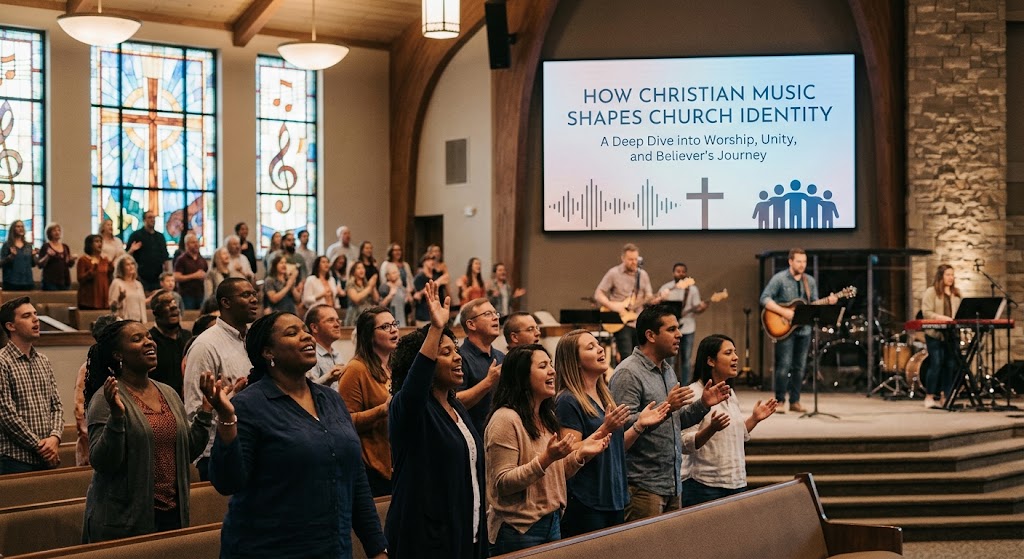
How Christian Music Shapes Church Identity
How Christian Music Shapes Church Identity
Music has always been more than background sound in the Christian faith. It has been a way for believers to express what they believe, remember what God has done, encourage one another and publicly declare their faith. From ancient psalms to traditional hymns and contemporary worship songs, Christian music has played a significant role in shaping how churches understand themselves and how they communicate their identity to the world. When we examine how Christian music shapes church identity, we discover that the songs a church repeatedly sings can influence its theology, culture, values, memories, relationships and even its understanding of what it means to belong to the body of Christ.
Church identity is not created only through a church’s name, denomination, building, leadership structure or statement of faith. It is also formed through repeated experiences. People learn what a church values by listening to what is preached, observing what is practised and participating in what is celebrated. Music sits directly inside that process. A congregation does not simply hear worship songs. It sings them, repeats them, remembers them and eventually connects those words with its own spiritual experience. Research into congregational singing has argued that musical forms and patterns can help form and define the faith and identity of Christian communities because music communicates theology while also connecting churches with their surrounding culture.
This is one of the reasons the question of how Christian music shapes church identity deserves serious attention. A song can become part of a church’s collective memory. A particular chorus may remind members of a revival, a conference, a season of prayer, a difficult period or a significant spiritual experience. Years later, hearing that same song can bring back emotions and memories that words alone might not reproduce. Music has an unusual ability to connect ideas with emotions, and when those ideas are repeatedly experienced within a Christian community, they can become part of the community’s identity.
The Bible itself gives music an important place in the life of God’s people. The New Testament encourages believers to sing psalms, hymns and spiritual songs and connects singing with teaching, encouragement, gratitude and devotion to God. Ephesians 5:19 speaks about believers addressing one another through psalms, hymns and spiritual songs while making melody to the Lord, while Colossians 3:16 connects singing with allowing the word of Christ to dwell richly among believers. This means Christian singing is not presented simply as an opportunity to create an emotional atmosphere. It can also serve a teaching and community building function.
That distinction is important because the songs a church sings can influence what its members remember about Christianity. A sermon may last thirty or forty minutes, but a song may be repeated hundreds of times. A congregation might sing the same declaration every week for months or years. Eventually, those words become familiar. They can become part of the language people use to describe their relationship with God. In this way, music can become a form of theological memory.
This helps explain how Christian music shapes church identity. The songs chosen by a congregation communicate what that congregation believes is important. If a church consistently sings about God’s holiness, its music reinforces an awareness of God’s holiness. If it repeatedly sings about grace, forgiveness and redemption, those themes can become central to the church’s spiritual vocabulary. If its songs frequently focus on personal victory, individual breakthrough and personal success, those themes may also influence how members understand their faith.
This does not mean that a church’s theology is determined entirely by its music. Preaching, Bible teaching, discipleship, prayer, leadership and Christian practice remain essential. However, music can reinforce or weaken the messages being communicated through those other activities. The connection between music and theology is therefore too important to ignore.
Colossians 3:16 is particularly interesting because it connects singing with teaching and admonishing one another. The implication is that Christian music can have a horizontal dimension. Believers are not only singing to God. They are also communicating truth to one another. When an entire congregation sings together, each person becomes both participant and recipient. One believer hears another believer singing words of hope, faith, gratitude or surrender. The congregation effectively teaches itself through song.
This is one of the most powerful ways music shapes church identity. It creates a shared vocabulary. Members who may have completely different personalities, professions, ages and backgrounds can stand together and sing the same words. For a few minutes, individual differences become less important and the shared confession becomes more visible.
A church might contain doctors, traders, students, teachers, business owners, farmers, civil servants, musicians and unemployed people. They may disagree about politics, fashion, football, business strategies or social issues. Yet when they sing together, they participate in a common expression of faith. That shared musical experience can reinforce the idea that the church is a community rather than merely a collection of individuals.
Research into communal singing and corporate identity has highlighted precisely this issue. Studies of congregational song suggest that singing together can contribute to communal identity and theological understanding, while concerns have also been raised about worship songs that become excessively individualistic and may unintentionally weaken the sense of belonging to the wider church.
This raises an important question for modern churches. What happens when the language of Christian music becomes almost entirely centred on the individual?
There is nothing inherently wrong with personal expressions of faith. Christianity is deeply personal. Believers can sing about their personal relationship with God, personal struggles, personal gratitude and personal experiences. The danger comes when the corporate dimension of Christianity disappears completely.
The church is not simply a place where individuals come to have individual spiritual experiences. Christians are called into a body. They worship together, serve together, encourage one another and carry one another’s burdens. Music can either reinforce that communal identity or unintentionally encourage isolation.
A church that regularly sings about “us”, “we”, “our”, the body of Christ, the mission of the church and the shared hope of believers may strengthen a sense of collective identity. A church whose music consistently centres only on “me”, “my blessing”, “my breakthrough” and “my victory” may develop a more individualistic worship culture. The difference may appear small when looking at a single song, but repeated over years, musical language can influence how a congregation understands itself.
This is another important aspect of how Christian music shapes church identity. Music does not merely tell people what to believe. It can also teach them who they are.
A congregation that sings about being the body of Christ is reminded of its collective identity. A congregation that sings about being called to serve can be encouraged towards service. A congregation that sings about evangelism can be reminded of its responsibility to reach others. A congregation that sings about God’s faithfulness during hardship can develop a shared language for navigating difficult seasons.
Music can therefore become a kind of spiritual mirror. The songs a church chooses can reveal what it believes about God, humanity, suffering, salvation, community, mission and Christian living.
Culture also plays an enormous role in this process. Christian music does not exist outside society. Every generation creates, adapts and receives music through the cultural environment around it. Musical instruments, rhythms, languages, vocal styles, production techniques and songwriting patterns can all reflect the culture in which a church exists.
This is particularly visible in African Christianity. Nigerian churches, for example, have developed distinctive musical expressions influenced by indigenous cultures, traditional rhythms, contemporary popular music and global Christian worship. Research published in the Journal of the Association of Nigerian Musicologists has examined congregational hymn singing within Nigerian Pentecostal churches and found that corporate music can become a space where tradition, change and identity are created and negotiated.
That observation is important because it shows that Christian music can simultaneously preserve history and embrace change. A church can sing an old hymn and a modern worship song in the same service. One connects the congregation with previous generations while the other connects it with the present generation.
In some Nigerian Christian communities, singing can also communicate cultural identity. Language matters. Rhythm matters. Vocal expression matters. The way a congregation sings can communicate where it comes from and how it understands its relationship with Christianity.
The study of Yoruba Christianity provides another interesting example. Research into the Cherubim and Seraphim Christian Church in Lagos has described communal singing as an important part of worship and as a practice through which members create unity around shared values. This demonstrates that music can become much more than an accompaniment to worship. It can become part of the social fabric of a Christian community.
At the same time, Christian music can help churches connect with people beyond their immediate cultural environment. A song can travel from Lagos to London, from Accra to Atlanta, from Nairobi to Toronto and from Johannesburg to New York. Digital platforms have made it possible for worship music created in one country to influence congregations thousands of kilometres away.
This global exchange has transformed Christian music. Churches can now access worship songs from different denominations, countries and traditions almost instantly. A local congregation can sing a song written by an artist on another continent. This creates opportunities for cultural exchange and global Christian connection.
However, it also creates questions about church identity. If every church simply adopts the same popular songs, will local musical traditions disappear? If every worship team sounds identical, will churches lose something unique about their own communities? These are not merely musical questions. They are questions about identity.
There is nothing wrong with learning songs from other churches or countries. Christian worship has always crossed cultural boundaries. But churches should also consider whether their musical choices reflect their own history, congregation, mission and theological convictions.
Christian music can preserve a church’s history in ways that written documents cannot. A particular song may be associated with the church’s founding. Another may remind members of a major revival. Another may have been sung during a difficult period when the congregation faced uncertainty. Another may have been written by someone within the church.
These songs become musical landmarks.
When new members learn them, they are not simply learning melodies. They are entering the historical memory of the congregation. They are learning part of the story of the community they have joined.
This is why church music can be especially powerful during anniversaries, funerals, weddings, baptisms, conferences and other major events. The right song can connect an event with the broader identity of the church. Music gives people a way to remember.
Another important way Christian music shapes church identity is through emotional association. People often remember how they felt when they heard a song during an important moment. A worship song may become connected with a season of grief, restoration, thanksgiving or personal transformation.
When that song is later sung in church, the memory can return.
This emotional dimension should not be dismissed as merely psychological. Human beings are emotional and spiritual creatures, and Christian worship engages the whole person. The challenge is to ensure that emotional power is connected to truth rather than replacing truth.
A powerful melody can move people deeply, but a moving melody does not automatically make a song theologically sound. This is why churches need wisdom when selecting music.
The question should not simply be, “Does this song sound beautiful?”
It should also be, “What is this song teaching?”
“Is what we are singing biblically faithful?”
“Does this song point people towards Christ?”
“Does it encourage love for God and neighbour?”
“Does it strengthen the church?”
“Does it reflect the identity we want this congregation to develop?”
These questions matter because songs are repeated. What is repeated eventually becomes familiar, and what becomes familiar can become influential.
This is why Christian musicians, worship leaders, pastors and church leaders have a significant responsibility. They are not merely selecting entertainment for a service. They are helping shape the vocabulary of a community.
That responsibility does not mean worship leaders should avoid creativity. Creativity is part of music. Churches can explore new sounds, instruments, languages and musical arrangements while remaining rooted in Christian truth.
In fact, creativity can help churches communicate the timeless message of Christianity to new generations. The challenge is not whether Christian music should change. The challenge is whether its message remains anchored while its musical expression develops.
A church that refuses every musical change may struggle to communicate effectively with younger generations. A church that embraces every musical trend without discernment may gradually lose its distinctive theological voice. Healthy church identity requires both continuity and thoughtful change.
Christian music also shapes church identity through participation. There is a major difference between watching musicians perform and singing as a congregation. Congregational worship requires people to participate.
When everyone sings, the worship experience becomes collective.
This is especially significant because Christian worship is not supposed to reduce the congregation to an audience. The New Testament’s emphasis on singing to God and addressing one another through song points toward active participation.
A church’s music culture therefore says something about what it believes worship is. If worship is treated primarily as a performance delivered by musicians to spectators, the congregation may gradually develop an audience mentality. If worship encourages everyone to participate, the church can reinforce the idea that every believer has a place in the community.
This does not mean every person must be a talented singer. Worship is not a talent competition. The power of congregational music comes partly from people singing together despite differences in musical ability.
There is something uniquely powerful about hundreds of ordinary believers singing the same words. The sound may not be technically perfect, but it can communicate unity.
Christian music can also help bridge generational differences. Older Christians may carry beloved hymns that younger believers have never heard. Younger Christians may introduce new songs that older members initially find unfamiliar. Rather than treating this as a battle between generations, churches can use music to create dialogue.
A healthy church does not necessarily have to choose between old and new. It can learn from both.
Traditional hymns can provide theological depth, historical continuity and poetic richness. Contemporary songs can provide fresh musical language and connect with present cultural expressions. African gospel traditions can contribute rhythm, communal energy and indigenous musical identity. Different traditions can enrich one another when handled wisely.
Ultimately, how Christian music shapes church identity comes down to repetition, meaning, participation and community. Churches repeatedly sing certain ideas. Those ideas become familiar. Familiar ideas influence collective memory. Collective memory contributes to identity.
This process is gradual, which is why it is easy to underestimate.
One worship song will not transform a church overnight. But hundreds of songs, sung over hundreds of services, can influence the spiritual vocabulary of a congregation for decades.
The most important question may therefore not be whether a church has good music. It may be whether its music is helping it become the kind of church it believes God has called it to be.
If a church wants to be known for compassion, does its music reinforce compassion?
If it wants to be known for biblical truth, does its music teach biblical truth?
If it wants to reach young people, does its music communicate faithfully in a language they can understand?
If it wants to maintain connection with its heritage, does it preserve meaningful musical traditions?
If it wants to build community, does its music encourage people to sing as a body rather than merely watch a stage?
These questions reveal why the subject is bigger than music.
How Christian Music Shapes Church Identity is ultimately a conversation about how communities remember, believe, communicate and worship. Music gives churches words to repeat, melodies to remember and stories to carry from one generation to another.
The strongest Christian music does not simply make people feel something for a few minutes. It can remind them who God is, who they are, what they believe and how they are called to live.
That is why churches should take their music seriously.
Not because every worship song must be complicated.
Not because every worship service needs the newest technology.
Not because louder music automatically means deeper worship.
But because what a church repeatedly sings can become part of what that church repeatedly believes, remembers and communicates.
Christian music can preserve a church’s history, express its theology, unite its people, connect generations, communicate its culture and strengthen its sense of mission. It can introduce new believers to the language of faith and remind older believers of truths they have carried for years.
At its best, Christian music turns theology into something people can sing together.
It turns memory into melody.
It turns doctrine into declaration.
It turns individual voices into a collective confession.
And it turns a group of people gathered in the same room into a community with a shared spiritual vocabulary.
The church will continue to change, technology will continue to evolve and musical styles will continue to develop. But the need for Christian communities to sing together will remain.
The question for every generation is therefore not simply, “What songs are popular right now?”
The deeper question is, “What kind of church are our songs helping us become?”
That is the heart of understanding how Christian music shapes church identity. The songs a church chooses today may become the memories, convictions and declarations that define its people tomorrow. When music is rooted in truth, expressed with sincerity and shared by the whole congregation, it can become one of the most powerful instruments a church has for building a distinctive, faithful and lasting identity.
For that reason, Christian music should never be treated as merely an introduction to the sermon or a pleasant part of the Sunday programme. It can be a ministry of teaching, remembrance, encouragement, unity and worship. It can carry the faith of one generation into the next.
And perhaps that is why, long after the instruments stop playing and the microphones are switched off, people often remember the song.
They remember what they sang.
They remember who they sang it with.
They remember what they believed.
And sometimes, they remember who they became.

Leave a Reply