
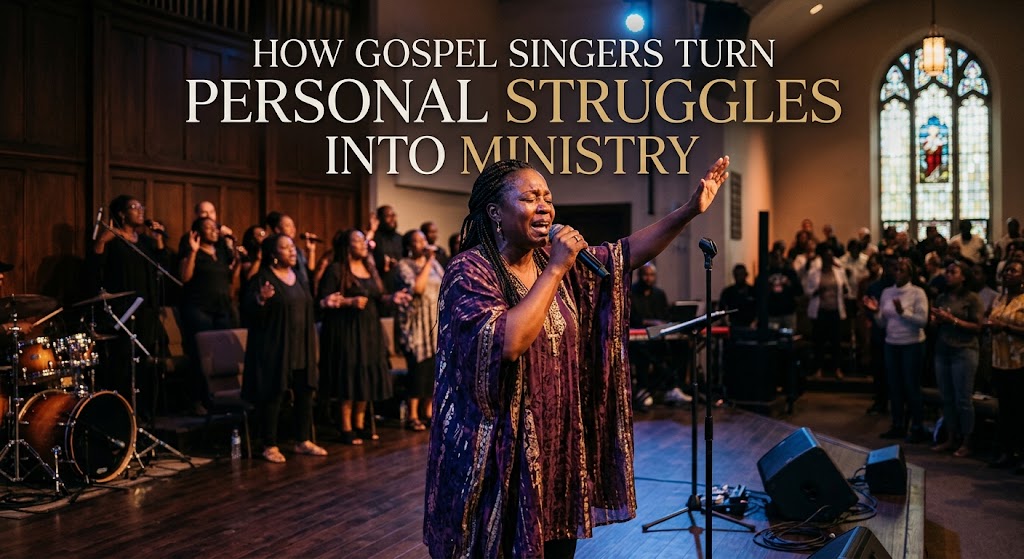
How Gospel Singers Turn Personal Struggles Into Ministry
There is something different about a gospel song that comes from a place of genuine pain. You can hear it in the trembling voice, the words that seem to carry a personal story, and the emotion behind every note. Sometimes, a song does more than entertain. It reaches into a place that ordinary conversation cannot reach. This is one reason how gospel singers turn personal struggles into ministry is such a powerful subject for anyone interested in Christian music.
Many gospel singers have discovered that the difficult seasons of their lives can become part of their ministry. The heartbreak, disappointment, rejection, financial difficulties, family problems, failures, waiting seasons and moments of uncertainty they experience can eventually become stories that encourage other people. Their struggles do not automatically disappear because they are musicians or believers. In many cases, those struggles become part of the testimony they carry into their music.
A person listening to a gospel song may have no idea what the singer experienced before writing or recording it. They may simply hear a beautiful melody and powerful lyrics. Behind those lyrics, however, there could be years of prayer, tears, disappointment and spiritual growth. The singer may have written the song after surviving something that once made them question whether they would ever be happy again.
This is where gospel music becomes much more than music. It becomes testimony.
When gospel singers turn personal struggles into ministry, they are essentially taking something that could have destroyed their hope and using it to communicate hope to somebody else. Their experience becomes a bridge between their story and the story of their listeners. A person going through a difficult season may hear a song and suddenly realise that they are not alone.
Pain has a strange way of making people feel isolated. When someone is struggling with grief, disappointment, rejection or failure, they can easily believe that nobody understands what they are experiencing. A gospel singer who has lived through something similar can challenge that feeling through music.
This does not mean every painful experience should immediately become a song. Some experiences require time, healing and privacy before they can be shared publicly. In fact, one of the greatest mistakes an artist can make is turning fresh wounds into public content before understanding what those wounds are teaching them.
Sometimes the song comes during the pain. Sometimes it comes after the pain. Sometimes it takes years before a singer can look back and understand why a particular season happened.
The difference is important.
When a gospel singer sings about surviving a difficult season after processing the experience, the message often carries a depth that cannot be manufactured. The singer is no longer simply singing about faith as an idea. They are singing about faith as something they have had to practise when life became uncomfortable.
This is one of the reasons personal testimony is so powerful in gospel music. People may debate theology, musical styles and denominations, but it is difficult to argue with someone’s personal experience. When an artist says, in essence, “I went through this, I cried, I prayed, I almost gave up, but I am still standing,” somebody listening may find the courage to keep standing too.
Personal struggles can also make gospel singers more compassionate ministers.
A person who has never experienced serious disappointment may struggle to understand someone who feels completely defeated. But a singer who has experienced rejection may sing differently to the rejected. Someone who has experienced grief may communicate comfort differently. Someone who has struggled financially may understand the anxiety of not knowing how tomorrow’s needs will be met.
Their experience gives them emotional language.
How Gospel Singers Turn Personal Struggles Into Ministry
They may not have all the answers, but they understand the questions.
That understanding can become ministry.
Consider a gospel singer who experienced years of waiting before receiving an opportunity they had prayed for. When that singer eventually releases a song about trusting God’s timing, the message may resonate deeply with people who are still waiting. The singer is not simply telling listeners to wait. They have waited themselves.
There is credibility in that.
This is also why some gospel songs remain meaningful long after their release. The music may be beautiful, but the story underneath the music gives it longevity. People return to songs that helped them through specific moments in their lives. A song becomes connected to a memory, a prayer, a breakthrough, a funeral, a difficult night or a season when everything seemed uncertain.
In this way, gospel singers sometimes become companions to people they have never met.
Someone may listen to a particular song alone at 2 a.m. while dealing with a problem they have told nobody about. The singer does not know that person exists, yet their personal struggle has become a source of strength for someone else.
That is one of the remarkable things about Christian music.
A singer’s private experience can become a public blessing.
However, turning personal struggles into ministry requires more than simply telling painful stories. The struggle has to be connected to a message. Gospel music is not merely about describing what went wrong. It is about pointing beyond the problem.
A song about heartbreak can point towards healing. A song about failure can point towards restoration. A song about rejection can point towards identity in God. A song about waiting can point towards patience and trust. A song about grief can point towards hope. A song about fear can point towards faith.
The struggle becomes the setting, but God remains part of the message.
This distinction matters because there is a difference between glorifying pain and using pain to communicate hope.
Gospel singers who turn personal struggles into ministry are not necessarily saying that suffering is good. They are showing that suffering does not have to be meaningless.
There can be purpose in the lessons learned during difficult seasons.
A singer who experienced betrayal may learn discernment. A singer who experienced failure may learn humility. A singer who faced rejection may learn perseverance. A singer who experienced loss may develop compassion. A singer who endured uncertainty may develop deeper trust.
Those lessons can eventually become songs.
Sometimes the most powerful ministry does not come from a singer’s greatest success. It comes from what happened before the success.
People see the stage, the microphone, the lights, the applause and the beautiful clothes. They may not see the nights when the singer questioned their calling. They may not see the rejection letters, unpaid bills, failed relationships, health battles, family struggles or seasons when the dream seemed impossible.
Yet those invisible moments may be responsible for the depth people hear in the music.
Success can make a person visible, but struggle often makes a person deep.
This is why personal struggles can become a powerful source of songwriting inspiration. When a songwriter has experienced something deeply, they often have emotions and observations that cannot be obtained simply by studying songwriting techniques.
They know what it feels like to hope and be disappointed.
They know what it feels like to pray and wait.
They know what it feels like to smile in public while crying privately.
They know what it means to keep believing when circumstances provide little evidence for optimism.
Those experiences can produce lyrics that sound real because they are real.
There is also a spiritual dimension to this process. For many gospel singers, difficult seasons become periods of deeper prayer and reflection. When familiar sources of confidence disappear, they may discover a different kind of dependence on God.
A person who has always trusted their talent may discover that talent cannot solve every problem. A person who has trusted money may discover that money cannot guarantee peace. A person who has depended heavily on people may discover that people can disappoint them.
Such discoveries can change the way an artist approaches music.
The song that follows may not be about impressing an audience. It may be about expressing gratitude.
The performance may not simply be a performance. It may be worship.
The lyrics may not simply be lyrics. They may be a testimony.
This is why some gospel singers describe particular songs as deeply personal. The song may represent a chapter of their life that they never want to forget.
There is another important element in how gospel singers turn personal struggles into ministry: vulnerability.
Vulnerability is risky.
Artists are often expected to appear strong, successful and confident. Social media has made this expectation even stronger. People see photographs, performances, awards, interviews and achievements, but rarely see the private struggles behind them.
When a gospel singer chooses to admit that they struggled, cried, doubted, failed or felt afraid, they challenge the illusion that people of faith never experience difficult emotions.
That can be liberating for listeners.
A Christian who is struggling may believe something is wrong with their faith simply because they feel overwhelmed. Then they hear a respected gospel singer speak honestly about a difficult season and realise that struggling does not automatically mean they have abandoned God.
Sometimes people do not need another person to tell them to “be strong.”
Sometimes they need somebody who can honestly say, “I have been there too.”
That is ministry.
Personal testimony also creates connection between artists and their audiences. Fans may admire a singer because of their voice, but they often become deeply connected to artists whose stories reflect their own lives.
The singer becomes relatable.
The audience is no longer simply listening to a celebrity. They are listening to someone who has experienced pain, asked questions, waited for answers and continued moving forward.
That connection can make a song more powerful.
However, gospel singers must also exercise wisdom when sharing personal struggles. Not every painful experience belongs in a song. Some stories involve other people’s privacy. Some wounds require professional counselling, pastoral guidance or personal healing rather than public exposure.
Being vulnerable does not mean revealing everything.
There is wisdom in knowing what to share, when to share it and why to share it.
The strongest testimony is not necessarily the most dramatic story. Sometimes the most powerful testimony is simply the quiet evidence that a person survived something they once thought would destroy them.
A singer may not explain every detail of their struggle. They may simply sing about God’s faithfulness.
The listener may never know the entire story, but they can still feel the weight behind the song.
Another reason personal struggles can become ministry is that they help gospel singers communicate hope realistically. Hope is more powerful when it has survived difficulty.
It is easy to talk about faith when everything is working.
It is harder to sing about faith when life has disappointed you.
When someone continues to worship after experiencing loss, their worship communicates something powerful. It says that faith is not based entirely on circumstances.
That message can encourage people who are going through their own storms.
Gospel music therefore has a unique ability to transform private pain into collective encouragement. One person’s story can become thousands of people’s reminder that difficult seasons do not have the final word.
This is particularly important in today’s world, where many people are silently struggling. Social media creates the appearance that everybody else is succeeding. People compare their lives with carefully edited photographs and public achievements.
A genuine gospel testimony can interrupt that comparison.
It can remind people that the person they admire also had difficult days.
The singer on the stage may have once been the person crying backstage.
The successful artist may have once been rejected.
The worship leader may have once wondered whether anybody would ever hear their voice.
The person singing about victory may have once struggled to believe victory was possible.
That contrast is powerful.
It shows that the journey matters.
Ultimately, how gospel singers turn personal struggles into ministry comes down to transformation. The goal is not to celebrate the pain but to demonstrate what can emerge from it.
A painful chapter can produce wisdom.
A season of rejection can produce resilience.
A period of waiting can produce patience.
A devastating disappointment can deepen compassion.
A personal failure can teach humility.
A difficult journey can produce a song that helps somebody else survive their own journey.
That is the beauty of gospel music.
It gives artists a language for experiences that ordinary conversation sometimes cannot explain. It allows them to turn tears into lyrics, lessons into melodies and testimonies into songs that travel far beyond the places where the struggles originally happened.
A singer may experience a private battle in one city and eventually release a song that reaches someone thousands of kilometres away. That listener may never know the singer personally, but the testimony still reaches them.
And perhaps that is one of the greatest forms of ministry a gospel singer can offer.
Not pretending that life is always easy.
Not pretending that faith eliminates every painful experience.
Not pretending that believers never struggle.
But showing that even in the middle of difficulty, there can still be hope.
The next time you hear a gospel song that moves you deeply, listen beyond the melody. Ask yourself what kind of story might have produced those words. There may be a testimony hidden inside the song. There may be a season of pain behind the chorus. There may be a prayer behind the melody.
And somewhere, someone who once struggled to understand their own pain may have discovered that their experience could become a message for somebody else.
That is how gospel singers turn personal struggles into ministry. They take what could have remained a private wound and, with wisdom and purpose, transform it into encouragement, worship, testimony and hope.
Their scars may not disappear, but their scars can become part of the song.
And sometimes, the song born from the darkest season of someone’s life becomes the very song that helps another person find the strength to keep going.

Leave a Reply