
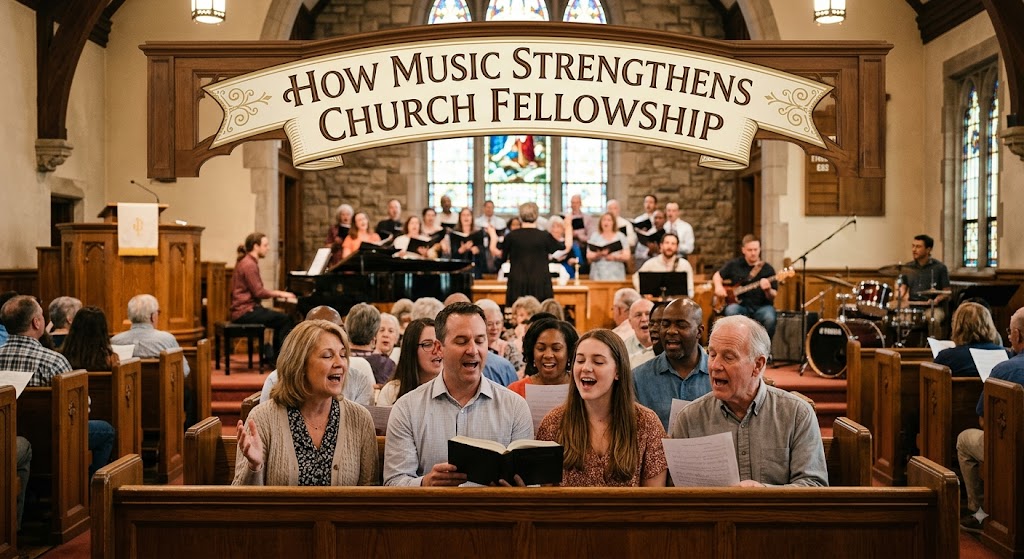
How Music Strengthens Church Fellowship
How Music Strengthens Church Fellowship is a powerful subject because music has always occupied a special place in the life of the Christian church. Long before modern sound systems, worship bands, streaming platforms and carefully produced gospel albums, believers gathered together and sang. They sang during celebrations, during difficult seasons, during prayer, during journeys and during moments when words alone could not adequately express what they felt. Music has a unique ability to bring people together, and within the church, that ability can become a powerful instrument for building relationships, encouraging unity and strengthening fellowship.
How Music Strengthens Church Fellowship becomes especially clear when we consider what happens when Christians sing together. A congregation may contain people from different families, professions, backgrounds, age groups and personal experiences. They may have different personalities and preferences, but when they stand together and participate in worship, those differences can temporarily become secondary. Everyone is contributing to the same experience. The congregation sings the same words, follows the same rhythm and directs its attention towards the same God. That shared experience can create a powerful sense of belonging.
Church fellowship is more than simply attending the same building on a Sunday morning. Fellowship involves connection, participation, encouragement, friendship, compassion and a willingness to walk with other believers through different seasons of life. Music can contribute significantly to each of these areas because it creates opportunities for people to participate rather than simply observe. A congregation that sings together is not merely listening to a performance. When worship is approached properly, people become active participants in a shared expression of faith.
One of the clearest ways music strengthens church fellowship is by creating a shared spiritual language. People may come into church carrying different experiences, but a familiar worship song can give everyone words with which to express their faith. Someone who struggles to explain what they are feeling may find comfort in a song about God’s faithfulness. Someone going through a difficult season may find strength in lyrics about hope. Another person may be celebrating an answered prayer and find that the same song expresses their gratitude. Music provides a common vocabulary through which different people can express similar spiritual realities.
This is particularly important in large churches where people may attend the same services without necessarily knowing one another personally. A congregation can become physically large while remaining emotionally disconnected. Music can help bridge that gap by creating shared experiences. When hundreds or thousands of people sing together, there is a sense that everyone is participating in something larger than themselves. That experience can help people feel that they are part of a community rather than simply individuals sitting in the same room.
How Music Strengthens Church Fellowship can also be seen in the way worship encourages participation from different generations. Churches often contain children, teenagers, young adults, middle aged adults and older members. Each generation may have its own musical preferences, but music can become a meeting point when churches intentionally create space for different expressions of worship. Traditional hymns can connect older generations with younger believers when their stories and meanings are explained. Contemporary worship can introduce younger members to expressions of faith that resonate with their experiences. Gospel, choral, African worship and other Christian musical traditions can also enrich the congregation.
When generations worship together, something important happens. Younger believers see that faith did not begin with their generation, while older believers are reminded that the church has a future. Music can create moments where grandparents, parents and children participate in the same spiritual experience. Those moments can strengthen family relationships and create memories that remain meaningful long after the service has ended.
Music can also strengthen church fellowship by helping people experience vulnerability together. There is something deeply human about singing. People who might be uncomfortable speaking publicly can still participate in a song. They can express sorrow, gratitude, hope, repentance or joy without having to explain every detail of their personal circumstances. When a congregation sings about God’s faithfulness during difficult circumstances, people who are privately struggling may realise that they are not alone.
A worship song can sometimes communicate what a sermon cannot communicate in exactly the same way. A sermon may explain a biblical truth intellectually, while music can help people internalise that truth emotionally and spiritually. This does not mean music replaces preaching or biblical teaching. Rather, music can reinforce important truths and give believers an opportunity to respond to them together.
Another important way music strengthens church fellowship is through encouragement. Christians do not always arrive at church feeling strong. Some may have experienced disappointment during the week. Others may be dealing with financial pressure, family difficulties, uncertainty, grief or personal failure. A congregation may not know what every individual is carrying, but collective worship can create an environment where people are reminded that they belong to a community.
Imagine someone entering church feeling discouraged and hearing hundreds of voices singing about hope. They may not know the people around them personally, but those voices can still provide encouragement. The person is reminded that faith is not a solitary journey. Other believers are standing, singing and believing alongside them. Sometimes that simple realisation can make a significant difference.
Music also creates opportunities for believers to serve one another. Church music is not limited to the person holding the microphone. Behind every worship service there may be singers, musicians, sound technicians, choir members, songwriters, instrumentalists, media volunteers, worship leaders and people responsible for organising rehearsals. When these individuals work together, they learn important lessons about cooperation, humility, patience and responsibility.
A worship team is essentially a small community within the larger church community. Members must learn to listen to one another. A musician cannot simply play whatever they want. A vocalist must pay attention to the leader. A drummer must understand the dynamics of the song. The sound team must respond to what is happening on stage. Everyone has a role, and the quality of the collective experience depends partly on people understanding that their individual contribution affects everyone else.
These lessons can extend beyond the worship service. Someone who learns to cooperate with others during rehearsals may become more willing to cooperate in other areas of church life. Someone who develops humility while serving in the music ministry may carry that attitude into other relationships. Someone who develops friendships through the choir may become more connected to the wider church community.
Music can also create friendships that might not have existed otherwise. Two people may discover that they enjoy singing together. Teenagers may build friendships through a youth choir. Adults may become close through a worship team. Children may develop confidence while participating in a children’s music programme. These relationships can gradually become part of the social structure of the church.
This is why churches should not treat music ministry merely as entertainment before the sermon. When music is approached as an opportunity for ministry and community building, its impact can reach much further. Rehearsals become opportunities for fellowship. Choir meetings become opportunities for encouragement. Music workshops become opportunities for learning. Performances can become opportunities for outreach. Songs can become reminders of shared experiences.
Another powerful aspect of music is memory. Many Christians can remember the first worship song they heard after experiencing a major life event. A particular song may remind someone of a baptism, wedding, funeral, revival meeting, youth conference or season of personal transformation. Music has a remarkable ability to attach itself to memories.
Churches can therefore build collective memories through music. A song that a congregation sings repeatedly over several years can become associated with a particular season of the church’s history. Members may eventually move to different places, but when they hear that song years later, they may remember the people they worshipped with and the experiences they shared.
Music can also strengthen fellowship by promoting unity during times of disagreement. Churches are communities made up of imperfect people, and disagreements are inevitable. Members may disagree about leadership decisions, programmes, finances, traditions or even musical preferences. However, shared worship can remind believers of the larger purpose that brought them together.
This does not mean music should be used to ignore genuine problems. Healthy fellowship requires honest conversations, accountability and reconciliation. Nevertheless, worship can help shift attention away from individual preferences and back towards shared faith. When people remember that they are part of the same spiritual family, they may become more willing to listen, forgive and seek peace.
The lyrics chosen for church worship also matter greatly. If songs consistently focus on biblical truth, God’s character, love, grace, faithfulness, salvation and Christian hope, they can help shape the spiritual culture of the congregation. What a church repeatedly sings can influence what its members remember and discuss.
This is one reason Christian songwriters and worship leaders carry an important responsibility. A catchy melody may attract attention, but meaningful lyrics can remain in someone’s heart for years. Music used in church should therefore be more than emotionally appealing. It should communicate truths that strengthen faith and encourage believers to live out what they believe.
How Music Strengthens Church Fellowship
How Music Strengthens Church Fellowship is also evident in outreach. Music can create an inviting atmosphere for people who may not yet feel comfortable in a church environment. A gospel concert, choir presentation, worship night or community music event can provide an accessible way for people to encounter Christian messages. Someone may initially attend because they enjoy music and eventually become interested in the faith behind the music.
This is particularly relevant in today’s digital environment. Christian music is no longer restricted to church buildings. People listen to worship songs through streaming platforms, social media, videos and personal playlists. A song recorded by a local church can reach someone thousands of kilometres away. A choir performance can be shared online. A testimony connected to a worship song can encourage people who have never attended the church that produced it.
Technology therefore gives churches new opportunities to use music to strengthen fellowship beyond physical gatherings. Members who are travelling, sick or unable to attend a service can still participate through worship recordings. People who move to another city can continue listening to songs that remind them of their church family. Online Christian communities can also form around worship music, allowing believers to connect across geographical boundaries.
However, churches should be careful not to confuse musical excellence with spiritual fellowship. A church can have extraordinary musicians, expensive equipment and impressive stage production while still struggling with genuine community. Music should serve fellowship, not replace it. The goal should never be to create an impressive show while leaving people emotionally disconnected.
Authenticity matters. People can often recognise when worship feels purely performative. Genuine worship encourages participation rather than turning the congregation into an audience. The strongest church music experiences are often not necessarily the most complicated ones. Sometimes a simple song sung sincerely by a united congregation can create a deeper sense of fellowship than a highly produced performance.
Church leaders can therefore encourage fellowship through music by creating opportunities for congregational participation. They can involve different age groups, encourage choirs and small music groups, organise worship gatherings and create spaces where members can develop musical gifts. They can also use music to celebrate milestones, remember important church moments and encourage members during difficult seasons.
Families can benefit from this approach as well. Parents can sing with their children at home. Families can create worship playlists and discuss the messages in the songs they hear. Parents can introduce children to meaningful Christian songs from different generations. These simple practices can turn music into a bridge between generations.
The influence of music can even extend into everyday relationships. When people share songs that encouraged them during difficult times, they are opening a small window into their personal lives. When a church member sends a worship song to another member who is struggling, that song can become an expression of care. Sometimes a simple message saying, “I thought you might need this today,” accompanied by a meaningful Christian song, can communicate compassion more effectively than a long conversation.
At its best, music reminds Christians that fellowship is not simply about being in the same place. It is about sharing faith, carrying one another, encouraging one another and growing together. Singing together does not automatically create a healthy church community, but it can provide one of the tools through which that community is developed.
The church should therefore recognise music as more than a background element in worship. Music can teach, encourage, comfort, unite, inspire and connect people. It can bring generations together, create friendships, strengthen service teams and provide shared memories. It can help believers express emotions that are difficult to put into ordinary conversation and remind struggling Christians that they are part of something bigger than themselves.
Ultimately, How Music Strengthens Church Fellowship comes down to one simple truth: people connect through shared experiences. When Christians lift their voices together, they are participating in a shared expression of faith. They are not merely hearing music. They are contributing to it. They are standing beside other believers and declaring common truths. They are creating memories, encouraging one another and reinforcing the sense that the Christian journey is not meant to be walked alone.
A strong church is not simply a church with talented musicians. It is a church where music helps people become more connected to God and to one another. The greatest measure of a worship ministry should therefore not only be how impressive the music sounds, but also what happens to the relationships within the congregation because of it.
When music encourages humility instead of competition, participation instead of performance, unity instead of division and service instead of recognition, it becomes a powerful instrument of fellowship. When people leave a worship gathering feeling not only inspired but also more connected to their fellow believers, something valuable has happened.
Music may begin with a melody, but its influence can reach much further. A song can start with one voice and become a chorus. A simple lyric can become a source of encouragement. A rehearsal can become a friendship. A worship gathering can become a treasured memory. A choir can become a family. A congregation can become more united because people have learned to sing, serve and worship together.
That is why churches should never underestimate the power of music. In a world where people are increasingly connected digitally but often disconnected emotionally, genuine community is becoming more valuable. Music provides churches with a natural opportunity to bring people together, create shared experiences and remind believers that they belong to one spiritual family.
When used wisely, biblically and sincerely, music can become one of the strongest bridges between individual faith and collective fellowship. It can help strangers become friends, help different generations understand one another and help discouraged believers rediscover hope. It can transform a group of people sitting in the same room into a community sharing one voice.
How Music Strengthens Church Fellowship is therefore not simply a discussion about songs or worship services. It is a discussion about people. It is about connection, belonging, encouragement, service, unity and shared faith. Music gives the church a language through which hearts can meet, voices can unite and believers can remind one another that they are not walking alone.
And perhaps that is one of the most beautiful things about Christian music. When one person sings, it may be a personal expression of faith. When an entire congregation sings together, it becomes a collective declaration. Different voices become one sound. Different stories become part of one community. Different journeys become connected by one faith.
The melody eventually ends, the instruments become silent and the congregation leaves the building, but the fellowship created through those shared moments can continue. People carry the encouragement into their homes, workplaces and relationships. They remember the song. They remember the people beside them. Most importantly, they remember that they belong.
That is the deeper power of music in the church. It does not merely fill the room with sound. When used with purpose, it can fill relationships with connection, hearts with encouragement and communities with unity. And that is precisely why understanding How Music Strengthens Church Fellowship matters for every church that desires not only to worship together, but also to grow together.

Leave a Reply