
How Worship Music Encourages Reflection and Renewal
How Worship Music Encourages Reflection and Renewal
There have been moments in my life when I did not need another long conversation, another motivational speech, or another person telling me what I needed to do. I simply needed to become quiet. I needed to step away from the noise around me, put on worship music, and allow my heart to breathe. Looking back, some of the clearest moments of reflection I have experienced did not happen when everything around me was silent. They happened while a worship song was playing softly in the background. How Worship Music Encourages Reflection and Renewal
This is one reason I have come to appreciate how worship music encourages reflection and renewal. Worship music has a unique way of slowing down the mind and directing attention towards things that are easy to overlook when life becomes busy. A song can remind you of God’s faithfulness, bring an old memory back to your mind, expose emotions you have been avoiding, or simply create enough quiet within you to think about where you are spiritually.
There are days when life moves so quickly that we barely have time to process what we are experiencing. We wake up, respond to messages, go to work, handle responsibilities, deal with financial pressures, interact with people, solve problems and eventually go to bed. Then we wake up and repeat the cycle. Somewhere inside that routine, reflection can disappear.
Worship music can interrupt that cycle.
When I listen to a meaningful worship song, I often find myself paying attention to words that I may have heard many times before. A lyric about God’s faithfulness can suddenly feel personal. A line about surrender can make me think about something I have been trying to control. A declaration about God’s presence can remind me that I have been worrying about a situation as though I am facing it completely alone.
That is how worship music encourages reflection and renewal. It does not necessarily give you a new situation. Sometimes it gives you a new perspective on the situation you are already facing.
Reflection is important because we can become so focused on moving forward that we never stop to ask whether we are moving in the right direction. We can be busy without being productive. We can be successful in certain areas while becoming empty in others. We can achieve goals while neglecting our relationship with God, our families, our character, our peace and our spiritual lives.
Worship creates an opportunity to pause.
I have discovered that certain songs make me ask questions I would probably avoid during a busy day. Am I trusting God or simply saying that I trust Him? Am I grateful for what I have or constantly focused on what I do not have? Am I allowing fear to make my decisions? Have I become too distracted by other people’s progress? Am I still willing to wait when things are not happening according to my timetable?
Those questions can be uncomfortable, but they can also be necessary.
One of the most beautiful things about worship music is that it can create an atmosphere where reflection feels natural. You are not necessarily sitting down with a notebook and deliberately analysing every aspect of your life. Instead, the music creates a space where thoughts begin to surface.
Sometimes I will hear a song and remember a season when I had very little certainty about the future. I remember how worried I was and how many questions I had. Yet I also remember how things eventually worked out in ways I could not have predicted at the time.
That kind of memory changes the way I look at my current challenges.
It reminds me that today’s uncertainty is not necessarily the final chapter.
This is another reason how worship music encourages reflection and renewal is such an important subject. Renewal often begins with remembering. When we remember God’s faithfulness in the past, we can approach the present with a different attitude. We may still have problems, but our problems no longer have the final word over our emotions.
Worship music can also help people process emotions.
There are emotions that we do not always know how to explain to another person. Sometimes you can be surrounded by people and still feel lonely. Sometimes you can be grateful and exhausted at the same time. Sometimes you believe God is working while still wondering when the answer will come.
A worship song can give language to those complicated emotions.
Instead of pretending everything is perfect, worship can provide a place where you acknowledge what you are feeling while still directing your heart towards God.
That balance is important.
Renewal does not mean pretending that problems do not exist. It means allowing your perspective, strength and hope to be refreshed even while problems remain.
I have listened to worship music during moments when I was excited about something new, but I have also listened during moments when I was disappointed. Interestingly, the same song can feel completely different depending on what you are experiencing.
A song about God’s goodness can sound like celebration when everything is going well. The same song can sound like an act of faith when everything is going badly.
That is the power of worship.
It can meet you where you are without leaving you there.
Another reason worship music encourages reflection and renewal is that it redirects attention. Our minds naturally become occupied by whatever is demanding the most attention. Bills, deadlines, relationships, business, social media, family responsibilities and personal ambitions can consume our thoughts.
Worship gives the mind something else to focus on.
Instead of constantly thinking about what needs to be fixed, you begin thinking about who God is. Instead of measuring your life only by achievements, you begin remembering that your identity is not completely determined by your possessions, career, income or social status.
That shift can be refreshing.
I have noticed that sometimes I do not need more information. I need perspective.
There is a difference between knowing more and seeing differently.
Worship music can help create that difference.
For example, you may spend an entire day worrying about something you cannot control. Then you listen to a worship song about surrender, and suddenly you recognise that your constant worrying has not changed the situation. What changes is your response to it.
You begin to understand that surrender is not giving up. Sometimes surrender is acknowledging that you cannot control everything and choosing to trust God with what is beyond your control.
That realisation can bring tremendous relief.
Worship music can also encourage gratitude. This is particularly important because dissatisfaction can quietly become a habit. When we constantly compare ourselves with other people, we can overlook the blessings already present in our lives.
Social media can make this even worse. You can open your phone and see someone buying a new car, launching a business, travelling to another country, building a house or celebrating an achievement. Before long, you start wondering why your own life does not look like theirs.
Then a worship song reminds you to look again.
You remember how far you have come.
You remember the prayers that were answered.
You remember the doors that opened.
You remember the people who helped you.
You remember the situations that could have ended differently but somehow worked out.
Gratitude changes perspective.
And perspective can produce renewal.
Another important aspect of worship music is its ability to bring people back to spiritual priorities. It is easy to become consumed with temporary things. Money matters. Career matters. Business matters. Education matters. Family matters. Physical needs matter. But when these things become the centre of everything, spiritual life can gradually move to the background.
Worship can bring spiritual priorities back into focus.
Sometimes a song about God’s presence can remind you that you have been pursuing God’s gifts more aggressively than you have been pursuing God Himself.
That can be a powerful realisation.
There is nothing wrong with wanting success. There is nothing wrong with building a business, pursuing a career or working towards financial stability. But worship reminds us that these things should not become substitutes for our relationship with God.
This is where reflection becomes more than simply thinking.
True reflection can lead to adjustment.
You think about where you are.
You recognise what needs to change.
You ask God for wisdom.
Then you make different decisions.
That is where renewal becomes practical.
How worship music encourages reflection and renewal can also be seen in the way music helps people slow down. In a world where almost everything competes for our attention, slowing down can feel uncomfortable.
We are accustomed to notifications, short videos, instant messages and constant updates. We can move from one piece of information to another without giving ourselves enough time to process anything deeply.
Worship can create a different rhythm.
You can sit down, close your eyes and listen.
You can breathe.
You can think.
You can pray.
You can allow the words to settle.
Sometimes that is all you need.
I have also learned that not every worship session needs to be loud. Some of the most meaningful moments can happen when the music is quiet. There are times when instrumental worship, gentle singing or even a familiar hymn can create an environment where the heart becomes calm.
The goal is not necessarily the volume.
The goal is connection.
Worship music can also renew hope. Hope is easy to lose when circumstances remain difficult for a long time. A person may pray about something for months or even years and become tired of waiting.
Songs about God’s faithfulness can remind that person that waiting does not automatically mean abandonment.
This does not mean that music magically solves problems.
It does not.
But music can strengthen the heart of the person facing the problem.
Sometimes you still have to make the phone call.
You still have to pay the bill.
You still have to have the difficult conversation.
You still have to make the business decision.
You still have to wake up tomorrow and continue working.
But you can do those things with a renewed perspective.
That is valuable.
Another thing I appreciate about worship music is that it can help people remember Scripture. A verse that may be difficult to memorise when read once can become deeply familiar when incorporated into a song.
There are biblical truths that I remember more easily because I have heard them repeatedly through music.
This is one reason Christian music has always played an important role in faith communities. Songs can carry messages from one generation to another. A parent can sing a worship song with a child. A church can sing the same song together. Years later, that song may bring back memories of a particular season of life.
Music creates memories.
Those memories can become spiritual reminders.
You may hear a song years later and immediately remember where you were when you first heard it. You remember the person you were at that time. You remember the challenge you were facing. You remember the prayer you were praying.
Then you realise that you survived that season.
That alone can be a powerful source of renewal.
Worship music can therefore become a kind of spiritual marker. Certain songs become associated with particular chapters of our lives. One song may remind us of a season of waiting. Another may remind us of a breakthrough. Another may remind us of grief. Another may remind us of a new beginning.
When we listen again, we are not simply hearing music.
We are revisiting memories.
And sometimes those memories help us recognise how much God has already carried us through.
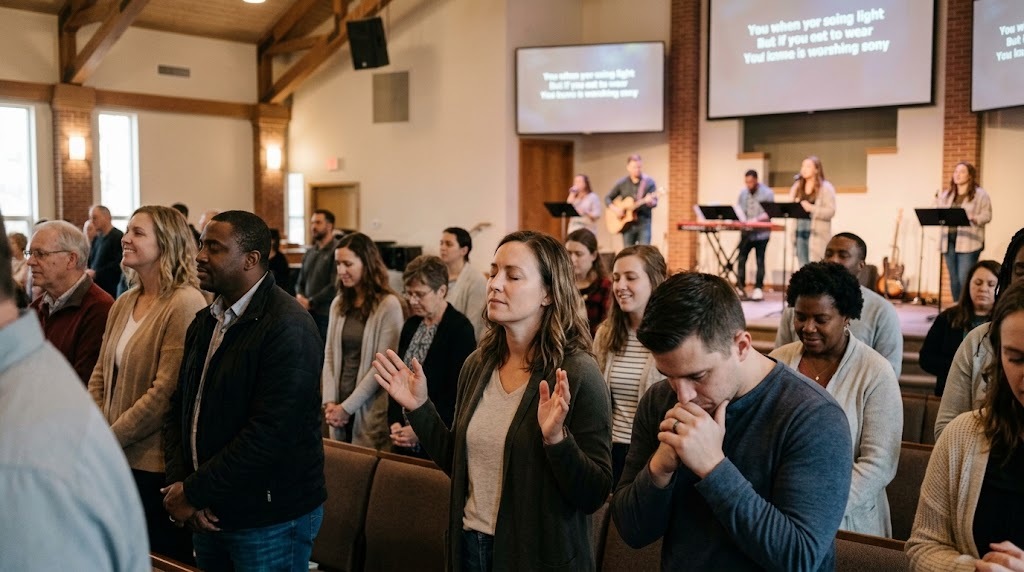
There is also something powerful about worshipping with other people. Personal worship is important, but congregational worship creates a different experience. Thousands of people can sing the same words with different stories, different struggles and different backgrounds.
One person may be celebrating.
Another may be grieving.
Another may be waiting.
Another may be confused.
Yet they can all sing the same words.
That shared experience can remind us that we are not alone.
Worship music therefore has the ability to connect individual experiences to a larger community of faith.
I think that is one reason worship songs can be so powerful in church services. When a congregation sings together, the experience is not simply about the musicians on stage. It becomes an opportunity for everyone present to participate.
The person who cannot sing perfectly can still worship.
The person who does not know every musical technique can still worship.
The person going through a difficult season can still worship.
Worship is not a competition.
It is a response.
And that response can create room for reflection and renewal.
There are also times when a worship song challenges me. Not every meaningful worship song makes me feel comfortable. Some songs force me to confront my priorities. Some remind me about forgiveness. Others challenge me to surrender pride, fear or resentment.
That is important because renewal is not always about feeling good.
Sometimes renewal begins with being corrected.
Sometimes the song exposes something that needs to change.
Sometimes you realise that you have been carrying bitterness for too long.
Sometimes you realise that you have allowed disappointment to change your view of God.
Sometimes you recognise that you have been so focused on what you want that you have forgotten to be thankful for what you already have.
These moments can be uncomfortable, but they can also be transformative.
How worship music encourages reflection and renewal ultimately comes down to what happens inside the listener. The song itself is not a magic formula. Two people can listen to the same worship song and have completely different experiences.
What makes the difference is often the heart of the listener.
If I listen only for entertainment, I may hear a beautiful melody.
If I listen prayerfully, I may hear a message that speaks directly to something I am experiencing.
That is why intentional listening matters.
Sometimes it helps to choose a song and sit with it instead of immediately moving to another one. Listen to the lyrics. Think about what they mean. Ask yourself why certain words are affecting you. Turn those words into a prayer.
If the song speaks about God’s faithfulness, thank Him for specific moments of faithfulness in your life.
If it speaks about surrender, identify what you need to release.
If it speaks about hope, ask God to renew your hope.
If it speaks about forgiveness, consider whether there is someone you need to forgive.
If it speaks about God’s presence, remind yourself that you do not have to face your circumstances alone.
This transforms listening into an active spiritual practice.
For me, one of the greatest lessons from worship music is that renewal does not always require a change in circumstances. Sometimes what needs to change first is the way we see those circumstances.
The problem may still be there.
The unanswered question may still be unanswered.
The journey may still be long.
But your heart can become stronger.
Your perspective can become clearer.
Your faith can become steadier.
Your hope can become stronger.
That is why I believe understanding how worship music encourages reflection and renewal is more than simply discussing Christian music. It is about understanding how something as simple as a song can create space for people to pause, remember, pray, think and begin again.
There will always be noise around us. There will always be deadlines, responsibilities, expectations and problems demanding our attention. There will always be another notification waiting on our phones and another issue waiting to be solved.
But sometimes we need to stop.
Sometimes we need to put the phone down.
Sometimes we need to close our eyes.
Sometimes we need to listen.
And sometimes, in the middle of a worship song, we discover that what we desperately needed was not another answer but a renewed heart.
Worship music may not remove every difficulty, but it can remind us that difficulty is not the whole story. It can help us remember God’s character when circumstances make us question everything else. It can bring forgotten gratitude back to the surface. It can give words to emotions we struggle to explain. It can create room for prayer and remind us of truths we may have neglected.
Most importantly, it can help us pause long enough to examine where we are and where we are going.
That is the beauty of reflection.
And that is the hope of renewal.
The next time you feel overwhelmed, distracted or spiritually tired, consider giving yourself a few quiet moments with worship music. Do not rush through the song. Listen carefully. Reflect on the words. Let your mind slow down. Talk to God about what comes to your heart.
You may discover that nothing outside you has changed immediately.
But something inside you has.
And sometimes that is where renewal begins.

Leave a Reply