
What Is a Music Split Sheet? A Guide for Gospel Songwriters
What Is a Music Split Sheet? A Guide for Gospel Songwriters
Imagine writing a gospel song with a friend. You create the chorus, your friend writes two verses, and a third person helps develop the melody. Later, a music producer contributes an arrangement that gives the song its final sound.
Everyone has contributed something valuable, but one important question remains: who owns the song, and what percentage belongs to each contributor?
This is where a music split sheet becomes useful.
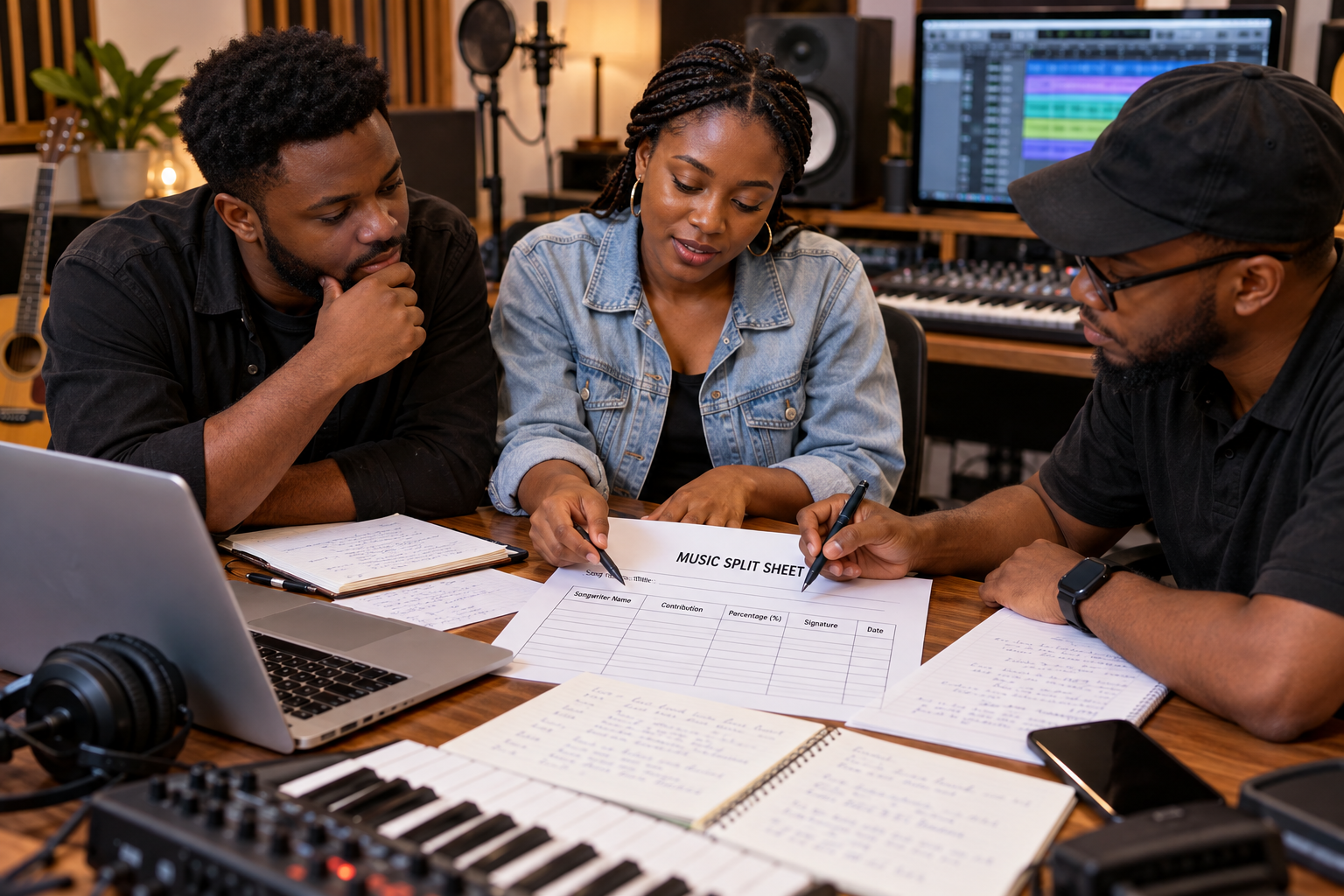
A music split sheet is a written record of the agreed ownership percentages for a song’s composition among its contributors. It helps songwriters and other eligible contributors document their respective shares before releasing a song.
For independent gospel artists, understanding music split sheets is especially important because collaborations can involve songwriters, worship leaders, composers, musicians, and producers working together without a traditional record label managing the paperwork.
Whether you write songs for your church choir, produce gospel music independently, or collaborate with other Christian artists, learning how split sheets work can help prevent misunderstandings and protect professional relationships.
What Is a Music Split Sheet?
A music split sheet is a document that records how ownership of a musical composition is divided among the people who contributed to writing it.
The composition generally includes the underlying musical work, such as the lyrics and melody. It is distinct from the sound recording created when performers record the song.
For example, a gospel song might have two lyricists and one person who composed the melody. The collaborators can use a split sheet to record the percentages they have agreed each person owns in the composition.
The document normally identifies the song, names the contributors, records their ownership percentages, and includes relevant contact and rights-management information.
A split sheet is not the same as a recording contract, a producer agreement, or a music distribution agreement. Each document serves a different purpose.
It is also important to understand that a split sheet does not automatically settle every question about music rights. The agreement should accurately reflect the contributors’ intentions, and other written agreements may be necessary when a collaboration involves production fees, recording ownership, publishing administration, or additional rights.
Why Do Gospel Songwriters Need a Music Split Sheet?
Many gospel songs begin informally. A chorus may emerge during personal devotion, a church rehearsal, a songwriting session, or a conversation between musicians.
Because the process feels natural, collaborators may postpone discussing ownership. They may assume that everyone remembers who contributed what or that the details can be settled after the song becomes successful.
Unfortunately, memories and expectations can differ.
One songwriter may believe that creating the chorus entitles them to half of the composition. Another may believe that writing the verses and developing the melody deserves a different percentage. A producer may also believe that their contribution should be recognised as songwriting.
Without a clear agreement, these differences can become difficult to resolve.
A music split sheet helps collaborators discuss the issue while everyone is still working together and the details are fresh.
1. It records agreed songwriting ownership
The most direct purpose of a split sheet is to document the agreed ownership shares in a composition.
Suppose two gospel songwriters collaborate on a song and agree that each owns 50% of the composition. Recording that agreement gives both parties a written reference for future administration.
The percentages should reflect the agreement the collaborators actually reach. There is no universal rule that every song must be divided equally.
2. It reduces misunderstandings
A contributor may remember a songwriting session differently from another person. Putting the agreement in writing gives everyone a shared record to refer to.
This is particularly useful when a song is released months after it was written or when the collaborators are no longer working together regularly.
3. It helps with royalty administration
Songwriting ownership can affect how composition-related royalties are allocated and administered.
A split sheet can help collaborators provide consistent ownership information when registering a song with a performing rights organisation, publisher, or other relevant rights administrator.
However, a split sheet does not itself guarantee payment. Contributors must still follow the registration and administrative requirements of the organisations handling their rights.
4. It supports professional collaboration
Clear agreements can help preserve relationships among Christian artists. Instead of leaving important questions unresolved, collaborators can discuss ownership openly and respectfully.
This allows everyone to concentrate on creating music while knowing that the business arrangements are being handled responsibly.
What Information Should a Music Split Sheet Contain?
A useful music split sheet should identify the song and the people who contributed to its composition. The exact information required may vary depending on the collaborators and how the song will be administered.
Consider including the following details.
Song title
Write the agreed title of the composition. If the title changes before release, make sure the final documentation and registrations identify the correct work.
Songwriters’ legal names
Record the full legal names of the songwriters. If an artist performs under a stage name, such as Godsfame, the document can identify that professional name alongside the person’s legal name where appropriate.
This helps distinguish the individual who owns the rights from the public identity used to promote the music.
Contributor roles
Describe each person’s contribution as accurately as possible. This might include lyrics, melody, or other agreed compositional contributions.
Be careful not to assume that everyone involved in a recording is automatically a songwriter. A studio musician, sound engineer, or producer may contribute to the recording without necessarily receiving ownership of the composition. Their rights depend on the actual contribution and the agreements in place.
Agreed ownership percentages
Record the percentage assigned to each composition owner.
For a simple arrangement involving two contributors, the agreed shares might be 50% each. For a song with three contributors, the shares could be divided in another way, provided the agreement is clear.
The total should normally account for 100% of the composition ownership being documented. If publishing rights or other interests are being handled separately, explain the arrangement rather than mixing different types of rights together.
Contact and rights information
Include suitable contact details and, where relevant, each contributor’s publisher or performing rights organisation information.
If a contributor has a songwriter or rights-management identifier, it may be useful to record it. Do not delay discussing the ownership agreement simply because someone has not yet received an identifier.
Date and confirmation
Record the date the agreement was made and obtain written confirmation from the relevant contributors. Depending on the circumstances and applicable law, signatures or another clearly documented form of agreement may be appropriate.
For important commercial releases, consider having a qualified music lawyer review the agreement.
How Do You Divide Songwriting Percentages Fairly?
There is no single percentage formula that works for every song. The collaborators should agree on the ownership shares based on their contributions, expectations, and any applicable agreements.
The key is to have the conversation before release rather than relying on assumptions.
Consider these examples.
Example 1: Two co-writers
Two songwriters work together on a gospel song. One develops the verses, while the other creates the chorus and melody. After discussing their contributions, they agree to own 50% each.
Their split sheet records the agreed arrangement.
Example 2: Three songwriters
Three contributors collaborate on the lyrics and melody. They agree on shares of 40%, 35%, and 25%, respectively.
The split sheet records these percentages, which add up to 100%.
Example 3: A producer contributes to the composition
A producer changes or develops a musical element in a way that the collaborators agree constitutes a songwriting contribution. The team discusses whether the producer should receive a share of the composition and records the agreed terms.
The producer’s involvement alone does not automatically establish a songwriting share. The nature of the contribution and any existing agreements matter.
These examples are illustrative, not universal formulas. Contributors should avoid assigning percentages based solely on assumptions about who worked hardest or who paid for the recording. Discuss ownership openly and document the agreement reached.
Is a Music Producer Automatically Entitled to Songwriting Royalties?
No. A producer is not automatically entitled to ownership of the composition simply because they recorded, mixed, or produced a song.
A producer may be paid a fee for their services. In another arrangement, a producer may also contribute to the composition and negotiate a songwriting share. Some agreements cover recording ownership or other compensation separately.
For example, a gospel artist might pay a producer to arrange and record a song whose lyrics and melody were already written. If the producer is only providing the agreed production services, the payment arrangement may not include composition ownership.
If the producer creates a new melody or contributes original lyrics, the parties should discuss whether that contribution warrants songwriting credit and ownership.
This is why independent artists should distinguish between the composition, the sound recording, and the services involved in producing it.
A written producer agreement can clarify fees, deliverables, recording ownership, permitted uses, and any additional rights or royalties. The split sheet can then document the agreed ownership of the composition.
What Is the Difference Between a Split Sheet and a Copyright Registration?
These two things are related, but they are not the same.
A split sheet records the collaborators’ agreed ownership arrangement. A copyright registration, where available and applicable, is a separate legal or administrative process governed by the relevant country’s rules.
In some countries, copyright protection arises automatically when an original work is created and fixed in a qualifying form. Registration may provide additional legal or evidentiary benefits, depending on the jurisdiction.
A split sheet should therefore not be treated as a substitute for every copyright-related requirement.
Similarly, registering a song with a performing rights organisation or publisher is not necessarily the same as registering copyright with a government copyright office.
Gospel artists should identify which process they need and follow the requirements of the relevant organisation or jurisdiction.
When Should You Complete a Music Split Sheet?
The best time to discuss and document songwriting ownership is during the collaboration or as soon as the composition is sufficiently developed for the contributors to identify their contributions.
Do not wait until the song is attracting attention or earning money.
A practical process is to:
- Identify everyone who contributed to the composition.
- Discuss the nature of each person’s contribution.
- Agree on the ownership percentages.
- Record the song title and contributor information.
- Obtain written confirmation from the relevant parties.
- Store the completed document securely.
- Use the agreed information when completing appropriate registrations.
If the contributors cannot agree, avoid submitting conflicting ownership claims as though the matter were settled. Continue the discussion and seek professional advice if necessary.
If the ownership arrangement changes later, document the change clearly and update relevant records where required.
Common Music Split Sheet Mistakes to Avoid
Even well-intentioned musicians can make mistakes when documenting a collaboration. Here are some common problems to watch for.
Leaving the discussion until after release. This can turn a manageable conversation into a disagreement about income or credit.
Assuming equal ownership without agreement. Equal splits can work well, but they should be agreed upon rather than presumed.
Confusing production services with songwriting. Paying for recording, mixing, or mastering does not automatically establish ownership of the underlying composition.
Using inconsistent contributor names. Different spellings or stage names can create administrative confusion. Record accurate legal and professional details where appropriate.
Failing to keep a copy. Each contributor should retain an accessible copy of the final agreement.
Treating the document as a complete music contract. A split sheet may not address recording ownership, publishing administration, licences, producer fees, or all other commercial terms.
Signing without understanding the agreement. Contributors should read the document carefully and ask questions about unclear terms before confirming their consent.
These simple precautions can make music collaboration more organised and transparent.
A Simple Music Split Sheet Example for Gospel Songwriters
The following example illustrates the type of information a basic split sheet may record. It is not a complete legal contract.
Song title: Example Gospel Song
Contributor 1: Songwriter A
Contribution: Lyrics and melody
Agreed composition share: 60%
Contributor 2: Songwriter B
Contribution: Additional lyrics and melody
Agreed composition share: 40%
Total composition ownership: 100%
Date of agreement: [Insert date]
Contributor confirmation: [Insert signatures or other agreed written confirmation]
The example assumes that both contributors agree to the arrangement. In a real collaboration, the contributors should confirm that the percentages reflect their actual agreement and that any separate publishing, recording, or contractual arrangements are properly addressed.
For a commercially significant song, a professionally prepared agreement may be more appropriate than relying on a basic template.
Final Thoughts: Protect the Song and the Relationship
Gospel music often grows out of collaboration. A songwriter may begin with a chorus, a musician may contribute a melody, and a producer may help turn the idea into a finished recording. Every collaboration benefits from clear communication.
A music split sheet provides a practical way to record agreed composition ownership before a song is released. It can help reduce confusion, support accurate rights administration, and encourage professional relationships among gospel artists and their collaborators.
The most important step is not simply downloading a form. It is having an honest conversation about ownership, documenting the agreement accurately, and ensuring that everyone understands what they are confirming.
Whether you are an independent gospel artist, a church songwriter, a worship leader, or a music producer, make ownership discussions part of your songwriting process.
Create the music together, agree on the rights clearly, and put the agreement in writing before the release.
Free Music Split-Sheet Checklist
Want to organise your songwriting collaborations more effectively? Download our free Music Split-Sheet Checklist for Songwriters, prepared by Godsfame Music.
Use this checklist to help identify contributors, record agreed songwriting ownership percentages, confirm important details, and keep your project records organised.
Note: This checklist is an educational resource, not a complete legal agreement or legal advice.

Leave a Reply