
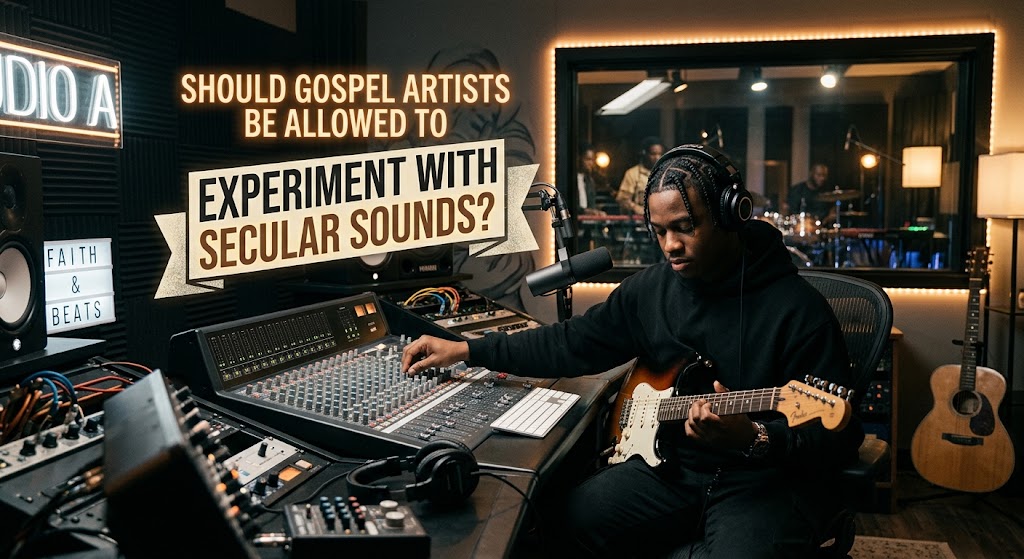
Should Gospel Artists Be Allowed to Experiment With Secular Sounds?
Should Gospel Artists Be Allowed to Experiment With Secular Sounds?
Should Gospel Artists Be Allowed to Experiment With Secular Sounds? This is a question that continues to generate passionate conversations among Christians, musicians, worship leaders and gospel music lovers around the world. As Christian music continues to evolve, the boundaries between traditional gospel sounds and contemporary musical styles are becoming increasingly difficult to define. Gospel artists are experimenting with Afrobeats, R&B, hip hop, reggae, pop, soul, electronic music and other modern sounds, and while some listeners celebrate the creativity, others believe that gospel music should maintain a clear musical identity that separates it from secular entertainment.
The debate is not necessarily about whether gospel artists should make good music. It is about how far they can go creatively without compromising the message and purpose of Christian music. For some people, the sound of a song immediately determines whether it feels spiritual or secular. For others, music is simply a tool, and what matters most is the message, intention and content behind the music. This difference in perspective is exactly why the question Should Gospel Artists Be Allowed to Experiment With Secular Sounds? has become so relevant in modern Christian music.
Music itself is not inherently Christian or secular. Musical instruments, rhythms, melodies and production techniques do not belong exclusively to one group of people. A drum does not become secular because a secular musician uses it. A guitar does not become sinful because it appears in a popular song. A particular rhythm is not automatically ungodly simply because it has been used extensively outside the church. What gives Christian music its identity is often the message, purpose and context in which the music is created and presented.
This is one of the strongest arguments in favour of experimentation. Gospel artists live in the same world as everyone else. They hear different sounds, interact with different cultures and experience changing musical trends. It is therefore understandable that some Christian musicians want to explore modern sounds while maintaining a Christian message. A gospel artist may use an Afrobeats rhythm, for example, while writing lyrics about faith, God’s love, hope, salvation or personal testimony. The rhythm may sound contemporary, but the message can still be distinctly Christian.
In Africa, this conversation is particularly interesting because gospel music has always evolved alongside local musical traditions. African gospel music has incorporated indigenous rhythms, percussion, highlife influences, Afro pop elements, contemporary worship and numerous other styles. What listeners consider normal today might have sounded unusual several decades ago. This shows that Christian music has never existed in only one musical form.
Consider the evolution of gospel music itself. Traditional gospel relied heavily on choirs, organs, pianos, hand clapping and particular vocal arrangements. Over time, Christian musicians introduced guitars, synthesizers, drum machines, contemporary production techniques and different vocal styles. If Christians had completely rejected every new musical influence, much of the contemporary gospel music enjoyed today might never have existed.
The real issue, therefore, may not be whether gospel artists should experiment with secular sounds, but whether there should be boundaries around that experimentation. Creativity without boundaries can sometimes create confusion, particularly when the music becomes almost indistinguishable from secular entertainment except for a few Christian words inserted into the lyrics.
This is where the concerns of critics deserve serious attention. Some Christians believe that gospel music should sound different because the Christian message is different. They worry that excessive experimentation could gradually remove the distinction between gospel music and secular music. An artist may begin by adopting a particular sound, then gradually adopt the culture, themes, imagery and lifestyle associated with that sound. Eventually, the Christian identity of the music could become difficult to recognise.
That concern should not simply be dismissed as being old fashioned. Christian musicians have influence, particularly among young listeners. Music does not only entertain people. It can shape emotions, attitudes, language, aspirations and cultural identity. A gospel artist therefore has a responsibility to think carefully about what they are communicating through both their lyrics and their overall artistic presentation.
At the same time, Christians should be careful not to create a list of musical styles that are automatically labelled sinful. A rhythm does not have a moral character by itself. The same musical structure can appear in songs with completely different messages. A beat can be used to promote violence, materialism and sexual immorality, but the same general musical style can also be used to communicate hope, faith and gratitude.
This is why judging a Christian song exclusively by its sound can be misleading. A song can sound traditional and still contain a shallow message. Another song can sound modern and still communicate a deeply biblical truth. The presence of a piano, choir or organ does not automatically make a song spiritually powerful, just as the presence of electronic production does not automatically make a song worldly.
The heart of the discussion should therefore include the lyrics. What is the artist saying? What values are being promoted? Does the song glorify God or glorify the artist? Does it encourage faith or promote destructive behaviour? Does it point listeners towards Christ or simply use Christian language as a marketing strategy? These questions may be more important than the particular beat being used.
There is also a practical reason why some gospel artists experiment with contemporary sounds. They want to reach people who may never voluntarily listen to traditional gospel music. A young person who rarely enters a church may nevertheless discover a Christian artist through an Afrobeats song, hip hop track or contemporary pop production. The music can create an opportunity for the message to reach an audience that might otherwise remain completely disconnected from Christian music.
This does not mean every gospel artist must become experimental. Different artists have different assignments, audiences and creative identities. Some are called to traditional gospel. Some are passionate about worship. Others specialise in contemporary Christian music. Others combine gospel messages with local cultural sounds. Diversity does not necessarily weaken Christian music. It can demonstrate how one faith can be expressed through different musical cultures.
However, experimentation should not become an excuse for abandoning Christian identity. There is a difference between borrowing a musical style and adopting values that contradict Christian beliefs. An artist can experiment with production while maintaining meaningful lyrics, wholesome imagery and a clear spiritual purpose. The danger comes when the desire to appear fashionable becomes more important than the message.
Another important factor is intention. Why does an artist want to use a secular sound? If the motivation is simply to gain attention, increase streams and become commercially successful, questions may need to be asked. There is nothing inherently wrong with financial success, but Christian musicians should not allow popularity to become the ultimate measure of their ministry.
On the other hand, wanting to make excellent music that appeals to a wider audience is not automatically a spiritual problem. Christian artists are allowed to be creative. They are allowed to improve their production. They are allowed to study musical trends. They are allowed to work with talented producers from different backgrounds. Excellence and innovation do not automatically contradict faith.
The Christian music industry itself is also changing. Streaming platforms have transformed how people discover music. Social media has made it possible for independent artists to reach audiences without major record labels. Short videos can turn an unknown song into a global sensation within days. In such an environment, gospel artists are naturally thinking about how to make their music competitive and discoverable.
This creates another difficult question. If a Christian song uses a sound that attracts millions of listeners but the message remains biblical, should Christians celebrate the opportunity or criticise the sound? There may not be one answer that satisfies everyone.
Perhaps the better approach is discernment rather than fear. Christian listeners should learn to evaluate music thoughtfully instead of automatically accepting or rejecting a song based on its genre. Gospel artists should also understand that creative freedom comes with responsibility. The fact that something is technically possible does not mean that it is always wise or beneficial.
The Apostle Paul expressed a similar principle when discussing Christian freedom. In 1 Corinthians 10:23, he explained that while many things may be permissible, not everything is beneficial. Although the verse is not specifically about modern music genres, the principle provides something worth considering. Christian freedom should be accompanied by wisdom, responsibility and concern for others.
A gospel artist may have the freedom to experiment, but they should also consider the people listening. Could the music confuse their audience? Could its presentation undermine the message? Could it encourage behaviour that contradicts the lyrics? Could the artist communicate the gospel more effectively through a particular sound without compromising their convictions?
These are deeper questions than simply asking whether a beat is secular.
There is also an argument that gospel music should not be trapped in the past. Christianity exists in every generation, and every generation develops its own artistic language. Young Christians should be able to express their faith using the musical vocabulary they understand. If Christian music refuses to evolve at all, it may become increasingly disconnected from younger audiences.
But evolution should not mean losing substance. Christian music can change its sound without changing its foundation. Production can become more sophisticated while biblical truth remains central. Artists can adopt new rhythms while continuing to write meaningful lyrics. Music videos can become visually impressive without compromising Christian values. Creativity and conviction can coexist.
The strongest gospel artists may ultimately be those who understand both sides of the conversation. They recognise that music should connect with contemporary listeners, but they also recognise that Christian music is not simply another branch of the entertainment industry. There is a message behind it. There is a responsibility attached to it. There is a reason people listen to it when they are celebrating, grieving, praying, worshipping and searching for hope.
Should Gospel Artists Be Allowed to Experiment With Secular Sounds? The answer should probably not be an absolute yes or no. Gospel artists should have room to experiment creatively, but that freedom should be guided by Christian conviction, wisdom and responsibility. The sound can evolve, but the message should not become meaningless. The production can change, but the identity of the artist should remain clear. Innovation can be welcomed without sacrificing integrity.
Perhaps Christians should stop asking only whether a song sounds secular and start asking what the song is actually communicating. Is it truthful? Is it uplifting? Is it consistent with Christian values? Does it glorify God? Does it encourage listeners towards something positive and spiritually meaningful? Does the artist genuinely believe in the message being communicated?
These questions can produce a much healthier conversation about Christian music.
There will always be people who prefer traditional gospel music, and there is nothing wrong with that. There will also be people who enjoy contemporary Christian music influenced by modern genres. Both groups can coexist. The Christian music world is large enough to accommodate different sounds, cultures, generations and artistic expressions.
The important thing is that experimentation should never become more important than the reason gospel music exists in the first place. A catchy beat can attract attention, but a meaningful message gives the music lasting value. Production can make people press play, but authenticity can make them listen again. A trend can generate streams, but a powerful message can remain with someone long after the song has ended.
Gospel artists should therefore be encouraged to create, explore and innovate, but they should also be challenged to remain intentional about what they represent. They should not be afraid of modern sounds simply because those sounds are also used by secular musicians. At the same time, they should not embrace every trend simply because it is popular.
The future of Christian music may depend on finding this balance. The next generation of gospel artists will probably sound very different from previous generations. They may combine African rhythms with contemporary worship, hip hop with scripture, electronic production with traditional choir arrangements and countless other influences. That does not automatically mean Christian music is losing its identity. It may simply mean that the expression of faith is changing.
Ultimately, the question Should Gospel Artists Be Allowed to Experiment With Secular Sounds? is bigger than music. It is really a question about how Christians engage with culture. Should they completely separate themselves from popular culture, or should they enter it and transform it through their message? Should Christian creativity have strict boundaries, or should artists have freedom to explore? Should the church preserve traditional sounds, or should it embrace whatever helps communicate the gospel to a changing generation?
There may never be universal agreement.
And perhaps that is not necessarily a bad thing.
A healthy debate can force gospel artists, church leaders and listeners to think more deeply about what Christian music represents. Instead of attacking every artist who tries something different, listeners can ask thoughtful questions. Instead of assuming every new sound is acceptable, artists can examine their motives and message. Instead of treating traditional music as automatically superior, Christians can appreciate its history while making room for new expressions.
Gospel music does not have to choose between creativity and conviction. It can have both.
The sound can change. The technology can change. The audience can change. The platforms can change. The industry can change. But if the purpose remains clear and the message remains genuine, experimentation does not necessarily have to mean compromise.
So, should gospel artists be allowed to experiment with secular sounds? Yes, but with discernment, responsibility and a clear understanding of what they represent. The goal should not simply be to sound different. The goal should be to use creativity in a way that communicates truth, reaches people and preserves the integrity of the Christian message.
And perhaps the most important question is not whether the beat sounds secular.
It is whether the message still sounds like Christ.

Leave a Reply