
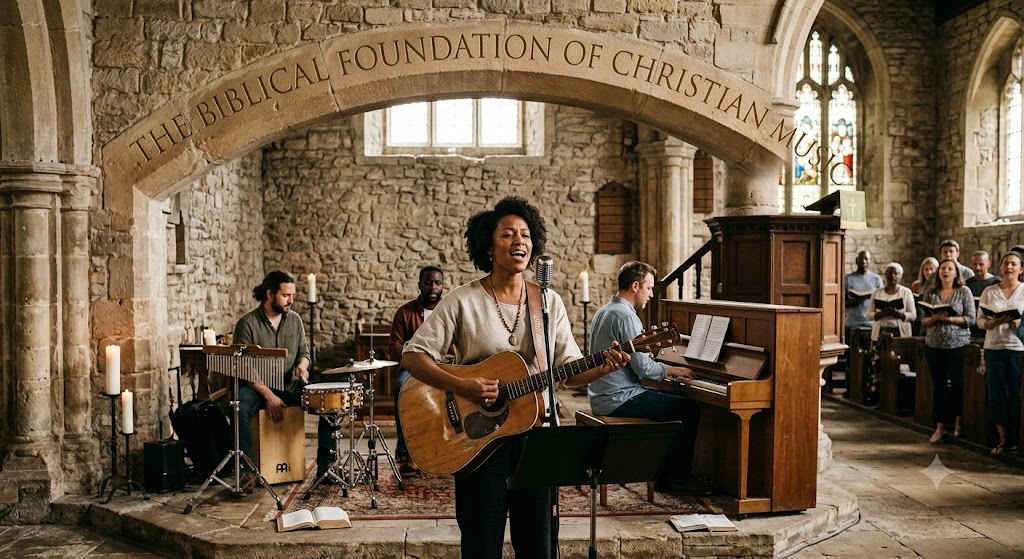
The Biblical Foundation of Christian Music
The Biblical Foundation of Christian Music is far deeper than melodies, instruments, talented singers or beautifully written lyrics. It begins with God Himself. Before choirs were organised, before churches gathered on Sundays, before hymns were composed and before contemporary worship songs filled concert halls, the purpose of music was already established by the Creator. Throughout Scripture, music appears as a divine gift, a powerful expression of worship, thanksgiving, celebration, repentance and proclamation. Understanding The Biblical Foundation of Christian Music helps believers appreciate that worship is not merely a performance but an act of obedience, devotion and love directed towards God. When Christians recognise that music has its roots in God’s eternal plan, they begin to see every song as an opportunity to glorify Him rather than to entertain people.
From the opening chapters of the Bible, creation itself reveals that God delights in harmony, beauty and order. Although Genesis does not explicitly describe music during creation, the rhythm and structure of God’s creative work point to a Creator who values order and beauty. Later in Scripture, Job 38:7 paints a remarkable picture of creation when it says that the morning stars sang together and all the angels shouted for joy. This glimpse into heaven reminds believers that praise existed before humanity walked the earth. Worship was not invented by people. It originated in heaven where God’s majesty naturally inspired joyful praise.
The Biblical Foundation of Christian Music becomes even clearer as the story of humanity unfolds. Music accompanied moments of victory, remembrance and worship. After God delivered the Israelites from Egypt by parting the Red Sea, Moses and the people broke into song, praising the Lord for His mighty acts. Exodus 15 contains one of the earliest recorded worship songs in Scripture. This song was not written for fame or popularity. It was a heartfelt response to God’s faithfulness and power. Miriam also took a tambourine and led the women in singing and dancing before the Lord. Their celebration demonstrates that music has always been an appropriate response to God’s salvation.
Throughout the Old Testament, music became deeply woven into the spiritual life of God’s people. King David, often remembered as a shepherd, warrior and king, was also a gifted musician and songwriter. Many of the Psalms were written by David and continue to inspire believers thousands of years later. These songs express every human emotion imaginable. Joy, sorrow, fear, hope, repentance, confidence and thanksgiving all find their place within the Psalms. This teaches an important truth about The Biblical Foundation of Christian Music. Authentic worship does not require pretending that life is perfect. Instead, believers are invited to bring every emotion honestly before God while trusting in His goodness.
David understood that music was not simply an artistic skill but a spiritual offering. He appointed musicians to minister continually before the Ark of the Covenant, ensuring that praise remained central in Israel’s worship. Skilled singers and instrumentalists were organised into groups that served faithfully in the temple. Their ministry was intentional, disciplined and dedicated to glorifying God. This demonstrates that excellence in music is not contrary to spirituality. Rather, using one’s gifts with diligence honours the One who gave those gifts.
The Biblical Foundation of Christian Music also reveals that music carries spiritual influence. When King Saul was troubled by an evil spirit, David played the harp, bringing relief and peace. Although the music itself possessed no magical power, God used David’s worshipful heart and musical gift as an instrument of comfort. This account reminds believers that songs centred on God have the ability to strengthen hearts, calm anxious minds and direct attention towards divine truth.
The Psalms repeatedly encourage God’s people to sing unto the Lord. Psalm 96 begins by declaring, “Sing unto the Lord a new song.” Psalm 100 invites believers to enter His gates with thanksgiving and His courts with praise. Psalm 150 concludes by calling upon everything that has breath to praise the Lord using a variety of instruments. These passages establish that worship through music is not optional entertainment added to faith but an integral part of responding to God’s greatness.
One of the strongest aspects of The Biblical Foundation of Christian Music is its connection with truth. Christian songs are meant to teach as well as inspire. Throughout Scripture, songs often served as tools for remembering God’s commands and mighty works. Before widespread literacy, music helped people memorise important truths. Even today, many believers can recall biblical principles through songs learned during childhood. This reflects God’s wisdom in using music as a vehicle for preserving His Word within the hearts of His people.
As the New Testament unfolds, the purpose of Christian music becomes even more evident. Jesus Himself participated in singing. After celebrating the Last Supper with His disciples, they sang a hymn before going to the Mount of Olives. This simple detail demonstrates that worship remained central even during the darkest hours leading to Christ’s crucifixion. Jesus, knowing the suffering that awaited Him, still joined His disciples in singing praise. His example teaches believers that worship should not depend solely upon favourable circumstances.
The apostles continued this pattern after Christ’s resurrection. Paul and Silas provide one of the most remarkable examples. While imprisoned, beaten and chained, they prayed and sang hymns to God at midnight. Their praise was not motivated by comfort but by confidence in God’s sovereignty. The result was extraordinary. An earthquake shook the prison, chains fell off and doors opened. More importantly, the jailer and his household came to faith in Christ. This account illustrates that Christian music can become a testimony that points others towards salvation.
The Biblical Foundation of Christian Music reaches one of its clearest teachings in Ephesians 5:19, where believers are instructed to speak to one another with psalms, hymns and spiritual songs, singing and making melody in their hearts to the Lord. Likewise, Colossians 3:16 encourages Christians to let the Word of Christ dwell richly within them while teaching and admonishing one another through psalms, hymns and spiritual songs with gratitude in their hearts. These verses reveal several essential principles. Christian music glorifies God, teaches biblical truth, encourages fellow believers and flows from thankful hearts.
Notice that Paul emphasises the condition of the heart more than musical style. The focus remains on sincere worship rather than outward performance. This truth continues to guide churches today. Musical preferences may vary across cultures and generations, but the ultimate purpose remains unchanged. Whether accompanied by an organ, piano, guitar, orchestra or simple voices alone, Christian music should direct attention towards Christ rather than towards human performers.
Another important aspect of The Biblical Foundation of Christian Music is that worship belongs to every believer. The Bible never limits praise to professional musicians alone. Congregational singing appears repeatedly throughout Scripture because worship is the responsibility and privilege of God’s people collectively. Every believer, regardless of vocal ability, is invited to join in declaring God’s greatness. This creates unity within the church as diverse individuals lift one voice in honour of their Saviour.
Christian music also plays an important role in spiritual formation. Songs shape beliefs because they are remembered long after sermons have ended. This is why biblical accuracy matters greatly in songwriting. Lyrics should faithfully reflect Scripture rather than merely expressing emotional experiences. While emotions are valuable, they must always remain anchored in God’s revealed truth. The strongest worship songs combine heartfelt devotion with sound doctrine, enabling believers to worship God in spirit and in truth.
The Biblical Foundation of Christian Music reminds believers that worship extends beyond church buildings. Although corporate worship is essential, songs of praise should accompany everyday life. Families can sing together at home. Individuals can worship during personal prayer, work or travel. Just as the Psalms accompanied God’s people through every season of life, Christian music today can become a constant reminder of God’s presence and faithfulness.
Throughout history, Christian music has carried the Gospel into cultures around the world. Missionaries often translated biblical truths into local songs, allowing people to understand and remember God’s Word in their own languages. Music crosses barriers that spoken words sometimes cannot. It reaches hearts, communicates hope and unites believers across different nations. This global impact reflects God’s desire that every tribe, tongue and people worship Him together.
The Biblical Foundation of Christian Music
Another beautiful element within The Biblical Foundation of Christian Music is thanksgiving. Scripture repeatedly connects praise with gratitude. Rather than focusing solely upon personal needs, worship redirects attention towards God’s character. He is holy, faithful, merciful, loving, just and worthy of praise regardless of changing circumstances. Gratitude transforms the believer’s perspective by shifting focus from temporary struggles to God’s eternal promises.
Humility also stands at the centre of biblical worship. Throughout Scripture, those who truly encounter God’s holiness respond with reverence. Christian musicians therefore serve as ministers before they become performers. Their greatest responsibility is not impressing audiences but honouring Christ. Technical excellence certainly has value, yet excellence without humility can easily become pride. Scripture continually reminds believers that God looks upon the heart.
The Biblical Foundation of Christian Music also teaches discernment. Not every song labelled Christian necessarily reflects biblical truth. Believers are encouraged to evaluate lyrics according to Scripture. Songs should exalt God rather than glorify humanity. They should proclaim Christ’s finished work, encourage holiness, inspire faith and remain consistent with biblical doctrine. This responsibility belongs not only to worship leaders but also to every Christian who listens and sings.
One of the most comforting realities found throughout Scripture is that God delights in the praises of His people. Worship is not designed because God lacks anything. Rather, He graciously invites His children into fellowship with Him. Through praise, believers draw near to the One who first loved them. Singing becomes an expression of relationship rather than religious obligation.
Christian music also points forward to eternity. The Bible provides glimpses of heaven where countless multitudes worship before God’s throne. The book of Revelation describes heavenly beings continually declaring God’s holiness while redeemed people from every nation join together in songs of praise to the Lamb who was slain. These heavenly scenes remind believers that earthly worship prepares them for eternal worship. Every sincere song offered today anticipates the greater worship that awaits in God’s presence.
The Biblical Foundation of Christian Music therefore extends from Genesis to Revelation. It begins with a Creator worthy of praise and concludes with eternal worship surrounding His throne. Along the way, Scripture consistently reveals music as an instrument for glorifying God, teaching truth, strengthening faith, encouraging believers and proclaiming the Gospel. Whether expressed through ancient psalms, traditional hymns or contemporary worship songs, the central purpose remains unchanged. God alone deserves the highest praise.
Modern churches continue to benefit from this timeless biblical pattern. Technology has transformed how music is recorded, distributed and consumed, but the principles established in Scripture remain constant. Popularity, commercial success and artistic recognition should never replace faithfulness to God’s Word. Christian music achieves its highest purpose only when it points listeners towards Jesus Christ and encourages lives of obedience and worship.
Every believer has an opportunity to participate in this sacred tradition. Some compose songs, others lead worship, many play instruments and millions simply lift their voices during congregational praise. Each contribution matters because worship is ultimately directed towards God. He receives glory not because every voice is perfect but because every sincere heart desires to honour Him.
The Biblical Foundation of Christian Music reminds Christians that music is both a privilege and a responsibility. Songs have the power to shape minds, strengthen churches, encourage weary souls and proclaim the Gospel to the nations. For this reason, believers should carefully choose music that reflects biblical truth, celebrates God’s character and magnifies Jesus Christ above everything else.
As Christians continue to navigate changing cultures and evolving musical styles, they can remain confident that the foundation established by Scripture will never change. The same God who inspired the songs of Moses, David, the psalmists, the apostles and the heavenly hosts still deserves the worship of His people today. Every generation has the opportunity to compose new songs while remaining rooted in timeless biblical truth. That balance between fresh expression and unwavering doctrine is what preserves the integrity of Christian worship.
Ultimately, The Biblical Foundation of Christian Music is not about instruments, genres or personal preferences. It is about God. It is about declaring His greatness, remembering His faithfulness, celebrating His salvation through Jesus Christ and preparing hearts for eternal fellowship with Him. When Christian music remains anchored in Scripture, filled with gratitude, centred on Christ and empowered by genuine faith, it fulfils the purpose for which God intended it from the very beginning. In every season of life and in every corner of the world, believers can confidently sing because their worship rests upon an unshakable foundation found in the living and enduring Word of God.

Leave a Reply