
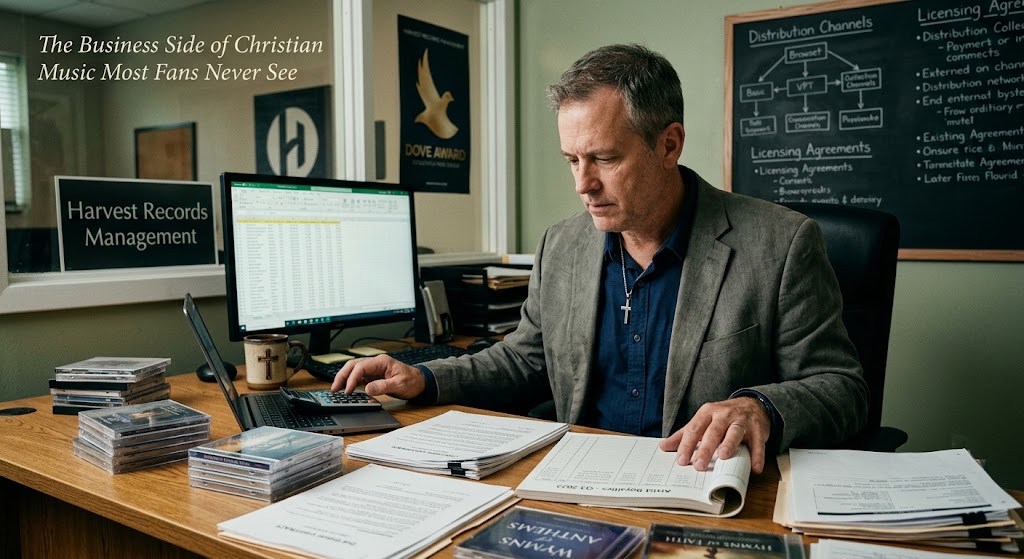
The Business Side of Christian Music Most Fans Never See
When you listen to a powerful Christian song, it is easy to focus on the lyrics, the melody, the singer’s voice and the emotions the music creates. You may hear a worship song during your morning devotion, play a gospel track on your way to work, share a new release with your friends or sing along with thousands of other believers at church. What you may not think about is everything that happens before that song reaches your ears. The Business Side of Christian Music Most Fans Never See.
Behind almost every successful Christian song is a business structure that most fans never see. There are recording costs, songwriting rights, music distribution, marketing, branding, streaming royalties, publishing agreements, performance opportunities, management decisions and countless hours of work. There are also people working behind the scenes to make sure the artist can create music consistently while building a sustainable career.
This is the business side of Christian music most fans never see.
Christian music is ministry, but for many artists, it is also a profession. These two realities can exist together without contradicting each other. A gospel singer can genuinely desire to glorify God through music while also needing money to pay musicians, book studio sessions, produce music videos, travel to events, promote new releases and support a family. Understanding this reality helps us look at Christian artists with greater appreciation and perhaps greater fairness.
One of the biggest misconceptions about Christian music is that because the music carries a spiritual message, the business surrounding it should somehow be free. The reality is very different. Recording a quality song can require producers, sound engineers, instrumentalists, vocalists, studio owners and mixing and mastering professionals. Every person involved brings a skill to the project, and those skills have economic value.
Consider what happens before an artist releases a single. The songwriter may spend days or weeks developing the lyrics and melody. A producer may create the instrumental arrangement. Musicians may record individual parts. The vocalist may spend hours recording multiple takes. An engineer then edits, mixes and masters the final recording. Artwork has to be created. Promotional materials have to be prepared. The song has to be distributed to streaming platforms. Social media content may need to be produced. A music video may also be planned.
The finished three or four minute song that you casually play on your phone may represent weeks or months of work.
This is one reason why the business side of Christian music most fans never see deserves more attention. The final product may feel effortless, but professional music rarely happens effortlessly.
Another important part of the business is music ownership. Many listeners assume that the person singing a song automatically owns everything connected to it. That is not always the case. A Christian artist may perform a song written by another songwriter. A producer may have contractual rights connected to the recording. A record label may finance the project and receive certain rights in return. A publisher may administer the songwriter’s composition.
This creates several different layers of ownership.
There is the composition itself, which includes the lyrics and melody. There is also the sound recording, sometimes called the master recording. These can involve different owners and different revenue streams. Understanding this distinction is extremely important for Christian artists because a song can become extremely popular while the person performing it does not necessarily control every part of its underlying rights.
The Business Side of Christian Music Most Fans Never See
Songwriting is another major part of the business. A songwriter does not simply create words for a singer. A songwriter creates intellectual property. That intellectual property can generate income when the song is streamed, performed publicly, reproduced, licensed or used in other contexts, depending on the applicable rights and agreements.
This is why Christian songwriters need to take their work seriously.
A song may begin as a simple idea written in a notebook or recorded as a voice note on a phone. Years later, that same composition could be performed by other artists, churches or choirs. If the songwriter has properly managed the rights, that song can become a valuable asset.
Unfortunately, some upcoming Christian musicians focus so heavily on ministry that they ignore the administrative side of their creative work. They may collaborate with people without documenting agreements. They may release songs without properly registering their compositions. They may give away rights without understanding what they are surrendering. They may assume that because everyone involved is Christian, disagreements will never happen.
Good intentions do not replace good agreements.
Christian musicians need wisdom in business just as they need wisdom in ministry. A handshake may feel friendly, but a clear written agreement can protect friendships by ensuring everyone understands what was agreed.
Record labels are another part of the industry that many fans misunderstand. A record label can provide funding, distribution, marketing, industry connections, promotion and other forms of support. In exchange, the label may receive certain rights or a percentage of revenue according to the contract.
Signing with a label can therefore be an opportunity, but it is not automatically a guarantee of success.
An artist should understand exactly what they are signing. How long is the agreement? Who owns the master recordings? How are expenses recovered? How are royalties calculated? Who controls the artist’s image and branding? What happens when the contract ends? What happens to unreleased music? What obligations does the artist have?
These questions matter whether the music is gospel, worship, contemporary Christian music or any other genre.
Independent Christian artists have also gained more opportunities because of digital technology. An artist no longer necessarily needs a major record label to release music globally. With the right distribution service, a musician can make a song available to listeners in different countries without physically manufacturing CDs or depending entirely on traditional distribution networks.
But independence comes with responsibility.
When an artist becomes independent, they often become their own marketing department, public relations team, content creator, booking agent, project manager and sometimes even accountant. The freedom can be exciting, but it can also become overwhelming.
This is where marketing becomes critical.
A beautiful Christian song does not automatically become popular simply because it is beautiful. Thousands of songs are released every day. If nobody knows a song exists, even an excellent recording can disappear into the crowd.
Marketing does not necessarily mean manipulating people. It means communicating the existence and value of a product to the people who may appreciate it.
For Christian musicians, marketing may involve social media videos, interviews, live performances, email newsletters, music blogs, playlists, collaborations, behind the scenes content and community building. It may involve creating short clips from a song that encourage people to listen to the full recording. It may involve telling the story behind the song.
The story can sometimes be as powerful as the song itself.
Imagine an artist writes a song after surviving an extremely difficult season. Instead of simply uploading the track with a generic caption, the artist explains what inspired it. Suddenly, listeners understand the emotion behind the lyrics. Someone going through a similar experience may connect deeply with the song and share it with someone else.
That is marketing through storytelling.
Streaming has also transformed the economics of Christian music. Many listeners have moved from purchasing individual albums to using streaming services. This has created new opportunities for artists to reach audiences around the world, but it has also changed how music generates income.
One stream is usually worth very little on its own. That means an artist may need significant listening volume and multiple income sources to build a sustainable career. This is one reason successful musicians rarely depend on one song or one revenue source.
Concerts can become important sources of income. Churches, conferences, festivals, private events and other organisations may pay artists to perform. Some artists also sell merchandise such as shirts, caps, books, physical music products or other branded items.
Then there are sponsorships, licensing opportunities, teaching, songwriting, production, membership communities and other business activities.
This is why the most successful Christian musicians often think beyond simply releasing songs. They build ecosystems around their music.
An artist might have a worship album, a devotional book, a YouTube channel, live events and educational programmes. Another might combine music with songwriting workshops, merchandise and speaking engagements. Someone else may build a production company that serves other artists.
The music becomes the centre of a larger creative business.
Management is another area most fans rarely see. An artist may appear to be making every decision personally, while a manager is actually helping coordinate the career behind the scenes. Managers can assist with planning, opportunities, negotiations, scheduling, partnerships and strategy.
As an artist grows, the number of decisions can become enormous. Which songs should be released? When should the next single come out? Which events should be accepted? Which opportunities are worth pursuing? How much should be spent on promotion? Should the artist hire a publicist? Should they release independently or pursue a label partnership?
These decisions can determine whether an artist remains financially stable or constantly struggles.
Christian music also has a significant visual business. Fans often remember the cover artwork, music video, photography and branding associated with a song. Professional visuals can help an artist communicate their identity before someone even presses play.
A music video may involve a director, camera operators, editors, lighting professionals, stylists, locations and other creative workers. Even a simple looking video may involve considerable planning.
The same applies to live performances. When you watch a worship leader on stage, you may see only the singer and musicians. Behind them may be sound engineers, lighting technicians, stage managers, instrumentalists, security personnel, event organisers and other workers.
A large Christian event is not simply a group of people gathering to sing.
It is also an organised production.
Travel creates another hidden expense. Artists have to move from one location to another. Flights, accommodation, transportation, food, equipment and personnel can become significant costs. For an artist who performs frequently, poor financial planning can turn a busy schedule into financial stress.
This is why popularity does not always equal profitability.
An artist can have millions of views and still struggle financially if expenses are high, contracts are unfavourable or income is poorly managed. A viral song can generate attention without necessarily creating long term financial stability.
This distinction is extremely important.
Fans sometimes see an artist trending online and assume that the artist must be wealthy. But public visibility and private financial health are not the same thing.
Christian musicians also face the challenge of balancing authenticity with commercial pressure. There can be pressure to produce songs that fit current trends, create viral moments or satisfy algorithms. Yet Christian music has a message that many artists do not want to compromise simply to become more popular.
This creates a difficult question.
How do you grow a Christian music career without allowing the pursuit of success to become more important than the purpose behind the music?
There is no universal answer, but the question itself is important.
The healthiest Christian music businesses understand that sustainability should support the mission rather than replace it. Money can provide resources for creating better music, supporting workers, reaching larger audiences and maintaining a professional operation. The problem begins when financial success becomes the only measurement of value.
There is also a responsibility on the audience.
Fans sometimes expect Christian artists to provide endless music for free because they see the music primarily as ministry. But musicians still have bills. Producers have bills. Studio engineers have bills. Graphic designers have bills. Videographers have bills. Tour personnel have bills.
Supporting Christian music does not necessarily mean blindly buying everything an artist releases. It can mean streaming legitimately, attending concerts, purchasing merchandise, sharing music, recommending artists, engaging with their content and paying for products or services when appropriate.
Small acts of support can contribute to an artist’s ability to continue creating.
Christian music blogs also play a role in this ecosystem. A thoughtful review can introduce an emerging artist to new listeners. An interview can give an unknown musician an opportunity to tell their story. A playlist can help people discover songs they might never have encountered.
This is one reason Christian music journalism matters.
The industry needs discovery platforms that look beyond the biggest names. There are talented singers, songwriters, producers and musicians working quietly in different communities who may never receive major media attention. Sometimes all they need is one opportunity to be discovered by the right audience.
Technology is making that discovery easier, but it is also making competition stronger.
A Christian artist can now reach an international audience from a bedroom studio, but thousands of other artists can do exactly the same thing. The barrier to releasing music has become lower, which means standing out has become harder.
Talent alone may not be enough.
Artists need consistency, professionalism, communication skills, financial discipline, audience understanding and a willingness to learn. They need to understand that building a music career is often a long process rather than a sudden breakthrough.
The business side of Christian music most fans never see is therefore much bigger than money. It is about systems, people, rights, relationships, planning, creativity and sustainability.
Behind the song you love may be a songwriter who spent months trying to find the right words. There may be a producer who rebuilt the arrangement several times. There may be an engineer who spent hours correcting tiny details that most listeners will never consciously notice. There may be a designer who created the artwork, a videographer who captured the visuals, a distributor who delivered the recording to platforms and a manager who coordinated the entire release.
When you understand all of this, you begin listening differently.
You stop seeing only the finished song and start seeing the ecosystem behind it.
You also begin to understand why Christian artists need both spiritual conviction and business wisdom. A powerful calling does not eliminate the need for planning. Faith does not mean ignoring contracts. Ministry does not mean refusing to understand money. Humility does not mean allowing people to take advantage of your work.
Christian musicians can serve God sincerely while operating professionally.
In fact, professionalism can be part of stewardship.
If an artist has been given musical ability, managing that ability responsibly may involve learning how the industry works. If a songwriter has created valuable intellectual property, protecting it can be responsible stewardship. If an artist has an audience, building a sustainable platform can allow that message to reach more people for a longer period.
The goal should not be to turn every worship song into a commercial product. Neither should Christian musicians be ashamed of earning a living from legitimate creative work.
The real challenge is finding the balance.
Christian music has always carried both spiritual and cultural influence. Today, it also exists within a sophisticated global entertainment industry. Streaming platforms, social media, digital distribution, live events and online communities have changed the way Christian music is created, promoted and consumed.
The next generation of Christian musicians will need to understand both sides.
They will need the heart of ministry and the mind of stewardship. They will need creativity and discipline. They will need faith and wisdom. They will need to understand that a song can touch a soul while also being part of a complicated business system.
So the next time you hear a Christian song that moves you deeply, pause for a moment before moving to the next track.
Think about the people behind it.
Think about the songwriter, producer, musicians, engineer, designer, videographer, distributor and everyone else who helped bring those few minutes of music into existence.
The business side of Christian music most fans never see is not something that should diminish the spiritual power of the music. If anything, understanding it can increase our appreciation for what it takes to create, distribute and sustain music that continues to inspire people.
Behind every memorable Christian song is often a story that extends far beyond the microphone.
There is faith.
There is creativity.
There is sacrifice.
There is strategy.
There is investment.
There is hard work.
And, whether the audience sees it or not, there is business.

Leave a Reply