
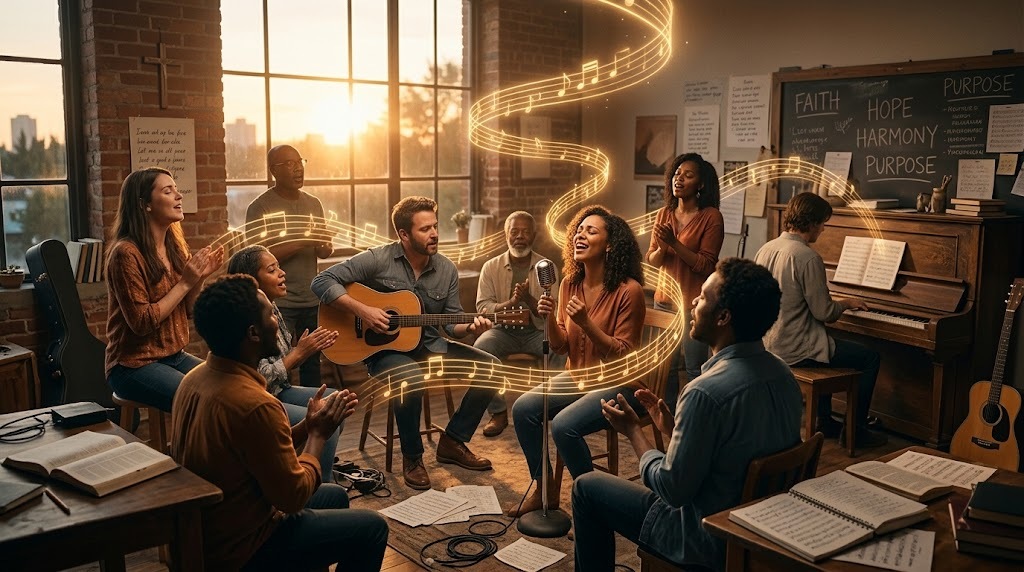
The Connection Between Faith, Music, and Purpose
The Connection Between Faith, Music, and Purpose
When I think about The Connection Between Faith, Music, and Purpose, I do not think about three separate things that happen to exist in the same conversation. I think about three things that can become deeply connected in a person’s life. Faith can give music meaning. Music can give expression to faith. And purpose can give both of them direction.
I have always found it interesting how a particular song can take me back to a moment I thought I had forgotten. Sometimes it is not even the lyrics that do it. It might be the melody, the voice of the singer, the sound of the instruments, or simply the atmosphere surrounding the song. You hear those first few seconds and suddenly you remember where you were, what you were going through, what you were praying about and what you were hoping would change.
That experience helped me understand that music is much more than sound. For many people, music becomes a language for emotions that are difficult to explain with ordinary words. In Christian life, that language can become even more meaningful because faith is not only something we believe in our minds. It is also something we express with our hearts, our words, our actions and sometimes our songs.
This is where The Connection Between Faith, Music, and Purpose becomes particularly fascinating. A Christian song can carry a message of faith, but behind that message there may also be a story of struggle, obedience, disappointment, hope, gratitude or calling. The person who wrote the song may have experienced something that forced them to look beyond themselves. What eventually comes out as music may be the expression of a journey that nobody listening to the song can fully see.
I have listened to Christian songs at different moments and noticed how differently the same song can sound depending on what I am experiencing. A song about trusting God can sound ordinary when everything is going well. But when you are waiting for an answer, dealing with uncertainty or trying to make sense of a difficult season, those same words can suddenly become personal.
That is one of the remarkable things about Christian music. It can meet people at different points in their lives.
Someone can hear a worship song and think about God’s faithfulness. Another person can hear the same song and remember a difficult season they survived. Someone else may hear it while searching for direction. Another person may hear it and simply enjoy the melody. The song remains the same, but the personal meaning can change.
Faith gives music a deeper foundation because it gives the message something to stand on. Christian music is not simply about creating pleasant sounds. At its strongest, it communicates beliefs, experiences and convictions about God.
This does not mean every Christian song will affect every listener in the same way. Music is personal. People have different experiences, cultures, musical tastes and spiritual journeys. But when faith and music come together sincerely, a song can become more than entertainment. It can become a reminder.
A reminder to keep going.
A reminder to pray.
A reminder to trust.
A reminder to be grateful.
A reminder that difficult circumstances do not necessarily define the entire story.
I have also come to appreciate how purpose enters the picture. A person can have musical talent without necessarily understanding what they want to do with that talent. Talent can open a door, but purpose can determine how someone chooses to walk through it.
This is particularly important for Christian musicians.
There is nothing wrong with wanting to become successful as a Christian artist. There is nothing wrong with having professional goals, building an audience, releasing quality music or earning money from music. These things can be part of a legitimate career. But for someone who sees music as part of their Christian calling, there may be a deeper question beyond success.
Why am I doing this?
That question can completely change the way an artist approaches music.
If the purpose is only popularity, then the artist may constantly measure success by numbers. How many people listened? How many followers were gained? How many views did the video receive? How quickly did the song trend?
Those numbers can be useful, particularly in the modern music industry, but they cannot answer every meaningful question.
A Christian musician may also need to ask whether the music communicates something worthwhile, whether it reflects their convictions and whether the work is contributing positively to the lives of the people who hear it.
This is where The Connection Between Faith, Music, and Purpose becomes more than an interesting Christian music topic. It becomes a question about identity.
Who are you?
What do you believe?
What are you carrying?
What has your life taught you?
And what do you want your music to communicate?
I think some of the most memorable Christian music comes from people who have something genuine to say. You can hear the difference between someone simply putting words together and someone expressing something they have personally wrestled with.
A song about hope can become powerful when it comes from someone who has experienced hopelessness.
A song about God’s faithfulness can become meaningful when it comes from someone who has had to wait.
A song about surrender can carry greater weight when it comes from someone who has had to release something they desperately wanted.
A song about purpose can become convincing when it comes from someone who has struggled to understand their own calling.
This does not mean an artist must experience every hardship before writing about it. But personal sincerity often gives music a quality that technical perfection cannot manufacture.
There have been moments when I have thought about how many people are carrying stories they have never turned into songs. Someone may have survived a difficult season, discovered a new understanding of faith and developed a message that could encourage another person. Yet they may never share it because they do not consider themselves talented enough.
That is another lesson I see in The Connection Between Faith, Music, and Purpose. Purpose does not always begin with perfection.
Sometimes it begins with willingness.
A person may start with a simple voice recording. Another may write lyrics in a notebook. Someone else may learn an instrument. Another person may begin singing in church. Someone may start sharing short worship covers online. These small steps can eventually develop into something much larger.
The modern digital world has also changed the way Christian music can reach people. A musician no longer has to depend entirely on traditional gatekeepers before sharing a song with an audience. Streaming platforms, social media, music blogs and video platforms have created additional ways for artists to distribute their work.
That opportunity also creates responsibility.
When music can reach thousands or even millions of people, the message being communicated matters.
Christian artists are not necessarily required to make every song sound the same. Christian music can include different cultures, instruments, rhythms, languages and production styles. A gospel song can sound completely different from another gospel song and still communicate Christian faith.
This is particularly visible in African Christian music.
Growing up around African music makes it easy to appreciate how rhythm, language and cultural expression can influence the way faith is communicated. Gospel music can incorporate local sounds while still carrying messages about God, hope, salvation, gratitude and worship.
That diversity is important because Christianity exists across many cultures. The expression may change, but the faith behind the expression can remain central.
I have also noticed that purpose can affect the way listeners respond to music. When people discover that an artist has a genuine story behind a song, they may connect with it differently. The song becomes a doorway into a larger story.
Perhaps that is why testimony is so important in Christian music.
A testimony says, in effect, “This is what I experienced, and this is what I learned about God through it.”
Music gives that testimony a form that can travel.
A person who has never met the songwriter may hear the song years later and find encouragement in it. Someone in another country may listen to it. A young Christian may discover it through a playlist. A church may sing it together. A family may hear it during a difficult period.
The original experience may have happened privately, but the song can give it a public life.
That is a powerful connection between purpose and music.
Purpose can turn personal experience into something that serves others.
Faith can give that purpose direction.
Music can become the vehicle that carries the message.
But I also think it is important to remember that purpose is not always loud.
Sometimes people associate purpose with large platforms, packed concert halls, millions of streams and international recognition. Those things can be wonderful, but they are not the only evidence that someone’s music has meaning.
A worship leader serving a small congregation can be fulfilling a meaningful purpose.
A songwriter creating songs for a local church can be fulfilling a meaningful purpose.
A parent singing Christian songs with their children can be creating meaningful spiritual memories.
A musician encouraging a friend through a difficult season can make a difference that will never appear on a streaming report.
Purpose is not necessarily measured by audience size.
Sometimes the impact of one song on one person’s life is enough to remind us why the song was written.
This perspective can also help musicians deal with seasons when their work seems unnoticed. Every artist eventually faces moments when the numbers are disappointing, opportunities disappear or the audience does not respond as expected.
During those moments, purpose can become an anchor.
If your entire identity depends on attention, silence can become devastating.
But if your work is connected to something deeper, silence does not necessarily mean the work has no value.
A song may take time to find its audience.
A message may reach someone privately.
A listener may never comment.
Someone may hear the song today and remember it years later.
We cannot always measure the full impact of creative work immediately.
That is why The Connection Between Faith, Music, and Purpose is relevant not only to musicians but also to listeners.
As listeners, we can become more intentional about the music we consume. Music influences our thoughts, emotions and memories. The songs we repeatedly hear can become part of the atmosphere of our lives.
That does not mean Christians must avoid every form of music that is not explicitly religious. Musical taste is personal, and people listen to many different genres for different reasons. But it can be valuable to ask what we are allowing to occupy our minds consistently.
Are the songs we listen to encouraging us?
Are they helping us reflect?
Are they strengthening values we want to live by?
Are they simply entertaining us?
There is room for entertainment, but there is also room for intentionality.
Christian music can occupy a unique place because it can entertain while also reminding us of what we believe.
And perhaps that is one of the greatest strengths of music.
You can hear a message without feeling as though someone is giving you a lecture.
You can remember a truth because it is attached to a melody.
You can carry a song with you while travelling, working, exercising or resting.
You can sing it when you are happy and return to it when you are struggling.
Music has a way of staying with us.
That is why musicians who understand their purpose have an opportunity to create something that goes beyond a temporary trend. They can create songs that become part of people’s stories.
The connection between faith, music, and purpose ultimately reminds me that creativity can be an expression of what we believe and what we value. Music does not have to be perfect to be meaningful. It does not have to become famous to have an impact. And an artist does not have to have the biggest platform to have something valuable to contribute.
Sometimes the most important song is the one that gives someone strength to continue.
Sometimes it is the song that helps someone pray when they cannot find the words.
Sometimes it is the song that reminds someone of a promise they had forgotten.
Sometimes it is the song that helps a family celebrate.
Sometimes it is the song that gives a young person courage to pursue a God given purpose.
And sometimes, the song simply reminds us to stop for a moment and remember what truly matters.
For me, The Connection Between Faith, Music, and Purpose is ultimately about more than Christian songs. It is about understanding why we create, why we believe and how we use what has been placed in our hands.
Faith can provide the foundation.
Music can provide the expression.
Purpose can provide the direction.
When those three come together, music can become more than something we hear. It can become something we experience, remember and carry with us.
That is why Christian music will continue to matter. Trends will change. Technology will change. Platforms will change. Musical styles will change. New artists will emerge and older sounds will evolve. But the human desire to express faith, tell stories, find hope and discover purpose will remain.
And as long as people have something meaningful to say, there will always be another song waiting to be written.

Leave a Reply