
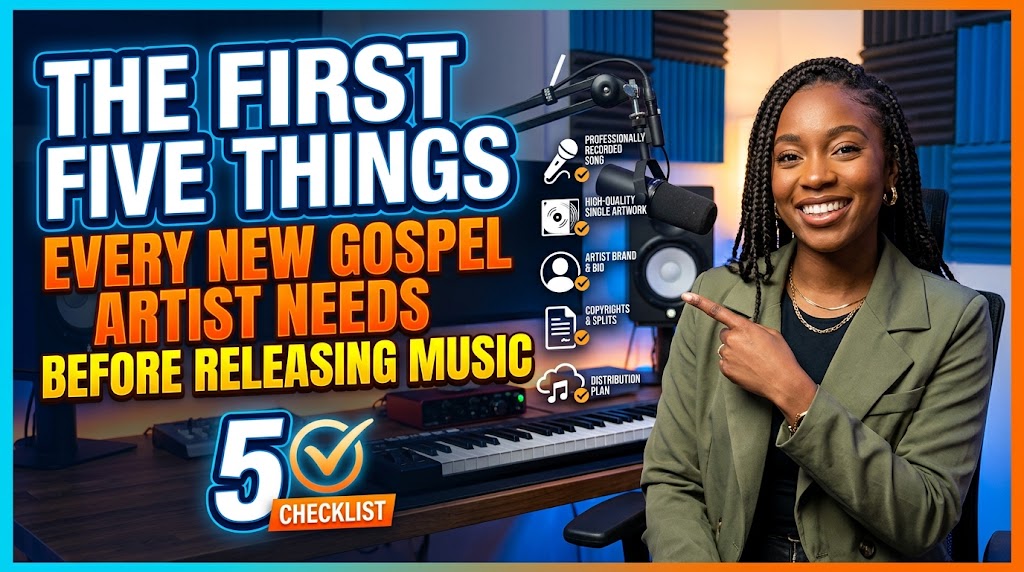
The First Five Things Every New Gospel Artist Needs Before Releasing Music
The First Five Things Every New Gospel Artist Needs Before Releasing Music
I still remember the excitement that comes with wanting to release a song for the first time. You have written the lyrics, recorded the song, listened to it repeatedly, and suddenly you start imagining people singing along to it. You picture the song on streaming platforms, YouTube, TikTok, Instagram and perhaps even being played in churches. At that point, it is very easy to think that the only thing standing between you and your music career is pressing the release button. The First Five Things Every New Gospel Artist Needs Before Releasing Music
But after spending time around music, content creation and the digital side of building an audience, I have realised that releasing a song is not the same thing as being ready to release a song. There is a lot that happens before the music gets into the hands of listeners.
This is why I started looking at The First Five Things Every New Gospel Artist Needs Before Releasing Music from a completely different perspective. It is not simply about having a good voice or recording a beautiful song. Those things matter, but they are only part of the journey. A new gospel artist also needs preparation, identity, ownership, presentation and a realistic plan for what happens after the song is released.
One of the biggest mistakes I see new artists make is putting almost everything into the recording itself and almost nothing into everything surrounding the recording. They spend money on production, mixing and mastering, then suddenly realise they have no professional artwork, no artist biography, no distribution plan, no promotional strategy and sometimes not even properly organised information about the people involved in creating the song.
The first thing every new gospel artist needs is a properly finished song.
This sounds obvious, but there is a major difference between a song that has been recorded and a song that is ready for public release. A song can be recorded and still need serious work. The vocals may need editing. The instrumental may need adjustments. The mixing may not be balanced. The mastering may not be suitable for different listening environments. There may be unnecessary background noise. The introduction may be too long. The ending may feel incomplete.
When you have listened to your song fifty times while working on it, you can become emotionally attached to it. That attachment can make it difficult to hear problems objectively.
I have learnt that sometimes the person who created something is not the best person to judge whether it is finally ready. You may love every part of your song because you remember the story behind every lyric. Someone hearing it for the first time does not have that advantage. They are simply listening.
That is why a new gospel artist should have trusted people listen to the finished recording before officially releasing it. Not everybody needs to be involved. You do not need twenty people giving you twenty different opinions until you become confused. A few people who understand music, your audience and your Christian message can provide useful feedback.
The goal is not to change the song every time somebody has an opinion. The goal is to identify genuine weaknesses that you may have missed.
Your final audio file should also be properly prepared for distribution. Do not assume that because the song sounds good through your phone speaker, it is ready for every platform. Professional production matters because your listeners will hear your music through headphones, cars, Bluetooth speakers, laptops, phones and other devices.
The second thing every new gospel artist needs is a clear identity.
Before releasing music, you need to know who you are as an artist. This does not mean you have to create a complicated brand strategy with expensive graphics and a huge marketing budget. It simply means you should understand what you represent.
Imagine discovering a new gospel artist today. You listen to one song and enjoy it. You then visit the artist’s social media page. What do you see? Does the page clearly identify the person as a gospel artist? Are the pictures reasonably professional? Is there consistency in the name? Does the biography explain who the artist is? Does the content give you a reason to follow?
These questions matter because your song may be the first thing people discover, but it may not be the last thing they investigate.
I have noticed that people often search for an artist immediately after discovering a song they like. They want to know the person’s name, other songs, background and social media accounts. If everything looks disorganised, you can lose some of the attention you worked hard to attract.
Your artist name should therefore be consistent across your major platforms where possible. Your profile picture should be clear. Your biography should explain your musical direction without becoming a full autobiography. Your social media profiles should look like they belong to the same person.
You also need to understand the kind of gospel music you want to create. Perhaps you are interested in contemporary gospel, Afro gospel, worship, praise, Christian hip hop, traditional gospel or another sound. You do not have to lock yourself into one box forever, but having some direction makes it easier for people to understand you.
A strong identity does not mean pretending to be someone else. In fact, it is almost the opposite. It means becoming more intentional about presenting who you already are.
The third thing every new gospel artist needs before releasing music is professional cover artwork.
This is one of those things that some artists treat as an afterthought. They spend weeks recording a song and then spend thirty minutes creating artwork because they want to release the song immediately.
Your cover artwork is often one of the first things people see when they encounter your music online. Before they hear your voice, they may see the image attached to the song.
That means the artwork should represent the quality and message of the music.
You do not necessarily need an expensive photoshoot. You do not need a complicated design filled with twenty different elements. Sometimes a clean photograph, strong typography and simple composition can communicate more effectively than an overcrowded design.
Your artist name should be correctly displayed. The song title should be accurate. The artwork should be clear enough to remain recognisable even when displayed as a small thumbnail.
This is particularly important because music is increasingly discovered through mobile devices. People may see your cover artwork in a playlist, search result, social media post or recommendation feed where the image is relatively small.
There is also something psychologically important about professional presentation. When someone encounters a well presented song, it communicates that the artist took the project seriously.
Your artwork should not promise something your music cannot deliver, but it should make the music look worthy of being explored.
The fourth thing every new gospel artist needs is a distribution and ownership plan.
This is where excitement can sometimes cause artists to make avoidable mistakes.
You have the song. You have the artwork. You are excited. Someone tells you, “Just send it to me and I will upload it.” Before handing over your music, you need to understand exactly what you are agreeing to.
Who owns the master recording?
Who wrote the song?
Who produced it?
Were any samples used?
Are there featured artists?
Who owns the composition?
Has everybody involved agreed on their respective contributions?
These questions may not feel exciting when you are dreaming about releasing your song, but they can become extremely important later.
A new gospel artist should keep proper records of the people involved in the project. Save the final audio files, instrumental versions where applicable, artwork, lyrics, songwriter information, producer information and other relevant project details.
You should also understand how your music will reach digital platforms. Music distributors can help artists deliver music to streaming services and digital stores, but the artist should still understand the information being submitted.
A simple spelling error in your artist name or song title can create unnecessary problems. Incorrect contributor information can also cause complications.
Do not assume that because someone is helping you upload your song, you no longer need to understand what happens to your music.
Your music is an asset. Treat it like one.
The fifth thing every new gospel artist needs before releasing music is a promotion plan.
This may actually be the part that surprises new artists the most.
Many people think the release is the promotion. It is not.
Uploading your song is distribution. Getting people to notice, listen to, remember and share the song is another task entirely.
I have seen people release songs with great excitement, post the streaming link once on WhatsApp, make one Facebook post and then wait for thousands of listeners to appear.
Unfortunately, the internet does not work that way.
There are millions of songs available online. Your song is competing for attention with other artists, videos, conversations, entertainment, news and everything else people consume every day.
This does not mean you need millions of naira to promote a new gospel song. It means you need creativity and consistency.
Before releasing the song, think about what you can post around it.
You can share a short story about why you wrote the song. You can explain the Bible verse or personal experience that inspired it. You can post a short chorus video. You can share a behind the scenes clip from the recording session. You can introduce the musicians involved. You can ask your audience a question related to the song’s message.
You can also create several short videos from one song instead of posting the full song repeatedly.
For example, if your song is about trusting God during difficult seasons, you could create a short video discussing a personal experience that inspired the lyrics. Another video could focus on one powerful line from the song. Another could explain why the message is important to you. Another could simply feature you singing part of the chorus.
Suddenly, one song has become several pieces of content.
This is one of the biggest lessons I would give any new gospel artist. Do not think only in terms of releasing songs. Think in terms of building a relationship with listeners.
Your first song may not immediately become a hit. Your second song may not either. That does not automatically mean the music is bad.
Sometimes people need to encounter an artist several times before they become interested. They may see your video today and scroll past it. They may see another one next week. They may hear your chorus through a friend’s post. Eventually, they may decide to listen.
Consistency gives your audience more opportunities to discover you.
There is also something else I believe new gospel artists should prepare for before releasing music: expectations.
You should be excited about your song, but you should also remain realistic.
Do not measure the value of your music solely by the number of streams you receive during the first twenty four hours. Do not assume that a small audience means nobody appreciates your work. Do not compare your first release with an established artist who has spent years building an audience.
Every artist starts somewhere.
Your first release can teach you things that planning alone cannot teach you. You will discover what kind of content your audience responds to. You will learn which promotional methods work for you. You may discover that people love a particular part of your song. You may find out that your audience is located in places you never expected.
That information becomes valuable when you prepare for your next release.
When I think about The First Five Things Every New Gospel Artist Needs Before Releasing Music, I therefore do not see them simply as five items on a checklist. I see them as five areas of preparation that can determine how professionally an artist enters the public space.
You need a properly finished song because your music is your product.
You need a clear identity because people need to understand who they are listening to.
You need professional artwork because presentation influences first impressions.
You need an ownership and distribution plan because your music deserves proper management.
You need a promotion plan because uploading a song does not automatically create an audience.
And there is one final thing I would add beyond these five: patience.
A gospel music career is not built from one release. It is built through a series of songs, relationships, performances, conversations, experiences and consistent efforts to improve.
Do not rush to release music simply because you are afraid somebody else will release something first. Your journey is not a race against every other artist.
Prepare properly. Finish the song. Understand your identity. Present the project professionally. Protect your work. Build a realistic promotional strategy and keep learning.
The goal should not simply be to say, “I have released a song.”
The goal should be to release music you are prepared to stand behind.
When you eventually press that release button, you should know what the song represents, who you are trying to reach, how people can find you and what you intend to do after the song goes live.
That is the difference between simply putting music on the internet and intentionally beginning a music journey.
For every new gospel artist preparing for that first release, remember that the song is only the beginning. The preparation surrounding the song can determine how effectively your message travels.
And sometimes, the smartest thing an artist can do before releasing music is not to ask, “How quickly can I release this?”
It is to ask, “Have I prepared properly for what happens after I release it?”

Leave a Reply