
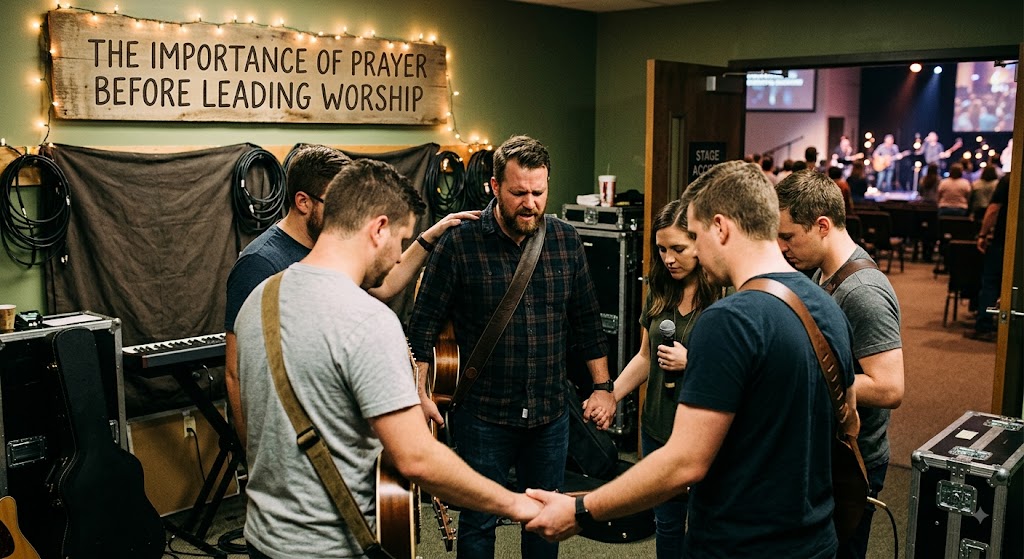
The Importance of Prayer Before Leading Worship
The Importance of Prayer Before Leading Worship is a subject every worship leader, worship team member, choir member and Christian musician should take seriously. Worship is not simply about standing in front of people, holding a microphone, singing the right notes or creating an emotional atmosphere. It is ultimately about directing people’s hearts towards God. That responsibility requires more than musical ability. It requires spiritual preparation, humility, sensitivity and dependence on God. This is why prayer should never be treated as an optional activity before leading worship. It should be one of the most important parts of the preparation process.
A worship leader can spend hours rehearsing songs, checking microphones, arranging harmonies and preparing transitions, yet still walk onto the platform spiritually unprepared. Musical preparation is valuable, but it cannot replace prayer. A perfectly rehearsed song may sound impressive while failing to communicate the heart of worship. On the other hand, a simple moment of worship that comes from a heart that has genuinely sought God can touch people in ways that technical excellence alone cannot achieve. The Importance of Prayer Before Leading Worship becomes clear when we understand that worship leadership is first a spiritual responsibility and only afterwards a musical responsibility.
Prayer helps the worship leader remember who the worship is really about. It is easy for a person standing before a congregation to become conscious of appearance, performance, reactions, applause and personal reputation. The more visible the role becomes, the easier it can be to lose sight of its purpose. Prayer brings the heart back to the right place. Before leading others into worship, the worship leader needs to personally acknowledge that God is the centre of the gathering. The microphone does not make the leader important. The stage does not make the leader important. Musical talent does not make the leader important. God remains the focus.
The Importance of Prayer Before Leading Worship is also connected to humility. A worship leader can have an excellent voice, strong stage presence and years of experience, but none of these qualities gives someone ownership over worship. Prayer reminds the leader that the opportunity to serve is a privilege. Instead of thinking, “I am going to show people what I can do,” the heart begins to say, “Lord, use me to point people towards You.” That difference may seem small, but it can completely change the atmosphere and intention behind the ministry.
Prayer also allows worship leaders to examine their hearts before they stand before others. Leading worship while carrying anger, pride, unforgiveness, jealousy, bitterness or hidden distractions can affect the way a person ministers. Prayer provides an opportunity to become honest before God. It is a private moment where the worship leader can say, “Search my heart. Correct what needs to be corrected. Remove anything that will distract me from serving You.” This does not mean a worship leader must become perfect before leading worship. No Christian is perfect. It means the leader should be willing to approach God honestly and allow Him to work within them.
There is something powerful about praying before singing because prayer changes the focus from performance to surrender. Without prayer, worship can easily become another scheduled activity. The team arrives, rehearses, performs and leaves. With prayer, however, the same activity can become an intentional act of service. Every lyric begins to carry greater meaning. Every instrument becomes an opportunity to contribute. Every pause becomes an opportunity to listen. Every song becomes more than music.
The Importance of Prayer Before Leading Worship is particularly important because worship leaders are not only leading songs. They are influencing the spiritual direction of a congregation. People arrive at church carrying different experiences. Some may be celebrating answered prayers. Others may be grieving. Some may be discouraged about their finances, relationships, careers or families. Others may be struggling with doubt or feeling spiritually exhausted. The worship leader may not know what every person is carrying, but God does. Prayer helps the leader become sensitive to the needs of the people being served.
A worship leader who prays can approach the service with greater spiritual sensitivity. Instead of forcing a particular mood, the leader can remain attentive to what God may be doing. This does not mean abandoning preparation or planning. It means understanding that preparation and dependence on God should work together. Rehearsal prepares the musicians for the music. Prayer prepares the heart for ministry.
Prayer can also help worship leaders overcome performance anxiety. Standing in front of a congregation can be intimidating, especially for someone who is new to worship ministry. The fear of making a mistake, forgetting lyrics, singing the wrong note or being judged can become overwhelming. Prayer does not necessarily remove every nervous feeling, but it can redirect attention away from fear and towards God. Instead of thinking, “What will people think of me?” the worship leader can begin thinking, “How can I serve God and serve these people?”
This change in perspective can bring freedom. Worship leaders do not have to prove their worth through a flawless performance. They are servants. Mistakes may happen. A lyric may be forgotten. A musician may miss a transition. The sound system may fail. The microphone may stop working. Yet worship can continue because worship does not depend on perfection. Prayer helps the leader remember that the presence and worth of God are greater than the imperfections of human performance.
Another reason prayer matters is that it helps worship leaders resist pride. This is especially important when ministry begins receiving attention. A worship leader may receive compliments about their voice, songwriting, appearance or ability to lead people. Encouragement is not wrong, but praise can become dangerous when a person begins believing that the ministry exists to make them famous. Prayer keeps the heart anchored. It reminds the leader that the gift belongs to God and should be used for His glory.
The Importance of Prayer Before Leading Worship
The Importance of Prayer Before Leading Worship also applies to the entire worship team, not just the person holding the microphone. Musicians, backing vocalists, sound engineers, choir members and technical volunteers all contribute to the worship experience. Every person involved should understand that their role is part of a larger ministry. A guitarist can pray before playing. A drummer can pray before serving. A keyboardist can pray before rehearsal. A choir member can pray before entering the sanctuary. The sound engineer can pray before checking the equipment. Worship becomes stronger when the team understands that everyone is serving rather than simply performing.
Prayer can also strengthen unity within a worship team. Musical disagreements can happen. Different personalities can clash. People may have different ideas about song choices, arrangements, volume, transitions or leadership. Without humility, these differences can create tension. Prayer encourages team members to put the mission above personal preferences. When people genuinely pray together, they are reminded that they are serving the same God. This does not mean every disagreement disappears, but it can create an environment where disagreements are handled with greater grace.
There is also a connection between prayer and preparation. Some people mistakenly believe that praying means they do not need to rehearse. That is not a healthy understanding of prayer. Prayer should not become an excuse for laziness. A worship leader should prepare musically and spiritually. Learn the songs. Know the lyrics. Understand the arrangements. Practise the transitions. Communicate with the team. Check the equipment. Then pray. Preparation says, “I will do my part.” Prayer says, “God, I depend on You beyond what I can do.”
The Importance of Prayer Before Leading Worship therefore involves both responsibility and dependence. A worship leader should never use prayer as a substitute for preparation, nor should preparation become a substitute for prayer. Both are necessary. Skill without spiritual sensitivity can become performance. Prayer without preparation can become an excuse for carelessness. Healthy worship ministry brings both together.
Prayer can also help a worship leader understand the songs they are about to lead. Instead of simply memorising lyrics, the leader can meditate on their meaning. What is the song actually saying about God? What truth is being communicated? What Scripture connects with the message? Why should the congregation sing these words? When a leader understands the spiritual meaning behind a song, their leadership becomes more genuine. They are not simply instructing people to sing words. They are personally engaging with the truth they are helping others express.
This is especially important when leading songs about difficult subjects such as suffering, surrender, waiting, forgiveness, obedience or trusting God during uncertainty. It is easy to sing about trusting God when everything is going well. But when the worship leader has personally wrestled with faith and still chooses to trust God, the message can carry a different depth. Prayer allows the leader to connect the song with a genuine relationship with God rather than treating it as another item on a programme.
Prayer before worship can also help remove unnecessary distractions. A worship leader may arrive at church thinking about bills, family problems, social media, personal ambitions or something that happened earlier in the day. These concerns are real, and prayer does not require pretending that they do not exist. Instead, prayer creates a place to surrender them to God. The leader can acknowledge the distraction and ask God for the grace to remain focused on the purpose of the moment.
One of the greatest dangers in modern worship ministry is confusing emotional reaction with spiritual transformation. A congregation may clap, shout, cry or become excited during a song, but emotional response alone does not automatically mean that people have experienced meaningful spiritual change. Worship leaders should therefore be careful about trying to manufacture reactions. Prayer helps protect against this temptation. It reminds the leader that their responsibility is not to manipulate emotions but to faithfully lead people towards God.
The Importance of Prayer Before Leading Worship is therefore not about creating a particular feeling in the room. It is about preparing the person leading the room. A worship leader who has prayed does not need to manipulate people into responding. They can lead with sincerity and allow God to work in people’s hearts.
Prayer also creates a deeper relationship between the worship leader and God outside the church service. This is perhaps one of the most important points. A person cannot build an authentic worship ministry solely on public moments. Private devotion matters. The worship that people see on Sunday should flow from a relationship with God that continues when nobody is watching. If the only time a worship leader prays is before taking the microphone, something important is missing.
Private prayer gives public worship its foundation. The worship leader learns to seek God without an audience, without applause and without recognition. This protects the heart from becoming addicted to visibility. It teaches the leader that worship is valuable even when nobody notices. The person who learns to worship privately is better prepared to lead publicly because they understand that God is worthy regardless of human response.
Prayer can also help worship leaders ask God for wisdom concerning song selection. Not every popular Christian song is necessarily appropriate for every gathering. The worship leader should consider the congregation, the purpose of the service, the message being communicated and the spiritual maturity of the people present. Prayer can help guide these decisions. A song may be musically beautiful but unsuitable for a particular moment. Another song may appear simple but communicate exactly what people need to hear.
The worship leader should therefore avoid relying entirely on trends, popularity or personal preference. Prayer creates room for discernment. It encourages leaders to ask not only, “Do I like this song?” but also, “Will this song help people focus on God?” That question can change the way worship sets are prepared.
There is also a powerful connection between prayer and spiritual courage. Worship leaders sometimes have to make decisions that may not be popular. They may need to simplify a worship set, remove unnecessary performance elements, change a song or address an issue within the team. Prayer gives leaders the courage to serve faithfully rather than simply seeking approval. When the heart is anchored in God, the leader becomes less controlled by people’s opinions.
Prayer can also help leaders respond when worship does not go according to plan. Perhaps the congregation is unusually quiet. Maybe the sound is poor. Perhaps the musicians are struggling. Maybe the leader makes an obvious mistake. In such moments, prayer helps prevent panic. The leader can remain calm and continue serving. Worship does not collapse because something unexpected happens.
Ultimately, The Importance of Prayer Before Leading Worship comes down to one fundamental truth: worship leadership is about God before it is about music. The songs matter. The instruments matter. The voices matter. Rehearsal matters. Sound quality matters. Musical excellence matters. But none of these should become more important than the heart behind the worship.
A worship leader should therefore develop a personal habit of praying before every service, rehearsal and ministry opportunity. The prayer does not have to be complicated. It can be as simple as asking God to purify the heart, guide the team, protect against distraction, give wisdom, strengthen the musicians and help everyone involved point people towards Christ. What matters is sincerity.
Before the first chord is played, pray. Before the first lyric is sung, pray. Before stepping onto the platform, pray. Before leading others, remember to personally seek the One you are leading them towards.
The greatest worship leaders are not necessarily those with the strongest voices or the biggest platforms. They are people who understand that their gifts are tools for service. They recognise that worship is not about becoming the centre of attention but about directing attention towards God. Prayer keeps that understanding alive.
When a worship leader prays, they are saying, “God, this is bigger than me.” They are acknowledging that talent has limits, preparation has limits, experience has limits and human strength has limits. But God does not depend on those limitations. Prayer places the ministry back into His hands.
That is why The Importance of Prayer Before Leading Worship should never be underestimated. Prayer prepares the heart, strengthens humility, encourages spiritual sensitivity, protects against pride, builds team unity, reduces performance pressure and helps worship leaders remain focused on their true purpose. It turns preparation from a purely musical exercise into an act of spiritual service.
Christian worship is not simply about producing beautiful sounds. It is about responding to God with the heart, mind, soul and strength. Anyone entrusted with leading others into that response carries a responsibility that should be approached with reverence.
So before you lead the next worship session, do more than check the song list. Do more than rehearse the transitions. Do more than test the microphone. Find a quiet place and pray.
Ask God to prepare you before you attempt to prepare others.
Ask Him to remove pride before you step into visibility.
Ask Him to give you sensitivity before you begin leading.
Ask Him to help you serve rather than perform.
Ask Him to make your heart worship before you ask anyone else to sing.
Because when prayer comes before worship leadership, the microphone becomes less about being heard and more about serving. The platform becomes less about being seen and more about pointing people towards Christ. The songs become more than melodies, and the worship leader becomes more than a performer.
They become a servant with a song, standing before people while depending completely on God.

Leave a Reply