
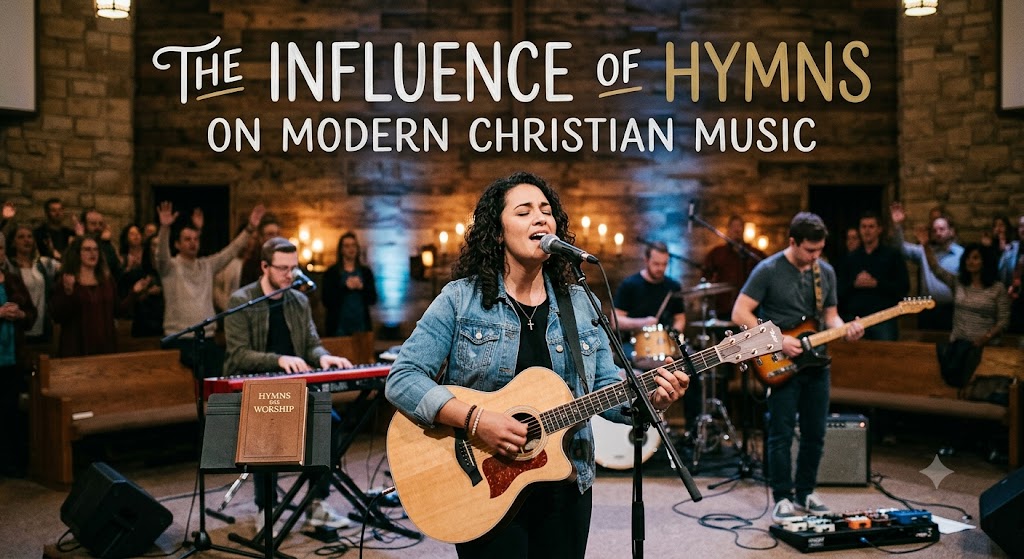
The Influence of Hymns on Modern Christian Music
The Influence of Hymns on Modern Christian Music can be seen in almost every corner of contemporary worship. From the melodies sung in traditional churches to the powerful worship anthems filling stadiums, conferences, Christian gatherings and digital streaming platforms, the fingerprints of hymns are still everywhere. Modern Christian music may sound different from the hymns our grandparents grew up singing, but many of its most important ideas, lyrical patterns, musical structures and spiritual themes have roots in the hymn tradition.
Hymns have survived generations because they were never simply songs. They were vessels for theology, memory, emotion, testimony and worship. Long before Christians had access to music streaming platforms, social media, sophisticated recording studios or global worship tours, believers gathered together and sang words that helped them understand who God is and what it means to follow Him. Those songs became part of their spiritual identity. Today, modern Christian musicians continue to draw from that rich heritage, sometimes consciously and sometimes without even realising it.
The Influence of Hymns on Modern Christian Music is particularly noticeable in the way Christian artists communicate deep spiritual truths through music. Many contemporary worship songs focus on themes such as grace, redemption, surrender, faith, God’s faithfulness, salvation, hope, sacrifice and the character of Jesus Christ. These themes are not new. They have been central to Christian hymnody for centuries. What has changed is often the musical presentation, language, production and cultural expression surrounding those timeless messages.
A hymn traditionally serves a purpose beyond entertainment. It teaches while it inspires. It reminds while it challenges. It gives believers words to express emotions that they may struggle to articulate on their own. This teaching function remains visible in modern Christian music. A contemporary worship song may have a simple chorus that thousands of people can sing together, but underneath that simplicity may be a profound statement about faith or God’s character. In this sense, modern Christian music continues one of the most important traditions established by hymns.
One of the strongest examples of The Influence of Hymns on Modern Christian Music is the continuing use of hymn melodies and lyrics. Some modern Christian artists have taken traditional hymns and given them new arrangements, introducing them to younger generations who might otherwise never encounter them. A familiar hymn can be transformed with contemporary instrumentation, modern vocal arrangements, atmospheric production and a different tempo while retaining its original spiritual message. This creates a bridge between generations.
The Influence of Hymns on Modern Christian Music
That bridge is important because Christian music has always evolved with culture. Every generation develops its own musical language. Instruments change, recording techniques improve and musical tastes shift. Yet the core purpose of Christian worship remains remarkably consistent. Hymns demonstrate that Christian music does not have to remain trapped in one musical era to preserve its message. Instead, timeless truths can be expressed through the musical vocabulary of different generations.
The Influence of Hymns on Modern Christian Music is also visible in songwriting. Many hymns were carefully written with strong theological foundations. Their writers understood that a song could become a teaching tool used by thousands or even millions of people. As a result, hymns often contain carefully constructed verses that tell a story, explain a doctrine or develop a spiritual idea. Modern Christian songwriters have inherited this approach, even though contemporary songwriting may use simpler language and shorter structures.
Consider the way many modern worship songs build emotionally. A verse introduces an idea. Another section develops it. The chorus provides the central declaration. A bridge may intensify the message before the song returns to the chorus. Although contemporary music has its own songwriting conventions, the basic idea of developing a spiritual message through repeated singing has deep connections with earlier Christian music traditions.
Another major contribution of hymns is congregational participation. Hymns were designed to be sung by communities rather than merely watched as performances. This principle remains at the heart of modern worship music. When thousands of Christians sing a worship song together, the experience becomes larger than the individual artist. The audience becomes part of the music.
This is one reason simple, memorable worship songs continue to be powerful. A song that is too complicated may be impressive when performed by a professional musician but difficult for an entire congregation to sing. Hymns taught generations of Christian musicians that a worship song must be accessible enough for ordinary believers to participate. Modern worship leaders continue to wrestle with the same principle.
The Influence of Hymns on Modern Christian Music can also be found in the emphasis on memorable melodies. A good hymn melody was often designed to remain in the mind long after the church service ended. People could sing it at home, during work, while travelling or during difficult seasons of life. Modern Christian music has inherited this power of musical repetition.
A melody can become attached to a personal memory. Someone may hear a particular worship song years after first encountering it and immediately remember a church service, a family member, a difficult season or a moment of spiritual breakthrough. This emotional connection is one of the reasons Christian music has such a powerful place in people’s lives.
Hymns also demonstrated that Christian music could address suffering honestly. Not every traditional hymn celebrates easy victories. Many speak about trials, weakness, uncertainty, death, perseverance and dependence on God. This is important because Christian faith does not eliminate difficult experiences. Modern Christian musicians who write about pain, doubt, waiting and perseverance are continuing a tradition that has existed for generations.
There is a tendency to assume that older Christian music was always joyful and uncomplicated while modern Christian music is more emotionally honest. The reality is more complicated. Hymn writers frequently addressed the realities of human suffering. They wrote about grief, temptation, spiritual battles, mortality and the need for divine grace. Modern Christian artists have simply found new musical and lyrical ways to communicate some of those same experiences.
Another important area of The Influence of Hymns on Modern Christian Music is theology. Hymns have historically helped Christians learn theological concepts through repetition. A believer might remember the words of a hymn long after forgetting the details of a sermon. Music has a unique ability to store information in memory. A theological truth attached to a melody can become remarkably difficult to forget.
This places an enormous responsibility on Christian songwriters today. What Christians sing repeatedly can influence what they believe, remember and emphasise. A beautiful melody is not enough. The message matters. Modern Christian musicians who understand this responsibility can create songs that entertain, encourage and educate at the same time.
The hymn tradition also demonstrates the importance of biblical language in Christian music. Many classic hymns draw heavily from Scripture, biblical imagery and Christian doctrine. Modern worship music continues this practice through direct references to biblical stories, promises and themes. Songs about God’s faithfulness, the cross, resurrection, grace, mercy and eternal life often echo biblical language that has been sung by Christians for generations.
At the same time, modern Christian music has expanded the vocabulary of worship. Contemporary artists frequently incorporate everyday language and personal testimony. Instead of speaking only in formal theological terms, they may describe fear, loneliness, relationships, personal struggles and moments of doubt. This can make Christian music feel more accessible to people who are unfamiliar with traditional church language.
The result is not necessarily a conflict between hymns and modern music. It can be a conversation between generations. Hymns provide historical depth and theological richness, while modern Christian music provides contemporary expression. When these two worlds learn from each other, Christian music becomes both rooted and relevant.
The Influence of Hymns on Modern Christian Music is especially obvious in the resurgence of traditional hymns among younger Christians. Many younger listeners who were raised primarily on contemporary worship music are discovering the emotional and theological power of older songs. Some churches are deliberately combining hymns with modern worship songs rather than treating them as competing forms.
This combination can create a powerful worship experience. A congregation might sing a centuries old hymn followed by a modern worship anthem. Although the musical styles may be completely different, the underlying message can be remarkably similar. Both songs may speak about God’s grace, human dependence, redemption or the hope found in Christ.
Technology has also helped preserve and revive hymns. Digital music platforms have made traditional Christian songs easier to discover than ever before. A person can encounter a hymn through a modern recording, search for its history and discover that the song was written generations ago. What was once confined to a particular church or denomination can now reach listeners around the world.
This global accessibility has created opportunities for musicians to reinterpret traditional Christian music in ways that reflect different cultures. African gospel musicians, contemporary worship bands, classical musicians, acoustic artists and independent Christian creators can all bring their own perspective to traditional songs. The result is a living musical heritage rather than a forgotten historical archive.
The Influence of Hymns on Modern Christian Music is also reflected in the emotional strength of many contemporary worship arrangements. Modern production techniques can make an old hymn sound completely different without destroying its original identity. Piano, acoustic guitar, electric guitar, orchestral instruments, electronic textures, drums and vocal harmonies can transform a traditional song into something that feels contemporary while preserving its message.
However, modern Christian musicians should be careful not to confuse production quality with spiritual depth. Technology can make a song sound bigger, louder and more polished, but it cannot automatically make the message more meaningful. Hymns remind today’s musicians that words matter. A simple melody carrying a powerful truth can remain relevant long after a heavily produced song has disappeared from public attention.
This is perhaps one of the greatest lessons modern Christian music can learn from hymns. Trends change quickly, but truth does not have to. Musical styles come and go. Instruments become popular and eventually fade. Production techniques evolve. Artists rise and disappear. Yet songs built around enduring spiritual truths can continue to speak to people decades or even centuries later.
The influence also extends to Christian artists themselves. Studying hymns can teach modern songwriters how to write with purpose. It can encourage them to think beyond catchy phrases and temporary popularity. Instead of asking only whether a song will perform well on streaming platforms, they can ask whether its message will still matter years from now.
This does not mean every modern Christian song must sound like a traditional hymn. Christian music should continue to evolve. New generations should be allowed to express their faith through the sounds they understand. The goal is not to recreate the past but to learn from it.
The Influence of Hymns on Modern Christian Music ultimately demonstrates that Christian music is part of a much larger story. Every generation receives something from those who came before it and adds something of its own. Modern worship musicians are not starting from nothing. They are participating in a musical tradition shaped by countless songwriters, worship leaders, choirs, congregations and ordinary believers who used music to express their faith.
There is something powerful about recognising that connection. A Christian listening to a modern worship song may be hearing a musical expression that is new, but the spiritual ideas behind it may have been sung by believers for generations. The melody may change, the instruments may change and the language may change, but the human desire to praise God, seek His presence, express gratitude and find hope remains.
Hymns therefore deserve more than occasional historical recognition. They deserve to be studied, preserved, performed and reimagined. They offer modern Christian musicians a valuable lesson about longevity. They show that music can become part of a community’s memory. They demonstrate that songs can carry theology across generations. They prove that a piece of music does not have to be new to be powerful.
For listeners, discovering hymns can also provide a deeper appreciation of Christian music. Instead of viewing traditional and contemporary music as completely separate categories, listeners can recognise the connections between them. A modern worship song may suddenly sound different when you realise that its themes, structure or message are connected to centuries of Christian songwriting.
For churches, incorporating hymns alongside contemporary worship can create opportunities for intergenerational connection. Older believers can hear familiar songs while younger believers encounter music they may never have discovered otherwise. Instead of allowing musical preferences to divide generations, churches can use the richness of Christian music history to bring people together.
For Christian musicians, the lesson is even more important. The most successful song is not necessarily the one with the biggest production budget, the most impressive vocals or the highest number of streams. A truly meaningful Christian song can be measured by the lives it touches, the truths it communicates and the memories it creates.
The Influence of Hymns on Modern Christian Music will continue because the questions addressed by hymns have not disappeared. People still experience fear. They still need hope. They still wrestle with suffering. They still celebrate redemption. They still search for meaning. They still need reminders of God’s faithfulness. And they still gather together to sing.
Modern Christian music may continue to change dramatically in the years ahead. Artificial intelligence, digital production, social media, streaming platforms and new musical genres will continue to influence how Christian songs are created and consumed. Yet the lessons of hymns will remain valuable because technology cannot replace the human need for meaningful expression.
The future of Christian music does not have to choose between the old and the new. It can honour the wisdom of the past while embracing the creativity of the present. Hymns provide roots. Modern Christian music provides new branches. Together, they form a musical story that continues to grow.
Perhaps the greatest proof of The Influence of Hymns on Modern Christian Music is the simple fact that people are still singing. Generations have come and gone, but the songs remain. Some have been rewritten, rearranged, recorded and introduced to entirely new audiences. Others remain almost unchanged. Yet their purpose continues.
Christian music is more than sound. It is memory, theology, testimony, emotion and community. Hymns helped establish that reality, and modern Christian musicians continue to build upon it. When today’s artists create songs that are musically fresh but spiritually meaningful, they are participating in a tradition that stretches far beyond their own generation.
The next time you hear a modern Christian worship song, listen beyond the melody. Pay attention to its message, its structure, its themes and the emotions it creates. You may discover that beneath the contemporary sound is an old idea that believers have been singing for generations. That is the lasting power of The Influence of Hymns on Modern Christian Music. The sound may change, but the song of faith continues.

Leave a Reply