
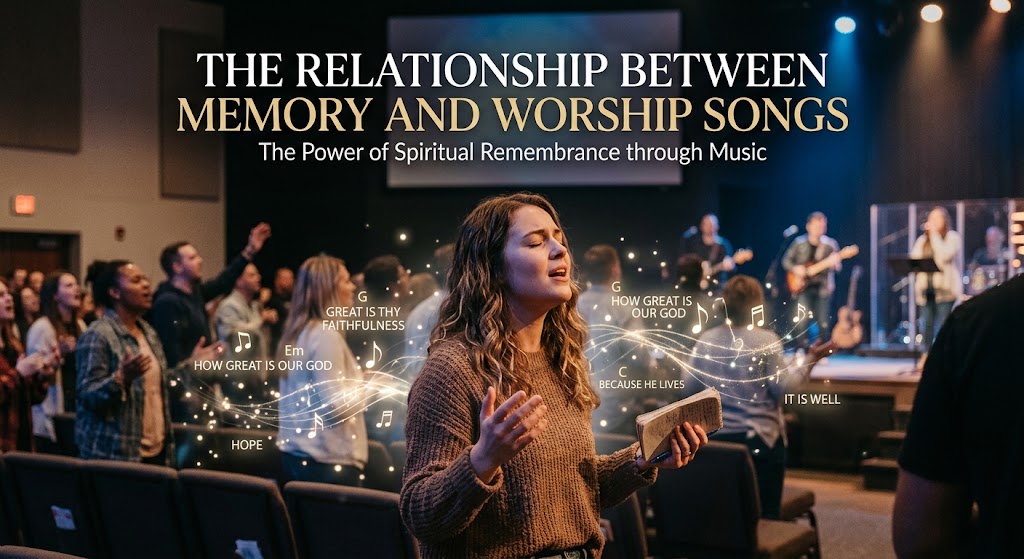
The Relationship Between Memory and Worship Songs
The Relationship Between Memory and Worship Songs
The Relationship Between Memory and Worship Songs is deeper than many people realise. A worship song can disappear from the radio, leave the charts, or stop being played in churches, yet years later, a single line from that song can suddenly return to your mind with remarkable clarity. Sometimes all it takes is hearing the opening melody, remembering a particular chorus, or listening to a familiar voice before an entire season of life comes rushing back.
This powerful connection between memory and worship songs explains why Christian music can remain meaningful long after the moment in which it was first heard. Worship songs are not simply collections of lyrics and melodies. They often become attached to prayers, church services, family moments, personal struggles, celebrations, seasons of waiting, answered prayers and encounters with God. Because of these emotional and spiritual associations, a song can become a kind of musical landmark in a person’s life.
The Relationship Between Memory and Worship Songs can be understood by looking at how human memory naturally connects information with emotion and experience. Music has a unique ability to trigger memories because it combines several elements at once. A melody gives the brain a recognisable pattern, lyrics provide words and meaning, rhythm creates movement, and personal experiences provide emotional context. When these elements become connected, hearing the song again can bring back much more than the sound itself.
Think about a worship song you heard repeatedly during an important period of your life. Perhaps you listened to it while preparing for an examination, during a difficult family situation, after losing someone you loved, while waiting for a breakthrough, or during a period when your faith was being tested. Years later, hearing that same song may instantly take you back to that particular season. You may remember where you were, what you were feeling, what you were praying about and even the people who were around you.
That is one of the most fascinating aspects of The Relationship Between Memory and Worship Songs. The song becomes connected to the story.
For many Christians, worship songs are closely connected to spiritual experiences. A person may hear a particular song during a church service when they make an important decision about their faith. Another person may discover a worship song while praying alone at night. Someone else may hear a gospel song immediately after receiving good news. These experiences can give the song a significance that goes far beyond its musical quality.
This is why two people can listen to the same worship song and have completely different emotional reactions. One person may simply enjoy the melody, while another may become emotional because the song reminds them of something deeply personal. The difference is not necessarily in the song itself. It is in the memories attached to it.
Worship songs can also become associated with particular places. A church building, a Christian conference, a youth programme, a family home or even a particular city can become permanently connected to certain songs. When those songs are played again, the listener may mentally return to that location.
This phenomenon is particularly powerful with songs that were repeatedly sung during childhood. Many Christians can remember songs they learned in Sunday school years before they fully understood their meaning. As they grow older, those melodies remain familiar. A few notes can be enough to bring back memories of childhood worship, church gatherings, parents, teachers and friends.
The Relationship Between Memory and Worship Songs is therefore particularly important when discussing children and Christian education. Children often learn through repetition, and songs can make spiritual concepts easier to remember. A child may struggle to recite a long passage of information but remember a song containing biblical truth for many years.
This does not mean music replaces Scripture or Christian teaching. Rather, music can reinforce what has already been taught. A carefully written Christian song can place biblical ideas into a memorable form that people can recall during everyday life.
This is one reason worship lyrics matter so much. A beautiful melody may attract attention, but meaningful words can remain with a person long after the music stops. When worship songs contain messages about God’s faithfulness, grace, mercy, love, holiness, salvation and promises, those words can become part of a believer’s internal vocabulary.
A person going through a difficult season may suddenly remember a line from a worship song. That line may encourage them to keep praying. Someone facing fear may remember lyrics about trusting God. Someone experiencing disappointment may remember a song about God’s faithfulness. The music has stopped, but the message continues working through memory.
There is also a powerful relationship between repetition and remembrance. Songs that are sung repeatedly become increasingly familiar. This is especially obvious in church environments where congregations sing the same songs week after week. With repeated exposure, people become more comfortable with the melody and lyrics. Eventually, they may be able to sing the entire song without consciously thinking about each word.
This familiarity can make worship songs particularly powerful during moments when people are emotionally overwhelmed. Instead of searching for words to express what they feel, they can sing words they already know.
Sometimes a worship song says what a person cannot say for themselves.
This is one reason people often return to particular worship songs during difficult seasons. When emotions are complicated and thoughts are difficult to organise, familiar music can provide language for feelings that are otherwise difficult to express. A person may not know how to articulate their disappointment, gratitude, fear or hope, but they may know a song that expresses it perfectly.
The Relationship Between Memory and Worship Songs also extends to communal memory. Worship is not always an individual experience. Churches create shared musical memories when large groups of people sing the same songs together. Over time, these songs can become part of a church’s identity.
A congregation may have songs that immediately remind members of particular seasons in the church’s history. Perhaps a song was repeatedly sung during a major revival, anniversary celebration, building project or period of hardship. Years later, members may still associate that song with what the church experienced together.
This shared memory can strengthen relationships among believers because music gives people a common emotional reference point. Someone can begin singing an old worship song and suddenly an entire congregation joins in because they remember it.
There is something remarkable about thousands of people singing words they already know.
The power of memory also explains why older Christian songs continue to find new audiences. A worship song does not necessarily become irrelevant simply because it is old. In many cases, age can actually increase its emotional significance. Songs that have accompanied people through decades of life can carry a sense of history that a newly released song has not yet had time to develop.
This does not mean older songs are automatically better than modern worship music. It simply means that time can give songs additional emotional meaning.
A song released today may eventually become the soundtrack of someone’s marriage, family life, ministry, personal testimony or spiritual journey. Its meaning can grow as the listener’s life develops.
Christian artists and songwriters should therefore understand that they are not merely creating entertainment. They are potentially creating music that people will carry for years.
This makes songwriting a serious responsibility.
The lyrics of worship songs can influence what people remember about their faith. If songs consistently communicate biblical truth, they can help listeners remember important aspects of Christianity. If songs are shallow or unclear, they may still be memorable, but memorability alone does not guarantee spiritual value.
The strongest Christian songs often combine musical beauty with meaningful truth. They give listeners something that can be enjoyed immediately and remembered later.
Another fascinating part of The Relationship Between Memory and Worship Songs is the connection between music and emotion. People often remember emotionally significant events more strongly than ordinary events. Because music can intensify emotional experiences, songs associated with those moments can become powerful memory triggers.
This explains why someone may hear a worship song after twenty years and immediately become emotional. They may not have deliberately thought about the associated event for years, but the music can reopen that memory.
For some people, the memory may be joyful. For others, it may be painful. A song might remind someone of a loved one who has passed away. Another song might remind someone of a season of loneliness. Another might bring back memories of a church they once attended.
The emotional response does not necessarily mean the person wants to return to the past. It simply demonstrates how strongly music can become connected to personal experience.
Worship songs can also become associated with prayer. Many Christians have songs they listen to before or during prayer because the music helps them focus their thoughts. Over time, these songs can become connected to their personal devotional routines.
Someone might have a particular song they always play early in the morning. Another person may listen to worship music while travelling. Someone else may use Christian music during quiet evening reflection. Eventually, the music becomes part of the rhythm of daily life.
When the song plays, the mind may naturally enter the emotional space associated with prayer and reflection.
This is another important reason Christian music remains relevant in the digital age. Streaming platforms have made it easier than ever for people to create personal worship playlists. Instead of depending entirely on church services or physical albums, listeners can organise songs around different seasons and needs.
A person can have a playlist for prayer, another for encouragement, another for quiet reflection and another for celebration. Over time, each playlist can become associated with specific experiences.
Technology may have changed how people access worship songs, but it has not removed the emotional power of music.
In fact, digital access may strengthen the relationship between memory and worship songs because listeners can return to specific songs whenever they want. A song that once required a physical CD or radio broadcast can now be accessed within seconds.
This accessibility also means that Christian artists have an opportunity to create music that remains relevant beyond the initial release period. A song does not have to remain at the top of a streaming chart to continue changing lives. Some songs may have relatively modest numbers but become deeply meaningful to the people who discover them.
This is an important reminder that popularity and impact are not always the same thing.
A worship song may have millions of streams, but another song with a much smaller audience may become the most important song in someone’s personal testimony. One song may dominate social media while another quietly accompanies someone through a difficult night.
The true value of Christian music cannot always be measured by numbers.
The Relationship Between Memory and Worship Songs also helps explain why people often recommend particular songs to friends during difficult circumstances. When someone says, “Listen to this song,” they may actually be sharing a piece of their own experience. They may be saying, in musical form, “This song helped me when I was where you are now.”
Music therefore becomes a form of testimony.
A worship song can tell someone, “You are not alone.” It can remind them that other people have experienced pain, waited for answers, struggled with doubt and still found reasons to hope.
This is particularly powerful in gospel music, where personal testimony is often closely connected to the message of the song. The listener is not only hearing a melody but also hearing a declaration of faith.
Christian music can therefore become part of a person’s spiritual autobiography.
There may be a song for the season when they first discovered Christ, another for their university years, another for marriage, another for parenthood, another for grief and another for a major breakthrough. Looking back, the playlist of their life may tell a story that words alone could not tell.
This is why worship songs can remain powerful even when musical preferences change. A person may develop a different taste in music as they grow older, but certain songs can remain special because of what they represent.
The song becomes more than a song.
It becomes a memory.
It becomes a testimony.
It becomes a reminder of where the person has been and, sometimes, how far they believe God has brought them.
For churches, this understanding can encourage greater intentionality when choosing worship music. Churches should consider not only whether a song sounds good but also whether its message is meaningful, biblically grounded and appropriate for congregational singing.
A song that people can easily remember can potentially remain in their minds throughout the week. That makes the words particularly important.
Worship leaders also have the opportunity to introduce songs that become meaningful parts of a congregation’s spiritual journey. However, the goal should not simply be to create emotional moments. Worship should remain focused on God rather than on manipulating emotions.
Music can influence emotions, but genuine worship involves the heart, mind and will.
This distinction matters because powerful music is not automatically evidence of powerful worship. A beautiful melody can produce strong feelings, but Christian worship ultimately points beyond the emotional experience towards God.
The Relationship Between Memory and Worship Songs becomes most meaningful when memory supports faith rather than replacing it.
A person may remember a powerful worship experience, but the deeper question is what that memory produces. Does it encourage faithfulness? Does it remind the person of biblical truth? Does it encourage prayer, gratitude, obedience and trust in God?
When worship music accomplishes these things, its influence can extend far beyond the moment in which it is heard.
The next time you hear a worship song that takes you back to another period of your life, pay attention to what you remember. You may discover that the song is connected to a prayer you once prayed, a challenge you once survived, a person you once loved, a church you once attended or a moment when your faith became stronger.
That connection is not accidental.
Music has a remarkable ability to preserve moments, and worship songs can preserve moments of faith.
Years may pass. People may change. Circumstances may become completely different. Yet a familiar melody can bring back a forgotten chapter of life in seconds.
That is the beauty of The Relationship Between Memory and Worship Songs.
Worship songs do not simply occupy our playlists. Some become part of our stories. They accompany us through seasons we never expected, give words to emotions we struggle to express and remind us of truths we might otherwise forget.
A powerful worship song can outlive its original recording. It can move from one generation to another, from one church to another and from one personal story to another. Its melody may remain familiar, but its meaning can continue changing as listeners encounter different seasons of life.
Ultimately, the relationship between memory and worship songs reminds us that Christian music can be more than something we hear. It can become something we remember, something we carry and something that helps us remember what matters most.
And sometimes, years after the music first played, a single familiar lyric can remind us of a truth we desperately needed to hear all over again.

Leave a Reply