
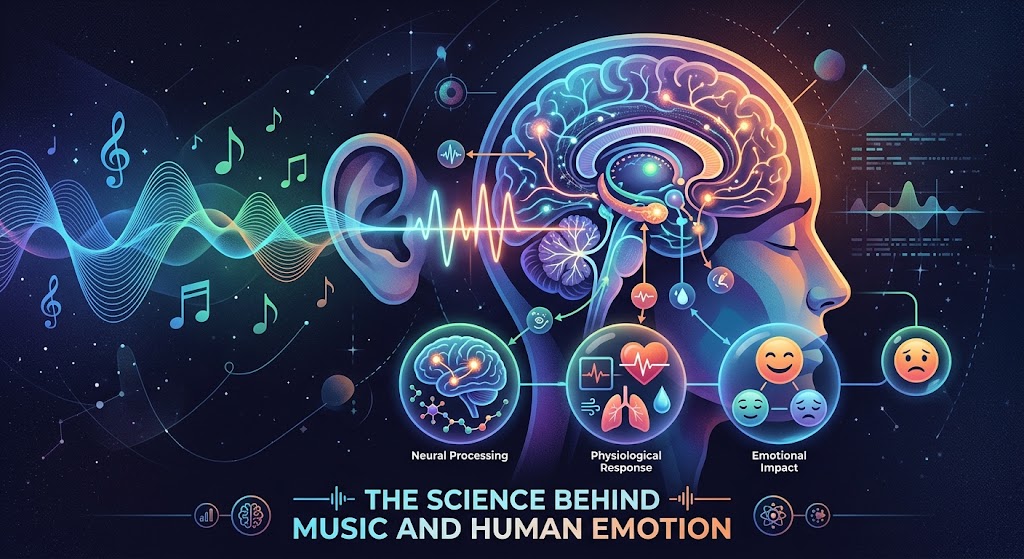
The Science Behind Music and Human Emotion
The Science Behind Music and Human Emotion
Music has a remarkable ability to change how we feel, often within seconds. A familiar melody can bring back memories we thought we had forgotten. A powerful worship song can make someone cry. An energetic rhythm can make people want to dance, while a slow and gentle arrangement can create a feeling of peace. But why does this happen? What is actually taking place inside the human brain when we listen to music? The science behind music and human emotion offers fascinating answers to these questions and reveals that our emotional response to music is not simply a matter of personal preference. It involves the brain, memory, expectation, rhythm, hormones, attention and even our physical responses.
The science behind music and human emotion begins with the way the brain processes sound. When music enters the ear, sound waves cause vibrations that are converted into electrical signals and sent to the brain. These signals are processed through several interconnected regions responsible for hearing, movement, memory, attention and emotion. Music is therefore unusual because it does not remain confined to one area of the brain. Instead, it can engage several systems at the same time. This is one reason music can feel so powerful. Listening to a song is not merely hearing a sequence of sounds. It is a complex neurological experience in which the brain continuously interprets patterns and predicts what might happen next.
One of the most interesting aspects of the science behind music and human emotion is the brain’s relationship with expectation. When we listen to music, our brains learn patterns. We begin to anticipate the next beat, note, chord or phrase. When the music follows the expected pattern, the experience can feel satisfying. When it unexpectedly changes direction, the surprise can create excitement, tension or emotional intensity. Skilled musicians and composers can use these expectations deliberately. They can build tension and then release it with a chord or musical phrase that feels deeply satisfying. This interaction between prediction and surprise is one reason certain musical moments can give listeners chills.
Music also interacts strongly with the brain’s reward system. Research has shown that pleasurable music can be associated with activity involving dopamine, a neurotransmitter involved in motivation, reward and learning. This does not mean that every song automatically produces a chemical reward, nor does it mean that dopamine is simply a happiness chemical. Rather, music can engage neural systems involved in anticipating and experiencing rewarding events. The anticipation of a favourite part of a song can itself become pleasurable, especially when the listener knows that a powerful chorus, instrumental section or vocal moment is approaching.
This helps explain why people sometimes listen to the same song repeatedly. The brain becomes familiar with the musical structure, and familiarity can increase enjoyment. A song that initially sounds ordinary may become more appealing after several listens because the listener has learned its patterns. Eventually, a particular introduction can trigger anticipation before the vocals even begin. A few notes may be enough to create an emotional reaction because the brain has already connected those sounds with the experience that follows.
Memory is another major part of the science behind music and human emotion. Music can become closely connected to personal experiences. A particular song may remind someone of childhood, school, a relationship, a church service, a difficult season, a celebration or a person who is no longer present. Sometimes the memory can return with remarkable emotional strength. This is partly because musical processing interacts with brain networks involved in autobiographical memory and emotion.
Think about hearing a song you have not heard for ten or twenty years. You may suddenly remember where you were when you first heard it, who you were with, what you were doing and even how you felt at that time. The song itself did not necessarily store the entire memory. Instead, it became an important cue associated with that period of your life. When the music returns, it can help reactivate the network of memories surrounding it.
This explains why music is frequently used in films and television to intensify emotional scenes. Imagine watching a dramatic scene without music. The dialogue and visuals may still communicate the story, but the emotional impact can be different. Add a carefully chosen musical score and the same scene can suddenly feel frightening, hopeful, romantic, heartbreaking or triumphant. Music can guide attention and influence how an audience interprets what it sees.
Tempo is another important factor. Faster music can increase feelings of energy and excitement, while slower music is often associated with relaxation, sadness or reflection. However, tempo does not determine emotion by itself. The same tempo can produce different emotional responses depending on the melody, lyrics, instrumentation, cultural context and personal associations of the listener. A fast gospel song may create celebration and excitement, while a fast piece of music used during a tense film scene may create anxiety.
Rhythm can also influence the body. Humans naturally respond to rhythmic patterns through movement. We tap our feet, nod our heads, clap our hands and sometimes dance without consciously deciding to do so. This relationship between rhythm and movement is particularly visible in African music traditions, where rhythm can be deeply connected to dance, community and celebration. Contemporary African gospel music often demonstrates this connection by combining spiritual messages with rhythmic structures that encourage physical participation.
Music can also influence physiological responses. Depending on the type of music and the individual listener, heart rate, breathing patterns, muscle activity and arousal can change. An intense musical passage can make someone feel physically alert, while gentle music may encourage relaxation. This is one reason music has been explored in settings involving stress management, exercise, rehabilitation and other areas of health and wellbeing.
The lyrics add another layer to the emotional experience. Instrumental music can produce powerful emotions, but words provide explicit meaning. When a listener hears lyrics describing an experience that resembles their own, the song can feel deeply personal. Someone going through heartbreak may connect with a song about loss. Someone experiencing uncertainty may connect with lyrics about hope. Someone celebrating a major achievement may find meaning in lyrics about perseverance and victory.
Christian and gospel music provide a particularly interesting example of the relationship between music, meaning and emotion. A worship song is not experienced only as a collection of musical notes. For many listeners, the lyrics are connected to personal faith, prayer, Scripture, testimony and memories of worship. A song about God’s faithfulness may evoke memories of difficult circumstances that the listener believes God helped them overcome. As a result, the emotional response may be much stronger than the musical arrangement alone would suggest.
This is one reason music can play such an important role in religious communities. Singing together creates a shared experience. When hundreds or thousands of people sing the same words at the same time, individual voices become part of a collective sound. That shared participation can create a powerful sense of belonging. The experience is not simply about listening to an artist perform. It involves participation, identity and community.
The science behind music and human emotion also involves social connection. Humans are highly social creatures, and synchronising movement and sound with other people can strengthen feelings of togetherness. Consider a crowd singing at a concert, football match or church service. People who may have never met each other can temporarily experience a strong sense of unity because they are participating in the same rhythmic and musical activity.
This may help explain why songs can become associated with communities, movements and generations. Certain songs become symbols of particular periods in history. They can represent cultural identity, social experiences or shared memories. Music therefore has the ability to operate at both a personal and collective level.
Another fascinating element is the relationship between music and sadness. Many people deliberately listen to sad songs when they are already feeling sad. At first this may seem strange. If someone is unhappy, why choose music that appears to make them even more emotional? One possible explanation is that sad music can provide emotional validation. It can make a person feel understood. The listener may recognise their own feelings in the melody or lyrics and experience a sense of companionship.
Sad music can also create a safe environment for emotional expression. Crying while listening to a meaningful song does not necessarily mean the music has made the person worse. In some circumstances, emotional expression can be part of processing difficult feelings. The effect depends heavily on the person, the situation and the type of music.
Personal experience is therefore extremely important. There is no universal song that makes everyone feel exactly the same way. Cultural background, age, personality, musical training and personal memories all influence emotional responses. A particular drum pattern might make one person feel joyful because it reminds them of celebrations, while another person may associate it with an entirely different experience.
Culture can influence how people understand musical structures as well. Listeners become familiar with the musical patterns common in their environment. What sounds emotionally powerful or natural to one group may sound unfamiliar to another. This does not mean that music has no universal qualities. Rather, it demonstrates that biological responses and cultural learning work together.
The human voice is another powerful emotional instrument. We can often detect emotion from a person’s voice even when we do not understand the words. Changes in pitch, volume, timing, tone and intensity can communicate excitement, sadness, anger, tenderness or confidence. Singers take advantage of these characteristics by controlling vocal dynamics and expression. A whispered line can feel intimate, while a powerful vocal climax can create an overwhelming sense of intensity.
Instrumentation matters too. Different instruments have different acoustic qualities that can influence emotional perception. A soft piano arrangement may create an intimate atmosphere, while powerful drums and layered vocals can create excitement. Strings can contribute to feelings of warmth, tension or melancholy, depending on how they are arranged. Producers therefore have many tools available when attempting to shape the emotional character of a recording.
Silence is also part of music. A brief pause before an important lyric or musical entrance can create anticipation. The absence of sound can sometimes make the return of the music feel even more powerful. This demonstrates that emotional impact is not created only by adding more instruments or increasing volume. Sometimes restraint creates the strongest response.
Technology has transformed how these musical experiences are delivered. Modern headphones and streaming platforms allow listeners to experience highly detailed recordings almost anywhere. Personal playlists also allow people to select music according to their emotional state. Someone may create playlists for studying, exercising, praying, relaxing, travelling or recovering from heartbreak. In this sense, music has become a personal emotional environment that people can carry with them throughout the day.
The relationship between music and emotion also explains why businesses use music strategically. Shops, restaurants, advertisements and films frequently select music based on the atmosphere they want to create. A commercial promoting an exciting product may use energetic music, while an advertisement about family may use gentle and emotionally warm sounds. Music can influence attention and emotional interpretation without the listener consciously analysing what is happening.
For musicians, understanding the science behind music and human emotion can be useful without reducing music to a formula. Great music is not created simply by combining a particular tempo, chord and instrument. Human emotion is too complex for that. Musical creativity involves cultural knowledge, personal expression, storytelling, technical ability and the ability to understand an audience.
The most powerful songs often combine several elements at once. They may contain a memorable melody, meaningful lyrics, expressive vocals, compelling rhythm and an arrangement that creates anticipation. But even then, the final emotional impact depends on the listener. A song becomes truly meaningful when the listener connects it with something larger than the recording itself.
Perhaps this is the most fascinating lesson from the science behind music and human emotion. Music exists physically as organised sound, but its emotional meaning is created through the interaction between that sound and the human brain. A melody can be objectively measured in terms of frequency and rhythm, yet its meaning can be deeply personal. One song can make someone dance, another can make someone cry and another can remind someone of a person they loved decades ago.
Music therefore occupies a unique position between biology, psychology, culture and personal experience. It can influence the brain’s reward systems, activate memories, encourage movement, shape attention and create social connection. At the same time, it can carry stories, beliefs, identities and emotions from one generation to another.
The next time a song gives you goosebumps, makes you smile unexpectedly or brings tears to your eyes, remember that something remarkable is happening. Your brain is not simply receiving sound. It is interpreting patterns, retrieving memories, anticipating what comes next and connecting the music with your experiences and emotions. That combination is what makes music one of the most powerful forms of human expression.
The science behind music and human emotion ultimately shows us that music is far more than entertainment. It is a biological experience, a psychological experience, a social experience and, for many people, a spiritual experience. It can help us celebrate, grieve, remember, connect, reflect and hope. Perhaps that is why humanity has created music across virtually every culture and throughout history. We do not merely hear music. In many ways, we experience ourselves through it.

Leave a Reply