
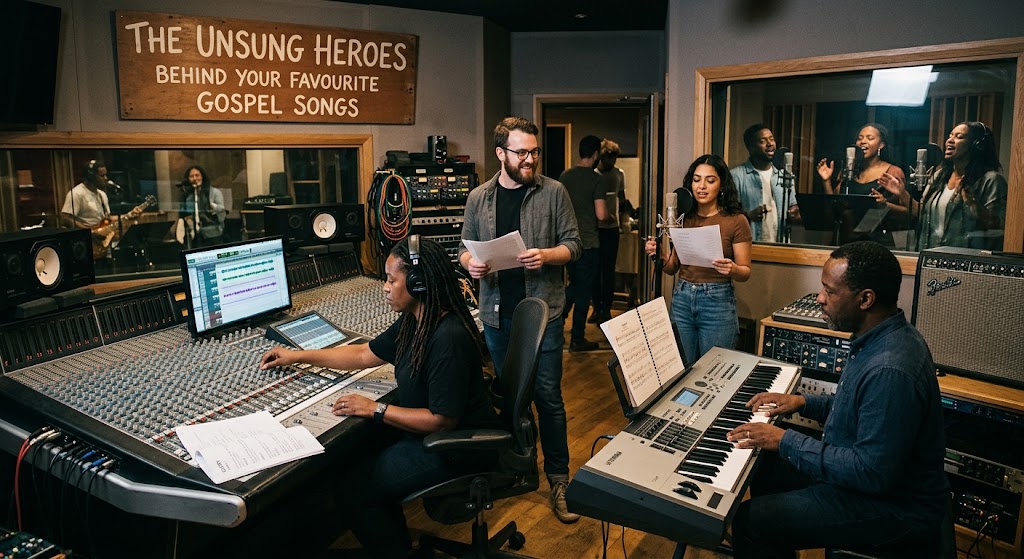
The Unsung Heroes Behind Your Favourite Gospel Songs
The Unsung Heroes Behind Your Favourite Gospel Songs
The Unsung Heroes Behind Your Favourite Gospel Songs are often the people you never see when the song begins to play. When a powerful gospel song fills a church, appears on a playlist, reaches millions of streams or becomes the soundtrack to someone’s testimony, attention naturally goes to the singer standing behind the microphone. We remember the voice, the face, the music video and sometimes the songwriter. But behind almost every memorable gospel song is a team of talented people whose contributions may never receive the recognition they deserve.
A great gospel song is rarely the work of one person alone. While the artist may be the most visible part of the process, countless hours of creativity, planning, musicianship, production, arrangement, engineering and spiritual preparation can happen behind the scenes before the public ever hears the finished record. The people responsible for these elements are The Unsung Heroes Behind Your Favourite Gospel Songs, and without them, many of the songs we love would sound completely different.
Think about a gospel song that has touched your life. Perhaps you discovered it during a difficult season. Maybe you heard it during worship and suddenly found yourself in tears. Perhaps a particular lyric reminded you of God’s faithfulness when everything around you seemed uncertain. You may know the singer and even remember the words perfectly, but do you know who played the piano? Do you know who arranged the harmonies? Do you know who produced the record? Do you know who mixed the vocals or mastered the final audio?
Most listeners do not.
That does not make their contribution less important. In fact, some of the most important creative decisions happen away from the spotlight.
The music producer is one of the most important figures behind a gospel recording. A producer can help transform an idea into a complete musical experience. They may influence the instrumentation, tempo, arrangement, vocal direction, sound and overall emotional character of a song. A producer often listens to the song differently from the average listener. While the audience hears a finished record, the producer hears possibilities.
A simple melody can become an emotional worship anthem because a producer knows when to introduce the drums, when to allow the piano to breathe, when the choir should enter and when the singer should deliver a particular line with greater intensity. Sometimes the best production decision is knowing what not to add.
This is particularly important in gospel music because the message must remain central. Production can make a song bigger, more modern and more commercially appealing, but the production should serve the message rather than overpower it. The producer therefore has the difficult responsibility of balancing musical creativity with the purpose of the song.
Then there are the arrangers.
Many listeners may not even realise how much work goes into arranging a gospel song. An arranger can take the basic musical idea and determine how different instruments, voices and sections should work together. In choir music, the arrangement can completely transform a song. The soprano, alto and tenor parts must complement one another. The musicians must understand the structure. The transitions have to feel natural. The build up must create the right emotional impact.
A song that sounds effortless when performed may have required hours of careful arrangement before anyone stepped onto a stage.
This is one reason The Unsung Heroes Behind Your Favourite Gospel Songs deserve greater appreciation. Their work often disappears into the final product because successful arrangement sounds natural. You do not listen to a beautiful harmony and immediately think about the person who wrote the harmony. You simply enjoy the sound.
The same applies to session musicians.
That beautiful piano line you hear at the beginning of a worship song may have been played by a professional keyboardist who spent years developing that skill. The guitar, bass, drums, strings, percussion and other instruments may have been performed by musicians who are exceptionally talented but remain largely unknown to the audience.
A great session musician does more than play notes. They understand the emotion of the song. They know when to play aggressively and when to create space. They can follow the singer, respond to the choir and contribute without distracting from the message.
In gospel music, musicians often have to be particularly sensitive because worship music is not simply about technical perfection. The atmosphere matters. The musicians have to support the emotional and spiritual direction of the performance.
Behind the musicians are also vocal directors and vocal coaches who help artists deliver their best performances. Singing a song in a studio is not always as easy as it sounds. A vocalist may need to repeat a section dozens of times to achieve the right tone, emotion and timing.
A vocal coach may help an artist understand how to approach difficult notes, control breathing or protect the voice. A vocal director may determine how background vocals should interact with the lead singer. They may also help create harmonies that make a chorus sound much richer.
Background vocalists themselves deserve enormous recognition.
They may not appear prominently in the music video, and their names may not be familiar to listeners, but background singers can completely change the power of a gospel recording. Their harmonies can make a chorus feel larger. Their responses can create a sense of congregation. Their voices can turn a solo performance into something that sounds like an entire community worshipping together.
Anyone who has listened to powerful gospel choir music understands this.
The lead singer may start the song, but when the supporting voices enter, something changes.
The sound becomes bigger.
The emotion becomes deeper.
The song begins to feel communal.
That is the work of people who may never receive the same attention as the person holding the microphone.
Another group of The Unsung Heroes Behind Your Favourite Gospel Songs are the audio engineers. Recording engineers are responsible for capturing the performance properly. They work with microphones, recording equipment, software and studio environments to make sure the sounds are recorded with clarity.
This job requires both technical knowledge and artistic judgement.
A microphone can be positioned differently depending on the desired sound. A vocal may need a particular recording technique. Instruments may need different microphone choices. Background vocals must be captured carefully so that they support the lead without becoming muddy.
After recording comes mixing.
The mixing engineer takes the various recorded elements and brings them together into one coherent listening experience. They determine how loud different instruments should be, how the vocals sit within the music, how much space exists between sounds and how the overall recording feels.
When you hear a gospel song and everything seems perfectly balanced, there is a good chance a skilled mixing engineer helped make that happen.
Then comes mastering.
Mastering is another stage that most casual listeners rarely think about. The mastering engineer prepares the final recording for distribution and ensures that it translates well across different listening environments. The song needs to sound good through headphones, phones, cars, speakers and other systems.
That final polish may seem invisible, but it can make a major difference.
There are also songwriters whose names may not be widely known. Some gospel artists write their own songs, while others record songs written by other people. Behind a powerful lyric can be a songwriter who spent months or even years processing personal experiences, studying Scripture, reflecting on faith and searching for the right words.
A simple line can carry enormous emotional weight.
Consider how many people may connect with a song about God’s faithfulness because they have experienced hardship. The songwriter may have written those words from a personal place of pain, disappointment or hope. Years later, another person hears the song during a completely different situation and feels understood.
That is one of the extraordinary things about gospel music.
A personal testimony can become a public source of encouragement.
The songwriter may never know how many people were helped by the words they wrote.
There are also church worship teams and choir directors who contribute significantly to the gospel music ecosystem. Long before some songs become popular online, they may have been tested in local churches. Worship leaders and choir directors understand how congregations respond to different musical arrangements. They know when a song is too complicated for congregational singing and when a melody is simple enough for everyone to participate.
Church musicians are therefore not merely performers. They are often teachers, arrangers, mentors and spiritual leaders within their communities.
Many gospel artists developed their musical abilities in churches where nobody was paying them millions of streams or buying concert tickets. They started by singing in small choirs, playing instruments during services or leading worship in rooms that held only a handful of people.
Those humble beginnings matter.
The gospel music industry also depends on people who handle the business side of music. Managers, publicists, promoters, photographers, graphic designers and digital marketers all play roles in helping artists reach audiences.
A brilliant gospel song can remain unknown if nobody knows how to distribute or promote it.
Today, digital platforms have made music distribution easier, but they have also created a new challenge. Artists are competing for attention in an enormous online environment. Someone has to create the artwork, distribute the song, prepare promotional materials, manage social media campaigns and communicate with blogs, radio stations, playlists and other media outlets.
These professionals may never sing a note, but they can determine how far a song travels.
Music video directors and production crews are also part of the story. A gospel song can have a powerful message, but the right visual presentation can help listeners connect with that message in a completely different way.
Behind a music video are camera operators, editors, lighting professionals, stylists, location managers and other crew members. They may work long hours to create a few minutes of finished footage.
The audience sees the final video.
They rarely see everything that happened before the camera started rolling.
Even photographers contribute to the identity of gospel artists. A powerful promotional photograph can become the image that fans associate with an artist for years. Graphic designers create album covers, social media artwork, event posters and visual identities that help songs stand out in a crowded digital marketplace.
The more you look behind a gospel song, the more people you discover.
There are also mentors who may never receive a public credit. A senior musician may teach a younger singer how to control their voice. A pastor may encourage an emerging worship leader to keep going. A songwriter may help another songwriter develop an idea. A producer may give an unknown artist an opportunity when nobody else would.
Sometimes the person who changes an artist’s career is not the person receiving the award.
They are simply the person who opened the door.
This is why recognising The Unsung Heroes Behind Your Favourite Gospel Songs is important. Music is collaborative. Success may have one face, but it usually has many hands behind it.
This does not diminish the artist. Quite the opposite. It makes the achievement even more impressive.
A great gospel recording represents a network of people bringing different gifts together for one purpose.
The singer brings the voice.
The songwriter brings the message.
The producer brings the vision.
The musicians bring the sound.
The arranger brings structure.
The engineers bring clarity.
The background singers bring depth.
The creative team brings visual identity.
The promoters bring the music to the audience.
The listeners then give the song another life by sharing it, singing it and attaching their own stories to it.
There is another important lesson here for aspiring Christian musicians. You do not need to be the person standing at the centre of the stage to make an impact.
Perhaps your gift is playing an instrument.
Perhaps you are better at writing lyrics.
Perhaps you understand sound engineering.
Perhaps you can arrange music.
Perhaps you have a gift for managing artists.
Perhaps you can create beautiful visuals.
Perhaps your greatest gift is encouraging other people.
All these contributions matter.
The Christian music community needs more than talented singers. It needs people who understand that music can be both creative work and ministry. It needs musicians who value excellence without losing humility. It needs producers who understand the message. It needs songwriters who care about what their lyrics communicate. It needs engineers who respect the recording. It needs leaders who are willing to develop younger musicians.
Most importantly, it needs people who understand that recognition is not the only measure of impact.
Some of the people who helped create your favourite gospel song may never become famous. Their names may appear briefly in the credits, or perhaps you may never see their names at all. But their fingerprints are present in the music.
The next time you listen to a gospel song that moves you deeply, take a moment to think beyond the person singing.
Think about the songwriter who found the words.
Think about the musician who created that unforgettable instrumental.
Think about the background singers who made the chorus powerful.
Think about the producer who decided exactly when the music should rise.
Think about the engineer who made every voice and instrument sound clear.
Think about the arranger who brought all the pieces together.
Think about the people who promoted the song until it finally reached your ears.
There is a story behind every great recording, and that story is usually bigger than the artist whose name appears on the cover.
The Unsung Heroes Behind Your Favourite Gospel Songs remind us that great music is rarely created in isolation. Behind the voices we celebrate are countless people whose creativity, patience, technical expertise, faith and hard work help transform simple ideas into songs that travel across churches, countries and generations.
Perhaps the next time your favourite gospel song plays, you will listen differently.
You may still celebrate the singer, and you should. But you may also appreciate the people standing quietly behind the scenes. The people whose names you might not know. The people whose faces you may never see. The people who contributed something essential without asking for the spotlight.
Because sometimes the greatest contribution is not being seen.
Sometimes it is simply helping create something that gives somebody else hope.
And that may be one of the most beautiful things about gospel music.

Leave a Reply