
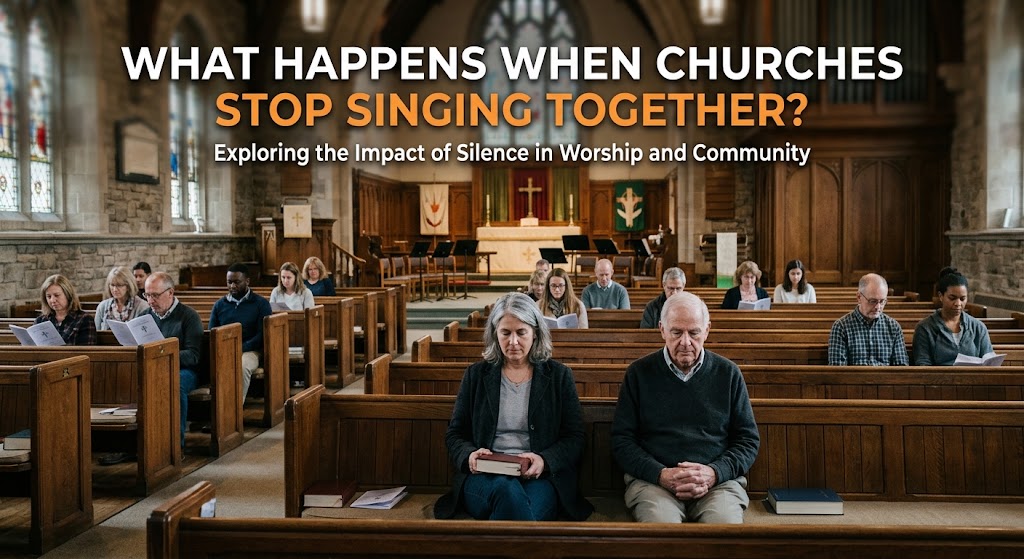
What Happens When Churches Stop Singing Together?
What Happens When Churches Stop Singing Together?
What happens when churches stop singing together? At first, it may seem like nothing serious has changed. The music may still be playing. The worship team may still be on stage. The instruments may still sound excellent. The lyrics may still appear on the screen. The service may still follow the same schedule. Yet something important can quietly disappear when the congregation stops participating in the singing.
Christian music has never been merely about producing beautiful sounds. Throughout Christian history, singing has been one of the ways believers express faith, remember biblical truth, encourage one another and publicly declare what they believe. The New Testament even connects singing with teaching and mutual encouragement. Ephesians 5:19 speaks about addressing one another with psalms, hymns and spiritual songs, while Colossians 3:16 connects singing with allowing the message of Christ to dwell richly among believers.
That raises an important question for modern churches: what happens when churches stop singing together?
The first thing that can disappear is participation. There is a major difference between watching worship and participating in worship. A congregation can become an audience very easily when the worship team does everything while everyone else simply listens. The musicians perform, the lead vocalist sings, the backing vocalists harmonise and the congregation observes. The atmosphere may still be emotional, but the communal act of singing has changed.
Christian worship was never designed to be entirely passive. Singing gives ordinary church members a voice. You do not need to be a professional singer to worship. You do not need perfect pitch, expensive equipment or a powerful microphone. When a church sings together, the wealthy person and the poor person, the pastor and the new believer, the young person and the elderly person can all participate in the same act.
That is one of the beautiful things about congregational singing. Everyone contributes something, even when individual voices cannot be distinguished. Research examining congregational singing has found that people commonly associate singing together with feelings of community and spiritual connection. In one large study involving 1,603 Catholics from German speaking countries, participants reported strong experiences of social connectedness during congregational singing.
When churches stop singing together, they may therefore lose one of the simplest ways of reminding people that Christianity is not merely an individual experience.
Faith is personal, but Christianity is also communal.
There is something powerful about hundreds of people standing in one room and singing the same words. Different personalities disappear into a shared declaration. People who may have completely different backgrounds suddenly have one voice. They may disagree about many things outside the church, but for a few minutes they are expressing the same faith, hope and gratitude.
When that disappears, worship can become increasingly individualistic.
Another thing that can happen when churches stop singing together is that the worship team becomes separated from the congregation. Instead of leading the church in worship, musicians can gradually become performers in front of the church. The distinction may appear small, but its consequences can be significant.
A worship leader is not simply a Christian version of a concert performer. The goal of congregational worship is not merely to impress people with vocal ability or musical excellence. Musical excellence has its place, and churches should not be afraid of quality, but excellence should serve participation rather than replace it.
A technically perfect worship performance can still leave a congregation strangely silent.
Sometimes the problem is not that people have stopped loving God. They may simply feel that the song is too complicated to sing. Perhaps the melody is written for a professional vocalist. Perhaps the key is too high. Perhaps the arrangement contains so many vocal runs that ordinary people cannot follow. Perhaps the band is so loud that the congregation cannot hear itself singing.
When this happens repeatedly, people may slowly learn that their role is to listen rather than sing.
And once people become comfortable listening, participation can become harder to recover.
There is also something else at stake: memory.
Many Christians can remember songs they learned years ago. A particular hymn can take someone back to childhood. A worship chorus can remind someone of a difficult season they survived. A gospel song can bring back memories of a parent, grandparent, church service or important moment in their spiritual journey.
Singing is deeply connected with memory, and research on congregational hymn singing has noted the particular significance of familiar melodies for congregants, including older people and those experiencing memory impairment.
This means that when churches abandon meaningful congregational singing completely, they may unintentionally weaken one of the ways faith is carried from one generation to another.
Children learn songs.
Young people remember songs.
Parents teach songs to their children.
Older believers pass songs down to younger believers.
A song can travel through generations in a way that a sermon may not.
This is particularly important because Christian music often carries theology. A congregation may sing about God’s faithfulness, the death and resurrection of Christ, grace, forgiveness, holiness, hope, salvation and the promises of Scripture. When people repeatedly sing those truths, they are not merely making music. They are rehearsing what they believe.
Colossians 3:16 is especially interesting because it connects singing with teaching and admonishing one another. In other words, Christian songs can function as a means of communicating and reinforcing truth within the community.
That means the question is not simply whether a church has music.
The more important question is whether the church is actually singing.
There is a difference.
A church can have a fantastic music department and still have weak congregational participation. It can have talented instrumentalists, expensive microphones, impressive lighting and professionally produced worship videos while the congregation barely opens its mouth.
The technology can be excellent while the participation becomes weaker.
This does not mean technology is bad. It does not mean churches should return to using only old hymns or reject contemporary worship music. Christian music has always developed, adapted and interacted with different cultures. A 2025 study of congregational hymn singing in Nigerian Pentecostal churches, for example, examined how worship music can preserve tradition while also reflecting change, identity and contemporary Pentecostal practice.
The issue is not whether a church uses hymns, contemporary worship, gospel music, African worship styles or modern production.
The issue is whether the people are still participating.
This matters because congregational singing can also create a sense of belonging.
Imagine someone attending church for the first time. They may not know anybody. They may feel nervous. They may not understand the culture of the church. They may not know where to sit or when to stand. But then the congregation begins singing a simple, familiar Christian song.
For a moment, they are no longer just an outsider watching a religious event.
They are part of the sound.
That shared voice can communicate something that announcements cannot. It says, “You are among us.”
This is one reason singing can be particularly powerful in Christian communities. Research into congregational singing has found that social effects can be especially pronounced, with participants reporting feelings of connection and community while singing together.
When churches stop singing together, they may therefore lose an opportunity to create belonging through participation.
There is also a spiritual dimension.
Singing does not magically make someone closer to God, and the absence of singing does not automatically mean a church has lost its spiritual life. Christians worship God through prayer, Scripture, service, obedience, generosity, preaching, fellowship and many other expressions of faith.
But singing has a unique place because it combines words, emotion, memory and community.
A person can sometimes sing words they struggle to say in ordinary conversation.
Someone who cannot explain their gratitude may sing about it.
Someone who is afraid may sing about God’s faithfulness.
Someone who is grieving may sing about hope.
Someone who feels weak may sing about God’s strength.
Sometimes the song becomes the prayer.
This is reflected in the biblical pattern of connecting singing with praise, thanksgiving and the life of the believing community.
This is why Christian music remains so important.
However, there is a danger in romanticising congregational singing. Not every church member will sing loudly. Some people are naturally quiet. Others may feel uncomfortable singing in public. Some may be unable to sing because of physical or emotional circumstances. Others may worship deeply through silent reflection.
Therefore, the goal should never be to pressure people into making noise.
The goal should be to create an environment where people are genuinely invited to participate.
That distinction matters.
A church should not measure the quality of worship by how loudly people sing. Nor should it assume that emotional volume equals spiritual depth. Quiet worship can be sincere worship.
But there is something concerning when an entire congregation becomes consistently silent because the worship culture has gradually turned them into spectators.
At that point, the church should ask why.
Are the songs difficult to sing?
Are they unfamiliar?
Are they being performed instead of led?
Is the sound system overpowering the congregation?
Are the lyrics difficult to understand?
Are worship leaders choosing songs primarily because they sound impressive?
Are people being given opportunities to participate?
Are children learning songs?
Are older songs being forgotten completely?
Are new songs being introduced in ways that help the congregation learn them?
These questions matter because congregational singing does not happen automatically.
It is cultivated.
A worship leader who wants people to sing may need to choose songs with memorable melodies and meaningful lyrics. The musicians may need to leave enough space for the congregation to hear itself. The church may need to teach new songs instead of expecting everyone to know them instantly. Leaders may need to explain the meaning of songs rather than treating them as musical transitions between different parts of the service.
Sometimes the solution is surprisingly simple.
Turn down the band.
Choose a song people can actually sing.
Let the congregation hear itself.
Teach the chorus.
Give people time.
Stop trying to make every moment spectacular.
Let ordinary believers make a beautiful sound together.
There is another important question that churches should consider. What happens when the congregation only sings songs that are designed to create an emotional experience?
Christian music should certainly engage emotion. Christianity is not emotionless. The Psalms themselves contain joy, grief, fear, confidence, desperation, celebration and hope.
But congregational singing should also teach.
A song can make people feel something while saying very little. Another song can contain profound biblical truth without having the most dramatic musical arrangement.
The strongest Christian songs often combine truth and beauty.
They give people words for their faith.
They help believers remember what they believe when life becomes difficult.
They allow people to sing theology instead of merely hearing it.
This is why the words matter.
When a congregation sings about God’s character, Christ’s work, grace, redemption and hope, those truths become part of the shared language of the church.
When churches stop singing together, they may gradually lose some of that shared vocabulary.
The consequences may not appear immediately.
Nobody may leave the church because there was no congregational singing on Sunday.
Nobody may complain.
The service may even look more polished.
But over time, something subtle can change.
The church can become more like a gathering of individual consumers of religious content and less like a community participating together.
That is perhaps the greatest danger.
Modern culture already trains people to consume. We watch instead of participate. We stream instead of gather. We scroll instead of converse. We listen through headphones instead of singing with neighbours.
The church should be careful not to reproduce that culture without thinking.
Christian worship does not have to compete with a concert.
It can offer something different.
A room full of imperfect voices singing together can communicate community in a way a perfect recording cannot.
That imperfect sound may actually be part of the beauty.
Nobody needs to sound like a professional artist.
The elderly voice matters.
The child’s voice matters.
The quiet voice matters.
The voice that is slightly out of tune matters.
The person who can sing beautifully matters.
The person who can barely sing matters.
When all of them sing together, the result is not a professional performance.
It is a community.
And perhaps that is what churches risk losing when they stop singing together.
They do not simply lose music.
They can lose participation.
They can weaken communal identity.
They can reduce opportunities for shared encouragement.
They can lose an important method of remembering biblical truth.
They can make worship feel more like something happening in front of people rather than something happening among people.
The answer, however, is not to attack modern worship teams or declare that every church must return to a particular musical tradition. Christian communities are diverse, and worship styles will continue to change.
The deeper question is whether the people of God still have a voice within their worship.
If the answer is yes, then the church has something precious.
If the answer is no, perhaps it is time to ask what has been lost.
What happens when churches stop singing together?
Perhaps the most honest answer is this: the church may continue to function, but it risks becoming quieter in a way that has nothing to do with volume.
Because when Christians sing together, they are doing more than producing music. They are reminding one another that faith is shared. They are teaching one another. They are remembering together. They are expressing gratitude together. They are carrying stories together. They are declaring hope together.
And sometimes, when one believer has no strength left to sing, the voices of everyone around them can carry the song for them.
That may be one of the most beautiful reasons churches should never underestimate the power of singing together.
A congregation does not need perfect voices.
It needs willing voices.
It does not need a spectacular performance every week.
It needs genuine participation.
It does not need to sound like a professional recording.
It needs to sound like people who believe the words they are singing.
Because the real power of Christian music may not be found in how impressive the church sounds from the platform.
It may be found in what happens when everyone in the room discovers that they have a voice.
And perhaps the question every church should occasionally ask is not, “How good did our worship team sound today?”
Perhaps it should be, “Did our people sing?”
Because when a church sings together, something powerful happens.
People participate.
People remember.
People encourage one another.
People find belonging.
People declare their faith.
And people who arrived carrying different burdens can leave having heard one another sing the same message of hope.
That is why the question “What Happens When Churches Stop Singing Together?” deserves more than a simple discussion about music. It is ultimately a question about community, participation, memory, discipleship and the way Christians experience faith together.
The church has always had a song.
The challenge is making sure the congregation has not forgotten how to sing it.

Leave a Reply