
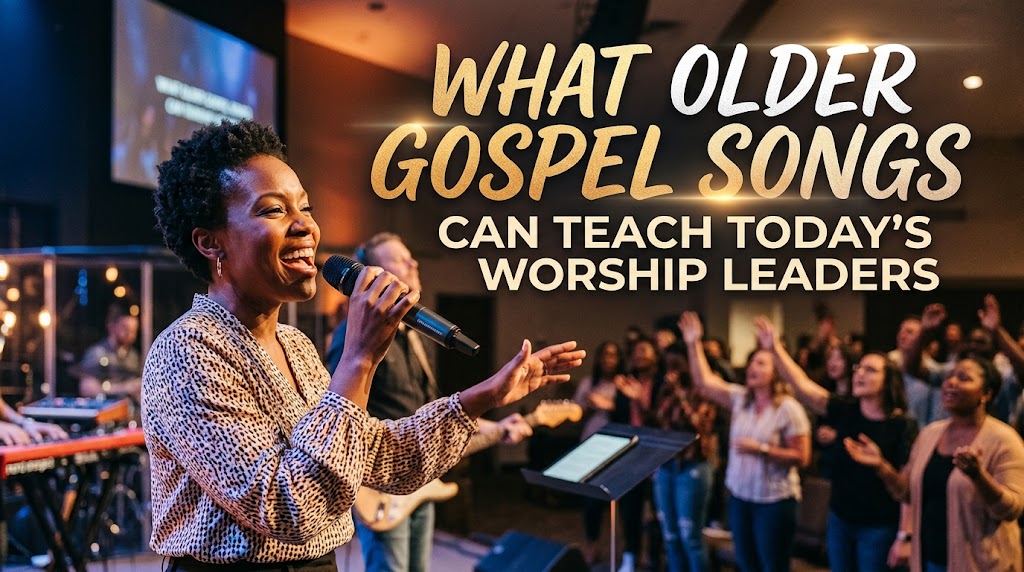
What Older Gospel Songs Can Teach Today’s Worship Leaders
What Older Gospel Songs Can Teach Today’s Worship Leaders
What Older Gospel Songs Can Teach Today’s Worship Leaders is a question worth asking at a time when Christian music is changing faster than ever. New sounds are emerging, worship teams are experimenting with different musical styles, and technology has completely transformed how songs are written, recorded, distributed and consumed. Yet, despite all these changes, older gospel songs continue to hold a special place in the hearts of millions of believers. Some songs that were written decades ago can still move people to tears, inspire prayer and bring entire congregations together. That lasting influence is not accidental. There are important lessons hidden inside the songs, stories and worship traditions of previous generations that today’s worship leaders can learn from.
The Christian music landscape today is incredibly diverse. A worship service can feature modern instruments, professional production, large screens, sophisticated lighting and carefully arranged vocal harmonies. Churches can stream their services to people thousands of kilometres away, while worship songs can reach millions of listeners through digital platforms within hours of release. These developments are valuable and have created opportunities that previous generations could hardly imagine. However, technological progress does not automatically produce deeper worship. A song can have excellent production and still fail to connect with the heart. This is one of the reasons What Older Gospel Songs Can Teach Today’s Worship Leaders remains such an important conversation.
One of the greatest lessons older gospel songs teach is that the message matters. Many classic gospel songs were built around simple but powerful truths about God, faith, salvation, grace, forgiveness, hope, perseverance and eternal life. The melodies were sometimes uncomplicated, and the arrangements were not always elaborate, but the message was strong enough to carry the song across generations. Today’s worship leaders can learn that a powerful worship song does not necessarily need complicated lyrics. Sometimes the simplest declaration of faith can become the most memorable part of a worship experience.
Older gospel songs also demonstrate the importance of sincerity. Many of the singers and musicians who performed these songs were not simply trying to create impressive musical moments. Their music often came from personal experiences, struggles, testimonies and genuine faith. They sang about God’s faithfulness because they had experienced difficult seasons themselves. They sang about hope because they understood disappointment. They sang about grace because they knew they needed it. This authenticity gave their music emotional weight.
Today’s worship leaders can learn from that authenticity. A worship leader does not need to pretend to have everything figured out. People connect with honesty. When worship comes from a genuine relationship with God rather than a desire to impress an audience, the difference can often be felt. Technical excellence has its place, but sincerity gives music its spiritual depth.
Another important lesson from older gospel songs is the power of storytelling. Many classic gospel songs tell stories. They describe hardship, deliverance, redemption, prayer, perseverance and God’s intervention. Instead of simply making statements, they invite listeners into an experience. A person can hear an old gospel song years after first encountering it and still remember the story it tells.
Modern worship leaders can use this principle when choosing or writing songs. People remember stories because stories connect truth with emotion. A song about God’s faithfulness becomes even more powerful when it communicates the journey from fear to confidence, from sorrow to hope or from failure to restoration. Worship music does not have to be complicated to be profound. Sometimes it simply needs to tell the truth in a way that people can recognise in their own lives.
Older gospel songs also teach today’s worship leaders the value of congregational participation. Many traditional gospel songs were designed to be sung by groups of people rather than simply performed for an audience. Call and response, repeated phrases and memorable choruses allowed congregations to participate actively. The distinction between performer and listener could become much less important because everyone was part of the musical experience.
This is an important lesson for modern churches. Worship is not supposed to be a concert where one group performs while everyone else watches. A worship leader’s responsibility is not merely to sound good. It is also to help people participate. The best worship leaders understand when to sing, when to invite the congregation to sing, when to simplify an arrangement and when to allow the room to carry the song.
Another thing What Older Gospel Songs Can Teach Today’s Worship Leaders is the importance of repetition. Modern listeners sometimes associate repetition with a lack of creativity, but gospel music has demonstrated for generations that repetition can be powerful when it reinforces a meaningful truth. Repeating a phrase about God’s goodness, faithfulness or presence can give people time to internalise the message.
Repetition can also transform a song from something people hear into something they remember. A worship song that remains in someone’s mind throughout the week can continue ministering long after the church service has ended. The goal should not be repetition for the sake of filling time, but repetition that allows a meaningful truth to settle deeply into the heart.
Older gospel music also teaches patience. In an age where people expect instant results, older songs remind us that powerful music does not always need to rush. Some classic gospel performances build gradually. They allow musicians to establish a mood, singers to develop a message and congregations to respond naturally. There is often room for pauses, reflection and emotional progression.
Today’s worship leaders can learn to resist the pressure to fill every second with sound. Silence can be meaningful. A pause between songs can create space for prayer. A quiet musical moment can allow people to reflect on the words they have just sung. Worship does not become more powerful simply because more instruments are playing.
Another lesson is the importance of musical discipline. It is easy to assume that older gospel music was powerful only because of emotion, but many classic recordings demonstrate impressive musicianship, vocal control, arrangement and timing. Simplicity does not mean carelessness. In fact, simple music often requires musicians to be even more disciplined because every note and every word becomes more noticeable.
Modern worship teams can therefore learn that spiritual passion and musical excellence do not have to compete with each other. A worship leader can pursue both. Preparation, rehearsals, vocal training, instrumental practice and good arrangements can help create an environment where musicians are not distracted by avoidable mistakes and can focus more fully on ministry.
Older gospel songs also show the importance of lyrics that people can understand. Some of the most enduring songs use ordinary language to communicate extraordinary truths. They speak about God in ways that ordinary people can sing and remember. This is particularly relevant today because worship lyrics can sometimes become unnecessarily complicated.
A worship song should not require a theological dictionary before someone can understand its central message. Depth is important, but clarity is equally valuable. Today’s worship leaders can learn to communicate biblical truths in language that is meaningful, memorable and accessible without sacrificing theological accuracy.
Another powerful lesson is that worship music can speak to people in difficult seasons. Older gospel songs often address pain directly. They do not pretend that believers will never experience suffering. Instead, they acknowledge hardship while pointing people towards hope. This balance is one reason such songs continue to resonate with people.
Modern worship leaders should remember that the people standing in front of them may be carrying burdens nobody else can see. Someone may have lost a loved one. Someone may be worried about finances. Someone may be struggling with disappointment, loneliness or uncertainty. Someone else may be celebrating an answered prayer. Worship music should create room for the full range of human experiences while consistently pointing people towards God.
Older gospel songs also teach today’s worship leaders about the value of endurance. Many songs from previous generations were born in circumstances that were far from comfortable. Their creators faced challenges, limitations and hardships, yet they continued to make music that communicated hope. Their example reminds today’s musicians that ministry is not always glamorous.
A worship leader may sometimes feel overlooked. There may be seasons when the church does not grow as quickly as expected, when a song does not receive attention online or when personal sacrifices seem unnoticed. Older gospel music offers a different definition of success. The goal is not always popularity. Sometimes success means faithfully serving the people God has placed in front of you.
This is especially important in the age of social media. Worship leaders can easily become influenced by views, streams, followers, likes and viral moments. Digital platforms can be useful tools, but they should never become the measure of spiritual impact. A song that reaches one hurting person and gives them hope may have accomplished something more significant than a song that receives millions of views.
Another lesson from older gospel songs is the importance of preserving heritage. Every generation wants to create something new, but Christian music does not have to choose between tradition and innovation. Today’s worship leaders can honour older songs while still developing new sounds. The goal is not to copy the past but to understand what made the past meaningful.
Listening to older gospel music can help worship leaders discover musical ideas that modern trends may overlook. They can study vocal arrangements, harmonies, storytelling techniques, choir structures and lyrical patterns. They can learn how previous generations used limited resources creatively. They can also discover the cultural and spiritual stories behind the music.
Older gospel songs can therefore become a source of education for young worship leaders. Instead of treating traditional gospel music as outdated, musicians can approach it as a library of lessons. Every generation has something to learn from the generation before it.
Another significant lesson is the power of community. Many older gospel songs were shaped by choirs, families, church groups and communities. Music was often deeply connected to shared faith experiences. This reminds today’s worship leaders that worship ministry should not revolve around one individual.
A healthy worship team develops people. The leader should be willing to mentor younger musicians, encourage singers, share opportunities and create an environment where others can grow. A worship leader who builds a strong team creates something that can continue even when they are no longer leading.
Older gospel music also demonstrates that imperfections do not necessarily destroy beauty. Some classic recordings may not have the polished production quality available today, but their emotional power remains. There may be background noise, less sophisticated instruments or vocal imperfections, yet listeners continue returning to them.
This teaches a valuable lesson about perfectionism. Modern worship leaders have access to powerful technology that can correct pitch, improve recordings, create elaborate arrangements and produce incredibly polished sounds. These tools can be useful, but they should not replace genuine expression. Sometimes people are moved by humanity rather than perfection.
What Older Gospel Songs Can Teach Today’s Worship Leaders also includes the lesson that worship should remain centred on God. Christian music can easily become personality driven because audiences naturally connect with charismatic singers and worship leaders. Artists can become celebrities, and songs can become associated more strongly with their performers than with the message they communicate.
There is nothing inherently wrong with artists becoming recognised. The problem begins when recognition becomes more important than worship. Older gospel music reminds us that the ultimate purpose of Christian music is bigger than the individual performer. The music should point beyond the singer to the God being worshipped.
Today’s worship leaders should therefore regularly ask themselves difficult questions. Why am I leading worship? Who am I trying to impress? Am I more concerned about how the congregation responds to me or whether people encounter God? Am I choosing songs because they are popular or because they serve the spiritual needs of the congregation? These questions can protect a worship leader from slowly turning ministry into performance.
Older gospel songs also teach the importance of hope. Many classic songs speak directly to the possibility of a better tomorrow because of God’s presence and promises. This message remains relevant because people still face fear, uncertainty and disappointment.
In today’s world, Christian music has an opportunity to become a voice of hope. Worship leaders can create songs that acknowledge reality without allowing reality to become the final word. Faith does not require pretending that problems do not exist. It means believing that problems do not have the final authority over our hope.
There is also a lesson about longevity. A song does not have to be released yesterday to be relevant today. Some older gospel songs remain powerful because their central messages are timeless. Love, grace, mercy, faith, redemption, forgiveness, worship and hope do not become obsolete.
This challenges today’s worship leaders to think beyond immediate trends. Instead of asking only whether a song will perform well this month, they can ask whether the song will still mean something five, ten or twenty years from now. Writing for longevity can produce music that becomes part of a church’s spiritual memory.
Ultimately, What Older Gospel Songs Can Teach Today’s Worship Leaders is not about rejecting modern Christian music. It is about learning from the wisdom of the past while embracing the opportunities of the present. Modern technology, contemporary sounds and innovative songwriting can all contribute positively to Christian worship. But innovation becomes more meaningful when it is built on strong foundations.
Older gospel songs remind today’s worship leaders that music is not merely about sound. It is about message, sincerity, community, testimony, participation, hope and faith. The most memorable songs often carry something deeper than a beautiful melody. They carry a truth that people can hold onto when life becomes difficult.
The next generation of worship leaders does not need to choose between old and new. They can listen to the past, understand its lessons and create something meaningful for the future. They can use modern instruments without abandoning meaningful lyrics. They can embrace digital platforms without allowing numbers to define their ministry. They can pursue musical excellence without losing sincerity. They can create new songs while respecting the songs that came before them.
Perhaps that is the greatest lesson of all. A worship leader’s greatest achievement may not be creating the loudest song, the most impressive stage moment or the most popular Christian music release. It may simply be helping someone remember that God is still faithful.
That is why older gospel songs still matter. They remind us that powerful Christian music does not depend entirely on technology, trends or popularity. It depends on truth that survives generations. When today’s worship leaders understand that, they can create music that does more than sound good for a few minutes. They can create songs that people carry into their homes, their families, their struggles, their prayers and their everyday lives.
What Older Gospel Songs Can Teach Today’s Worship Leaders is ultimately a lesson in remembering where the music came from, understanding why it mattered and using that knowledge to build something even more meaningful for the future. The sound may change. The instruments may change. The platforms may change. The audience may change. But the power of a sincere message of faith can remain timeless.

Leave a Reply