
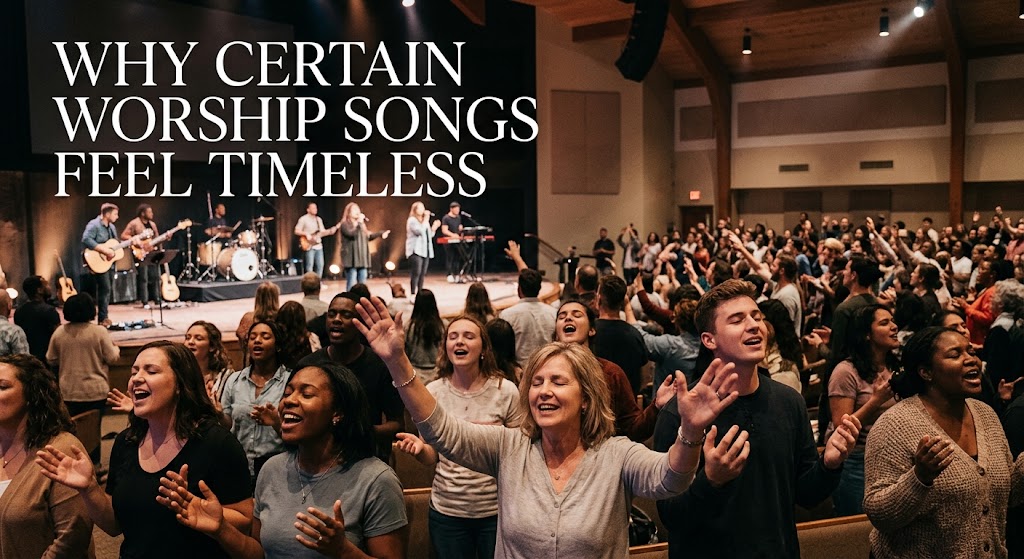
Why Certain Worship Songs Feel Timeless
Why Certain Worship Songs Feel Timeless
Why Certain Worship Songs Feel Timeless is a question that becomes especially interesting when you notice how some Christian songs remain powerful long after their release. New worship songs are released every week, artists experiment with fresh sounds, producers introduce new production techniques, and musical trends constantly change. Yet somehow, certain worship songs continue to be sung in churches, played during personal devotion, remembered by entire generations, and passed from parents to children. Their melodies remain familiar, their lyrics remain meaningful, and their emotional impact seems almost untouched by time.
There is something remarkable about hearing a worship song you have not listened to for years and suddenly remembering almost every word. You may have changed jobs, moved to another city, experienced disappointment, entered a new season of life or grown significantly in your faith, but the song can still take you back to a particular moment. This is one of the reasons why certain worship songs feel timeless. They become more than recordings. They become part of people’s spiritual memories.
Timeless worship music is rarely defined simply by the year it was released. A song does not become timeless because it is old. In the same way, a newly released song is not automatically temporary simply because it is contemporary. What gives a worship song longevity is a combination of meaningful lyrics, memorable melodies, theological depth, emotional honesty, accessibility and the ability to speak to experiences that do not disappear with changing generations.
One of the strongest reasons why certain worship songs feel timeless is that they address permanent truths. Musical styles change constantly, but fundamental questions about God, faith, hope, forgiveness, suffering, salvation, gratitude and dependence on God remain relevant. A song that speaks about God’s faithfulness can still connect with someone decades after it was written because human beings will always experience seasons when they need to be reminded that God is faithful.
The same applies to songs about grace. People fail. People struggle. People experience guilt, disappointment and uncertainty. The need for grace does not belong to one generation. It is part of the human experience. When a worship song communicates a truth that believers continue to need, the song has a much greater opportunity to outlive the musical era in which it was created.
This helps explain why certain worship songs feel timeless even when their original musical arrangements sound dated. You may hear an older recording and immediately recognise that the production belongs to another era. The instruments may sound different from what is popular today. The tempo may feel slower. The recording technology may seem less sophisticated. Yet the message remains powerful because the message is not dependent on production quality.
A timeless worship song can survive a change in musical fashion because its central message is stronger than its arrangement. The production may eventually be updated, but the core idea remains. Churches can introduce a different arrangement, a different tempo or a different instrumentation while preserving the heart of the song. This adaptability is another important reason why certain worship songs feel timeless.
Melody also plays an enormous role. A worship song can contain beautiful theology, but if the melody is difficult to remember or uncomfortable to sing, it may struggle to become a lasting congregational song. Research and practical guidance on congregational singing consistently emphasise singability, memorable musical patterns and an appropriate vocal range. Songs that people can easily learn and confidently sing are more likely to become part of a congregation’s shared musical memory.
This is particularly important because worship music is different from music that exists primarily for performance. A performer can sing an extremely complicated melody because the audience is there to listen. Congregational worship works differently. The congregation is supposed to participate. If the melody is too complicated, the vocal range is too wide or the rhythm is too difficult, people may stop singing and become spectators.
Timeless worship songs often give ordinary people an opportunity to participate. You do not necessarily need to be a professional singer to sing them. You do not need extensive musical training to follow the melody. The song invites the congregation into the experience rather than placing the artist at the centre of it.
That participatory quality can make a worship song remarkably powerful. When hundreds or thousands of people sing the same words together, the song becomes a collective expression rather than simply an individual performance. The Calvin Institute of Christian Worship notes that congregational singing engages everyone gathered and can function both as an offering to God and as a way for worshippers to minister to one another.
This collective experience creates memories. Someone may remember singing a particular worship song at a wedding, during a church conference, at a youth programme, during a difficult season, at a funeral or during a powerful church service. Years later, hearing the song again can bring those memories back almost instantly.
That emotional connection is another reason why certain worship songs feel timeless.
Music has a remarkable relationship with memory. A song can become attached to a particular period of your life. Perhaps you listened to it every morning while preparing for work. Maybe you played it during a season when you were praying for a breakthrough. Perhaps your parents used to sing it at home. Maybe your church sang it when you were growing up.
Eventually, the song becomes connected not only to its lyrics and melody but also to your personal history.
This is why two people can hear exactly the same worship song and experience completely different emotions. One person may remember a joyful season while another remembers a painful one. The song becomes a container for personal memories.
Timeless worship songs often have enough emotional depth to accommodate different seasons of life. When you are celebrating, the lyrics may sound like thanksgiving. When you are struggling, the same lyrics may sound like a prayer. When you are waiting, they may become an expression of faith. When you are grieving, they may provide words for emotions you cannot express yourself.
This flexibility gives certain songs remarkable longevity.
Another important factor is theological depth. A worship song that says something meaningful about the Christian faith can continue to serve believers long after its initial popularity disappears. Congregational songs do more than create an atmosphere. They can teach, remind, reinforce and help believers articulate what they believe. Recent discussions of worship music continue to emphasise that songs can shape theological understanding because repeated singing places ideas about God and faith into people’s memories.
This is one reason lyrics matter so much.
A song with an attractive melody may become popular for a season, but a song containing rich and enduring truth can become part of a believer’s spiritual vocabulary. People may use its words when praying. They may quote its message when encouraging someone else. They may remember its central idea during difficult circumstances.
When a song gives believers language for their faith, it becomes more than entertainment.
This also explains why songs built around biblical themes often have remarkable longevity. The Bible addresses realities that every generation encounters. Fear, hope, sin, redemption, suffering, forgiveness, worship, obedience, trust, love and perseverance are not outdated subjects. A worship song that communicates these themes clearly can continue to speak to people regardless of the decade in which it was written.
There is also something powerful about simplicity.
Some of the most memorable worship songs do not contain hundreds of words. They may repeat a central idea that is easy to understand and easy to sing. Repetition can sometimes be criticised when it feels empty, but repetition can also help a meaningful truth become deeply embedded in memory. The effectiveness depends on what is being repeated and how it functions within the song.
Musical patterns also contribute to memorability. Predictable structures can help people learn a song quickly, while a carefully placed musical change can keep the song interesting. Analysis of congregational song has highlighted the importance of identifiable musical shape, comfortable vocal range, predictable rhythm and harmony, combined with enough variation to maintain interest.
This balance is extremely important.
A song that is completely predictable may become boring. A song that is excessively complicated may become difficult to sing. Timeless worship music often finds a middle ground. It gives listeners something familiar enough to remember while providing enough musical movement to keep the experience engaging.
Another reason why certain worship songs feel timeless is that they can cross cultural boundaries.
Christianity exists across languages, continents and musical traditions. Worship music from Africa can influence believers elsewhere. Hymns from previous centuries can be rearranged with contemporary instrumentation. Songs written in one country can become popular in churches thousands of kilometres away.
Nigeria provides a particularly interesting example of how Christian musical traditions evolve while preserving continuity. Research into congregational hymn singing in Nigerian Pentecostal churches has found that congregational music can become a space where tradition, change and identity interact.
This means timelessness does not necessarily require a song to remain musically unchanged. In fact, one of the secrets of longevity may be the opposite. A song can survive precisely because each generation is willing to interpret and present it differently.
A worship song can receive a new arrangement without losing its identity. A choir can perform it differently from a contemporary worship band. A soloist can reinterpret it. A church in Africa can give it a different rhythmic character from a church in Europe or North America.
The song remains recognisable while the musical environment around it changes.
This is a powerful distinction between timelessness and nostalgia. Nostalgia says, “This reminds me of the past.” Timelessness says, “This still speaks to the present.”
A song that survives only because people remember when it was popular may eventually disappear. A song that continues to communicate something meaningful to new listeners has a much stronger chance of lasting.
Timeless worship music therefore does not simply belong to the generation that created it. It becomes available to new generations.
Another reason why certain worship songs feel timeless is their emotional honesty. People connect deeply with songs that acknowledge the reality of life rather than pretending that faith eliminates every struggle.
Christian faith includes celebration, but it also includes waiting, lament, uncertainty, repentance and perseverance. The biblical tradition itself contains songs of joy as well as songs of sorrow. This gives Christian music an enormous emotional range.
A worship song that gives people permission to bring their genuine emotions before God can remain relevant because human emotions do not disappear.
Someone may sing a song with confidence during a season of victory and later sing exactly the same song through tears during a season of loss. The meaning may deepen because the person has experienced more of life.
This is why some worship songs seem to become more powerful as you grow older.
You may have understood the words when you were younger, but you may not have understood them in the same way. After experiencing disappointment, responsibility, loss, answered prayer, unanswered prayer and unexpected blessings, certain lyrics begin to carry a completely different weight.
The song has not changed.
You have.
That is one of the most beautiful explanations for why certain worship songs feel timeless. Their meaning grows as the listener grows.
A young Christian may hear a song about trusting God and think it sounds beautiful. Years later, after experiencing a situation in which trusting God was genuinely difficult, that same song can become deeply personal.
The words have moved from theory into experience.
Timeless worship songs also benefit from being associated with communities. A song can become part of the identity of a church, denomination, family or generation. When people sing together repeatedly, the song becomes part of their shared history.
The Calvin Institute of Christian Worship observes that songs sung over many years can help shape a congregation’s identity and should not necessarily be discarded simply because newer songs are available. At the same time, newer songs can be added to expand the congregation’s musical and spiritual vocabulary.
This creates an important lesson for modern worship leaders.
The goal should not necessarily be to choose between old and new. The better question is whether a song serves the congregation well. A new song can eventually become timeless if it possesses the qualities that allow people to learn, remember, sing and live its message. An old song can remain valuable because its message continues to speak.
The real test is not simply age.
The real test is endurance.
There is also a difference between a song being popular and a song being timeless. Popularity can happen quickly. A song can trend online, accumulate millions of streams and dominate Christian playlists for months. But popularity does not automatically guarantee longevity.
Timelessness is measured differently.
A timeless song continues to be meaningful after the excitement surrounding its release has disappeared. People keep singing it when it is no longer the newest song. Churches continue teaching it. Families continue remembering it. Musicians continue rearranging it. New listeners continue discovering it.
That is a much more difficult achievement than becoming temporarily popular.
Modern Christian music exists in an environment where attention is constantly being divided. Streaming platforms introduce listeners to thousands of songs. Social media can make a song famous almost overnight. Trends change rapidly. Artists compete for attention. Production styles evolve.
Yet timeless worship music demonstrates that attention is not the same thing as endurance.
A song does not need to be the loudest, newest or most technically impressive song in the room to survive.
Sometimes it simply needs to tell the truth well.
This is why worship songwriters should think beyond the immediate release. Instead of asking only whether a song sounds contemporary, they can ask whether the message will still matter years from now. Will people still understand it? Will a congregation be able to sing it? Will it help people remember something important about God? Can someone use its words during both celebration and suffering?
Those questions go much deeper than production quality.
For listeners, understanding why certain worship songs feel timeless can also change the way we listen. Instead of judging a song only by whether we like its sound, we can ask what makes it endure. Is the message meaningful? Is the melody memorable? Is the song accessible? Does it give people words for their faith? Does it create a shared experience? Does it remain relevant when musical trends change?
When the answer to several of these questions is yes, you may be listening to something more significant than a temporary hit.
You may be listening to a song that has the potential to become part of someone’s spiritual memory.
Perhaps this is ultimately why certain worship songs feel timeless. They are not really competing against time. They are speaking to realities that time cannot erase.
Musical technology changes. Instruments change. Fashion changes. Recording styles change. Church cultures change. Generations change. But people still search for hope. People still need forgiveness. People still experience fear. People still celebrate answered prayers. People still walk through grief. People still wonder whether God is near. People still need reminders of God’s character and promises.
A worship song that speaks meaningfully into those permanent human experiences has a foundation that can survive changing trends.
The greatest worship songs therefore become more than songs. They become prayers remembered by communities. They become declarations sung by people who may never have met the songwriter. They become memories shared between generations. They become musical expressions of faith that can accompany people through seasons the songwriter could never have predicted.
That is the real power of timeless worship music.
It does not remain alive simply because people refuse to forget it.
It remains alive because people continue to find themselves inside it.
A child may learn it from a parent. A teenager may discover it through a church service. A young adult may sing it during a difficult season. A worship team may introduce a new arrangement years later. A congregation may sing it during a celebration. Someone going through heartbreak may quietly play it alone at night. Decades can pass, yet the same words can continue carrying meaning.
That is why certain worship songs feel timeless.
They capture eternal truths in memorable melodies, express genuine human emotions, invite people to participate, carry messages that remain relevant and create memories that become attached to people’s spiritual journeys. They do not simply belong to a particular moment in Christian music. They become part of the continuing conversation between faith, memory, community and worship.
And perhaps the greatest measure of a timeless worship song is surprisingly simple.
Years after everyone has stopped talking about the latest musical trend, can people still sing the song from memory?
If they can, the song has already achieved something remarkable.
If they can sing it through joy, through pain, through uncertainty, through gratitude and through changing seasons of life, then it has become more than music.
It has become part of their faith story.
That is why certain worship songs feel timeless.
They remind us that while musical styles may change with every generation, the deepest human desire to praise, remember, trust and draw near to God does not disappear.

Leave a Reply