
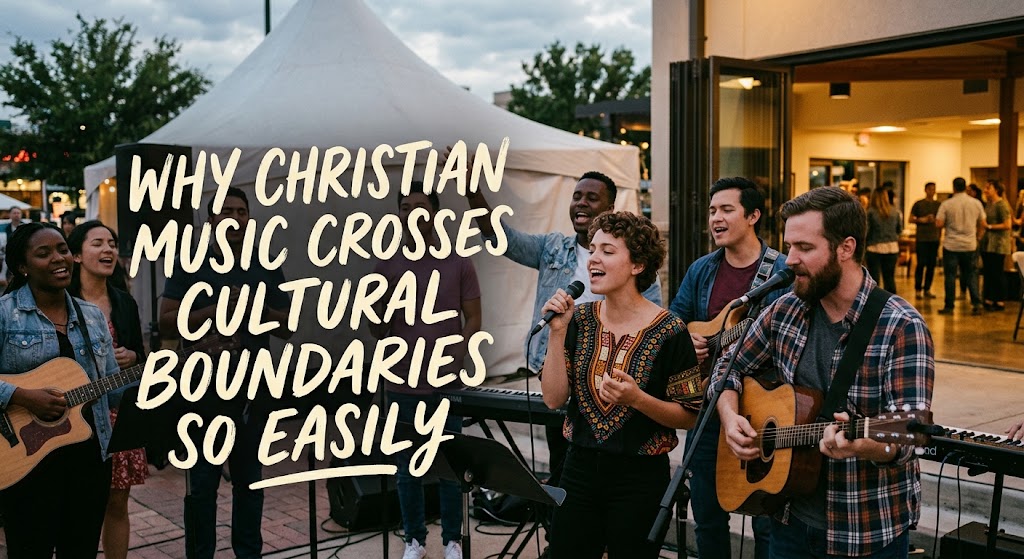
Why Christian Music Crosses Cultural Boundaries So Easily
Why Christian Music Crosses Cultural Boundaries So Easily
Christian music has a remarkable ability to travel. A worship song can begin in a small church, perhaps written by a songwriter who simply wanted to express gratitude to God, and eventually find listeners thousands of kilometres away who speak another language, belong to another culture, use different musical instruments and have completely different life experiences. Somehow, the message still connects. This raises an interesting question: Why Christian Music Crosses Cultural Boundaries So Easily? The answer lies in the unique combination of faith, emotion, storytelling, melody and universal human experiences that are woven into Christian music.
Music has always been one of the strongest ways human beings communicate beyond spoken language. People may not understand every word of a song, but they can often understand its emotion. They can recognise joy, sorrow, hope, celebration, longing and gratitude through melody, rhythm and vocal expression. Christian music benefits enormously from this universal quality. When a worship song speaks about hope, God’s love, forgiveness, faith, grace or the desire to draw closer to God, those themes can resonate with people from very different cultural backgrounds.
One of the clearest reasons Why Christian Music Crosses Cultural Boundaries So Easily is that its central message is not limited to one particular culture. Christianity itself is practised across continents, nations and ethnic groups. From Africa to Europe, North America to Asia, Latin America to the Pacific, Christians express their faith through music in ways that reflect their local communities. The musical styles may differ dramatically, but many of the spiritual themes remain remarkably similar.
Consider what happens when a worship song about trusting God reaches someone going through a difficult season. That listener does not necessarily need to have the same nationality, upbringing or musical background as the songwriter. The experience of uncertainty is universal. So is the desire for hope. A person in Lagos, London, Nairobi, Accra, Manila or Johannesburg can hear a song about trusting God during difficult circumstances and recognise something of their own story in it.
This universality gives Christian music a powerful advantage. The music may sound different from one country to another, but the emotional foundation remains familiar. A Nigerian gospel song may contain African rhythms and indigenous musical influences, while a worship song from another part of the world may have a completely different arrangement. Yet both can communicate worship, gratitude and faith.
Another major reason Christian music crosses cultural boundaries is the simplicity of many of its core messages. People do not always need complicated theological language to understand a song about God’s love. They can understand a song about hope. They can connect with lyrics about overcoming fear. They can relate to expressions of gratitude. They can identify with songs about seeking God’s presence during difficult moments.
This does not mean Christian music is always simple. Some Christian songs contain deep theological ideas and references to Scripture that require considerable knowledge to fully appreciate. However, even these songs can communicate emotionally before every theological detail is understood. The melody, vocal performance and overall atmosphere can create a connection that encourages listeners to explore the meaning more deeply.
Language is often considered one of the biggest barriers between cultures, but music has a strange ability to reduce that barrier. A listener may not understand every word sung in another language, yet still enjoy the melody and emotional expression. Once a song becomes popular, translations, covers and adaptations can take its message even further.
This is particularly visible in the global growth of gospel and worship music. Songs can move from one country to another through churches, social media, streaming platforms, music videos and personal recommendations. A listener may discover a Christian song through YouTube, Spotify, TikTok, Facebook or a friend’s playlist and become interested even before understanding every lyric.
Digital technology has accelerated this cultural exchange. In previous generations, discovering music from another country could be difficult. Today, a song released by an independent Christian artist can potentially reach listeners around the world within hours. Streaming platforms have removed many of the geographical limitations that once restricted music distribution.
Social media has made this even more powerful. A short worship clip can become popular because of its emotional impact, a powerful vocal performance or a particularly memorable chorus. Someone may share the clip with friends in another country, who then share it with their own communities. Before long, a song that was created for a specific local audience can become part of an international conversation.
African gospel music provides an excellent example of this phenomenon. African Christian music has developed distinctive sounds influenced by local languages, rhythms, instruments, dance and cultural traditions. Yet the music increasingly reaches audiences outside Africa. People who may not understand the language can still respond to the energy, vocals, instrumentation and message.
This demonstrates something important about Why Christian Music Crosses Cultural Boundaries So Easily. Cultural uniqueness does not necessarily prevent international appeal. In fact, cultural uniqueness can make music more attractive. People often want to hear something authentic and different from what they encounter every day.
A gospel artist does not necessarily need to remove every cultural element from their music to reach a global audience. Sometimes the opposite is true. A strong cultural identity can give a song character. Traditional rhythms, indigenous instruments, local languages and distinctive vocal styles can make a Christian song memorable to listeners who have never encountered that particular sound before.
At the same time, Christian music can create connections between cultures because worship is a shared activity among believers. When Christians from different countries gather for conferences, concerts, crusades or worship events, music can provide common ground. People who cannot communicate easily through ordinary conversation can sing together.
This is one of the most powerful characteristics of worship music. Congregational singing does not require everyone in the room to have the same background. The words may be translated, but the act of worship remains recognisable. Hands may be raised differently, people may dance differently and musical arrangements may vary, but the intention can remain the same.
Christian music also crosses boundaries because it frequently tells stories. Humans are naturally drawn to stories. A song about a person who experienced pain, waited for an answer, found forgiveness or discovered hope can connect with listeners because storytelling is not exclusive to one culture.
The story behind a gospel song can sometimes be just as powerful as the song itself. When listeners discover that an artist wrote a song after experiencing grief, failure, financial hardship, rejection, illness or a major life transition, the music can become more personal. The listener begins to hear not just a performance but a testimony.
Testimony is particularly powerful in Christian music because Christianity places significant importance on personal transformation. Songs about what God has done in someone’s life can encourage listeners to believe that change is possible in their own circumstances.
This is another reason Why Christian Music Crosses Cultural Boundaries So Easily. People everywhere experience moments when they need encouragement. They experience disappointment, loss, uncertainty and fear. They also experience celebration, gratitude, love and hope. Christian music gives artists a way to transform these experiences into something that can be shared.
Another factor is the role of repetition. Many worship songs use repeated phrases and memorable choruses. This makes them easier for listeners to learn, sing and remember. A person may hear a song only a few times before being able to sing part of the chorus.
Repetition also makes translation and adaptation easier. A powerful chorus can be translated into another language without losing the central emotional idea. Churches can then adapt the arrangement to fit their own musical traditions.
Christian music has also benefited from collaboration between artists from different countries. When musicians work together, they naturally combine influences. A song may bring together African gospel rhythms, Western contemporary worship production, Caribbean elements or Asian musical traditions. These collaborations demonstrate that Christian music does not have to belong exclusively to one musical culture.
Instead, it can become a meeting place where different cultures contribute something valuable.
The global Christian music community is therefore becoming increasingly interconnected. Artists can learn from musicians in other countries. Worship leaders can discover new arrangements. Producers can experiment with different sounds. Songwriters can find inspiration from musical traditions they might never have encountered without the internet.
This exchange can also challenge stereotypes. Someone who discovers Christian music from another country may realise that their assumptions about that culture were incomplete. Music can introduce people to different languages, instruments, rhythms and expressions of faith.
However, the global reach of Christian music does not mean cultural differences disappear. They remain important. A worship song that works exceptionally well in one culture may not have the same impact somewhere else. Musical preferences differ. Worship practices differ. Even the way people interpret particular lyrics can be influenced by culture.
That is why successful international Christian music often balances universal themes with cultural authenticity. It does not attempt to pretend that everyone is the same. Instead, it allows different cultures to express shared faith in their own voices.
This balance is particularly important for Christian artists hoping to reach international audiences. Trying too hard to sound global can sometimes make music feel generic. Authenticity can be more powerful. An artist who confidently embraces their own musical heritage may create something that listeners around the world find refreshing.
The same principle applies to language. Singing in English may provide access to a large international audience, but Christian music does not have to be restricted to English to become globally influential. Songs in Yoruba, Igbo, Hausa, Swahili, French, Spanish, Portuguese, Korean and countless other languages can reach audiences beyond their original communities.
Translation can help, but emotional connection often begins before translation.
Christian music also crosses cultural boundaries because of the worldwide Christian community itself. Christianity is not confined to one continent or ethnic group. The diversity of the Christian population naturally creates a global audience for Christian music.
A song can therefore move through churches and communities organically. A worship leader hears it at a conference. They introduce it to their congregation. Someone records a performance. The recording reaches social media. Another church discovers it. A Christian artist creates a cover. A different language version appears. The song continues travelling.
This organic process can be more powerful than traditional advertising because people are not simply consuming a product. They are sharing something they believe has meaning.
Of course, not every Christian song becomes internationally popular. Thousands of songs are released every year, and many remain known only within their local communities. Global success depends on numerous factors including songwriting quality, production, promotion, artist visibility, timing, distribution and audience response.
Nevertheless, the potential for Christian music to travel across cultural boundaries remains extraordinary.
Perhaps the deepest explanation for Why Christian Music Crosses Cultural Boundaries So Easily is that it speaks to questions that human beings have asked for generations. Why are we here? Where can we find hope? What happens when we fail? Can we be forgiven? Is there purpose in suffering? Can life begin again? Where is God when everything seems to be falling apart?
These questions are not restricted to one nationality.
A person may live in a wealthy city or a rural village. They may speak English or another language. They may grow up listening to choirs, traditional instruments, contemporary pop or African rhythms. Yet when life becomes difficult, the desire for hope remains.
Christian music gives that hope a sound.
It gives prayer a melody. It gives testimony a voice. It gives gratitude a rhythm. It gives sorrow a place to breathe. It gives faith words that people can sing together.
That may be why a song written in one corner of the world can move someone living thousands of kilometres away.
Christian music does not cross cultural boundaries because every culture sounds the same. It crosses them because different cultures can hear the same fundamental message through their own unique musical languages.
The future of Christian music is likely to become even more global. Technology will continue connecting artists and listeners. Independent musicians will have more opportunities to distribute their work. Collaborations across continents will become easier. Local musical traditions will continue influencing contemporary worship. New generations will find new ways to express ancient truths.
For Christian music bloggers, this global movement creates enormous opportunities for meaningful content. There are stories to tell about emerging gospel artists, international worship movements, African gospel, Christian music collaborations, indigenous worship sounds, viral worship songs and the changing relationship between faith and digital music consumption.
Ultimately, Christian music proves that cultural diversity does not have to prevent connection. Different cultures can have different rhythms while singing about the same hope. They can use different instruments while expressing the same gratitude. They can speak different languages while reaching toward the same God.
That is the real answer to Why Christian Music Crosses Cultural Boundaries So Easily. Its strength is not that it erases cultural differences. Its strength is that it gives those differences a common place to meet.

Leave a Reply