
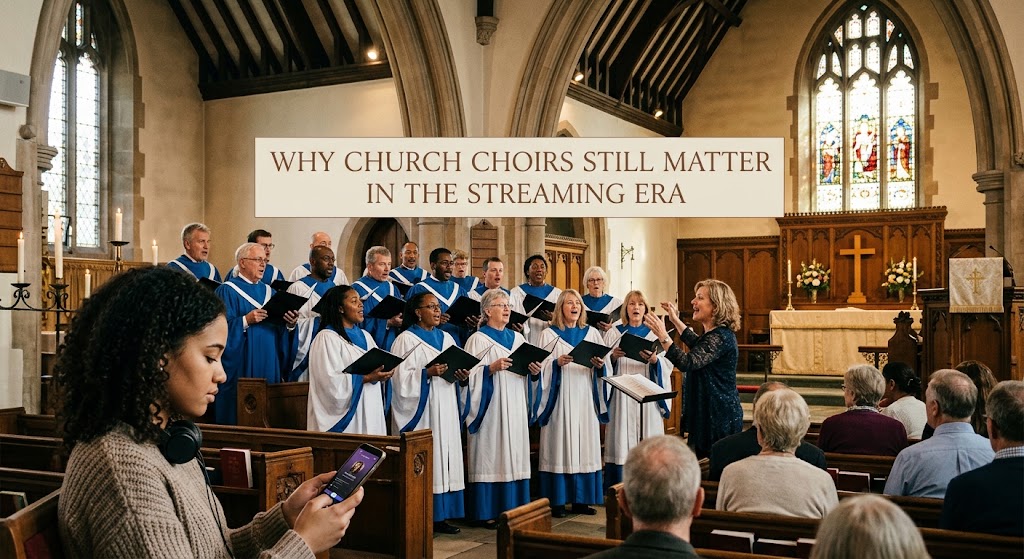
Why Church Choirs Still Matter in the Streaming Era
Why Church Choirs Still Matter in the Streaming Era
Why Church Choirs Still Matter in the Streaming Era is a question worth asking at a time when technology has completely transformed the way people discover, listen to and experience music. Today, you can open a smartphone and access millions of songs within seconds. Streaming platforms have made it possible to listen to worship music from almost anywhere in the world without waiting for a radio programme, buying a physical album or attending a church service. With professional solo artists, worship bands, producers and Christian music groups dominating digital platforms, it may seem as though the traditional church choir has become less important. But despite the rise of streaming, church choirs continue to play a unique and powerful role in Christian worship.
The truth is that a church choir is more than a group of people standing together and singing songs. It represents community, participation, discipline, tradition, spiritual expression and collective worship. While a recorded song can be listened to privately through headphones, a choir creates an experience that involves people physically, emotionally and spiritually. The difference is important because Christianity has never been built entirely around private consumption. There is a strong emphasis on gathering together, encouraging one another and worshipping collectively.
Streaming has changed music consumption, but it has not eliminated the human need for connection. In fact, the digital age may have made genuine human connection even more valuable. A person can spend hours listening to worship music alone without speaking to another believer. A church choir offers something completely different. It brings people into the same room, gives them a shared purpose and allows them to participate in something bigger than themselves. That sense of belonging is one of the major reasons why church choirs still matter in the streaming era.
One of the greatest strengths of a church choir is collective worship. When dozens of voices come together, the result is different from listening to a single vocalist through a pair of headphones. There is something powerful about hearing ordinary people use their voices together to express faith. The imperfections can sometimes make the experience even more meaningful. A choir does not necessarily need perfect vocal technique to create a powerful worship moment. What matters is the unity behind the voices.
Streaming platforms have encouraged people to become consumers of music. We choose an artist, select a song and listen whenever we want. There is nothing wrong with that. Christian music can be deeply encouraging when listened to privately. However, church choirs remind believers that worship is not simply something to consume. It is something to participate in. Instead of watching someone else worship, members of a choir are actively involved in creating the worship experience.
Church choirs also provide opportunities for people who may never become professional musicians. Not everyone who loves music wants to become a recording artist. Some people simply want to serve God with the gifts they have. A church choir gives them an opportunity to do exactly that. Someone with a beautiful voice can contribute. Someone with an average voice can also contribute. Someone who is learning music can improve through participation. In this sense, the choir becomes a place where musical gifts can be discovered and developed.
This is particularly important for young people. In a world where many young Christians are exposed to professional Christian artists through social media and streaming services, they can easily develop the impression that Christian music is something performed by celebrities on massive stages. Church choirs provide a different picture. They show young people that worship is not reserved for famous singers. You do not need millions of followers, a recording contract or a professionally produced music video to use your gift in worship.
Church choirs can also serve as training grounds for future Christian musicians. Many singers, musicians, worship leaders and songwriters begin their musical journeys in local churches. Choir participation teaches discipline, harmony, timing, listening skills and teamwork. It also teaches an important lesson that the modern music industry can sometimes overlook: music is not only about individual talent. It is also about learning how to work with other people.
The choir teaches singers to listen to one another. A soprano cannot simply sing as loudly as possible because she wants people to notice her. A tenor cannot ignore the bass section because he believes his part is more important. Everyone has a role. The strength of the overall sound depends on individuals understanding that they are part of something bigger. That lesson extends beyond music and can influence how people approach community, leadership and service.
Another reason why church choirs still matter in the streaming era is their ability to preserve Christian musical heritage. Music carries history. Songs passed from one generation to another often contain memories, theological ideas and cultural traditions. When older members of a congregation teach younger members songs they grew up singing, they are passing more than melodies to the next generation.
This is particularly visible in gospel music traditions across Africa. Choirs have played an enormous role in preserving indigenous musical styles, harmonies, rhythms and expressions of faith. In many African churches, the choir is not simply an optional musical department. It is part of the cultural identity of the congregation. Local languages, traditional rhythms and distinctive vocal arrangements can be incorporated into Christian worship in ways that might never appear on mainstream streaming playlists.
Streaming platforms have made global Christian music more accessible than ever, and that is a wonderful development. Someone in Nigeria can listen to a worship artist from the United States. Someone in Ghana can discover a gospel singer from South Africa. Someone in the United Kingdom can hear a Christian choir from Kenya. Digital technology has created an extraordinary global exchange of Christian music.
Yet this globalisation also makes local musical identity important. Church choirs can help communities maintain their own musical voices while still participating in the global Christian music conversation. A local choir singing in its indigenous language is not competing with an international worship artist. It is contributing something unique to the broader Christian music landscape.
Another important factor is emotional connection. There are certain moments in life when people do not simply want to listen to a perfectly produced recording. They want to hear familiar voices. They want to sing with people they know. They want to stand beside family members, friends and fellow believers. A choir can create memories that remain with people for years.
Think about someone who grew up attending church and remembers the choir singing during important family occasions. Perhaps it was a Christmas service, a wedding, a funeral, an Easter celebration or a special thanksgiving service. Years later, a particular song can bring back those memories instantly. That emotional connection is difficult for a streaming algorithm to reproduce.
This does not mean streaming music is less valuable. Quite the opposite. Streaming and church choirs can complement each other. A person may discover a worship song on a streaming platform and later hear that same song performed by their local choir. A choir may learn songs from international Christian artists and introduce them to a congregation. At the same time, a choir can record its own music and distribute it through streaming platforms, allowing its ministry to reach people far beyond the walls of the church.
This creates an opportunity for church choirs to embrace technology instead of fearing it. A choir does not have to choose between tradition and innovation. It can preserve its traditional role while using modern platforms to expand its reach. Churches can record choir performances, publish them online, create music videos, share rehearsal moments and distribute original songs through digital music platforms.
Social media can also help younger generations connect with church choirs. A short video of a powerful choir performance can reach thousands or even millions of people. A choir that once sang only to its local congregation can now potentially introduce its sound to an international audience. Technology has therefore not necessarily reduced the relevance of choirs. In some cases, it has given them opportunities they never had before.
There is also something important about the discipline required to participate in a choir. In an age of instant gratification, choir membership teaches patience. Members have to attend rehearsals, learn songs, practise difficult sections and sometimes repeat the same passage many times. They have to arrive on time and work with others. These lessons are valuable because meaningful results rarely happen instantly.
Streaming can make music look effortless. A listener hears the finished recording without seeing the hours of writing, rehearsal, recording, editing and production behind it. Choir members experience the process more directly. They understand that beautiful music requires preparation. That understanding can develop discipline that extends into other areas of life.
Church choirs also create a sense of responsibility. When you are part of a choir, other people depend on you. If one section is missing, the overall sound can change. This encourages members to take their commitments seriously. It can also build confidence in people who might otherwise struggle to find a place where they feel valued.
For some people, joining a choir may be one of the first ways they become deeply connected to a church community. They meet people, build friendships and discover opportunities to serve. A choir can therefore become more than a music department. It can become a community within a community.
There is also a spiritual dimension that should not be ignored. Christian music is not simply about sound. For believers, songs can communicate biblical truths, encourage faith and remind people of God’s promises. A choir that understands this responsibility can help reinforce the spiritual message of a church service.
However, church choirs must also be careful not to become overly focused on performance. The danger exists whenever music becomes more about impressing people than serving God. A choir can have excellent voices, beautiful uniforms, impressive choreography and sophisticated arrangements while losing sight of the purpose of worship.
The challenge for modern church choirs is therefore not simply to sound good. It is to remain spiritually meaningful while embracing excellence. There is nothing wrong with improving musical quality. There is nothing wrong with learning modern arrangements or using technology. The important question is whether those things support the message or distract from it.
This is another reason why church choirs still matter in the streaming era. They can remind the Christian music community that worship is not ultimately about numbers. It is not about streams, followers, views or chart positions. Those things can be useful indicators of reach, but they do not necessarily measure spiritual impact.
A song with ten million streams may encourage someone deeply, while a small church choir singing to fifty people may also change someone’s life. The size of the audience does not automatically determine the value of the ministry.
Church choirs also demonstrate that Christian music does not have to follow every trend. Trends change quickly. Musical styles evolve. What is popular today may disappear tomorrow. Choirs can adapt without losing their identity. They can incorporate contemporary sounds while maintaining the richness of group singing and congregational participation.
The future of church choirs will probably involve both physical and digital spaces. A choir may sing on Sunday morning and release a recording online later in the week. It may rehearse in person while using digital tools to share music sheets and practice recordings. It may perform traditional hymns in church while experimenting with contemporary arrangements for online audiences.
This combination could make church choirs even more relevant. Instead of viewing technology as the enemy, churches can use technology to amplify what already makes choir ministry special.
The most important thing to remember when considering Why Church Choirs Still Matter in the Streaming Era is that technology cannot replace community. A streaming platform can give you access to music, but it cannot fully reproduce the experience of standing beside other people and singing together. An algorithm can recommend a song, but it cannot replace the encouragement of a fellow choir member. Headphones can deliver beautiful harmonies, but they cannot completely reproduce the shared experience of creating those harmonies with people around you.
The streaming era has changed how Christian music is distributed, but it has not changed the fundamental human desire to belong, participate and express faith together. Church choirs continue to meet that need.
Perhaps the real question is not whether church choirs can survive the streaming era. It is whether churches are willing to give them the support, creativity and vision they need to thrive in it. Choirs that remain stuck in the past may struggle to connect with younger generations. Choirs that abandon their identity in an attempt to copy every online trend may lose what makes them special. The strongest choirs will likely be those that combine timeless Christian values with modern musical creativity.
Church choirs still matter because people still matter. They matter because worship is more than listening. They matter because community cannot be completely digitised. They matter because music carries memories and traditions. They matter because young people need places to discover and develop their gifts. They matter because local churches have stories and musical identities worth preserving. They matter because collective voices can communicate something that a solo voice sometimes cannot.
The streaming era has not made church choirs obsolete. It has simply given them a new environment in which to operate. The choir of the future may sing in a church building on Sunday morning, appear in a social media video on Monday, release a song on a streaming platform on Tuesday and reach listeners on another continent by Wednesday.
That is not the death of the church choir. It is an opportunity for reinvention.
As Christian music continues to evolve, there will always be room for professional artists, worship bands, solo singers, producers and digital creators. But there should also remain a place for ordinary believers standing shoulder to shoulder, lifting their voices together.
That is why church choirs still matter in the streaming era. They remind us that Christian music is not merely something we hear. It is something we can live, share and experience together. And no matter how advanced technology becomes, there will always be something powerful about a room full of people singing with one heart and one purpose.

Leave a Reply