
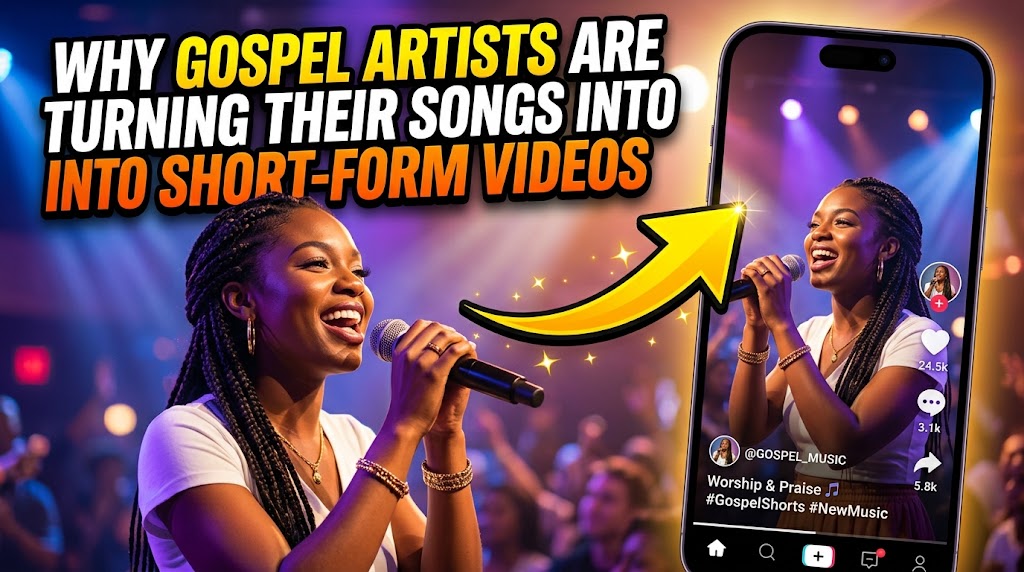
Why Gospel Artists Are Turning Their Songs Into Short-Form Videos
Why Gospel Artists Are Turning Their Songs Into Short-Form Videos
When I first started paying closer attention to how gospel music was being promoted online, I noticed something that was difficult to ignore. Gospel artists were no longer depending only on full music videos, album launches, radio interviews, church programmes and streaming platforms to get their songs heard. Increasingly, artists were taking a small portion of a song and turning it into a short video that could be watched in a few seconds. Why Gospel Artists Are Turning Their Songs Into Short-Form Videos.
At first, I thought it was simply another social media trend. You know how these things work. One platform introduces a new feature, everybody starts using it, and before long, the internet moves on to something else. But the more I observed gospel musicians, independent Christian artists, worship leaders and even established gospel music ministries, the more I realised that something bigger was happening.
This is one of the reasons why gospel artists are turning their songs into short form videos.
The change is not necessarily because gospel music has suddenly become less valuable in its traditional format. The opposite may actually be true. Gospel artists are discovering that short form video can help introduce their music to people who may never deliberately search for a new gospel song.
Think about the average person scrolling through social media. They may not wake up in the morning and say, “Today I am going to search for a new gospel artist.” They may simply open TikTok, Instagram Reels, YouTube Shorts or Facebook and begin scrolling. Within seconds, they encounter a song. The song catches their attention. They listen to the lyrics. Perhaps the lyrics describe exactly what they are experiencing. They stop scrolling.
That small moment can become the beginning of a relationship between the listener and the artist.
I have personally seen how powerful a short piece of content can be compared with simply telling people that a new song has been released. There is a major difference between saying, “My new song is out, please listen to it,” and actually giving somebody a 15 or 30 second experience of the song.
The first one asks for attention.
The second one earns attention.
That distinction is becoming increasingly important in gospel music promotion.
For many years, music promotion was heavily dependent on getting people to listen to the complete song. Artists would release a single and then spend weeks telling people to stream it. They would share links repeatedly. They would post the cover art. They might upload the official music video and wait for people to discover it.
Today, the journey can be completely different.
An artist can take the strongest line from a song and create a short video around it. Another artist can record a simple worship moment using the chorus. Someone else can create a relatable story that ends with the most powerful lyric from the song. A gospel musician can even use a short testimony to explain the experience that inspired the song before allowing the music to play.
Suddenly, the song is no longer just a song.
It becomes content.
And that is a significant shift.
When I look at why gospel artists are turning their songs into short form videos, one of the biggest reasons is simply attention. People’s attention is constantly being competed for online. Gospel music is not being promoted in an empty environment. Gospel artists are competing for attention alongside comedians, influencers, football clips, news, motivational speakers, lifestyle creators, businesses, celebrities and millions of other videos.
That does not mean gospel artists have to compromise their message.
It means they have to understand the environment in which their message is being delivered.
There is nothing inherently wrong with taking a powerful Christian message and presenting it in a format people already consume. In fact, Jesus Himself often communicated profound truths through stories, examples and memorable statements that people could understand and remember.
Short form video works in a similar way.
The format may be short, but the message does not have to be shallow.
A 20 second video can contain a lyric that someone remembers for the entire day. A 30 second worship clip can encourage someone who is struggling. A short testimony can remind someone that they are not alone. A simple video showing an artist singing a meaningful chorus can introduce the artist to thousands of potential listeners.
This is another reason why gospel artists are turning their songs into short form videos. They are discovering that people do not always need the entire song before they become interested in the entire song.
Sometimes they only need a reason to press play.
The short form video becomes that reason.
Another important factor is discoverability. A full song uploaded to a streaming platform is usually competing within a massive catalogue of music. There are millions of songs available across the major music platforms. Even a beautiful gospel song can remain largely undiscovered if nobody encounters it.
Short form platforms provide another discovery path.
A person may hear a song without knowing the artist’s name. They may hear the chorus in a video created by the artist. They may hear somebody else using the sound. They may save the video. They may visit the artist’s profile. They may search for the complete song later.
That journey is extremely valuable.
I have come to see short form video as a bridge between an artist and an audience. It does not necessarily replace the complete song. It can actually help people find the complete song.
This is particularly important for upcoming gospel artists.
An established artist may already have an audience waiting for a new release. An upcoming artist may have nothing except a song, a phone and a desire to reach people.
That artist cannot always afford an expensive music video.
But they may be able to create several short videos using the same song.
This changes the economics of music promotion.
Instead of thinking that promotion requires one expensive video, an artist can think in terms of multiple pieces of content. One song can produce a lyric video. It can produce a performance clip. It can produce a testimony. It can produce a behind the scenes video. It can produce a story about why the song was written. It can produce a question based on the song’s message. It can produce a worship moment. It can produce a short prayer connected to the lyrics.
Suddenly, one song has become a content library.
That is one of the smartest things I have noticed about the modern gospel music space.
Artists are beginning to understand that creating a song and promoting a song are two different responsibilities.
You can write an excellent song and still have nobody hear it.
You can record a powerful worship song and still have the internet behave as if nothing happened.
The quality of the music matters, but distribution matters too.
This is where short form video becomes particularly interesting.
Another reason why gospel artists are turning their songs into short form videos is emotional connection. Music has always been emotional, but video gives artists another layer through which they can communicate.
Imagine hearing a gospel song about God’s faithfulness while watching the artist sitting quietly in a room explaining the difficult season that inspired the song. The listener is no longer only hearing music. They are receiving context.
That context can make the song feel more personal.
I have noticed that people often connect with stories before they connect with products. Music is not a traditional product, but the principle still applies. When people understand why a song exists, they may become more interested in listening to it.
This is why a gospel artist can say something as simple as, “I wrote this song after one of the most difficult seasons of my life,” before playing the chorus.
That one sentence creates curiosity.
People want to hear the song.
They want to know the story.
They want to understand the lyrics.
And sometimes, they see themselves in the story.
Short form video also makes audience participation easier. A gospel artist can ask people to share the lyric that encouraged them most. They can ask listeners to use a particular portion of the song in their own videos. They can invite people to share testimonies connected to the message.
This turns music promotion into conversation.
That is very different from simply posting a flyer announcing that a song has been released.
A flyer communicates information.
A conversation creates engagement.
There is also the issue of repetition. In traditional music promotion, an artist might feel uncomfortable promoting the same song repeatedly. They may think, “I already posted this song yesterday.”
But online audiences do not necessarily see everything you post.
Even if an artist posts eight pieces of content around the same song, different people may encounter different pieces. One person may see the testimony. Another may see the chorus. Someone else may see the behind the scenes clip. Another person may discover the song through a listener’s video.
The song therefore gets multiple opportunities to be discovered.
This is another reason why gospel artists are turning their songs into short form videos. They are realising that one release does not have to mean one announcement.
A song can have a campaign.
That campaign can continue for weeks.
It can even continue months after the initial release.
One of the things I find particularly interesting is that short form video allows gospel artists to humanise themselves. People may know the artist as a singer, but they may not know the person behind the music.
A short video can show personality.
It can show humour.
It can show vulnerability.
It can show the artist praying, rehearsing, writing, travelling, recording or simply talking about life.
When audiences begin to know the person behind the music, the music can become more meaningful to them.
However, I also think gospel artists need to be careful about chasing trends simply because they are popular.
There is a difference between using a modern content format and changing the identity of your ministry to fit every internet trend.
The goal should not be to make gospel music indistinguishable from every other form of online content. The goal should be to communicate the message effectively within the digital environment where people already spend their time.
Authenticity matters.
If an artist is naturally energetic, let the videos reflect that personality. If an artist is calm and reflective, there is no need to pretend to be a comedian simply because comedy videos receive attention. If the song is deeply worshipful, a sincere worship moment may communicate more effectively than an artificial attempt to create virality.
Short form video should serve the music, not destroy its identity.
There is another lesson here that extends beyond gospel music.
Having a great product is not enough.
You need to know how to introduce that product to people.
A website can be excellent, but if nobody knows it exists, its quality will not automatically create traffic. A business can have an excellent service, but if potential customers never encounter the business, they cannot buy. In the same way, an artist can have a powerful song, but if people never encounter the song, they cannot listen to it.
Short form video gives gospel artists another doorway.
And the interesting thing is that the doorway does not have to be expensive.
A smartphone, reasonable lighting, clear audio and a good idea can sometimes be enough to create a useful piece of content.
Of course, professional production still has value. Music videos can tell stories that short clips cannot. High quality visuals can strengthen an artist’s brand. Professional photography, cinematography and production design all have their place.
But the rise of short form content means artists no longer have to wait until they have a massive budget before they begin promoting their music creatively.
They can start with what they have.
That may be one of the most important lessons for upcoming gospel artists.
Do not confuse a lack of resources with a lack of opportunity.
Sometimes the biggest problem is not that an artist lacks money. It is that the artist has not yet discovered how to turn the resources already available into content.
A phone can record.
A song can tell a story.
A lyric can create a conversation.
A testimony can create connection.
A short video can create curiosity.
And curiosity can lead someone to the complete song.
This explains why gospel artists are turning their songs into short form videos. It is not simply because everyone else is doing it. It is because the way people discover music has changed.
People are discovering songs while scrolling.
They are discovering artists through stories.
They are discovering worship moments through short clips.
They are discovering lyrics through videos.
They are sharing sounds with friends.
They are creating their own videos around songs they like.
The modern music journey can therefore begin with a 20 second clip and end with someone listening to the complete song repeatedly.
For gospel artists, this creates an enormous opportunity.
The challenge is to use that opportunity wisely.
Instead of asking only, “How can I make people listen to my song?” an artist can start asking, “How can I create moments around this song that people will want to experience and share?”
That is a much bigger question.
A song about God’s faithfulness could become a series of testimonies.
A song about waiting could inspire people to share what they are believing God for.
A worship song could become a daily worship series.
A song about overcoming difficult seasons could be accompanied by the artist’s personal story.
A song about gratitude could inspire people to share what they are thankful for.
The music becomes the foundation, while the short form videos become different doors into the message.
That is why I do not think the rise of short form video means the end of traditional gospel music promotion. I see it more as an expansion.
The full song still matters.
The album still matters.
The official music video still matters.
Streaming still matters.
Live performances still matter.
Church ministry still matters.
But now there is another layer.
The short form video.
For gospel artists willing to understand this environment, the opportunity is not simply to chase views. It is to use short videos to communicate messages, build communities, introduce songs and create genuine connections with listeners.
And perhaps that is the most important thing to remember.
A viral video is not the final destination.
The real opportunity is what happens after somebody stops scrolling.
They hear the lyric.
They connect with the message.
They discover the artist.
They listen to the full song.
They share it with someone else.
They return to it when they need encouragement.
And eventually, the song becomes more than another piece of content on their screen.
It becomes part of their life.
That is the real potential behind why gospel artists are turning their songs into short form videos. The format may be short, but the impact does not necessarily have to be.
In a digital world where attention is increasingly difficult to capture, gospel artists have an opportunity to take timeless messages and introduce them through modern channels without losing the heart of the message.
The technology has changed.
The platforms have changed.
The way people discover music has changed.
But the power of a meaningful song to connect with a human being remains.
The question for every gospel artist is no longer simply whether short form video is worth trying.
The bigger question is what they can creatively do with the few seconds they have been given.

Leave a Reply