
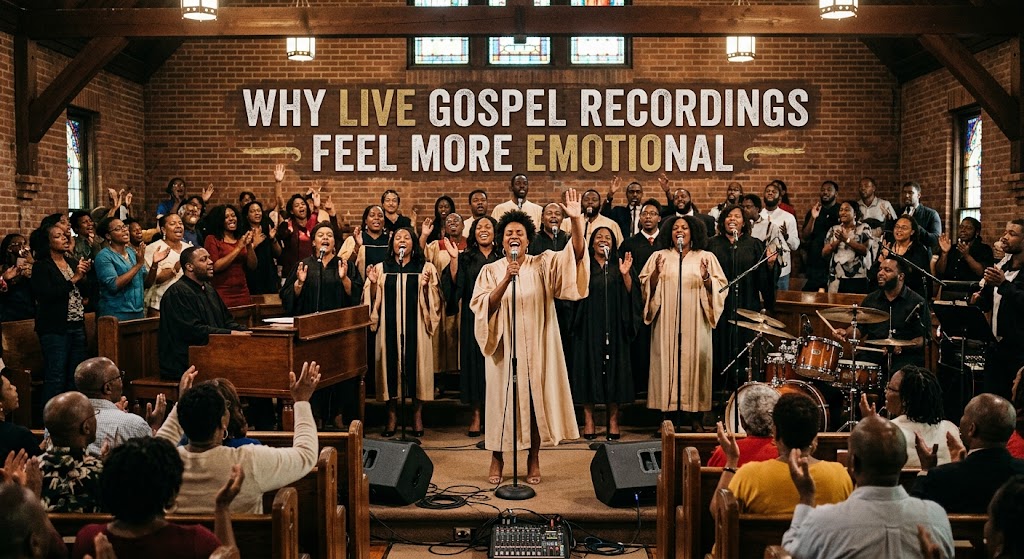
Why Live Gospel Recordings Feel More Emotional
Why Live Gospel Recordings Feel More Emotional
Why Live Gospel Recordings Feel More Emotional is a question many gospel music lovers have probably asked themselves after listening to a powerful live worship session. There is something about hearing a gospel song performed in front of a real audience that can make the music feel deeper, warmer and more personal. Sometimes a song that sounds good on a studio album can feel completely different when the same artist performs it live. The vocals may not be perfectly polished, the crowd may sing loudly in the background, and the musicians may make small changes to the arrangement, yet the experience can become far more moving.
Live gospel recordings have a unique ability to capture moments that cannot always be recreated inside a recording studio. They preserve the atmosphere, reactions, imperfections and spiritual intensity of a gathering. Instead of hearing only the finished musical product, listeners get a sense that they are participating in something happening in real time. That feeling of presence is one of the biggest reasons live gospel recordings can feel so emotional.
One important reason why live gospel recordings feel more emotional is the presence of an audience. Gospel music is deeply connected to communal worship, and the response of a congregation can dramatically change the emotional energy of a performance. When hundreds or thousands of people sing the same words together, the sound becomes much larger than the lead singer’s voice. The audience becomes part of the recording.
Imagine listening to a worship song where the singer pauses and the entire congregation continues singing the chorus. That moment can be incredibly powerful. The artist is no longer carrying the song alone. The crowd takes over, creating a collective expression of faith. Even someone listening through headphones can feel the magnitude of that moment.
This communal element is particularly important in gospel music because many gospel songs are designed to be experienced together. Call and response, repeated choruses, spontaneous singing and congregational participation are all traditions that encourage people to become active participants rather than passive listeners. A live recording captures these interactions in a way that a carefully controlled studio session often cannot.
Another reason live gospel recordings feel more emotional is the natural vulnerability of the performer. In a studio, artists have the opportunity to record the same vocal line multiple times, correct mistakes, adjust timing and select the strongest performance. Modern production technology can make vocals sound incredibly clean and precise. While this can create an impressive recording, perfection can sometimes remove some of the vulnerability that makes music emotionally relatable.
During a live performance, the singer has only one opportunity to deliver that particular moment. The voice may crack. A note may be slightly imperfect. The singer may become emotional and pause. The audience may respond unexpectedly. These moments can make the performance feel human.
Those imperfections are not necessarily weaknesses. In many cases, they are exactly what makes a live gospel recording powerful. When listeners hear a singer struggling to hold back tears while singing about God’s faithfulness, they are hearing genuine emotion rather than simply hearing a technically perfect vocal performance.
There is also something special about knowing that a live recording captured a moment that happened only once. A studio recording can be reproduced thousands of times in exactly the same way. A live performance is different. The atmosphere of that particular night, the audience response, the artist’s emotions and the musical improvisations combine to create something unique.
That sense of uniqueness can make listeners pay closer attention. They know they are hearing a particular moment in time. A singer may extend a chorus for several minutes, introduce an unexpected melody or speak directly to the congregation. The musicians may follow the singer’s direction and create an arrangement that was never planned exactly that way.
Spontaneity is another major factor behind the emotional power of live gospel recordings. Gospel music has a strong tradition of spontaneous worship, and live performances provide space for artists to move beyond the original arrangement. A song that lasts four minutes in the studio might become ten or fifteen minutes on stage because the worship atmosphere continues to build.
The singer may repeat a particular line because it connects strongly with the audience. The keyboardist may introduce a new chord progression. The drummer may gradually increase the intensity. Background singers may repeat a response. The congregation may begin singing independently. All of these elements can create an emotional journey.
This spontaneity makes listeners feel as though something is unfolding rather than simply being played back. That distinction matters. People naturally respond to moments that appear unpredictable. When a performance develops organically, the listener may become more emotionally invested because they do not know exactly what will happen next.
The musicians also contribute significantly to the emotional quality of a live gospel recording. Live bands often respond directly to the energy of the singer and congregation. Instead of simply reproducing a predetermined arrangement, musicians can adjust their playing according to what is happening in the room.
A drummer might become more restrained during a quiet prayerful moment and then increase the intensity when the congregation begins celebrating. A keyboard player may add subtle musical phrases that respond to the singer. Guitarists, bassists, percussionists and backing vocalists can all contribute to the changing atmosphere.
This interaction between musicians and performers gives live recordings a sense of movement. The music breathes. It rises, falls, pauses and builds. The listener can sometimes sense the musicians reacting to the moment, and that reaction can make the recording feel alive.
The physical environment also matters. Studio recordings are generally created in controlled acoustic spaces where engineers carefully manage every aspect of the sound. Live recordings capture the natural acoustics of churches, auditoriums, outdoor venues and large worship gatherings.
The sound of people singing in a large room can create a powerful sense of scale. Voices bounce from walls and ceilings, producing natural reverberation. When the congregation sings loudly, the room itself seems to become part of the instrument.
This is one reason headphones can make live gospel recordings particularly immersive. You may hear the lead vocalist clearly in the centre while crowd vocals surround the performance. You may hear someone in the audience shouting encouragement or singing slightly away from the microphone. You may even hear applause, laughter or emotional reactions.
Those sounds provide context. They remind the listener that the music is not being created in isolation.
Another powerful element is emotional contagion. Human beings naturally respond to the emotions expressed by other people. When we hear a crowd cheering, crying, singing passionately or responding enthusiastically, those reactions can influence how we experience the music ourselves.
This is particularly noticeable in gospel music because the lyrics often address deeply personal subjects such as faith, hope, forgiveness, suffering, restoration, gratitude and God’s presence. When a congregation responds emotionally to those themes, listeners can become emotionally engaged as well.
A live recording can therefore create a shared emotional experience even when the listener is physically far away from the original event. Someone listening in their bedroom, car or office may feel connected to people who were standing in a church or concert venue thousands of kilometres away.
The emotional delivery of the vocalist is another major factor. Gospel singers often use vocal techniques that communicate intensity, vulnerability and conviction. They may move between soft singing and powerful declarations. They may hold notes longer, improvise melodies or speak between lines.
In a live setting, these techniques can become even more expressive because the singer is responding to the audience. A vocalist may hear the crowd singing and decide to repeat a phrase. They may become emotional because of the response. They may change the melody because the atmosphere calls for it.
These spontaneous choices can make the listener feel that the singer is not simply performing a song but experiencing the message personally.
Lyrics also play a major role in the emotional power of live gospel recordings. Many gospel songs tell stories of struggle and victory. They speak about moments when people felt abandoned but found hope, experienced difficulty but continued believing, or faced uncertainty while trusting God.
When such lyrics are performed live, listeners may connect them with their own experiences. A person going through financial difficulties may hear a song about God’s provision differently from someone who is celebrating a new opportunity. Someone grieving may hear lyrics about God’s comfort differently from someone enjoying a season of happiness.
The same song can therefore become emotionally different depending on the listener’s circumstances.
Live gospel recordings can also feel more emotional because they often create anticipation. A performer may begin quietly, allowing the audience to settle into the song. The music gradually builds. The chorus becomes louder. The congregation joins in. The musicians increase the intensity. Eventually, the entire room may be singing together.
This gradual build creates emotional tension and release. Music has always been capable of influencing human emotions through rhythm, harmony, dynamics and repetition, but live gospel performances often combine these musical elements with human participation.
Repetition is particularly important. In many gospel and worship performances, a simple phrase may be repeated several times. At first, it may sound like an ordinary lyric. After several repetitions, however, the phrase can take on greater emotional meaning because the audience begins singing it collectively.
The repetition allows listeners to stop analysing the music and simply experience it.
Another reason live gospel recordings feel more emotional is the connection between music and personal testimony. Gospel artists sometimes share stories before or during a performance. They may explain why a song was written, describe something they experienced or encourage people facing difficult circumstances.
When listeners understand the story behind the song, the lyrics can become more meaningful. A song about overcoming hardship sounds different when the artist explains that the words were written during one of the darkest periods of their life.
The audience’s reaction to these stories can also become part of the recording. Applause, shouting, silence and emotional responses can create moments that feel deeply personal.
Live gospel recordings also preserve the spiritual atmosphere of a gathering. While the spiritual experience of worship is personal and cannot be measured simply through audio, the communal atmosphere surrounding a worship event can certainly affect how a recording feels.
A studio recording can reproduce the melody, lyrics and instrumentation, but it cannot perfectly reproduce the experience of standing among hundreds or thousands of people singing together. Live recordings come closer because they preserve some of the sounds and interactions associated with that environment.
This does not mean studio gospel recordings are less meaningful. Studio recordings have their own strengths. Artists can spend more time refining arrangements, experimenting with sounds and producing extremely polished performances. Some songs require that level of precision.
The difference is that studio recordings often focus on musical perfection, while live recordings can place greater emphasis on experience.
That distinction explains why some listeners prefer live versions of songs they already know. They are not necessarily choosing the live recording because it has better production. They are choosing it because it feels more personal.
There is also an element of nostalgia associated with live gospel recordings. People may associate a particular live performance with a church service, concert, conference or significant period in their lives. Hearing the recording years later can bring those memories back.
Music is strongly connected to memory. A song can remind someone of where they were, who they were with and what they were feeling at a particular moment. Live gospel music can make those memories even stronger because the recording itself contains sounds of a crowd and a specific environment.
Technology has also changed the way listeners experience live gospel music. Streaming platforms have made it easier for people around the world to discover performances they could never have attended physically. A worship event in Lagos can be heard by someone in London. A gospel concert in Atlanta can reach listeners in Accra. A church performance in Johannesburg can inspire someone in another country.
This global accessibility has expanded the reach of live gospel music and allowed emotional worship experiences to travel across geographical boundaries.
Social media has strengthened this trend. Short clips from live gospel performances can spread rapidly when they capture an especially powerful vocal moment, unexpected audience reaction or spontaneous worship session. People may discover an artist through a thirty second clip and then search for the full performance.
This demonstrates that emotional authenticity can be a powerful form of music discovery.
Another interesting factor is audience participation through singing. When listeners hear a congregation singing words they already know, they may instinctively sing along themselves. This changes the listening experience from passive consumption to participation.
Someone listening alone can suddenly feel as though they are part of the gathering. They may raise their voice, clap their hands or simply become emotionally still while listening.
This participatory quality is one of the defining strengths of gospel music.
Live gospel recordings also remind listeners that worship is not always neat or predictable. There may be moments of silence, laughter, spontaneous prayer, extended singing or unexpected musical changes. These moments can make the recording feel authentic because they reflect the unpredictability of real human gatherings.
In an age where so much digital content is carefully edited and presented, authenticity has become increasingly valuable. People are often drawn to moments that feel genuine rather than manufactured. A live gospel recording can provide that sense of authenticity through its imperfections and spontaneous reactions.
Ultimately, Why Live Gospel Recordings Feel More Emotional comes down to the combination of music, people, atmosphere, vulnerability, spontaneity and shared experience. A live gospel recording does not simply preserve a song. It preserves a moment.
It captures the singer’s voice, the musicians’ response, the congregation’s energy, the acoustics of the room and the emotional journey taking place at that particular time. These elements combine to create an experience that can feel more intimate and powerful than a perfectly polished studio recording.
Perhaps the most beautiful thing about live gospel music is that it reminds us that music is not only about sound. It is also about connection. A song can carry someone’s testimony. A chorus can become a congregation’s prayer. A melody can remind someone of a difficult season they survived. A simple lyric can become the words someone needed to hear at exactly the right moment.
That is why a live gospel recording can sometimes make you stop what you are doing, close your eyes and listen differently.
The next time you hear a live gospel performance that moves you deeply, pay attention to what is happening beyond the lead vocal. Listen to the congregation. Notice the pauses. Hear the musicians responding to one another. Pay attention to the emotion in the singer’s voice. Notice how the atmosphere changes as the song develops.
You may discover that what makes the recording emotional is not one single element. It is the combination of many small human moments happening at the same time.
And perhaps that is the real power of live gospel music. It does not have to be perfect to be powerful. Sometimes the cracked voice, the unexpected pause, the loud congregation and the spontaneous chorus are exactly what make the moment unforgettable.
Live gospel recordings feel more emotional because they allow us to hear not only the song, but also the people behind the song. They capture worship as an experience rather than simply presenting music as a finished product. They remind listeners that faith can be expressed through voices, instruments, stories, tears, celebration and collective hope.
In a world increasingly filled with polished digital content, there is something deeply refreshing about hearing people simply come together and sing. The imperfections make it human. The participation makes it communal. The message makes it meaningful. And the moment makes it memorable.
That is why the best live gospel recordings often stay with listeners long after the final note has disappeared.

Leave a Reply