
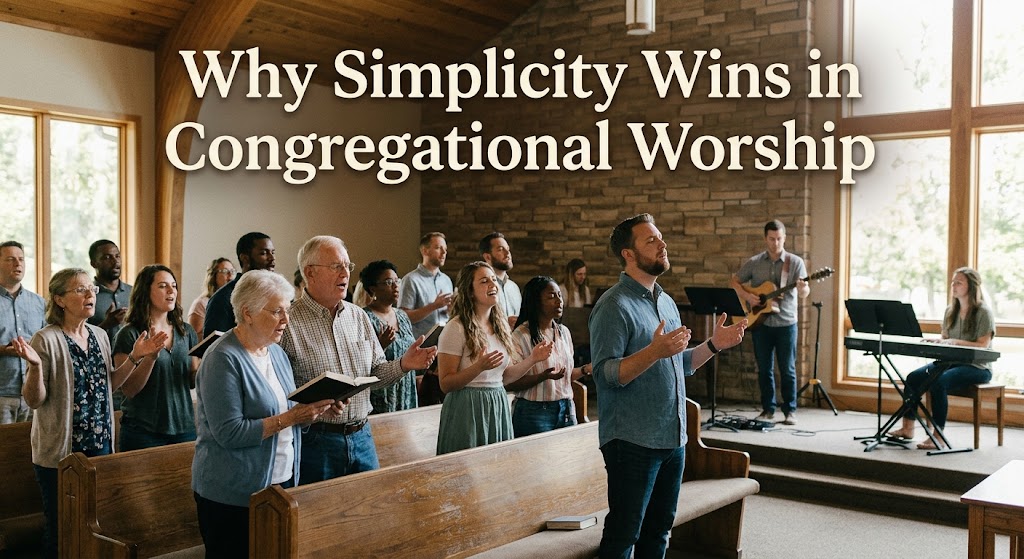
Why Simplicity Wins in Congregational Worship
Why Simplicity Wins in Congregational Worship
In a world where bigger often seems better, it is easy for churches to assume that worship must become increasingly sophisticated to remain relevant and engaging. Modern technology has made it possible to create worship experiences with professional lighting, advanced sound systems, elaborate stage designs, backing tracks, visual effects, and highly polished musical arrangements. While none of these things are inherently wrong, an important question remains: does complexity actually help congregational worship, or can it sometimes become a barrier to participation? This question leads us directly to the heart of why simplicity wins in congregational worship.
The primary purpose of congregational worship is not to showcase musical excellence or creative innovation. The goal is to unite believers in glorifying God together. Corporate worship is unique because it is not a performance delivered by a few people while everyone else watches. Instead, it is a collective act of praise where every voice matters. When simplicity is embraced, worship becomes more accessible, more inclusive, and more focused on God rather than on the mechanics of the service itself. This is one of the strongest reasons why simplicity wins in congregational worship.
Throughout church history, some of the most enduring worship songs have been remarkably simple. Whether one considers ancient hymns, traditional gospel songs, or modern worship choruses, the songs that survive for generations tend to be those that ordinary people can remember, sing, and carry with them throughout life. Simplicity creates familiarity. Familiarity creates participation. Participation strengthens community. The result is a worship environment where the congregation becomes actively involved rather than passively engaged.
One of the greatest strengths of simple worship is accessibility. A congregation is made up of people from different backgrounds, educational levels, age groups, and musical abilities. Some members may be trained musicians while others may struggle to carry a tune. Some may be new believers attending church for the first time, while others may have decades of Christian experience. Worship that relies heavily on complicated melodies, unusual rhythms, or intricate arrangements can unintentionally exclude many people. Simplicity removes these barriers and allows everyone to participate with confidence. Studies and observations from worship leaders consistently highlight that songs with clear melodies, predictable phrasing, and comfortable vocal ranges encourage greater congregational singing.
Another reason why simplicity wins in congregational worship is that it keeps the congregation at the centre of the experience. In healthy worship settings, the platform exists to support the people, not the other way around. Worship leaders, musicians, and vocalists are not the main attraction. Their role is to help the congregation express praise to God. When arrangements become overly complex, attention can gradually shift from participation to observation. People begin listening instead of singing. They become spectators rather than contributors. Simplicity helps preserve the original purpose of corporate worship by ensuring that the focus remains on collective praise.
Simple worship also encourages unity. There is something profoundly powerful about hundreds of voices singing together in harmony. The beauty of congregational worship is not found in perfection but in participation. When a church sings a simple and meaningful song together, social distinctions begin to fade. Young and old, rich and poor, experienced believers and new converts all join in a common expression of faith. Simplicity creates a shared experience that strengthens the sense of belonging within the church community.
The effectiveness of simple worship can also be understood from a psychological perspective. Human beings naturally remember things that are easy to repeat. Simple melodies remain in the mind long after a service ends. Straightforward lyrics are easier to recall during difficult moments of life. A worship song that can be remembered on a hospital bed, during a personal crisis, or in a moment of private prayer has far greater long term value than a technically impressive composition that is forgotten by the next day. The songs that often make the deepest spiritual impact are not necessarily the most sophisticated but the most memorable.
This explains why repetition is commonly used in congregational worship. While some critics argue that repeated phrases are unnecessary, repetition serves an important purpose. Repetition reinforces truth. It allows worshippers to move beyond merely understanding words intellectually and begin experiencing them emotionally and spiritually. Simple repeated declarations about God’s faithfulness, love, mercy, and power can become deeply rooted in the hearts of believers. The effectiveness of these songs often lies in their simplicity rather than their complexity.
Why simplicity wins in congregational worship can also be seen in the way it supports spiritual focus. Worship should direct attention toward God. When music becomes overly complicated, people can become distracted by technical details. They may focus on difficult melodies, unusual chord changes, or elaborate instrumental performances. Simplicity allows worshippers to engage with the message rather than struggle with the mechanics. Many worship leaders have observed that simpler arrangements create more room for genuine engagement because people are not preoccupied with following complicated musical structures.
There is also a practical advantage to simple worship. Not every church has access to professional musicians, expensive equipment, or large worship teams. Many congregations around the world meet in modest buildings, homes, schools, community centres, or temporary locations. Simple worship allows these churches to thrive regardless of their resources. A congregation does not need a sophisticated production to worship effectively. A few voices singing meaningful songs can be just as powerful as a large professionally produced service. This reality demonstrates that the power of worship comes from the presence of God and the participation of His people rather than from external enhancements.
Simplicity also creates flexibility. Churches that rely heavily on technology may face challenges when equipment fails or circumstances change. In contrast, a congregation that embraces simple worship can continue seamlessly under almost any conditions. Worship becomes less dependent on external factors and more dependent on the hearts of the people involved. This resilience has allowed Christian worship to flourish throughout history in prisons, homes, fields, catacombs, and remote villages where resources were limited but faith remained strong.
The history of Christian worship further supports the idea that simplicity wins in congregational worship. Many influential church traditions intentionally emphasised simple and accessible music. Their goal was not to create artistic masterpieces for a select audience but to enable entire congregations to participate. Historical movements that prioritised congregational singing often used melodies that were easy to learn and remember because they understood that accessibility encourages engagement.
Simple worship also leaves room for authenticity. When people are not concerned about keeping up with complex musical arrangements, they are more likely to engage sincerely with the words they are singing. Authentic worship is not measured by the sophistication of the music but by the sincerity of the heart. Simplicity often creates an environment where worshippers feel free to express genuine gratitude, repentance, joy, and devotion without feeling pressured by performance expectations.
Another compelling reason why simplicity wins in congregational worship is its ability to transcend cultural and generational differences. Musical tastes vary significantly between age groups and communities. What one generation considers inspiring, another may find unfamiliar. However, simple melodies, straightforward lyrics, and clear biblical themes tend to connect with people across diverse backgrounds. Simplicity creates common ground where different generations can worship together without becoming divided by stylistic preferences.
Modern trends are increasingly recognising the value of simplicity. Many younger worship leaders are intentionally moving away from highly produced services and rediscovering the power of participatory worship. They are finding that a room filled with voices singing together often creates a more meaningful experience than a perfectly executed production. Participation is becoming a key measure of effectiveness because worship is ultimately about engaging the congregation rather than impressing an audience.
The importance of simple language should not be overlooked either. Just as simple melodies encourage participation, simple lyrics improve understanding. Worship songs should communicate profound truths in ways that ordinary people can grasp and remember. Simplicity does not mean shallowness. In fact, some of the deepest theological truths are often expressed through remarkably simple words. Great worship songs combine depth with clarity, allowing believers to reflect on profound spiritual realities without becoming overwhelmed by complicated language.
Simplicity also protects worship from becoming overly dependent on trends. Musical styles change constantly. What sounds modern today may feel outdated in a decade. Churches that build their worship primarily around current trends may find themselves continually chasing the next innovation. Simple worship, however, possesses a timeless quality. Because it focuses on participation and truth rather than novelty, it remains relevant across changing cultural landscapes.
Furthermore, simple worship creates opportunities for discipleship. Songs that are easy to remember can be carried into daily life. People can sing them during personal devotion, family prayer, work, travel, and times of hardship. In this way, worship extends beyond the church service and becomes part of everyday spiritual formation. The most effective congregational songs often become lifelong companions because their simplicity makes them accessible in every season of life.
None of this suggests that excellence should be abandoned. Simplicity is not the same as carelessness. Effective simple worship requires thoughtful planning, intentional leadership, and a commitment to serving the congregation. Creating something simple is often more challenging than creating something complex. The goal is not to remove quality but to remove unnecessary obstacles that hinder participation. True simplicity combines excellence with accessibility.
Ultimately, why simplicity wins in congregational worship comes down to one fundamental truth. Worship is about people collectively responding to God. The more barriers that are removed between the congregation and that response, the more effective worship becomes. Simplicity enables participation. Simplicity encourages unity. Simplicity strengthens memory. Simplicity promotes authenticity. Simplicity supports spiritual focus. Simplicity allows churches of every size and resource level to engage meaningfully in praise.
When congregational worship is simple, people are free to lift their voices without hesitation, focus their hearts without distraction, and unite their faith without barriers. In a culture that often equates complexity with value, the church is reminded that the most powerful worship experiences are not always the most elaborate. Sometimes the greatest moments occur when ordinary believers sing timeless truths together with sincere hearts. That is why simplicity wins in congregational worship, and why it will continue to remain one of the most effective foundations for meaningful corporate praise for generations to come.

Leave a Reply