
Why Some Christian Songs Connect With People Outside the Church
Why Some Christian Songs Connect With People Outside the Church
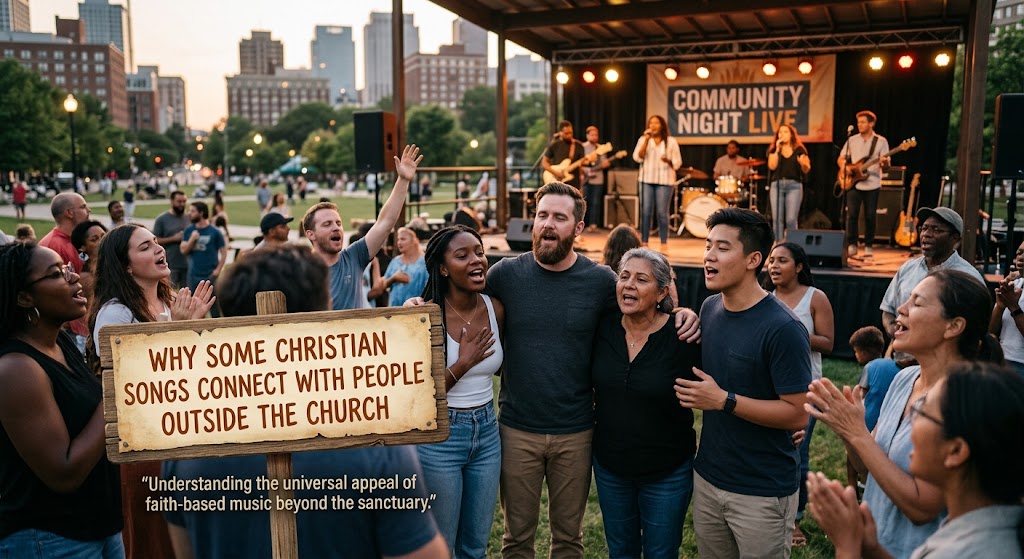
Why Some Christian Songs Connect With People Outside the Church is a question worth exploring because some Christian songs reach far beyond church buildings, Sunday services, and people who already identify as believers. You can hear a gospel song playing in a taxi, a Christian song appearing on someone’s social media video, or a worship song being shared by someone who rarely attends church. Sometimes the listener may not even consider themselves religious, yet something about the song captures their attention.
This raises an interesting question. What makes a Christian song connect with someone who may not share the faith behind the music?
The answer is not always complicated. Music has a unique ability to communicate emotions before people fully understand the words. A song can speak about heartbreak, hope, loneliness, forgiveness, fear, love, failure, gratitude, or the desire for a better tomorrow. These are human experiences, not experiences reserved for Christians. A person does not need to attend church to understand what it feels like to be broken, disappointed, hopeful, afraid, or desperate for another chance.
This is one of the biggest reasons why some Christian songs connect with people outside the church. They speak about universal human experiences through the language of faith.
Imagine someone going through a painful season. Perhaps they have lost a loved one, experienced a failed relationship, lost a job, disappointed their family, or simply reached a point where they do not know what to do next. When that person hears a Christian song about finding hope in the middle of darkness, they may connect with the emotion before they even consider the religious message.
The song has met them where they are.
That is the power of meaningful music.
Christian music has always had the potential to communicate beyond the walls of the church. At its strongest, it does not merely tell people what to believe. It tells stories about what it means to struggle, believe, fall, rise, forgive, wait, hope, and continue.
These experiences belong to everyone.
Another reason why some Christian songs connect with people outside the church is authenticity. People can often recognise when an artist genuinely feels what they are singing. A technically perfect vocal performance may impress someone, but an emotionally honest performance can move them.
There is a difference between singing a song and communicating a personal experience through a song.
When a Christian artist sings about God’s faithfulness after surviving a difficult season, the listener may hear more than religious words. They may hear the voice of someone who has experienced pain and found a reason to continue. That story can resonate even with someone who has different beliefs.
Authenticity creates a bridge.
People may disagree about theology, but they can still recognise genuine emotion.
This is particularly important in today’s music environment, where audiences are constantly exposed to polished content. Social media has made it possible for almost anyone to produce music, promote themselves, and reach thousands of people. As a result, listeners have become increasingly sensitive to what feels genuine and what feels manufactured.
A Christian song that sounds honest can stand out.
Lyrics also play a major role in explaining why some Christian songs connect with people outside the church. Great songwriting does not simply use religious vocabulary. It paints pictures of human experiences.
Consider the difference between telling someone that God is faithful and describing what it feels like to wake up after a night of uncertainty and still find the strength to keep going. Both communicate faith, but the second approach creates an emotional picture.
People remember pictures.
They remember stories.
They remember emotions.
They remember songs that gave words to something they could not explain themselves.
This is why a powerful Christian song can reach someone who was not necessarily looking for Christian music. The listener may not search for a worship song, but they may search for hope. They may not search for gospel music, but they may search for encouragement. They may not search for a song about God, but they may search for something that helps them survive a difficult night.
Sometimes the song finds the listener before the listener finds the faith behind it.
Another important factor is melody. Before people understand lyrics, they experience sound. A beautiful melody can immediately create an emotional response. A powerful vocal performance can make someone stop scrolling. A memorable chorus can stay in someone’s head long after the song has finished.
This is why Christian music does not necessarily have to sound completely different from other forms of popular music to communicate its message.
Christian artists today work across many musical styles. Gospel music can include Afrobeat influences, contemporary pop, hip hop, R&B, soul, rock, acoustic music, electronic sounds, choir arrangements, and traditional musical elements. This diversity allows Christian artists to reach people who may never intentionally search for a traditional gospel song.
A young person who enjoys Afrobeat may discover Afro gospel.
Someone who enjoys R&B may discover Christian R&B.
Someone who loves powerful vocals may discover a worship singer.
Someone who enjoys hip hop may discover a Christian rapper.
The musical style can become the doorway through which the message enters.
This does not mean that Christian music needs to copy secular music to become relevant. Rather, it shows that Christian creativity can communicate faith through many musical languages.
Another reason why some Christian songs connect with people outside the church is that they address pain without pretending that pain does not exist.
People are tired of messages that make life sound effortless.
Real life contains grief, disappointment, rejection, financial pressure, loneliness, uncertainty, broken relationships, family problems, failure, and unanswered questions. When a song acknowledges these realities instead of ignoring them, listeners can recognise themselves in it.
A Christian song that says, in essence, “I have been through darkness, but I still have hope” can speak powerfully to someone who is currently in darkness.
The listener may not agree with every theological statement in the song.
But they may understand the struggle.
They may understand the tears.
They may understand the longing for another chance.
They may understand hope.
And sometimes that is enough to create a connection.
There is also something powerful about vulnerability in Christian songwriting. Artists who are willing to acknowledge their weaknesses can create deeper relationships with listeners. When musicians only present themselves as perfect examples of faith, some people may find them difficult to relate to.
But when an artist communicates that they have struggled, doubted, cried, waited, failed, or felt lost, the music becomes more human.
People do not always connect with perfection.
They connect with honesty.
This is particularly relevant for people who have complicated relationships with religion or church. Someone may have grown up around Christianity but stopped attending church. Someone may have experienced disappointment from religious leaders. Someone may have questions about faith. Someone else may simply have never been interested in religion.
Yet that same person may still appreciate a song about forgiveness, hope, love, family, courage, or perseverance.
Music can create an emotional connection without demanding immediate agreement.
That is another reason why some Christian songs connect with people outside the church.
The song does not always begin with a debate.
It begins with a feeling.
Social media has also completely changed how Christian music travels. A song no longer needs to be played on Christian radio or performed in a church to become popular. A short section of a song can appear in a video and reach millions of people who would never have searched for the artist.
Someone may hear a Christian song underneath a motivational video.
Another person may discover it through a wedding video.
Someone else may hear it in a tribute to a loved one.
Another listener may encounter it through a testimony.
The original context can change, but the emotional message remains.
This has created an interesting opportunity for Christian musicians. Their songs can travel into spaces where traditional evangelism may never reach.
A song can enter someone’s headphones during a morning commute.
It can play quietly in someone’s bedroom at midnight.
It can become the soundtrack to someone’s recovery.
It can accompany someone through grief.
It can become part of someone’s personal story.
That is an extraordinary level of influence.
Another factor is the human desire for hope. No matter what someone believes, difficult moments create a desire for something better. People want to believe that their current situation is not the end of their story.
Christian music has an enormous reservoir of hope because its central message is often built around redemption, restoration, grace, resurrection, faithfulness, and new beginnings.
These themes are incredibly powerful.
A person may not understand Christian doctrine, but they understand the desire to start again.
They understand wanting forgiveness.
They understand wanting peace.
They understand wanting to believe that tomorrow can be better than today.
Christian songs that communicate these ideas effectively can therefore reach audiences far beyond the traditional Christian community.
Love is another universal theme.
Christian music frequently speaks about God’s love, unconditional love, forgiveness, compassion, and sacrificial love. These ideas can resonate with people regardless of their religious background because humans naturally respond to messages about being valued and accepted.
Someone who feels forgotten may be deeply affected by a song about being seen.
Someone who feels rejected may connect with a song about unconditional love.
Someone who feels ashamed may connect with a song about forgiveness.
Someone who feels hopeless may connect with a song about restoration.
The religious framework may be Christian, but the emotional need is human.
This is why Christian musicians should never underestimate the power of simple, honest songwriting.
Sometimes the most complicated production cannot compete with one honest sentence.
A song does not always need hundreds of words to change someone’s mood. One line can become someone’s personal reminder. One chorus can become someone’s prayer. One melody can take them back to a particular moment in their life.
That is when music becomes more than entertainment.
It becomes memory.
It becomes emotion.
It becomes companionship.
For Christian artists, this also creates a responsibility. Reaching people outside the church should not mean abandoning the identity or message of Christian music. The goal should not simply be to make a Christian song indistinguishable from everything else.
Instead, artists can explore creative ways to communicate Christian truth while remaining authentic to their faith.
There is room for excellence and conviction.
There is room for creativity and biblical truth.
There is room for contemporary sounds and timeless messages.
The strongest Christian songs often understand this balance.
They sound relevant without becoming empty.
They feel emotional without becoming manipulative.
They are accessible without losing their identity.
They are creative without losing their purpose.
Another reason why some Christian songs connect with people outside the church is the quality of the storytelling. Humans have always been drawn to stories. Before people could read books or watch films, they told stories through music.
A song can tell the story of someone who was lost and found direction.
It can tell the story of someone who fell and received another opportunity.
It can tell the story of someone who waited for years and finally experienced a breakthrough.
It can tell the story of someone who lost everything but discovered that hope remained.
Stories invite listeners to see themselves inside the experience.
That is why storytelling remains one of the strongest tools available to Christian musicians.
When a song stops sounding like a lecture and starts sounding like someone’s life, people pay attention.
The future of Christian music may therefore belong to artists who understand both their message and their audience. The world does not necessarily need more songs that simply repeat familiar phrases. It needs songs that communicate timeless truths in ways people can understand and feel.
This does not mean compromising the gospel.
It means communicating it creatively.
A person outside the church may never click on an article about Christian theology. They may never attend a worship conference. They may never search for a sermon.
But they may listen to a song.
And in those three or four minutes, something may happen.
They may remember a loved one.
They may cry.
They may feel encouraged.
They may reconsider something they thought they had given up on.
They may search for the artist.
They may search for the meaning behind the lyrics.
They may eventually ask questions about the faith that inspired the song.
The song may become the beginning of a conversation.
That is why the question of why some Christian songs connect with people outside the church matters so much. The answer is found in the combination of universal emotions, authentic storytelling, powerful melodies, relatable experiences, excellent production, vulnerability, hope, and meaningful messages.
Christian music has the ability to cross boundaries because human emotions cross boundaries.
Pain does not ask for your denomination before it hurts.
Hope does not ask for your church membership before it inspires you.
Love does not require a religious identity before it touches your heart.
Music can therefore become a bridge between people who believe differently.
For Christian musicians, that bridge represents an enormous opportunity. A song can travel further than its creator. It can reach people the artist may never meet. It can enter homes, cars, phones, workplaces, social media feeds, weddings, funerals, celebrations, and quiet moments.
And sometimes, the person listening is exactly the person the artist never expected to reach.
That may be the most beautiful thing about Christian music.
The person outside the church may not initially be looking for a Christian song.
They may simply be looking for something that understands them.
If the music can give them that understanding while pointing them towards hope, grace, love, and faith, then the song has accomplished something much greater than simply gaining streams.
It has connected.
And sometimes, one genuine connection is more powerful than a million passive listens.

Leave a Reply