
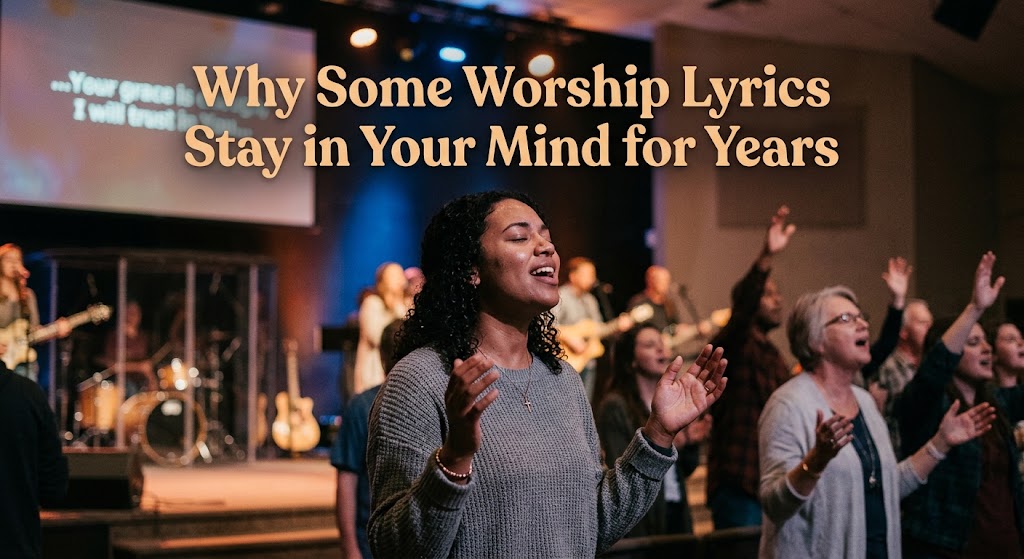
Why Some Worship Lyrics Stay in Your Mind for Years
Have you ever heard a worship song once and found yourself remembering the lyrics years later? You may forget the name of the singer, the date you first heard the song, or even the circumstances surrounding that particular moment, yet somehow, a few words from the song remain firmly planted in your memory. You could be driving, cooking, working, praying, or simply sitting quietly when those familiar words suddenly return. Why does this happen? Why do certain worship lyrics remain in our minds for years while countless other songs disappear from our memory almost immediately? Why some worship lyrics stay in your mind for years.
The answer is deeper than simply having a good memory or listening to a catchy song. Why some worship lyrics stay in your mind for years has a lot to do with the way music interacts with emotion, repetition, personal experiences, language, faith, and memory. Worship music has a unique ability to attach words to moments that matter deeply to us. When those elements come together, a few lines of a song can become almost impossible to forget.
Music has always been closely connected to human memory. A familiar melody can take you back to a particular place almost instantly. You may hear an old song from your childhood and suddenly remember a classroom, a friend, a family member, a journey, or an event you thought you had forgotten. The music acts like a key that unlocks a part of your memory.
Worship music can have an even stronger effect because it is often connected to deeply personal experiences. People do not always listen to worship songs simply for entertainment. They listen while praying, crying, celebrating, waiting, hoping, grieving, worshipping, or searching for strength. When a song becomes part of one of those moments, the lyrics can become permanently connected to the experience.
This is one of the biggest reasons why some worship lyrics stay in your mind for years. The words are not remembered as isolated sentences. They become attached to emotions and experiences. A person who listened to a particular worship song while going through a difficult season may remember that song years later because the lyrics became part of their story.
Think about someone who was waiting for an answer to a difficult prayer. During that season, they repeatedly listened to a song about trusting God. Eventually, the words became more than lyrics. They became a personal declaration. Years later, even after the situation has changed, hearing those words can bring back the emotions of that period.
This is why worship lyrics can become deeply personal. A song written by someone else can begin to feel as though it was written specifically for you. The songwriter may have been describing their own experience, but somehow the words describe something you have experienced too.
Another important reason is repetition. Worship music frequently uses repetition, and repetition is one of the most effective ways to reinforce memory. When a phrase is repeated several times during a song, the brain receives multiple opportunities to process and store it.
Church worship can make this even stronger. A worship leader may sing a line, the congregation may repeat it, the musicians may return to the chorus, and the same phrase may continue for several minutes. By the time the worship session ends, those words may have been repeated enough times to become deeply familiar.
This does not necessarily mean repetition makes every lyric meaningful. A phrase can be repeated without leaving a lasting impression. What makes worship music particularly powerful is the combination of repetition with emotion and meaning.
When a simple phrase expresses something important to a person’s faith, repeated singing can reinforce it. Words such as declarations of God’s faithfulness, mercy, presence, love, grace, protection, or promises can become deeply embedded because the listener is not merely hearing them. They are participating in them.
There is also something powerful about singing words instead of merely reading them. When you read a sentence, you process it primarily as language. When you sing it, several systems work together. You are processing the words, melody, rhythm, timing, breathing, and emotional expression at the same time.
This combination can make information easier to remember. That is why people can sometimes remember the lyrics of songs they have not heard in years while struggling to remember something they read yesterday.
Melody also plays a major role. A powerful melody gives the words a structure that makes them easier to retrieve from memory. Once the melody begins playing in your head, the lyrics often follow automatically.
This explains why you may suddenly find yourself singing a worship song without deliberately deciding to think about it. Perhaps you heard someone sing a particular phrase earlier in the day. Hours later, the melody returns. Then another line appears. Before long, you are mentally singing the entire chorus.
Sometimes the melody becomes the pathway through which the lyrics are retrieved.
The emotional quality of worship music makes this effect even stronger. Human beings tend to remember emotionally significant experiences better than emotionally neutral ones. If a song makes you feel comforted, hopeful, grateful, broken, joyful, peaceful, or spiritually encouraged, the emotional response can help strengthen the memory.
This is particularly noticeable during difficult seasons of life. Someone might hear a worship song while dealing with loss, financial pressure, relationship problems, uncertainty, illness, loneliness, or disappointment. The song may become associated with the moment when they felt they were not completely alone.
Years later, the same lyrics can bring back those emotions.
Sometimes this happens without warning. You might be listening to a song while driving and suddenly remember a difficult period from five years ago. You remember where you were, what you were thinking, who you were talking to, and what you were praying about. The song has become a kind of emotional time machine.
That is one of the reasons worship music can be so powerful in Christian life. It does not simply communicate information about faith. It can become part of a person’s spiritual journey.
Why Some Worship Lyrics Stay in Your Mind for Years
Another reason why some worship lyrics stay in your mind for years is simplicity. The most memorable lyrics are not always the most complicated. Sometimes a short, simple statement carries more power than an elaborate paragraph.
Simple language is easier to understand, repeat, sing, and remember. When a lyric communicates a profound truth using ordinary words, people can quickly internalise it.
Consider how many worship songs contain short declarations about God’s goodness, faithfulness, love, grace, presence, or sovereignty. These concepts are spiritually significant, but they are also easy to express in memorable language.
A complicated lyric may require several listens before you understand it. A simple lyric can immediately communicate its message. Once the message connects with your heart, it can stay there for a very long time.
The biblical foundation behind many worship songs also contributes to their longevity. Christian music has a long tradition of turning Scripture and biblical themes into songs. When people repeatedly sing words rooted in familiar biblical truths, those words can become part of their spiritual vocabulary.
For many Christians, this means a worship song can function almost like a musical reminder of Scripture. A particular lyric may remind someone of God’s promises, a Psalm, a story from the Bible, or a lesson they learned in church.
This creates another layer of memory. The listener is not only remembering a song. They may also be remembering the biblical truth behind the song.
There is also the communal aspect of worship. People often remember songs because they experienced them with other people. Singing alongside hundreds or thousands of believers creates a powerful sense of connection.
Imagine standing in a crowded church with people singing the same words together. The sound of many voices, the atmosphere, the music, and the shared expression of faith create an experience that can become deeply memorable.
Years later, hearing the same song may bring back the entire atmosphere.
This is especially true for songs associated with major Christian events, conferences, weddings, funerals, retreats, revivals, concerts, or important church services. The song becomes attached to the occasion.
A worship song may therefore have multiple memories connected to it. The lyrics, melody, people, location, emotions, and circumstances can all become part of one memory network.
Another fascinating factor is personal interpretation. Two people can hear the same worship song and take completely different meanings from it. One person may hear a message about hope. Another may hear reassurance. Someone else may hear a reminder of a difficult prayer they once prayed.
This personal connection makes certain lyrics much more memorable.
A worship lyric does not need to be universally meaningful to become unforgettable. Sometimes it only needs to be meaningful to one person at one particular moment.
That is why asking why some worship lyrics stay in your mind for years cannot be answered by looking only at the quality of the music. The listener matters too.
Your experiences, beliefs, emotions, memories, struggles, victories, and relationships influence which songs remain with you.
There is also a fascinating connection between worship lyrics and identity. People tend to remember things that reinforce how they understand themselves. If someone sees themselves as a person who trusts God during difficult times, a lyric about trusting God may become especially meaningful.
If someone has experienced a dramatic personal transformation, songs about grace and redemption may carry unusual emotional weight.
The lyric becomes connected to identity.
This may explain why the same worship song can feel ordinary to one person but life changing to another. The music has not necessarily changed. The listener’s relationship with the message has changed.
Another factor is frequency of exposure. Some worship songs become part of daily routines. People play them while getting ready for work, travelling, exercising, cleaning, praying, or relaxing. Every repetition strengthens familiarity.
Eventually, the song can become part of the background of everyday life.
This is why someone may remember a worship song from a period when they listened to it every morning. The song became attached to their routine, and the lyrics were reinforced repeatedly without requiring deliberate memorisation.
Technology has made this even more common. Streaming platforms, social media, music videos, playlists, church broadcasts, and short form videos allow people to encounter the same worship song repeatedly in different places.
A song may first be heard in church, then appear on a social media video, then play in someone’s personal playlist, and later be performed at another event. Every encounter strengthens recognition.
But perhaps the most important reason some worship lyrics stay in your mind for years is that they often answer questions people carry inside themselves.
People want to know whether they are loved, whether there is hope, whether their suffering has meaning, whether tomorrow can be better, whether they can start again, whether they are forgiven, and whether God is still present when life becomes difficult.
When a song gives language to those questions, it becomes more than music.
It becomes a voice for something the listener was already feeling.
That is why a worship lyric can appear in someone’s mind at exactly the moment they need encouragement. The words were stored long before the crisis arrived, but the crisis gives them new meaning.
A lyric that seemed ordinary three years ago can suddenly become deeply powerful today because your circumstances have changed.
This is also why worship music can become associated with prayer. When people do not know what to say, they sometimes sing words that express what they are feeling. A song can provide language when personal words fail.
Someone may not know how to describe their gratitude, pain, fear, hope, or surrender. Then a familiar worship lyric comes to mind and says exactly what they could not express.
In that moment, the song becomes part of their prayer.
There is something beautiful about that.
The lasting power of worship music is therefore not simply about catchy melodies. It is about the meeting point between music, memory, emotion, faith, repetition, community, Scripture, and personal experience.
Why some worship lyrics stay in your mind for years is ultimately connected to why humans remember stories, experiences, and words that matter to them. The lyrics become attached to something bigger than the song itself.
They may remind you of who you were.
They may remind you of what you survived.
They may remind you of a prayer that was answered.
They may remind you of a prayer that is still waiting for an answer.
They may remind you of someone you loved.
They may remind you of a season when you almost gave up.
They may remind you that you once had hope when hope seemed impossible.
And sometimes, they simply remind you of God.
That is why a worship song can disappear from your playlist but never completely disappear from your memory. The recording may stop playing, but the words remain somewhere inside you.
Years later, a single melody can bring them back.
You may suddenly remember the chorus. You may sing the words without thinking. You may remember where you were when you first heard them. You may even realise that the lyric has been quietly shaping the way you think about your faith for years.
Perhaps that is one of the greatest gifts of Christian music.
A good worship song does not merely occupy your ears for a few minutes. Sometimes, it occupies a place in your story.
And when a song becomes part of your story, its lyrics can stay with you for a lifetime.
So the next time you find yourself unexpectedly singing an old worship song, do not dismiss it as just another tune stuck in your head. Ask yourself why those particular words returned.
Maybe there is a memory attached to them.
Maybe there is a lesson you have forgotten.
Maybe there is a season of your life those words are reminding you about.
Or perhaps there is something your heart needs to hear again.
Because sometimes the lyrics we remember longest are not necessarily the lyrics we listened to most.
They are the lyrics that meant something when we needed them most.

Leave a Reply