
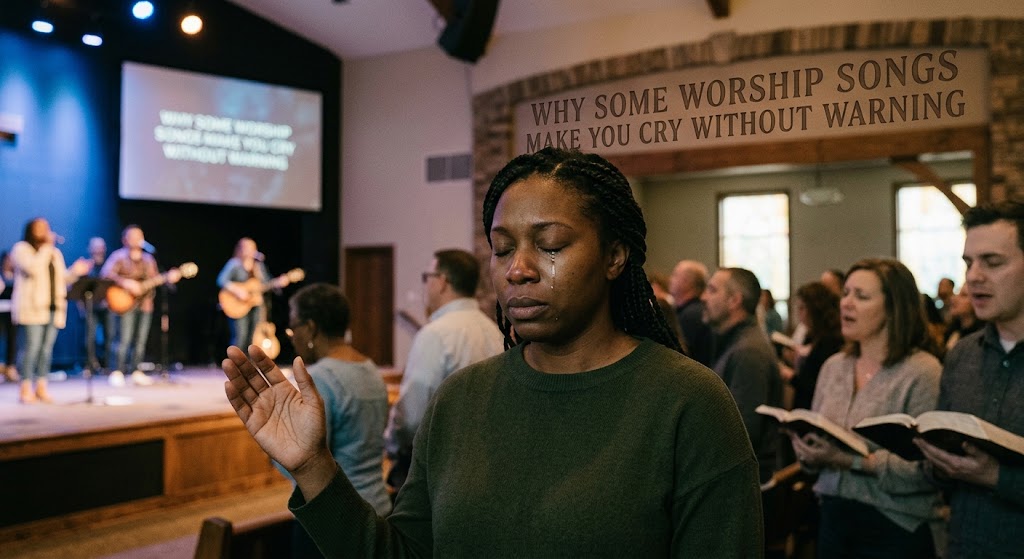
Why Some Worship Songs Make You Cry Without Warning
Have you ever been listening to a worship song and suddenly found tears rolling down your face before you even realise what is happening? You may not have been sad. Nothing terrible may have happened that day. You could even be sitting comfortably in your room, driving to work, attending church, or listening through your headphones when a particular lyric, melody, voice, or musical moment touches something deep inside you. Before you know it, your eyes become wet and you are asking yourself, “Why am I crying?” Why Some Worship Songs Make You Cry Without Warning
Why some worship songs make you cry without warning is a question many Christians have experienced personally but may struggle to explain. Sometimes the tears appear because the song reminds you of something you have experienced. Sometimes the lyrics express a prayer you have been unable to put into words. At other times, the music seems to reach a place in your heart that ordinary conversation cannot reach.
Worship music has a unique ability to connect emotion, memory, faith, and personal experience. Unlike ordinary background music, worship songs often communicate ideas about God, hope, forgiveness, surrender, gratitude, suffering, restoration, and eternity. When those themes intersect with something happening inside your life, the emotional response can be surprisingly powerful.
One reason some worship songs make you cry without warning is that they can give language to emotions you have been carrying silently. There are moments when you know you are tired, disappointed, afraid, grateful, hopeful, or overwhelmed, but you cannot find the right words to explain it. Then a worship song begins playing and suddenly the lyrics describe exactly what you have been feeling.
That experience can be deeply emotional because the song seems to say what your heart has been trying to say. A lyric about trusting God during uncertainty may remind you of a difficult decision. A line about God’s faithfulness may remind you of something you survived. A song about surrender may expose the fact that you have been trying to control something you cannot control.
The tears are not necessarily a sign that something is wrong. Sometimes they are simply the emotional release that comes when something inside you finally finds expression.
Memory is another powerful reason worship songs can produce unexpected tears. Music is strongly connected with personal memories. A particular melody can take you back to a church service, a difficult season, a family gathering, a prayer meeting, a funeral, a breakthrough, or a moment when you felt particularly close to God.
You might hear the opening notes of a song you have not heard in years and immediately remember where you were when you first heard it. You may remember who introduced it to you. You may remember the person who used to sing it. You may remember a season when you were desperately praying for something.
Suddenly, you are not simply listening to music anymore. You are revisiting a chapter of your life.
This is one of the reasons people sometimes cry during worship songs even when they did not expect to become emotional. The song becomes connected to a personal story. Every time it plays, it can reopen that emotional memory.
For some people, the memory may be joyful. For others, it may be painful. A worship song can remind someone of a loved one who has passed away, a relationship that ended, a difficult period they survived, or a prayer that was eventually answered.
The song may sound exactly the same, but the person listening to it has changed.
Why Some Worship Songs Make You Cry Without Warning
Another important factor is the message contained in worship music. Worship songs frequently focus on themes that are deeply meaningful to Christians. They speak about God’s love, grace, mercy, protection, forgiveness, faithfulness, salvation, and presence.
These are not merely abstract ideas to someone who believes them. They can be connected to real experiences.
Imagine someone who has just survived an extremely difficult season hearing a song about God’s faithfulness. The lyric may sound simple to another listener, but to that person it may represent months or years of struggle.
The song becomes a reminder of everything they have survived.
That can make the emotional response extremely strong.
Sometimes the tears come because a worship song reminds you that you are not alone. Life can be noisy and demanding. People may expect you to remain strong even when you are exhausted. You may have responsibilities that prevent you from expressing your emotions openly.
Then you hear a song that reminds you that God sees you.
That simple message can break through emotional barriers that have been holding you together.
There is also something powerful about singing or hearing words of hope when life feels hopeless. Worship music can create a moment where someone stops focusing on circumstances and begins focusing on what they believe.
That shift can be emotional.
A person who has spent the entire day worrying about money may suddenly hear a song about God’s provision. Someone dealing with uncertainty may hear lyrics about trusting God’s plan. Someone carrying guilt may hear a song about grace.
The circumstances may not have changed, but the emotional perspective can change.
That is why tears sometimes appear during worship even when the listener was not consciously thinking about anything painful.
The human voice itself can also contribute to the emotional experience. A powerful vocal performance can communicate vulnerability, sincerity, longing, joy, or desperation. When a singer delivers a worship song with genuine emotion, listeners may respond emotionally even before they process every word.
You can hear the difference between someone simply singing a song and someone who appears to be living the words they are singing.
That authenticity can be contagious.
A worship leader who sounds broken while singing about God’s faithfulness may communicate something that goes beyond technical vocal ability. The listener may not know the singer’s story, but the emotion in the performance can still create a connection.
This does not mean every emotional worship performance is automatically spiritually powerful. Musical skill, production, and emotional expression are different from genuine spiritual transformation. However, the emotional qualities of music can certainly influence how deeply listeners experience a song.
The melody itself also matters. Music can influence emotions through rhythm, harmony, dynamics, repetition, tempo, and vocal arrangement. A quiet beginning followed by a powerful chorus can create a sense of emotional build up. A simple piano arrangement can create intimacy. A choir can create a feeling of collective strength.
Sometimes the lyrics are not even the first thing that makes someone emotional. The music creates an atmosphere that allows emotions to surface, and the lyrics then give those emotions meaning.
This is particularly noticeable during live worship.
There is something different about hundreds or thousands of people singing the same words together. Individual voices become part of a larger sound. People may raise their hands, close their eyes, kneel, pray, or simply stand quietly.
The experience can feel deeply personal and communal at the same time.
Someone may arrive at church carrying an emotional burden that nobody else knows about. When the congregation begins singing, that person may finally feel safe enough to release what they have been carrying. Why Some Worship Songs Make You Cry Without Warning.
The tears may therefore have very little to do with sadness.
They may represent relief.
They may represent gratitude.
They may represent surrender.
They may represent hope.
They may represent the emotional weight of realising how far you have come.
Another reason why some worship songs make you cry without warning is that worship can confront you with vulnerability. Many people spend their days trying to appear strong. They work, provide, solve problems, take care of others, answer messages, attend meetings, and continue moving forward.
There may be very little space for emotional honesty.
But worship can create a different environment.
When you are alone with God, you may not feel the need to pretend.
You can admit that you are tired.
You can admit that you are afraid.
You can admit that you do not have all the answers.
You can admit that you need help.
Sometimes tears are simply what happens when a person finally stops pretending to be okay.
This is particularly powerful when a worship song contains themes of surrender. There is a profound difference between saying, “I can handle everything,” and saying, “God, I need You.”
For someone who has been fighting internally for a long time, that surrender can be overwhelming.
A worship song can also trigger gratitude. People often become emotional when they realise how many things they once prayed for have become normal parts of their lives.
You may hear a song about God’s goodness and suddenly remember where you started.
You remember the doors that opened.
You remember the dangers you escaped.
You remember the prayers that were answered.
You remember the people who helped you.
You remember the moments when you thought you would never make it.
Then you realise that you are still here.
That realisation can bring tears.
Sometimes the most powerful worship experience is not created by receiving something new but by remembering something old.
There is also a spiritual dimension that many Christians associate with worship. For believers, worship is not simply an artistic experience. It is an expression of faith and relationship with God.
A person may therefore interpret tears during worship as a moment of spiritual connection, conviction, gratitude, comfort, or reflection.
Different Christians may describe this experience differently. Some may say they felt God’s presence. Others may describe it as conviction. Someone else may simply say that the song touched their heart.
Regardless of the language used, the experience can be deeply meaningful.
However, it is important not to assume that crying automatically means a worship experience was spiritually superior. Tears are an emotional response, and emotional responses can have many causes.
Someone can cry during a beautiful song without experiencing spiritual transformation. Another person may stand completely still without shedding a tear while experiencing a deeply meaningful moment of worship.
Faith is not measured by how much someone cries.
Worship is not a competition.
You do not need tears to prove that you love God.
You do not need goosebumps to prove that a song is anointed.
You do not need an overwhelming emotional reaction to prove that God is present.
Sometimes worship is emotional. Sometimes it is quiet. Sometimes it is joyful. Sometimes it feels ordinary.
All of these experiences can be part of a person’s spiritual journey.
One of the most fascinating things about worship music is that the same song can affect different people in completely different ways. A song that makes one person cry may leave another person completely unaffected.
That does not necessarily mean one person has greater faith.
Personal history matters.
Your experiences determine what certain words mean to you.
A song about a mother may affect someone who recently lost their mother. A song about healing may affect someone recovering from a difficult experience. A song about waiting may deeply affect someone who has spent years praying for a particular breakthrough.
The music may be identical, but the listener’s story is different.
This is why there is no single answer to why some worship songs make you cry without warning. The answer may be hidden somewhere between the song, your memories, your emotions, your faith, your circumstances, and your interpretation of the message.
Sometimes the song finds you at exactly the right moment.
You may have heard it dozens of times without becoming emotional. Then one ordinary afternoon, the same song plays and suddenly everything feels different.
The lyrics have not changed.
You have.
Perhaps you are finally ready to hear what the song has been saying all along.
This is one of the beautiful things about music. It can meet people at different stages of life. A song that once sounded ordinary can become incredibly meaningful after you experience the situation described in its lyrics.
A worship song about waiting sounds different after you have waited.
A song about loss sounds different after you have lost someone.
A song about restoration sounds different after you have been restored.
A song about God’s faithfulness sounds different after you have witnessed it personally.
Experience gives lyrics a new weight.
For Christian music lovers, this is one reason building a personal worship playlist can become meaningful over time. Certain songs become markers of different seasons. You may have one song connected to your university years, another connected to your first job, another connected to marriage, another connected to a difficult season, and another connected to a major breakthrough.
Years later, hearing those songs can feel like opening old chapters of your life.
And sometimes, the tears return.
Not because you are still trapped in the past, but because you remember what it took to get where you are.
So, why some worship songs make you cry without warning is ultimately a deeply personal question. Sometimes it is the lyrics. Sometimes it is the melody. Sometimes it is memory. Sometimes it is the voice of the singer. Sometimes it is the atmosphere. Sometimes it is gratitude. Sometimes it is pain finally finding an outlet.
And sometimes, you simply encounter a song at a moment when your heart is open.
Those unexpected tears may be telling you something worth paying attention to. Perhaps there is an emotion you have ignored. Perhaps there is a memory you have not processed. Perhaps there is something you need to surrender. Perhaps you are simply overwhelmed by gratitude for how far God has brought you.
The next time a worship song makes you cry without warning, do not necessarily rush to wipe away the tears or feel embarrassed about them.
Pause.
Listen.
Ask yourself why this particular song is affecting you today.
What does that lyric mean to you?
What memory did it bring back?
What are you carrying that you have not been able to say?
What are you grateful for?
What are you afraid of?
What are you hoping God will do?
Sometimes a song does not create the emotion.
Sometimes it reveals the emotion that was already there.
And perhaps that is why certain worship songs remain unforgettable. They do not merely give us something to hear. They give our hearts words for things we could not explain.
That is the extraordinary power of worship music.
A melody can become a memory. A lyric can become a prayer. A chorus can become a reminder. And a few minutes of music can sometimes open a door to emotions we did not even know we were carrying.
So if a worship song suddenly makes you cry, you are not necessarily being overly emotional.
You may simply have encountered a song that found the exact place in your heart that needed to be heard.

Leave a Reply